All posts by Michael Burge

Journalist, author, artist

A Writer’s first obituary

BROTHERLY LOVE (L-R) Nicholas, Michael & Andrew Burge in 1973.

Nicholas Burge (June 1973 – September 1973).

ONE of the earliest original pieces of writing I completed was an obituary, written for my younger brother Nicholas who had died seven years prior from Sudden Infant Death Syndrome (SIDS).

I was in the final year of primary school, with an inspiring teacher, a sensitive Welshman, who set us a writing task to record the story of ‘something I’ll never forget’.

I don’t know why I chose Nicholas. Most probably it was because there had not been much talk about him since he died, even though I had experienced first-hand the devastating impact his loss had on my family.

The piece has long since been lost, but I know I wrote about the morning he died. Me (aged three) and my older brother (four) were the ones who discovered the baby, dead, in his cot, during our usual morning ritual of waking him and taking him into our parents’ room.

Not understanding the concept of death, of course we did not see the impact that was coming, when we went to tell mum and dad that the baby wouldn’t wake up.

At the time of writing about the day, I had no more than a mental picture of my mother, flying out of the bed with a great sweep of the pink sheets, and my father trying to wind the old party-line telephone into action. Mum, keening like a seagull, held the dead baby in her arms.

I learned much later that we’d all driven from our farmhouse into town, the dead baby in a carry-basket between my brother and I. We were left with our grandparents while Nicholas’ body was taken to the hospital.

Later again, when I retrieved his death certificate, I discovered Nicholas was buried the very next day in the family plot. Apparently my father was incapable, in his grief, of driving away from the cemetery. Mum took over.

We didn’t last much longer on the farm after that. Despite being encouraged to have another baby, the grief worked its way between my parents, and we left the land for a brief life in town, before they separated and divorced. Not long after, we moved with mum closer to the city where she’d grown up.

There were psychological reasons for everyone’s behaviour in the wake of Nicholas’ death, but this is not the place to explore them. When I wrote his obituary, I was too young to understand them anyway, I was only responding to being asked about something ‘I would never forget’.

Perhaps this was also my first lesson in how powerful words can be? I know it bonded me closer to my mother, to have her son recall with great importance something that was a life-changing moment for her family. When I packed up our house after her death, I found Nicholas’ clothes in a little bundle wrapped inside her wedding veil in a bottom drawer in the garden shed. A photograph of the baby boy confirmed they were his.

When I wrote to my father about the same events many years later, he expressed that he always believed it was better to get on with the care of the living, as opposed to thinking about the dead. At the time, I said nothing, because I didn’t know if I agreed, or not.

But writing about my memories gave Nicholas a place in my life, even though his own had been so very short. Like most of my writing, this little obituary involved looking back, and I have since learnt how controversial that can be. In this case, I believe it was more than worth it.

Obituaries are biographies, often written at acutely painful times. I recall my obituary for my brother Nicholas was very short, like his life. It was an affirmation that he existed, that we knew him, and that we loved him. Sometimes writing is really that simple.

© Michael Burge, all rights reserved.

M*A*S*H forever

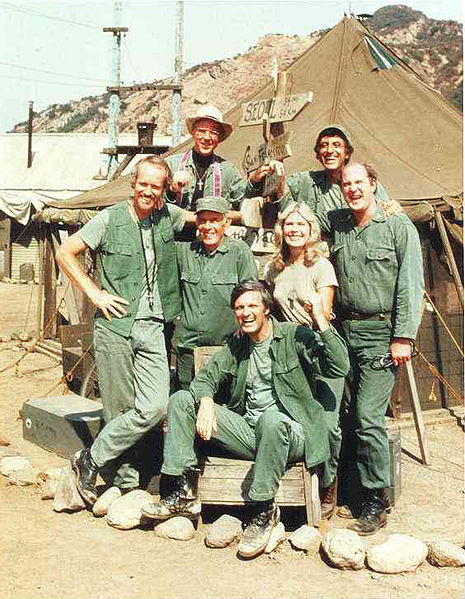
SERVING OF M*A*S*H The cast of the long-running TV sitcom during its 8th season.

A Writer’s first lesson in comic timing.

WHILST participating in a television interview, Cate Blanchett apologised for answering a question about acting using an American accent, explaining that to her, ‘American English’ is the language of comedy, after years of watching M*A*S*H.

Being of exactly the same generation, I can only agree with her.

This long running sitcom, set in a Mobile Army Surgical Hospital during the Korean War of the 1950s, was my very first ‘adult’ experience of television.

As the child of a nurse, it was considered appropriate viewing for my first years of staying up late.

“It’s a well-known maxim that all great comedy springs from the worst situations of human deprivation.”

The fun-filled yet desperate world the characters inhabited worked its way into the very fabric of my writer’s brain, just as it was in the process of forming.

When I am writing comedy, all the classic scenarios of M*A*S*H spring to mind, because between 1972 and 1983 the writers explored every comic angle they could think of. Thanks to syndication, the series has been playing across the world’s television screens for four times longer than it aired originally, and counting.

The secret of the comedy lay not in what was overtly funny, but rather in what was deadly serious about life for Americans stuck in Korea patching-up the wounded.

It’s a well-known maxim that all great comedy springs from the worst situations of human deprivation. Pathos tempers farce. Sadness frames wit. Laughing in the face of death is always more three-dimensional than laughing or crying alone. The two states are very close in the human experience.

M*A*S*H capitalised on those extremes, from the original book MASH: A Novel About Three Army Doctors by ‘Richard Hooker’ (a pseudonym for Dr. H. Richard Hornberger and W.C. Heinz), where the basics of the show’s characters were created, to Robert Altman’s 1970 satirical black comedy feature film M*A*S*H and the series it inspired.

But the TV series had the time and the following to explore the dynamic to its extremes, and evolved from slapstick (think ‘Hot Lips’ Houlihan and Frank Burns cavorting, as though no-one knew they were having an affair), to a kind of black comedy that was borderline drama by the time the show took its final curtain call in the feature-length series finale Goodbye, Farewell and Amen (1983).

For me, the array of three-dimensional male characters who joked, sported, laughed, cried, cross-dressed and generally expressed themselves in ways that it was rare to see men behave in the ‘real world’, were beautifully countepointed by one of my all-time acting heroes – Loretta Swit.

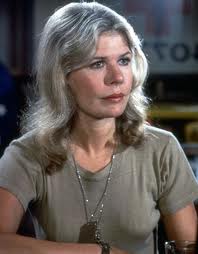
MAJOR HERO Loretta Swit, who played Major Margaret ‘Hot Lips’ Houlihan for the entire run of M*A*S*H.

Stunning, prickly, sympathetic, quick-witted, great at her nursing job, devoted to the army and her country, yet willing to take emotional risks at the drop of a hat, how could you not love Margaret Houlihan, the winning smile that lit up the khaki cloud of Korea?

Swit’s work as Major Houlihan ranks amongst the best-drawn television performances ever, but she had her work cut out for her. Alan Alda (who is the only actor to perform in more M*A*S*H episodes than Swit, as Captain ‘Hawkeye’ Pierce), paid tribute to her achievement in transforming the ‘sex bomb’ tag that the role was originally drawn with, by turning ‘Hot Lips’ Houlihan of 1972 into simply, ‘Margaret’, by the show’s end in 1983.

Interestingly, this change coincided with the women’s liberation movement, and remains one of Pop Culture’s best examples of the metamorphosis of a stereotype.

Apart from being the best education in comic timing I can think of, the series is also a great example of time economy in a script. Next time you watch an episode, notice how the half-hour format restricts the use of too much foreshadowing and requires simple, fast set-ups to every laugh.

If you’re re-writing a script and you need to touch-base with how it should be done, whether it’s a comedy or a drama, watch an episode of M*A*S*H.

© Michael Burge, all rights reserved.
Waiting for Waiting for Godot

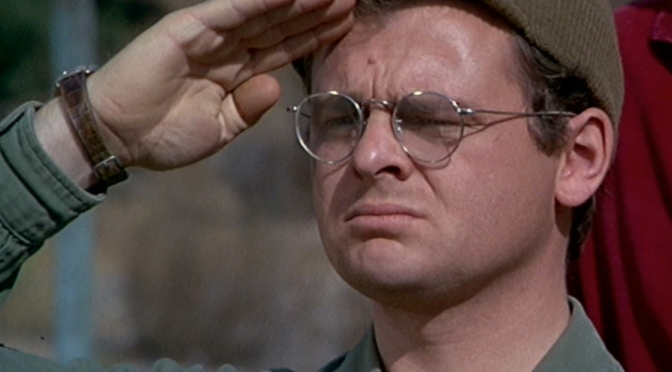
WAITED WORDS Mehdi Bajestani as Lucky (from a production of ‘Waiting for Godot’ by Naqshineh Theatre).

A Writer’s introduction to great theatre.

THE best piece of professional theatre I’ve experienced remains one of the first I ever saw.

It was my last year of school, and our English class travelled to the city to see Sydney Theatre Company’s production of Samuel Beckett’s Waiting for Godot.

We arrived on time, were seated amongst an array of other school groups, and waited for the performance to begin.

Eventually, a lone figure – one of the actors – walked sheepishly onstage to deliver an apology.

One of the school groups (a busload of students from the Central West, apparently) was late, and the stage management had decided to wait for their imminent arrival. It seemed a little inappropriate that one of the actors was selected to give us the news.

Whether he was playing Vladimir or Estragon was not clear – he wore the Chaplin-like baggy pants and bowler hat of Beckett’s main characters, and he sat on a chair, like the rest of us, and waited.

And waited … and waited … and waited.

As teenagers, we all did what teenagers do while they’re waiting. We got impatient. We gossiped. We heckled one another. We heckled the actor. We did everything we’d predictably do. I recall going inside myself, my outer shell not showing impatience, but I was seething inside, thinking: “Typical country school, couldn’t leave home on time … now we won’t have any shopping time before we have to go home on the train.”

Eventually, it seemed even the actor had waited enough. He sat upright and addressed us, but not to make a further announcement. The lights went down suddenly, leaving only a spotlight on his face, and, using Beckett’s words, he berated us all for being so foolish as to believe his cunning little trick of making us understand, whether we liked it or not, what this classic piece of Absurdist Theatre is really about.

And that wasn’t all. There were no other actors to this production. Usually, Waiting for Godot has a cast of five. Very quickly it became apparent that we were going to be roped-into this production, quite literally.

And there was no such thing as personal space. The actor proceeded to push his way along certain rows, unravelling a rope as he went, thick rope that weighed into our laps. No amount of complaining got through to him, as he sectioned-off an entire block of the audience to evoke the roped-by-the-neck character Lucky, by whipping the rope with each hand. Many of the lines were delivered directly to people in the front row. “Poor them,” I thought, “lucky we weren’t seated down there.”

The effect got right under my teenager’s shell, cut through all my boundaries, and made me respond against my will.

ABSURD THEATRE Sydney Theatre Company, housed in a wharf on Sydney Harbour.

I don’t think the actor took a curtain call. We poured out into the foyer, and I quickly disappeared on foot. I couldn’t wait for the bus – I just walked.

I strode through the city, walking over two kilometres, trying to rid myself of the feelings. Muttering how ‘bad’ the show was. Questioning why they couldn’t have done ‘Godot’ traditionally, whatever that meant.

I eschewed the shops, too unsettled to think about more than these feelings, got on an early train by myself, and settled into my seat feeling like a bit of an idiot.

The rhythmical rocking of the train unravelled me bit by bit, until I could reflect, at a distance, on what a brilliant production I had experienced.

It lead to me following a career in the performing arts, hoping to be a part of an industry which could affect people that way.

In two decades, I have never been quite so literally ‘moved’ by a piece of theatre.

© Michael Burge, all rights reserved.