Category Archives: Performers

Take Another Look: Debra Winger in Betrayed, a ‘hate letter to the heartland’

The fifth in a series of retrospective pop culture reviews revisits the 1988 movie that predicted America’s slide into right-wing populism…


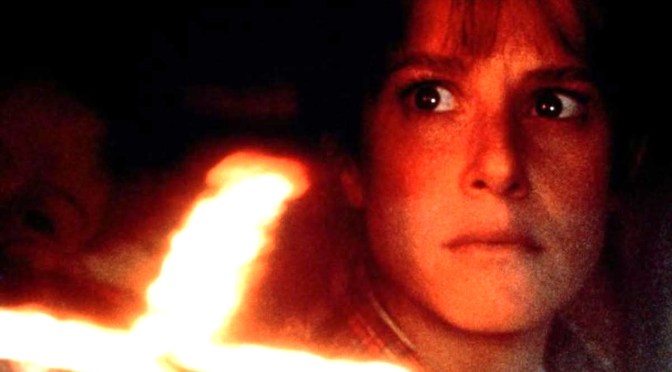
AT THE MIDPOINT of Costa-Gavras’s 1988 screen thriller Betrayed there’s a scene in which a young woman tucks her widowed boyfriend’s motherless children into bed in a Midwestern American farmhouse. It’s so ordinary that the horror she hears from the mouths of these youngsters eclipses almost everything in the screenplay by Joe Eszterhas.

We’ve already witnessed nightmarish scenes of racism and murder by this stage of the story, yet innocent kids blithely damning Jews, Blacks and Queers while putting their heads to the pillow are far more chilling than overt violence.

Debra Winger plays the woman settling the children: Katie Philips, the “combine girl” their widowed Vietnam veteran father Gary Simmons (a riveting portrayal Tom Berenger) invited home during harvest season.
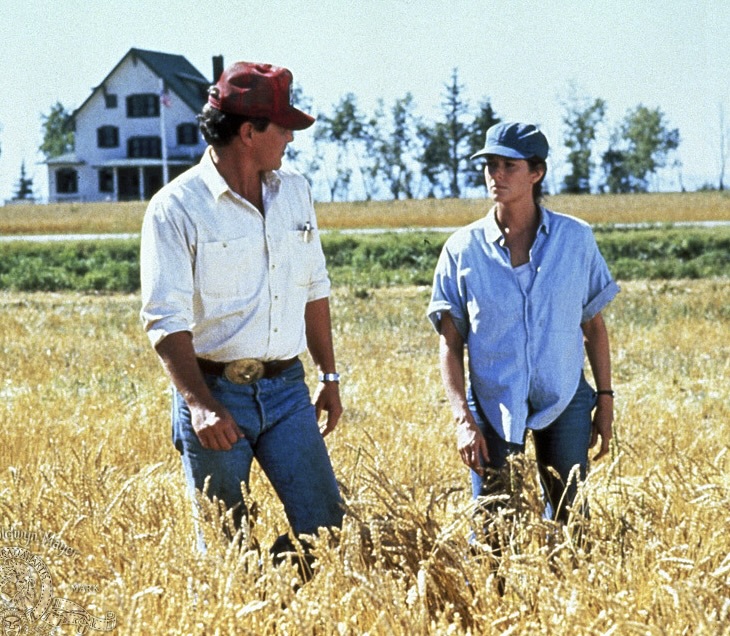
HAPPY COUPLE Tom Berenger and Debra Winger.

Slight spoiler: Katie is actually FBI agent Catherine Weaver on her first undercover mission after the brutal killing of a Jewish shock jock in Chicago. Gary is in the Bureau’s sights as the brains behind a series of domestic terror threats, but it is Catherine’s creeping awareness of the depth of prejudice in the rural heartland that gives this story its emotional charge, not least because she develops feelings for the handsome and charismatic Gary.

As Katie’s attraction grows, so does Catherine’s fear about what she discovers in his community, and the danger she’s in. Welcome on his hunting and camping trips, Katie is transfixed; but Catherine is appalled at the white-supremacist subculture being stirred into paranoid resistance by nationalist preachers and self-interested politicians.

Sounds familiar, which makes Betrayed essential viewing four decades since its release.

Compost Heap

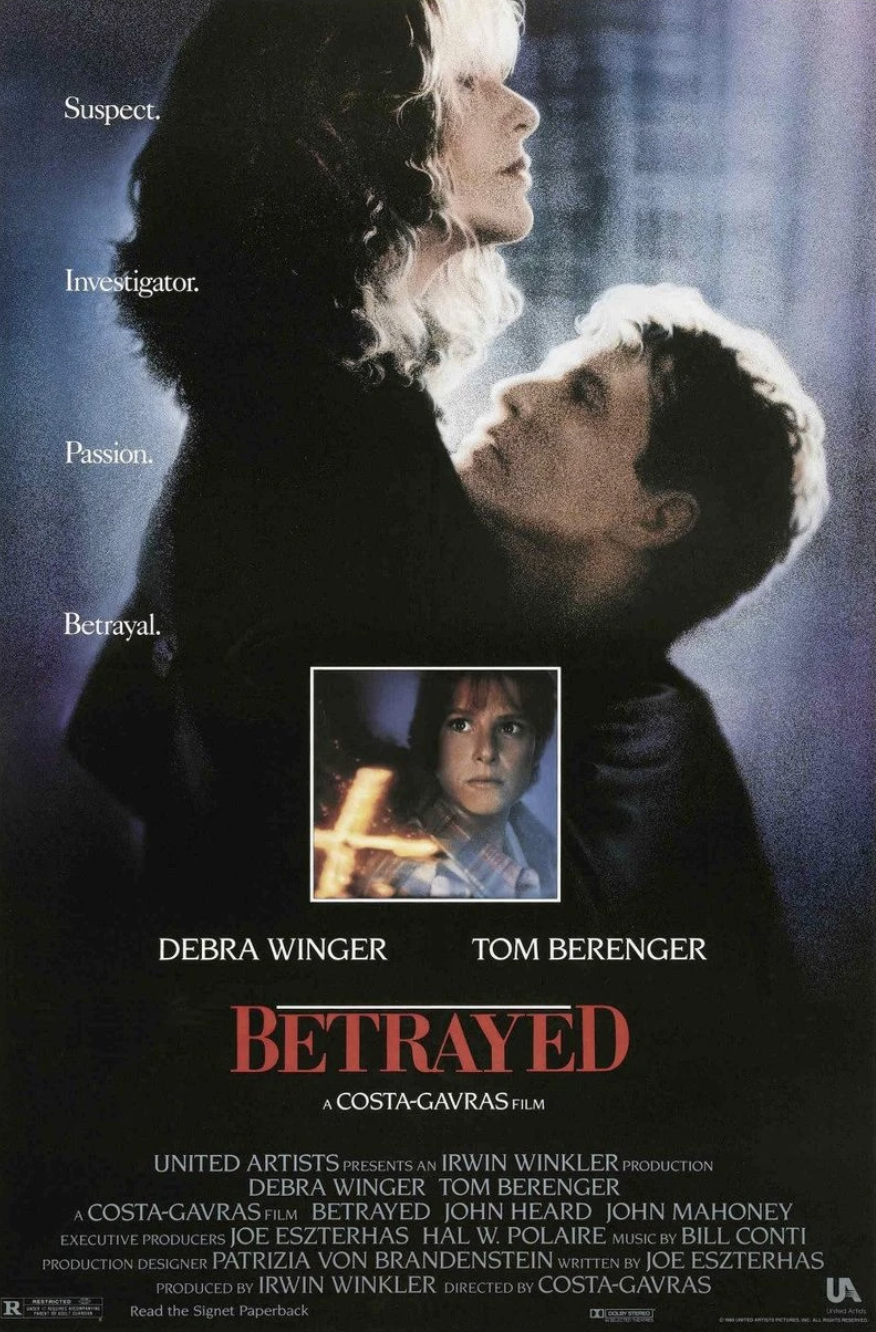
Despite a highly experienced team and an A-list cast put together by film titan Irwin Winkler, the production made a modest profit and didn’t really live up to its promise.

By the mid-1980s, Costa-Gavras was renowned for thrillers with a strong political edge. Eszterhas had entertainment chops built on a string of hits, including Jagged Edge (1985) which explored the attraction between a lawyer and the client she’s never quite sure is innocent.

For Winger, Betrayed was an opportunity to revisit the type of down-to-Earth American woman that had been so well-received in An Officer and a Gentleman; and Berenger’s career was at its peak after his Oscar-nominated role in Platoon in 1986.

The strong supporting cast included John Heard as FBI agent (and Catherine’s old flame) Mike Carnes; John Mahoney and Ted Levine as Shorty and Wes (Gary’s partners in crime), and Betsy Blair as Gary’s gentle yet deeply prejudiced mother. But critics saw only hints of brilliance in the nightmare.

“Winger is radiantly warm, smart and, against all odds, believable as a woman physically drawn to a man whose ideas are repugnant to her,” wrote Sheila Benson in the Los Angeles Times, “but she is sunk by the growing improbabilities of the story.”

Roger Ebert agreed: “More than anything else, Betrayed is finally just very deeply confused. Costa-Gavras must have considered it a political film, Eszterhas undoubtedly saw it as a thriller, and Winger and Berenger, to give them full credit, interpret it as the complicated human stories of their characters.”

Writing for the Los Angeles Herald-Examiner, Peter Rainer cut to the chase: “As hate letters to the heartland go, Betrayed is right at the top of the compost heap.”

The Real Enemy

America took more than one look at its history of race relations on the big screen in 1988, with the release of Alan Parker’s Mississippi Burning four months after Betrayed. An exploration of the real-life murder of African-American civil rights activists in the 1960s, Parker’s film had its share of vocal critics concerned about historical accuracy, but it fared much better with audiences.

That might have been due to Mississippi Burning’s focus on sins of the past, whereas Betrayed demanded viewers look themselves in the eye during the latter years of the Reagan presidency and the peak of a recession, and identify the real enemy.
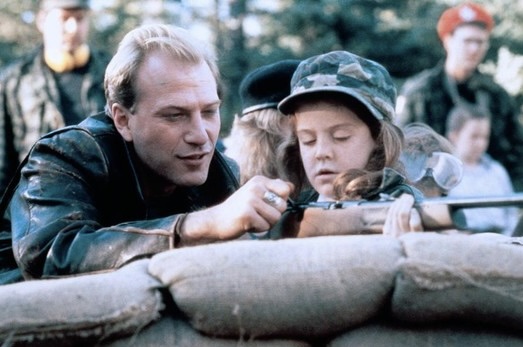
SHOOTING LESSONS Ted Levine and Maria Valdez.

Across the film’s second half, Gary, Katie and the kids visit a remote retreat. At the gate, a sign states: “The White Race is an Endangered Species.” The Klan is there in force, burning crosses. The children have “school lessons” – shooting practice aiming at racist caricatures – and political candidates spruik cheap promises to, “hand America back to real Americans” while collecting campaign donations.

Around the campfire, Shorty (John Mahoney) explains his motivations to Katie: the bank stole his farm, Vietnam killed his son, “I got nothing left to take,” he says.

This extended sequence normalises racism, the illegal arms trade and the radicalising of children. There’s even moments of humour in the horror show, when Katie has to pretend that Catherine isn’t a crack shot with an automatic weapon. But when the Neo Nazis arrive selling vintage weapons and paraphernalia, Gary draws the line at fraternising with the movement his father fought in World War Two.

Yet the point is clear: this is a lifestyle for big chunks of the United States. Furthermore, authorities like the FBI and the political class that underpins the Bureau seem impotent when compared to the self-determination of Gary and his charged-up mass movement.

This becomes particularly clear whenever Catherine asks the Bureau for support during her assignment. Mike Carnes (John Heard) is her colleague and and former lover, but he offers none of Gary’s virility and allure. Every one of Mike’s failings leave Catherine almost entirely to her own devices.
One of her lifelines is Gary’s daughter Rachel (Maria Valdez), and the connection between Catherine and this guileless daughter of the resistance fuels the emotional punch of the whole exercise, right to the unmissable final scene.

Yet for many viewers in 1988, the film’s betrayal of American values was not worth the ticket price. Audiences these days, accustomed to daily trashing of standards by right-wing nationalists, will have absolutely no confusion about this riveting movie.

Betrayed is streaming on Apple TV.
Take Another Look: The ‘passionate absurdities’ of James Lapine’s Impromptu

The fourth in a series of retrospective pop culture reviews revisits the historical romance that reignited the careers of Judy Davis and Hugh Grant…


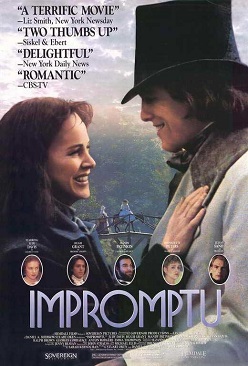
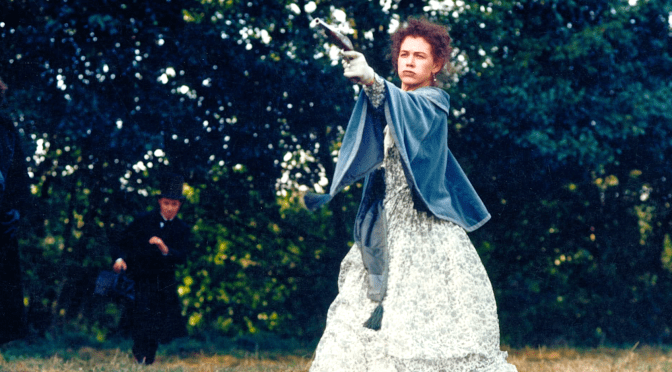
TWO-THIRDS OF THE way through James Lapine’s 1990 film Impromptu, Mandy Patinkin (as 19th century French poet Alfred de Musset) stretches his face towards the camera in full clown whiteface and viciously shuts down his flaky colleague Hugh Grant (as Polish composer Frédéric Chopin), shouting, “Art never apologises!”

It heralds an explosive turning point in screenwriter Sarah Kernochan’s reimagining of the notorious affair between French writer George Sand (played with pants-wearing, gun-toting, acrobatic gusto by Judy Davis) and sickly Chopin (in the hands of comedically brittle Grant).

Legends of the 19th century’s French Romantic era have joined Sand, Chopin, de Musset, composer Franz Liszt (Julian Sands), writer Marie d’Agoult (Bernadette Peters), and painter Eugène Delacroix (Ralph Brown) at the bucolic retreat of patron Duchess d’Antan (Emma Thompson).

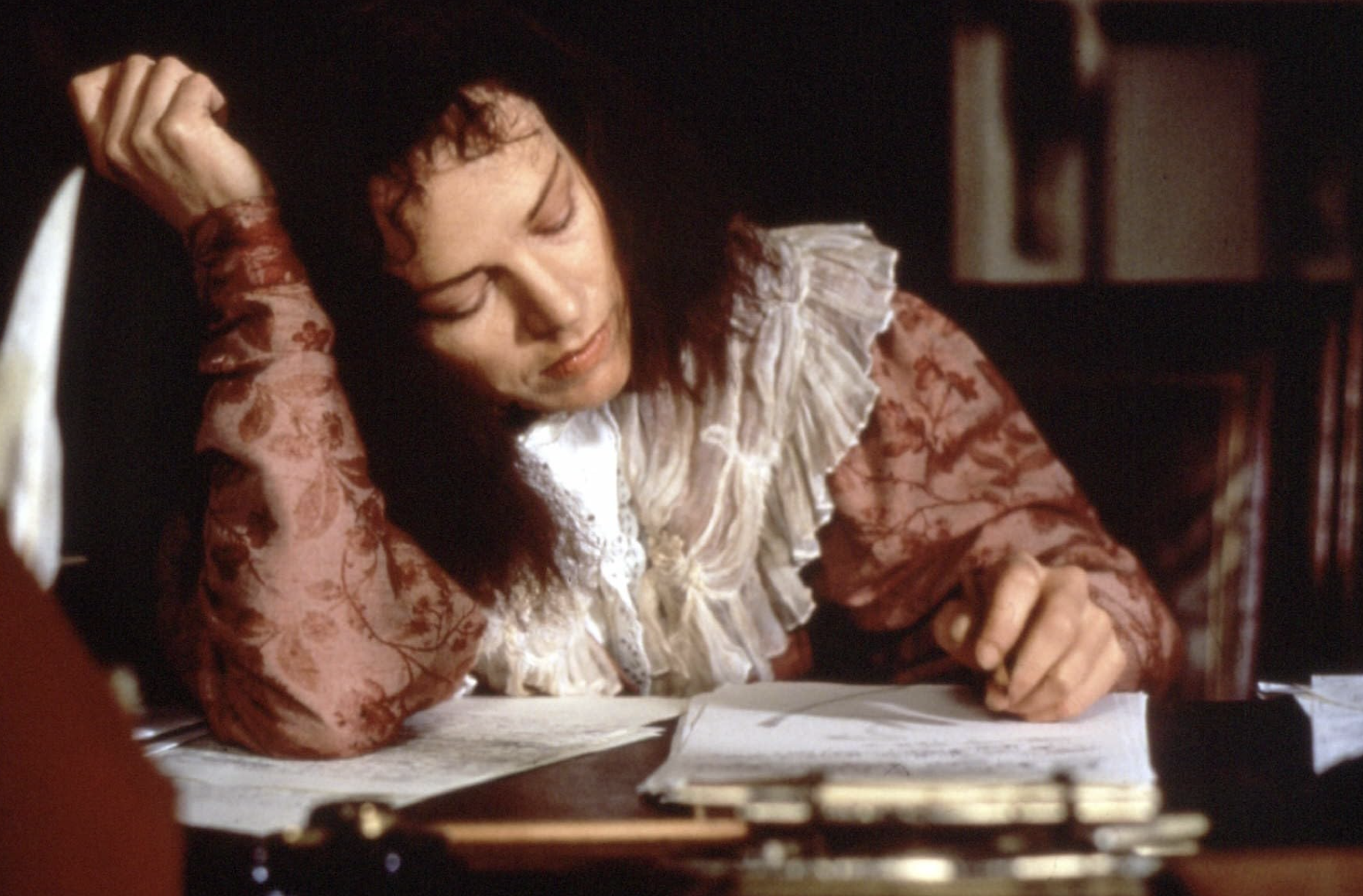
SCREEN SAND Judy Davis

In a black comedy akin to Peter’s Friends meets Dangerous Liaisons, picnics, croquet and illicit sex punctuate Madame Sand’s escapades from former lovers. All the while she simply wants to seduce the man behind the music: the phlegmatic and reclusive Chopin.

He represents a higher form of expression to the brash novelist’s hungry heart. Trapped by a seemingly unconquerable object of desire, the great feminist novelist meets her match, and in the fallout of this summer jaunt Impromptu finds its feet as an original and compelling romance.

Romantic Heroism

The film contains several treats, particularly Thompson’s early comedic turn as the hilarious Duchess d’Antan; and Elizabeth Spriggs as an enthusiastic fan who corners Sand just as Chopin’s music really starts to beguile her.

There was near-universal critical praise for Judy Davis in another career-defining portrayal of a writer at a very different stage of her career to the aspiring Sybylla Melvyn in My Brilliant Career (1979). 

“A great actress in a great role,” wrote Terrence Rafferty in The New Yorker. “Davis makes Sand’s passionate absurdities both funny and tremendously moving; this woman’s willingness to embarrass herself seems a kind of romantic heroism.”

Davis stepped up to play the unconventional Sand at a critical time of her career, and put an heroic effort into promoting her first international lead role since A Passage to India, the production that left her with that ‘difficult actress’ reputation.

A 1991 interview with the Los Angeles Times from a Hollywood hotel reads a bit like a charm offensive. Confined to the descriptor of “Australian actress”, Davis delivered several bombshells that can be read as a form of art in a state of apology.

Her up-front explanation to the notorious clash with “autocratic” British director David Lean (“we got into an actual screaming match in India”) came the very month of the movie titan’s death. This is counterpointed with revelations about Impromptu, shot entirely in France with a director who did not speak the language, “a recipe for disaster” dodged due to Lapine’s “staying power”, according to Davis.

Yet despite her picking up an Independent Spirit Award for best actress, in a role that amplified Davis’ independence, Impromptu failed to outsell its modest budget.

Discordant Twits

Some critics focussed on the director’s inexperience. Renowned for his Pulitzer Prize-winning libretto of the Broadway premier of Sunday in the Park With George (complete with Peters and Patinkin in a Sondheim masterpiece exploring France, art and love) Lapine’s film debut came off as lacking in big-screen technique.

CHOPIN LISZT Julian Sands and Hugh Grant

“When he introduces the music of Chopin and Liszt into the proceedings, the effect isn’t revelatory, it’s discordant,” wrote Peter Rainer in the Los Angeles Times. “It’s impossible to believe that such sounds could have issued from such twits.”

Yet Rafferty found more nuance in Grant’s performance, a precursor of portrayals to come: “A brilliant caricature of the Romantic ideal of the artist; he gives the character an air of befuddled unworldliness.”

Kernochan might have put one of the Romantic era’s greatest mysteries on the page – exploring why the reticent Chopin succumbed to the steamroller Sand – but Hugh Grant and Judy Davis came into their own portraying it.

Drawing on Sand’s strength, Chopin fronts up to a duel with one of her former lovers. He fails miserably and she picks up the pieces, but left to their own devices in a rural farmhouse (designed with exquisite simplicity by art director Gérard Daoudal) Sand and Chopin are finally able to work themselves free of artifice.

By then, she’s adopted her real name, Aurora, and taken to dresses (Jenny Beavan’s outstanding work). He shrugs off his shyness in a tender and unpredictable bedroom scene where, as it turns out, artists do apologise when they seek true connection.

In the hands of key creatives Lapine and Kernochan – a spousal team in a rare collaboration – Impromptu says much about the meeting of minds that is possible for artistic couples.

Chopin allowed Grant to realise his potential as a leading man who can embrace his pathetic side, and Sand gave Davis the opportunity to transcend her independent reputation by owning it.

Impromptu is streaming on Apple TV.

Take Another Look: Michael Apted’s ‘pleasantly endurable’ Agatha

The third in a series of retrospective pop culture reviews revisits the mystery movie that Christie fans love to hate-watch …


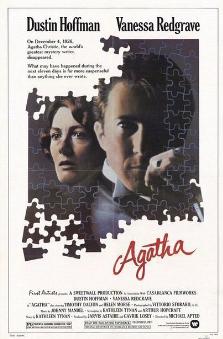
THERE’S AN EVOCATIVE scene in the big-screen adaptation of Kathleen Tynan’s novel Agatha when Vanessa Redgrave as Agatha Christie and Helen Morse as her new bestie Evelyn Crawley, languish in a steam room at Harrogate’s Royal Baths in 1926.

In this tranquil, white-tiled, female-only space, the conversation between two fictitious women (Agatha is at that point pretending to be Teresa Neele of Capetown, South Africa; Evelyn is an entirely made-up character) drifts from ageing to the changeability of men.

Evelyn confesses to being very choosy with her lovers, a concept that Teresa is slightly shocked about and attempts to counter with a rather limp argument for faithfulness.

“It hardly seems worth it,” Evelyn replies. “That’s why choosing’s important. We can’t just let things happen to us.”

Up to this point in the film, director Michael Apted (1941-2021) and story writer Kathleen Tynan (1937-1995) had played reasonably fair with the facts, exploring significant gaps between the dots about the infamous disappearance of Agatha Christie (1890-1976).

Her disintegrating marriage, her car crash in Surrey followed by a night train to Yorkshire’s spa town Harrogate, her adoption of a new persona: these are all known facts.

The rest of Agatha (1979) could only be described as a masterclass in how to get away with portrayals of real-life people, or a cautionary tale about what can go wrong when you try.

Unarguably, the time was right. The ‘Queen of Crime’ had died in early 1976 when her cult was at its peak. Her posthumously released autobiography made no mention of her disappearance, but Tynan’s book Agatha: The Agatha Christie Mystery (1978), with its pitch of “an imaginary solution to an authentic mystery”, captured the interest of American and British film producers.

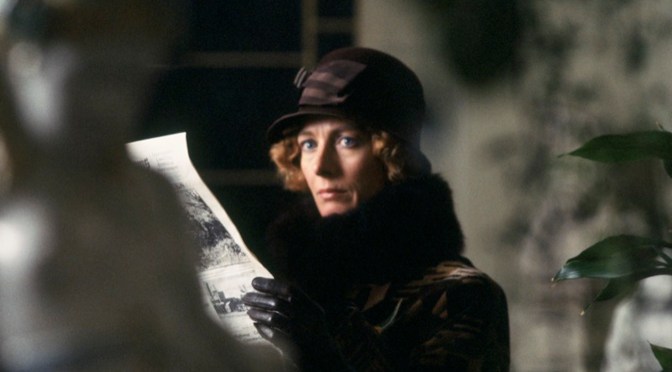
CINEMA’S CHRISTIES: Timothy Dalton and Vanessa Redgrave.

Agatha’s exposition beautifully portrays a collapsing marriage in the home counties between the wars. Timothy Dalton drives the scenes as the well-mannered but hardline Archie, the jaded husband who ignites the hidden survival instinct in Redgrave’s crumbling Agatha.

But American Gumshoe Wally Stanton (Dustin Hoffman in full flight) sniffs out a story in the ruins of the marriage, and as the tension rises, Timothy West’s pragmatic police detective delivers the cynicism that underpins the massive manhunt for the crime writer when she goes missing.

By the midpoint, Historic Harrogate serves up all the flavour of the Roaring Twenties, a decade that had been recaptured so exquisitely and profitably on film throughout the Seventies.

Tynan’s vision for Agatha was bold, yet her book and the subsequent film have been largely forgotten, something only devoted Christie fans love to hate-watch.

Woman in Crisis

Film critic Vincent Canby of The New York Times made allowances for Agatha “given the few verifiable facts of the case”.

“The result is a handsome, rudder-less sort of movie that isn’t quite a mystery story, not quite a love story and certainly not a biography,” he wrote, concluding that the production felt “unfinished”, “aimless” and “pleasantly endurable”.

Pauline Kael of The New Yorker saw “the oddness of genius” in Redgrave’s portrayal, but believed the production team, “haven’t come up with enough for their sorrowful, swanlike lady to do.”

It wasn’t until 2020, in a broad-ranging article Re-writing the Past, Autobiography and Celebrity in Agatha by academic Sarah Street, that we got a thorough examination of what happened to Tynan’s story when it was committed to film.

Street concluded that Tynan’s adaptation of her own novel had a “sympathetic premise” towards Agatha Christie, but unearthed a movie production she described as “torturous”.

“Apart from exploiting intense public interest in Christie, the film involved conflict between other celebrities and professionals who in their different ways struggled to make sense of this puzzling event in Christie’s life,” Street wrote.

Given access to transatlantic film production archives, she was able to examine correspondence between key creatives, tussling over the narrative.

In a 1977 letter to Apted during hurried, late-stage rewrites, Tynan described the characters of Evelyn and Wally as catalysts for the personal growth of Agatha Christie, a “woman in crisis”.

In recent years, much has been written about the mental health struggles of Agatha Christie in the 1920s. But in the 1970s, Kathleen Tynan was one of the first writers to suggest the author’s flight to Harrogate played out a desire for reinvention.

Evelyn Crawley was the emotional guide Tynan gave her, through a reckoning that had been intended to play out in the hands of women.

The original casting for this glamorous, independent character also became apparent in the details unearthed by Street: Julie Christie, who pulled out of the film due to illness. Helen Morse deftly stepped in, but late screenplay rewrites supplanted Evelyn with Wally in the film’s second half. The gumshoe becomes the wayward crime writer’s love interest, something Tynan never intended, according to her archived correspondence.

The major consequence was the unravelling of the feminist thread in Agatha. There’s a trace of it in that steam room conversation, when Evelyn encourages Agatha about not letting things just happen to her. Like a moment of insight in a fever dream, it feels as close to the emotional truth as anything.

Hang onto it when you watch this problematic but gripping film, to make sense of what Agatha does next.

Agatha is streaming on Apple TV and Prime.