THE northern NSW town of Tenterfield is opening its heart to four same-sex couples for an affordable and unique pop-up wedding event in September.
‘One of many rural electorates that voted in favour of altering the Australian Marriage Act to allow equal access to same-sex couples.’
To celebrate the arrival of marriage equality in Australia, a group of local businesspeople has created a fun, intimate wedding experience in this colourful corner of the New England country region.
Say I Do in Tenterfield is an initiative of Amanda Rudge, Sharon Julius, Desley Roos, Kim Thompson and Wendy Roots.
According to the group, the pop-up wedding concept was inspired by locals noticing a trend, but also a major shift in national politics.
“In the past 12 months our town has become a very popular wedding destination for city and coastal brides and grooms seeking to have their wedding in a beautiful, relaxed country town,” the group said in a statement.
“As 2017 rolled to a close, Australia voted yes for marriage equality! The group of experts behind Say I Do in Tenterfield wanted to celebrate, so we’ve teamed up with the 2018 Peter Allen Festival to launch something special.”
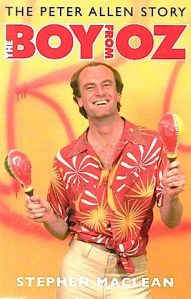
Immortalised as the birthplace of Grammy-nominated and Oscar-winning singer-songwriter Peter Allen in his single ‘Tenterfield Saddler’, the town is an LGBTIQ-friendly destination.
Tenterfield is situated in one of many rural electorates that voted in favour of altering the Australian Marriage Act to allow equal access to same-sex couples, and local LGBTIQ have been taking their vows ever since.
Constituents in this region didn’t have much leadership on the issue. Held by the National Party at federal level by the staunchly anti-marriage equality Barnaby Joyce MP, assisted by the similarly opposed Senator John ‘Wacka’ Williams, the wider community rallied during the marriage equality survey to show how out of touch its Canberra representatives are on LGBTIQ equality.
Michael Burge and Richard Moon outside the Tenterfield Saddlery.
I should know, because it was here that I finally got to marry my long-term partner, silversmith Richard Moon. We tied the knot in the New England in May this year, after more than a decade of pushing for a change in the law.
I was born at nearby Inverell, and after living and working throughout the world in the four decades since I left, it was a touching experience to be able to marry in the place which has become my homeland once again.
Richard was born at nearby Toowoomba, so these two country boys have been able to come home and get married in the border country where we hale from.
And since moving to the region from southeast Queensland in 2017, we have found the New England community very LGBTIQ-friendly. We know of two lesbian weddings in the New England region this year, in fact Richard created the wedding rings for one couple.
Better than Eloping
According to the Say I Do in Tenterfield team, their pop-up wedding event will be “better than eloping”.
“If you’ve always wanted to get married but you don’t want to deal with all the fuss and fluff, let us take care of it and create an intimate wedding for you to enjoy!”
The group underlined that the Say I Do in Tenterfield consortium has all bases covered for stress-free and affordable nuptials, without putting couples through a media circus.
“From published photographers and first-class stylists, to a world-renowned wedding cake creator, let us take care of the lot for under $10,000!”
COLOURFUL COUNTRY Tenterfield is known for its seasonal beauty. (Photo: Tenterfield Tourism)
The Say I Do team includes Amanda Rudge, co-owner and manager of Tenterfield’s Our Place Wine and Espresso Bar; Sharon Julies and Desley Roos, business partners of Inspired By You wedding style and hire; Kim Thompson, owner of The Bungalow and Ivy Leaf Chapel and Tenterfield Topiary Hire, and Wendy Roots, owner of Tenterfield Weddings.
“We look forward to holding more themed pop-up weddings and renewals in the very near future,” the group said in a statement.
“Our aim is to include as many local and regional businesses, services and products as we can.
“Come and experience first-hand what other brides and grooms have already experienced and loved! Taste, smell, see and feel our exceptional regionally-produced products, services and our soulful town.
“Tenterfield has so much history: beautiful old buildings, picturesque landscapes and is central for wedding guests to meet.”
According to the Say I Do in Tenterfield team, the cost of a wedding in the country is considerably less than city prices, and much more stress-free.
“Couples can’t believe the value you get for your money, and how relaxed and easy it is to deal with our local businesses and services, with nothing too hard to put together,” they said.
“You can make your wedding rings in one day with Richard Moon; have a private Yogalates session for you and your family and friends; get gourmet picnic packs sent out with you as you explore our magical national parks, and there’s many more little secrets to come!”
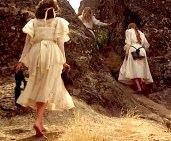
I RECENTLY came across a first edition of Joan Lindsay’s iconic 1967 novel Picnic at Hanging Rock at a country market, and an early print-run of the book’s last chapter, The Secret of Hanging Rock, published two decades later.
“Was there ever such a telling oversight in the history of Australian publishing?”
With the new television adaptation out this year, my interest was piqued and I purchased both, eager to pick over the evidence of one of Australia’s enduring literary mysteries. Not what happened to the missing schoolgirls and their governess on a volcanic outcrop in the bush at the turn of the 19th century, but why the original publishers thought Australians, in the 1960s, weren’t ready to know the end of the story.
The copy of Picnic is rather dog-eared, having been purchased for a secondary school library soon after publication in 1967. The borrowing slip in the back reveals the book was enthusiastically loaned in the years before Peter Weir’s groundbreaking screen adaptation of the novel in 1975.
NOW A MAJOR FILM Penguin’s 1975 film tie-in paperback.
I own a very well-thumbed paperback published by Penguin in 1975 as a film tie-in, but this is the first time I have ever seen the iconic F. W. Cheshire Publishing Ltd. hardback, with its lurid green, psychedelic dust jacket illustration oozing a 1960s vibe like Rosemary’s Baby. I checked online and found that even in this condition, my battered, plastic-covered survivor is worth hundreds of dollars. Not a bad buy on my part, for just five.
Despite Cheshire’s and Penguin’s apparent reluctance to publish it, The Secret of Hanging Rock emerged in 1987. This slim volume is Lindsay’s final chapter to Picnic, padded by literary essays from members of a lucrative cult that grew out of Lindsay’s only successful novel.
MYSTERY AUTHOR Joan Lindsay’s name is mysteriously absent from the cover of her last published work.
These can be broadly defined as utilising humour, whimsy and academic analysis to justify the decision to keep the solution to Joan Lindsay’s mystery from the international (paying) audience of book and film. What none of them countenance is that the original story — if you keep Chapter Eighteen intact — is hardly a mystery at all.
What was strangely missing from the front cover of The Secret of Hanging Rock was the name of the woman who ensured Picnic’s final chapter saw the light of day: Joan Lindsay herself.
Was there ever such a telling oversight in the history of Australian publishing? Truncated stories and omitted credits… it’s as though Lindsay wasn’t ever to be trusted with her own work. Luckily she ensured we got to see Chapter Eighteen regardless of all the hullabaloo.
Although at least four reprints of this chapter were released in 1987, the title quickly disappeared from high-street bookshelves. Eventually, it started to garner very high prices on the second-hand market.
AUTHOR, REINSTATED Joan Lindsay finally got cover credit in 2016.
That all changed in 2016 when it was re-released by ETT Imprint with an extra essay penned by Mudrooroo, who towed the cult’s line by nixing any hint of Lindsay’s final chapter containing a solution.
The eBook edition reached No. 1 on Amazon in its category, Joan Lindsay finally made her own front cover, and everyone, including her estate, got their portion.
But outside the machinations of publishing, this new outbreak of picnic fever has arrived with something of a reckoning.
Lifting the gossamer veil
In 2015, the fortieth anniversary of Weir’s film, which hit our screens during Australia’s constitutional crisis around Gough Whitlam’s sacking, a few journalists marked the milestone with reminders of Picnic at Hanging Rock’s enduring cultural significance.
DREAMING WITHIN A DREAM The schoolgirls approach escape velocity.
I called for a remake to reinstate Lindsay’s final chapter and acknowledge the bridge that she built between European settlers and Aboriginal Dreamtime in her truncated last chapter. Australians were ready to have the mystery solved, I reckoned.
An ongoing protest titled Miranda Must Go was on a similar trajectory, started by Melbourne artist and PhD student Amy Spiers, whose ultimate aim is to “decolonise” Hanging Rock and allow its Indigenous meaning to re-emerge.
But there are those who want the Edwardian gossamer veil to remain in place.
In 2017, a new biography of Lady Linsday, including an analysis of her Picnic oeuvre, came in the form of Janelle McCullough’s weighty tome Beyond The Rock.
It’s a very good read (check out my review) for those wanting to know more about Joan Lindsay, and it sheds a little more light on the origins of the story, but Lindsay’s bridge to Aboriginal Australians was not analysed.
Picnic camps
Walking the line between these two Picnic camps is Fremantle Media’s television adaptation of Lindsay’s novel, currently screening on Foxtel with its astonishingly youthful cast.
WHAT DO YOU KNOW? Helen Morse as Mlle de Poitiers and Vivean Gray as Miss McGraw in Peter Weir’s 1975 film Picnic at Hanging Rock.
Despite decades of calling for more roles for older women in popular culture, it was a shock to read that iconic middle-aged characters like headmistress Miss Appleyard and mathematics teacher Miss Greta McGraw (thoroughly well-portrayed by Rachel Roberts and Vivean Gray in Weir’s production) were cast with actors barely older than the schoolgirls.
This decision seems, at least partially, to cloud the “feminist lens” producer Jo Porter (director of drama for Fremantle Media Australia) claimed the production has at its core.
Pre-production on the series was dogged by protests from the Australian Directors’ Guild about engaging an offshore director instead of looking to Australian creatives, particularly since the production is financed solely by Australian backers.
What’s clear is there’s a strong sense of ownership around Picnic at Hanging Rock. The book, the place, and all cultural expressions of it have become critical to ongoing discussions about reconciliation between colonising Europeans (and others) and Aboriginal Australians.
One territory was drawn on Joan Lindsay’s behalf by her publishers when the decision was made to remove the last chapter in 1967, and ongoing attempts to besmirch its content as “unfilmable” and an unsatisfactory end to the story.
But another camp has settled into this Picnic. Around it, people are speaking (and listening to) the truth about Hanging Rock, its Indigenous heritage and significance. The conversation does not start, or end, with Joan Lindsay.
Right on cue, Penguin has re-released a new TV tie-in edition, staunchly entrenched with its blind-spot on what Lindsay’s final chapter might add to the reconciliation conversation.
WHEN Australian same-sex couples were finally granted equal access to the Marriage Act in December 2017, the widespread expression of relief was tempered by a growing awareness of a legal minefield.
“Here we were on the other side of the world not being able to have clarified which of our relationships was valid.”
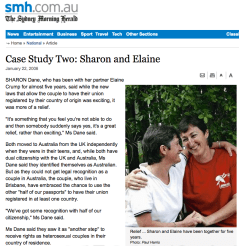
Brisbane couple Elaine Crump and Sharon Dane let the emotions in, but the status of their long-term relationship remained in limbo. Like many same-sex couples seeking legal documentation during the interminable wait for Australia to pass marriage equality, Elaine and Sharon had already taken their chances in countries where equality was accessible.
The pair first solemnised their relationship with a civil partnership at the British Consulate in Brisbane during 2006 — in fact they were the first lesbian couple to do so in this country — but neither could have predicted that was merely the start of an arduous legal journey.
“It gave us some credibility among our family and peers,” Elaine, a tradesperson, remembers.
“We were no longer just a couple living together but had some form of formal recognition, albeit in another country; and both our families are British.
“There was a level of excitement about it, as it was something we were finally sharing together that others were able to take for granted.”
IN THE SPOTLIGHT Sharon Dane and Elaine Crump.
Sharon, a psychology researcher, agrees: “There was no other way back then of us formalising our relationship”.
“The only thing we had to show we were a couple prior to that was a ‘stamp duty free’ declaration form from the Department of Transport.
“As we were British citizens, we felt that at least we were being legally recognised in a country that was part of our identity,” she adds.
According to Sharon, just before the couple were civilly-partnered, staff at the consulate required them to officially acknowledge that they understood the ceremony was not a marriage.
“That was hard to swallow,” she says.
“We were well aware of that, but to have it emphasised on our special day was upsetting.”
The ‘Best Wedding’
The ceremony attracted significant media attention during the Beaconsfield Mine collapse in Tasmania. Elaine and Sharon recall the sudden scrutiny brought on by the media’s need for alternate content during the lengthy wait before the trapped miners were brought to the surface.
“We allowed the media into that occasion and there was a sense of politics about it which somewhat detracted from the very personal nature of what we were doing,” Elaine says.
“For this reason, I drew the line in not allowing the media at our reception.”
Sharon believes the spotlight came as a result of being one of the first same-sex couples to enter into a UK civil partnership in Australia.
“Interestingly, we weren’t allowed many people to attend the ceremony at the consulate, only immediate family and our witnesses,” she says.
“So there wasn’t that sense of celebration you would normally experience at a wedding.
“Instead, the media filled the room taking photographs.
“While this took away from some of the personal nature of it, it also gave it some sense of celebration, with it being acknowledged as something historic and special.”
According to Elaine, the bulk of the ceremony was at home with close friends and family: “I do remember my mum saying it was the best wedding she had ever been to.”
Time Capsule
By 2008, overseas civil partnerships between same-sex couples were still not recognised in Queensland. That process would not begin until 2011 or be settled into law until 2016.
Elaine and Sharon’s relationship recognition had therefore reached an impasse, but they saw an opportunity in another country.
“Part of it was opportunism, as Sharon had to go to Rhode Island for a conference and I decided to go with her for a holiday,” Elaine recalls.
“We decided we would use the opportunity to drive up to Canada to marry, as it was another step in our journey.
“Marriage felt far more normalising. It would allow us to say we are married couple now, not civilly-partnered.
“We could come home and say that at least somewhere in the world we are a married couple.”
Sharon remembers her critical concern was about she or Elaine dying before they had the opportunity to marry or have a civil partnership recognised at home.
“If that happened, you couldn’t turn back the clock,” she says.
“There would be no way of the surviving partner showing we were ever married.
“I felt it was like putting it in a time capsule, ready to pull out once the laws had changed.
“It was also because people got it when you said you were married, they didn’t get it when you said you were civilly-partnered.”
Marriage Activists
SPEAKING OUT Dr Sharon Dane speaking at a PFLAG Brisbane event in 2014.
By the time of Elaine and Sharon’s 2008 marriage in Toronto, Canada, the couple had become involved in marriage equality activism, although both remember how entering into their second relationship certification was not in any way political.
“We were doing it for us,” Sharon says.
“However, letting the media tell our story was politically motivated, as we wanted to get the message out there that we were a normal couple that just wanted to be treated like everyone else.”
Elaine agrees: “From a political perspective it was great that our ceremonies helped highlight the issues in the press.”
Sharon’s role as a psychology researcher working on the relationships and wellbeing of LGBTIQ Australians was extended into her activism, which strengthened her views on why having the choice to marry was so important.
“As the research strongly indicated, it was simply about being respected and included in society,” she says.
“The desire to marry was a personal one, but to have the choice was critical in terms of feeling treated as an equal.”
Spare Bunk
Elaine and Sharon met through the Brisbane entity of the social group Older Wiser Lesbians (OWLS).
“I was away in Darwin on a work trip and when I came back Sharon was a new member and we became friends,” Elaine says.
“Eventually, and when I was no longer in a relationship, we found a mutual attraction to each other.”
Sharon recalls the pivotal weekend the relationship began: “A group of us women went camping at a lake. Elaine had a small sailing boat which you could sleep in. Everyone was deciding what tent they were going to sleep in and Elaine said ‘I’ve got a spare bunk in my boat’.
“Well I quickly put my hand up for that offer, and just as well, as it was in that boat where we expressed a mutual attraction,” she adds.
“That was almost 17 years ago. We no longer have that boat but a picture of her hangs proudly in our house as a reminder.”
It’s Complicated
After their 2008 Canadian marriage, Sharon and Elaine continued to campaign for marriage equality in Australia, including staunch opposition to the Turnbull Government’s planned plebiscite on the human rights issue throughout 2016.
According to Sharon, their interest in laws regarding civil unions and same-sex marriages across the world made the couple aware that it wouldn’t be possible to have two formal relationships — even if to each other — recognised in the same country.
“As the UK later changed its laws in 2014 to recognise overseas same-sex marriages, we started to wonder which of our two relationships — the civil partnership or the Canadian marriage — it would recognise,” she recalls.
“To complicate matters further, Canada changed its laws in 2014 to recognise an overseas civil partnership as equivalent to a marriage, with a Canadian lawyer advising us that our civil partnership would be viewed as the true marriage because it happened in 2006, two years prior to our 2008 Canadian marriage.”
The couple quickly realised they were in the same position as countless other same-sex partners in Australia: in need of legal and/or consular advice about the status of their relationships.
“We first contacted the Foreign and Commonwealth Office of the UK government,” Sharon says.
“They told us that it was complicated because we didn’t live in England and therefore they weren’t sure which of our relationships was valid.
“This meant we were not allowed to have our civil partnership converted to a marriage in case the Canadian marriage had rendered the civil partnership void in the UK.”
The couple corresponded with the United Kingdom Government for over three years while remaining in what they describe as “legal limbo”.
“Finally, they agreed that if we could seek the expert opinion of specialists in English family law, they would consider our case,” Sharon recalls.
“This was a costly exercise that we feel we should not have had to go through.
“We felt we had no choice but to pay for the services of a London lawyer specialising in same-sex marriage law.”
Sharon did an internet search for “Family Law, England, LGBT”.
“Luckily we found A City Law Firm, a wonderfully supportive and knowledgeable legal firm in London,” she remembers.
“They, with counsel on the matter from a barrister, made it clear to the UK government that it was our Canadian marriage that was void under English law, not our civil partnership.”
Reality Check
“The reality set in: Were we really legally married?”
In late 2017, the Turnbull Government conducted a compulsory postal survey to gauge public sentiment on allowing same-sex couples equal access to the Marriage Act.
Sharon was present in the House of Representatives at Parliament House, Canberra, when marriage equality was voted on and passed on December 7 that year.
“I remember calling Elaine right after and us crying over the phone, and that we were ecstatic this had happened,” she says.
“I think the passing of the law at that time was when I experienced the huge emotional outpouring.
“But then within a week of that, the reality set in: Were we really legally married?
“That put a real damper on things.”
According to Sharon, words can’t adequately describe the frustration and powerlessness that she and Elaine went through while they waited on a response from the UK Foreign and Commonwealth Office.
“Here we were on the other side of the world not being able to have clarified which of our relationships was valid,” she says.
“This meant we couldn’t confirm if we were already married, nor could we get married in Australia in case the Canadian marriage was deemed valid.
“I couldn’t help but feel bitter, as if we had the right to marry in Australia in the first place we would not have had to have gone through this unnecessary stress and expense, which was of no fault of ours but as a consequence of same-sex marriage laws changing around the world.”
When the news finally came through from the UK government in February, 2018, that the couple could convert their civil partnership to a marriage, Sharon and Elaine recall being overwhelmed with joy and relief, particularly because the certification was back-dated to take into account the total number of years of their marriage.
“This was the relationship we entered into first, 12 years ago, and the one that involved all our friends and family in Australia,” Sharon says.
“It was the one with a wedding album, flowers, a cake and our loved ones.”
Sense of Peace
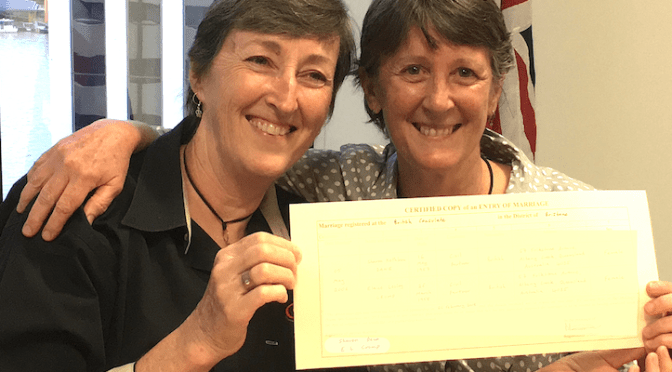
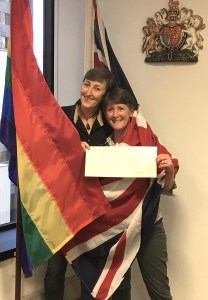
AT LAST Elaine Crump and Sharon Dane with their marriage certificate after converting their UK civil partnership to a marriage, at the British Consulate in Brisbane, February 2018.
This year, Elaine and Sharon returned to the British Consulate in Brisbane to have their 2006 civil partnership converted to a marriage that was automatically recognised in Australia.
The certification was likely to have recorded theirs as the first lesbian marriage in this country.
For Elaine, the overriding feeling was relief: “It’s been such a battle for so long,” she says.
“We finally know it’s legally binding and recognised in the place we call home.
“When we go out now and introduce each other as ‘this is my wife’, I don’t get that feeling that people think ‘oh yeah that’s nice, but they are not really married’.
“After all these years of exclusion, I’m able to say ‘yes I’m part of this, I am legally married, you are my wife’.”
Sharon recalls the conversion as an experience of happiness on two fronts, the “huge relief” of ending a drawn out legal battle, and that having the marriage recognised in Australia gave the couple “closure and a sense of peace”.
“All the boxes are now ticked,” she says.
“There is no more fighting on an Australia level, no more fighting on a British level, or any other level.
“We are now like any other couple who can say ‘okay we are married’ and that’s the end of it.”