All posts by Michael Burge

Journalist, author, artist

The writer’s block of E. M. Forster

COPSE Michael Burge at Piney Copse, June 2014.
FORSTER’S FOREST The writer at Piney Copse, June 2014.

AFTER SPENDING MOST of the 1990s living in England, I returned with my husband in the spring of 2014. As soon as we arrived, I navigated while Richard drove us across the Thames and out of London towards Surrey.

Once we crossed the M25, we were swallowed by the high hedgerows of the Hackhurst Downs, before dropping into the village of Abinger Hammer in search of one very hallowed place for this writer.

The region boasts two famous former residents: actor Prunella Scales (Sybil in Fawlty Towers) and the author Edward Morgan ‘E. M.’ Forster (1879-1970).

I first encountered his novels at school, although it took reaching the age of forty-four to fully understand him. My life had taken various ‘Forsterian’ turns in the interim, and I had a new appreciation of why he penned barely a word of fiction for the four decades after moving to Abinger Hammer in the wake of his bestselling 1924 publication A Passage to India.

Forster’s public explanation was that he’d had enough of writing politically light novels like A Room with a View and Howard’s End, although after the private experiment of his gay romance Maurice – which crucial gay friends unfairly criticised – and several controversies of gay literature breaching the criminal code, none of his gay-themed writing saw the light of day until after his death in 1970, the year of my birth.

FORSTERS WAY English novelist Edward Morgan Foster by Howard Coster.
FORSTER’S WAY English novelist Edward Morgan Forster by Howard Coster.

Moving to a genteel Surrey village ought to have been a source of inspiration, but it left Forster in a career limbo at the age of forty-four, living with his elderly mother Lily.

The pair found a hopeful new start to their codependency when they moved to an Abinger property – West Hackhurst – designed and built decades before by Forster’s architect father.

The Forsters already had connections in the region, notably the Farrers of Abinger Hall, an estate from which West Hackhurst had been hived off on a sixty-year lease, which allowed Forster’s Aunt Laura to see out her days there. The remainder of the tenancy she left to her nephew.

Before moving in, Forster made inquiries with Tom, Lord Farrer, who agreed that should Mrs Forster still be alive when the lease expired in 1937, an extension would be granted to cover the remainder of her life.

“My installation at West Hackhurst was indeed depressing. I had feelings of misgiving and imprisonment,” Forster wrote. “The Farrers apart, it was too female a house. I had always had to fit in there, and now I felt trapped in its ovary, and would climb to the top of the downs, and look longingly towards industrialism and London.”

Forster’s problem was not inspiration, but rather that he’d come to terms with his sexuality and had been putting it into practice. Surrey was altogether too straightlaced, and the threat of discovery – by Lily, or the police – was greater outside the city. 

But he had rooms in London, and with the Gomshall railway station only minutes’ walk from West Hackhurst through a small forest and across an empty field, Forster was happy to compromise with ongoing maternal cohabitation.

Until this escape route of his came under threat.

The appearance of workmen digging in the forest alerted him, and he made immediate inquiries with the vendor, who revealed a potential housing development. So too did Lord Farrer, who honourably allowed Forster first refusal on the small block known as Piney Copse, slotted between farms, homes, and the railway.

The American royalties of A Passage to India gave Forster the purchasing power to cover the 450-pound settlement.

BEECH BOUGHS Forster planted Piney Copse with beech trees after 1924.

While ruminating on the practical and philosophical concerns of land ownership, he made a few attempts to beautify his forest, planting beech trees and discouraging oak seedlings, which he despised as too patriotically English, and settled into comfortable inter-war life in the village. Meanwhile, he secretly started the significant relationship of his life, with London policeman Bob Buckingham.

But around the same time as the threat of Nazism began to rise beyond Germany’s borders, another war was waged at Abinger Hammer. Forster inadvertently started it when he made inquiries with Lord Farrer about extending the lease.

“I got so fidgety that I could not wait the full time,” he wrote, “and it was in 1935 that I reminded him of his promise, and played my usual card about my mother’s age.”

Friendship had not flourished between the neighbours, and the Forsters stewed on it. Perhaps they were considered ‘staff’, since Lily had been a governess to Farrer children decades before? Or perhaps Lord Farrer was still piqued at missing out on purchasing Piney Copse?

It’s likely, since he made its future a stipulation of Mrs Forsters’ residence beyond 1937, when lawyers communicated she could stay for the duration of her life, but only in exchange for ownership of Forster’s forest.

“I was to give up my beloved wood, the one Surrey object that had roots in my heart,” Forster wrote.

TREES IN TRUST The western boundary of Piney Copse, Abinger Hammer, Surrey.

He moved quickly to take Piney Copse out of the equation by leaving it to the National Trust in his will, purposely choosing an organisation the Farrers could not object to, since Lord Farrer sat on the committee.

These angry reactions were the opposite of Forster’s regular, more tempered appearances in BBC Radio broadcasts, which became the mainstay of his self expression and fame after 1929. His popular WWII talks on fear, identity and faith got him onto Hitler’s hit list at the same time as he was doing battle with the Farrers over land, leases and access.

Lily Forster died in the closing months of the war, and the Farrers moved quickly to reclaim West Hackhurst. Forster’s heart, and his home, were broken when he left in a painful separation we’d now call a mid-life crisis.

The first time I followed these stories to Piney Copse twenty years ago, there were no signposts and the whole block was so overgrown it was impossible to take a decent photograph.

I was there on a location recce, having started the process of producing a film of Forster’s 1909 short story Other Kingdom.

The setting of his allegorical tale was a beech forest adjacent to a genteel home, with leases and fences and local battles over land ownership, and a pivotal escape route for a troubled protagonist. I had a suspicion Forster’s ownership of West Hackhurst and Piney Copse was a case of life imitating art.

The house was still visible from within the beech thicket. Walking the fence line, I got an up-close glimpse of the old place, which seemed uninhabited.

It would have served ideally as the location for a film. House and forest came in one package in a very quiet neighbourhood, and the building was just ramshackle enough to have benefitted from the attention of a film crew.

But art imitating life imitating art was all too hard to communicate to funding bodies, and my project fell over, although I could never quite shake the memory of Forster’s forest.

I started to read his non-fiction more widely, and with the publication of his diaries in 2011, including his searing account of the war over Piney Copse under the ironic title ‘West Hackhurst: A Surrey Ramble’, a clearer picture emerged of the deep hurt at his removal from Abinger Hammer, wrapped-up as it was in his mother’s death, his long-dead father’s memory, and his thwarted sense of place, at a time when it was impossible to live openly as a gay man.

I finally realised it’s not Forster’s art that runs deepest at Piney Copse, it’s his life.

He never wrote fiction again, and left his entire body of work to the place that took him in after his flight from his father’s house – King’s College Cambridge.

His forest of trees – unprocessed novels in their rawest, elemental form – was wired-up on his departure in 1946. I am not sure if he ever visited the place again.

FFFF
COPSE AND CROPS Piney Copse seen from the eastern boundary.

On my return visit to Piney Copse in 2014, Richard and I parked at Abinger Hammer and navigated on foot. Away from the main road, which must have been perilous for pedestrians even in 1920s, we hit a muddy track that seemed to go in the right direction, and soon a National Trust sign showed itself on the western boundary.

A train slid by on its way to London, and we took shelter beneath the spreading beeches as heavy raindrops started to fall.

Transformed by care, Piney Copse is now closer to Forster’s vision of an egalitarian, shared England. Gates and stiles freely give way to a depth of greenery that shuts off the real world.

A shower closed in quickly, coating Forster’s beloved beech leaves. There was light enough that the tresses of foliage held that glow I had travelled the globe to experience in person, again. In a few minutes I had explored this tiny patch of England, heart filled with hope, as rich as a boy’s.

Foster’s forest grows on, exempt from the machinations of people and economies, just as he would have liked.

Richard was waiting for me on the other side of the gate, and we peered along the drive for a glimpse of West Hackhurst, now restored and inhabited, before tracing our way along farm roads, past ancient fields and the place where the ‘honourable’ Farrers’ Abinger Hall once stood, long since demolished in the wash-up of another of England’s old families.

Foreheads wet from the sun showers, and baptism over, we took tea back at Abinger Hammer, in a world changing faster for gay men than Forster could ever have imagined.

© Michael Burge, all rights reserved.

This article appears in Michael’s eBook Pluck: Exploits of the single-minded


Shakespeare – a farmer who cultivated words

Title_page_William_Shakespeare's_First_Folio_1623
WORDSMITH-WOOLSELLER William Shakespeare (1564-1616) from the title page of the First Folio, 1623, by Martin Droeshout.

NO writer in the English language ever had their life and times examined as much as William Shakespeare, a native of the rural Warwickshire market town of Stratford-upon-Avon, who went on to become the world’s greatest playwright.

With few known facts and little primary evidence, speculation by academics, impresarios, directors and eccentrics has created the various ‘lives’ of Shakespeare that so often go unquestioned.

Just as many theories discredit Shakespeare, painting him as an uneducated buffoon from a farming backwater who must have covered for an educated person more deserving of the title ‘the greatest English playwright’.

But there is one easily overlooked element to Shakespeare’s work which indelibly links him – and his plays – to Warwickshire: his use of that county’s unique vernacular throughout his work.

“Just as many theories discredit Shakespeare, painting him as an uneducated buffoon from a farming backwater.”

Much of the Warwickshire jargon in Shakespeare is the vocabulary that anyone who grew up in the parish of Stratford would have picked up from a very young age, and needed little formal education in.

Long before writing plays for the realm’s premier theatre company at London’s Globe Playhouse, William Shakespeare was born into a family like most in Warwickshire – one with strong farming connections, and rural language.

800px-Mary_Arden's_House_Farm_-_Wilmcote_-_Palmer's_Farmhouse
ARDEN AGRICULTURE Shakespeare’s mother Mary Arden’s farm at Wilmcote, near Stratford-upon-Avon. (Photo: Elliott Brown)

Shakespeare’s Father, John, was at various times a leatherworker and glovemaker, and a wool dealer who served as an alderman on the local council. His mother Mary Arden’s family farmed for centuries in the Stratford region.

Although by the time Shakespeare was born his family were ‘townies’ living on Henley Street in Stratford-upon-Avon, both sets of his grandparents were farmers.

The Shakespeares had been tenant farmers on land owned by the Ardens, but there is plenty of evidence Shakespeare’s father broadened the family interests away from the graft of running farms to a more genteel, lucrative and often illegal income as a landowner, agricultural trader and money-lender.

And although he went on to achieve literary fame, his son William also followed his father’s rural buying and selling footsteps for his entire life.

If Shakespeare picked up an early education on the rural landscape from an array of older family members, by the time he was a trader in his own right, the language of cropping and grain selling, animal husbandry and wool sales, and the production of food and clothing from grain, fibre and hide, well and truly completed his knowledge of all things farming.

That’s not to say he poured this experience into his popular entertainments. Rather, like inconvenient seedlings throughout his work, they ‘crop up’.

Paul Englefield.
RURAL HEARTLAND Warwickshire crops and sheep (Photo: Paul Englefield).

It was historian Michael Wood who underlined Shakespeare’s use of the term ‘hayd land’ in Henry IV Part 2 in his series In Search of Shakespeare. Referring to a strip of land left uncultivated when a Warwickshire ploughman turned his plough around, London typesetters unfamiliar with the original term inserted it as ‘hade land’ in printed versions of the play.

Like Wood, Scott McCrea, in his book The Case for Shakespeare: The End of the Authorship Question, identified another piece of rural slang: “In Antony and Cleopatra, Scarus’s simile of ‘the breeze upon her, like a cow in June’ makes little sense until it’s understood that breeze means stinging gadfly in Warwickshire.”

Other researchers see reflections of a significant rural event – The Midland Revolt – in Shakespeare’s Roman tragedy Coriolanus. The infamous 1607 uprising saw thousands protest from Northamptonshire to Warwickshire and Leicestershire, unhappy at the latest round of Enclosure Acts that locked farmland away from common use.

The grain shortages in Coriolanus have parallels with the revolt, although any of the alternative authors suggested for Shakespeare’s plays – such as Cambridge graduate Christopher Marlowe – could have strung the contemporary reports of the Midland Revolt into a play; whereas if you really seek to claim Marlowe wrote Shakespeare’s plays, you’re going to have to prove the Kent-born dramatist knew a swathe of Warwickshire slang; and not just workaday words easily picked up in any market square, but practical farmers’ trading terms, the kind that typesetters got wrong in the 17th century and citified actors misinterpret to the present day.

You’ll also need to show how a great writer of tragedies like Marlowe was savvy enough to use these words to comic effect.

800px-Wool_fleece_69
FLEECE FACTS Shorn wool in an English shearing shed.

Shakespeare didn’t require any special education to include the discussion on the price of sheep in Henry IV Part 2 between his comic characters Silence and Shallow. Nor did he have any problem accurately portraying the correct price of wool when a shepherd in The Winter’s Tale attempts to calculate the value of his fleeces:

“Let me see: every ‘leven wether tods; every tod yields pound and odd shilling; fifteen hundred shorn. What comes the wool to?”

One of the earliest eyewitness accounts of Shakespeare’s dual literary-farming legacy in Stratford-upon-Avon came in 1708, when London actor and theatre manager Thomas Betterton visited.

Almost a century after the town’s most famous son had died, there was no sign of the tourist mecca that Stratford-upon-Avon would become. For a chunk of the interim period, including the Civil War, plays had been considered sinful and anyone who had anything to do with them treated as scum.

Betterton recounted what he found to dramatist, poet and Shakespeare editor Nicholas Rowe, who used it to write the first biography of the Stratford Shakespeares in 1709 – the basis for much of the later research on the subject of William Shakespeare.

Engraving of William Shakespeare's funerary monument in Stratford from the first volume of Nicholas Rowe's 1709 edition of his works. Gerard Van der Gucht
WOOL BALE? Engraving of William Shakespeare’s funerary monument by Gerard Van der Gucht  from the first volume of Nicholas Rowe’s 1709 edition of his works.

Whether it was a case of Betterton’s bad memory, or an oversight by engraver Gerard Van der Gucht, there was no quill or parchment in the engraving in Rowe’s book of the only visible remnant of William Shakespeare in Stratford-upon-Avon in 1709 – the monument and bust of the playwright in the town’s Holy Trinity Church.

Instead, there is what appears to be either a bag of grain, or a wool bale.

This yawning gap between a man who wrote plays and poems, many of which became pre-eminent in the English language, who never went to university and cannot be proven to have attended school – yet also made a significant living as a land and agricultural commodities trader – has always been too great for many in the British establishment.

By 1725, when another image of the Shakespeare bust appeared, someone had added a quill and parchment to the monument. Those who seek to separate Shakespeare the playwright from Shakespeare the farmer use this mysterious action as evidence that he did not write the plays that forever made his name.

“It’s hard to overlook the academic snobbery aimed at a non graduate who had airs above his station.”

I have something in common with William Shakespeare. I hale from a small farming community and, after we moved off the land, I went on to become a writer. Apart from one year at university, where I started an Arts degree, my tertiary education consisted of vocational training in the performing arts, which was undoubtedly more than Shakespeare received.

WRITER'S CUSHION? Shakespeare's monument as it appears today, with quill and parchment (Photo: Tom Reedy).
WRITER’S CUSHION? Shakespeare’s monument as it appears today, with quill and parchment (Photo: Tom Reedy).

Nobody knows for sure how Shakespeare got to London and took up acting and writing. There are missing years when he cannot be found trading in Warwickshire’s farming records, but his name – or a version of it – appears in a terse review by playwright and Cambridge graduate Robert Greene, who attempted to put a young upstart in the London theatre scene of the 1590s in his place.

Alluding to a line in Shakespeare’s Henry IV Part 3: “O tiger’s heart wrapped in a woman’s hide”, Greene wrote:

“…for there is an upstart Crow, beautified with our feathers, that with his Tygers hart wrapt in a Players hyde, supposes he is as well able to bombast out a blanke verse as the best of you: and being an absolute Johannes fac totum, is in his owne conceit the onely Shake-scene in a countrey.”

You have to hand it to Greene – his ticking-off of the young Shakespeare is witty. Not only does he call the younger dramatist a ‘Jack of all trades’, the use of ‘Shake-scene’ cements exactly who this ‘Jack’ is.

Greene also shows off his knowledge of Latin, his audience being university graduates, whose ‘feathers’ he accuses Shakespeare of using to call himself a serious playwright, although it’s hard to overlook the academic snobbery aimed at a non-graduate who had airs above his station.

When I lived, studied and worked in the United Kingdom, I encountered the same competitive spirit. A vocational education in theatre practice was never enough to get me work on a stage or a studio, whereas declaring my country roots landed me a job in rural media in a flash. I suspect what has been in place ever since Greene’s put-down of Shakespeare is the pathway of entitlement that runs from Oxbridge straight to the West End.

Whenever British playwrights made a splash without a university education – the likes of Joe Orton, John Osborne and Tom Stoppard – there was a chorus from the establishment reminiscent of Robert Greene’s begrudging comments.

But William Shakespeare is an inspiration to this former farm boy who also became a writer, because he will forever wear the crown over the likes of Greene, having employed nothing but his ‘owne conceit’; and despite adding more than 1700 words to the English language, he also remembered those of his childhood landscape.

Play | COMING SOON

He remains an unsurpassed Jack of all trades who was a master yarn spinner, which, as anyone from the country will tell you, is exactly how they breed them in the bush.

© Michael Burge, all rights reserved.
This article appears in Michael’s book Merely Players.


Proof that you can read!

A Writer drowning in words.

I’M proofreading my first two publications right now, and I’m aiming to complete around 140,000 words in under a week.

It’s an ambitious task and thankfully I have some assistance, however, as an independent publisher (a fancy way of saying ‘self-published’, which carries a terrible stigma), this is my self-inflicted creative penance.

Cue the violins! Independent publishing is not all it’s cracked up to be!

“It’s no wonder everyone’s avoiding checking their own work – it was always a relatively crap job.”

Sure, it’s liberating when you don’t have to run decisions past anyone, but when it comes time to hit that publish button, where the quality of the finished product is concerned the buck stops with you. What’s worse it that although they pay very little for our books, quality has very high value placed on it by our readers.

If you’ve ever watched TV talent shows you know how risky stepping into the limelight can be for singers who have not been massaged into the public gaze by management and stage training. Quality comes across only when contestants have a decent amount of singing ability.

How cringeworthy is it when wobbly performers compete week after week slightly off pitch or rough on the high notes? It doesn’t mean they’re not talented, but it’s almost a relief when they get voted out, leaving the stage to more assured vocalists.

Art is a bitch that way, and writers have all the same potential to seem extremely unattractive in the public domain. No matter how schmick our book’s cover or what publicists we’re tempted to pay, we are prone to get voted off in the first paragraph.

Part of being match fit is ensuring our words are the best they can be, which means either paying for copy editing and proofreading, or doing it ourselves.

I’ve chosen the latter, because I have the skills, but this week I have wondered if this was the wisest course of action.

All writers have patterns. We use language in wildly different ways, and, despite appearances, there is no one language standard when it comes to the written word.

My particular weakness is hyphenation. If I can manage to slip-in an inappropriate or un-necessary hyphen, I will.

Yes, we have spell check and grammar guides in our word processing software, but do you know which standard of which language yours is set on, and have you ever tried to change it?

Yes, there are dictionaries, but have you ever wondered how many?

5113847621_10e4cbdb2e_bThe factual answer is nobody knows, but that doesn’t stay the judgmental hand of the average Grammar Nazi, who I imagine scanning free samples of eBooks instead of buying them, seeking out the errors as a form of bloodsport.

Language is an organic, ever-changing entity. To successfully proofread something, writers need to accept that they’ll capture the language they’re using for a brief moment before it continues its evolution.

If you decide to DIY your book’s proofreading, doing so consistently within that moment is your job, and that’s the really hard part, especially for the generations of writers who were not taught grammar at Australian primary or secondary schools from the 1970s, when it was deemed unnecessary, a directive that continues to this day.

I know several writers who claim to be unable to proofread their own output – journalists, mainly, who’ve had the luxury of sub-editors for decades.

But sub-editors are being shafted by media organisations across the English-speaking world, leaving journalists to proof our own articles.

It’s no wonder everyone’s avoiding checking their own work – it was always a relatively crap job that should be royally paid for, when at its core it’s basically clearing up the shit written by others.

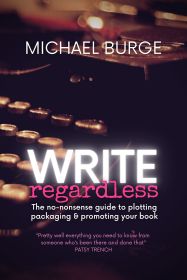
write-regardless-cover
BUY NOW

I have one tip for writer-proofreaders aware of the reality that self publishing is expensive – shut the windows, put the cat out, tell your partner not to come knocking, and simply read your work so damned well it’s like the last time you’ll ever read it.

And I have one tip for writers willing to pay for proofreading – no matter how much you pay, it’ll never be perfect.

© Michael Burge, all rights reserved.

Check out Michael’s book on indie publishing.