All posts by Michael Burge

Journalist, author, artist

‘We love entertaining the local community’: Chris McIntosh makes directing debut at Deepwater

LONGTIME LOCAL CHRIS McIntosh has stepped up to direct the upcoming production of Deepwater Players, a raucous production that gets to the heart of family life in country towns, showing at Deepwater in October.

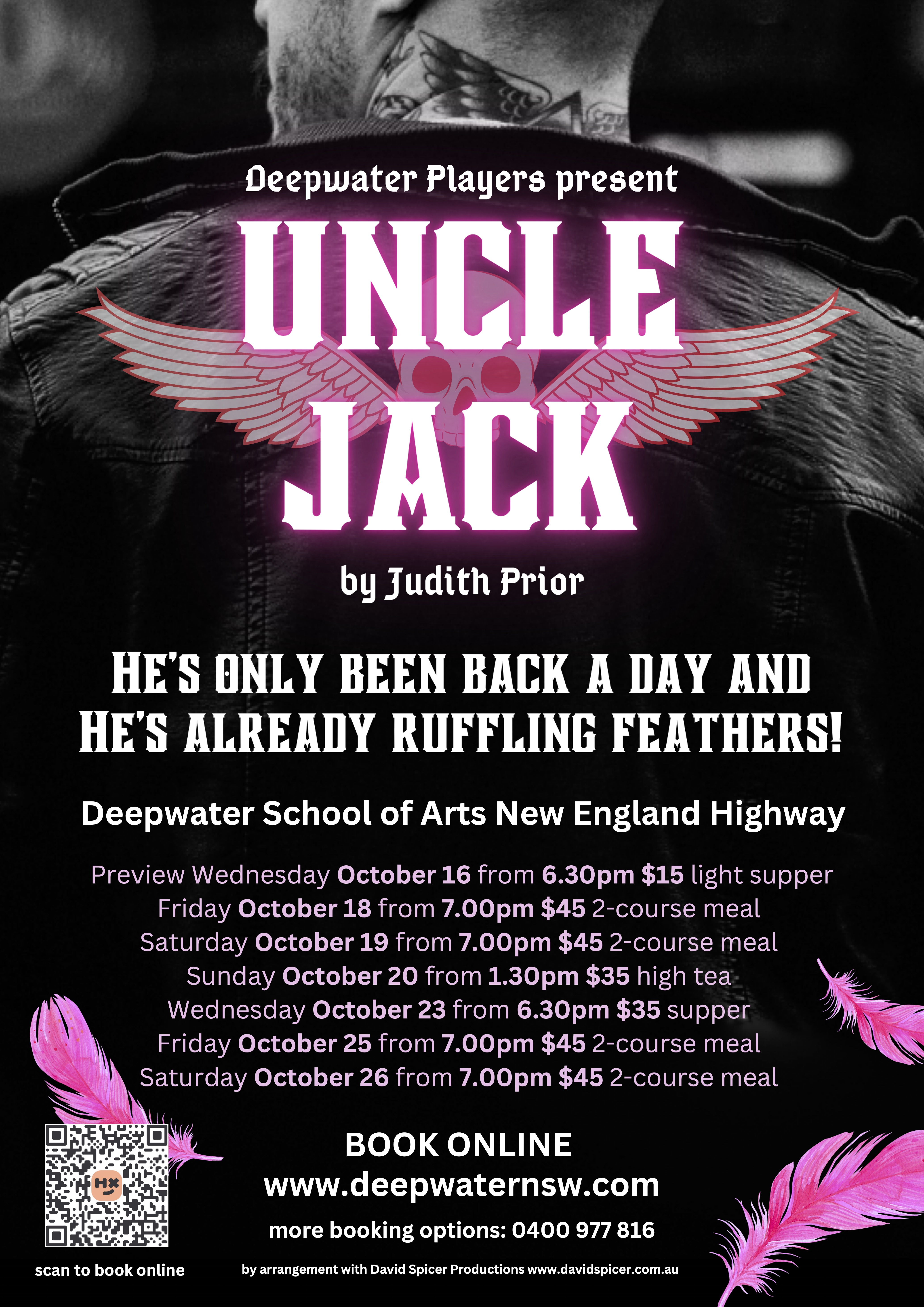
Uncle Jack is a comedy by Australian  playwright Judith Prior, with relatable characters who a lot of people will recognise or identify with,” McIntosh says, speaking from his home at Wellington Vale, west of Deepwater.

“I wanted to put on a play that felt right at home in the Deepwater Hall, for the audience to feel like the characters onstage could be people from their own lives or families. 

Uncle Jack is literally set in a hall in a small town, with very Aussie characters. It also covers some very real and relatable themes, so while there’ll be some laughs the audience will also have something to mull over after they leave.”

McIntosh describes the typical Deepwater Players performance as “an immersive experience”. 

“All shows include either supper, high tea, or a two-course seated dinner,” he says.

“Our dinner sessions include a licensed bar, available before the show and during intermission; and the plays themselves often feature singing, dancing and humour. 

“We don’t want our guests to just come and see a show, we want them to have a great night out.”

Creative energies

According to McIntosh, the Deepwater area is secretly a very creative community. 

“We have artists, craftsmen and designers of various kinds, jewellers, published authors and more,” he says.

“The Deepwater Players fit right in. We’re another avenue for local people to channel their creative energies into.

“The Deepwater plays have become a local icon, too. Most sessions sell out, and having 600-700 people through the doors – when the whole town only has 300-400 – is quite an achievement. We love entertaining the local community. People still talk about plays they came to ten or twenty years ago.”

A prominent fundraising aspect underpins the mounting of productions in the township, with a history stretching back more than four decades. 

“Proceeds from each play are distributed amongst a number of local charities, community groups and not-for-profit organisations,” McIntosh says.

“Recipients in the past have included the Deepwater Public School P&C, Red Cross, Royal Far West, our golf and tennis clubs, the Emmaville Pony Club, our local SES unit and the Westpac Rescue Helicopter.

“The first play was actually prompted by a local tragedy – a young boy died who could have been saved if the right medical equipment had been available in the town. 

“That first play was produced specifically to raise money for emergency medical equipment for the town. It was such a great success that the group decided to continue on the same model, producing shows every two years or so.”

McIntosh pays tribute to local high school teacher Jenny Sloman, who adapted and directed plays for most of the time the Players have existed.

“Although Jenny has now retired from that role, we still have a couple of the original cast members who have appeared in nearly every production here,” he says.

“We are also very welcoming of newcomers, including people who’ve never been on stage before. 

“Our last play [Phantom of the Music Hall, also penned by Prior] featured a 17-year-old schoolgirl from Dundee, who has since gone on to study acting in Wollongong.” 

Worked wonders

A veteran of three previous Deepwater productions, McIntosh says participating in the performing arts is “daunting but also really rewarding”.

“Being talked into getting on stage for the first time worked wonders on a much younger me. 

PERFORMING PHANTOM: (L-R) Cathy Wheatley, Chris McIntosh and Charlie Coldham in Deepwater Players’ 2021 production of ‘Phantom of the Music Hall’ by Judith Prior

“It was a real confidence builder,” he says.

“Acting can be very inward-looking, as you try to inhabit a specific character – to become someone who might be very different to you in every way.

“That can be difficult, even confronting, but also a lot of fun! You’re also literally in the spotlight, with a lot of attention on you and an audience giving you live feedback about your performance.”

He finds directing involves being more concerned about what everyone else is doing.

“There’s much less ‘I’ in this role,” he says.

“It’s a management role, it’s about people, relationships, organisation and logistics. 

“You’re still involved in the performance, but from the point of view of the audience, and you need to get into the minds of all of the characters, not just your own. It’s a very different experience.”

Another project McIntosh has been working on recently is the Welcome to Deepwater website. 

“This is a directory site listing practically everything in the town, designed as a resource for both locals and visitors,” he says.

“I realised some time ago that there were a lot of individual businesses, clubs and community groups with their own websites or social media, but there wasn’t really a single place to find all of that information.

“I started making my own list, and the site grew from there. 
“I’m hoping to support the Deepwater community, with this site acting as a one-stop place for information about our town and what it has to offer – whether you’re a long term local, new resident, visiting friends or family in the area, or a tourist or traveller just passing through.”

Uncle Jack by Judith Prior will be performed by Deepwater Players at the Deepwater School of Arts Hall from October 16-26. For all bookings head to www.deepwaternsw.com 

Beyond every dead body

I NEVER SET out to be a crime writer, it was something that crept up on me like the growing awareness of the killer in a whodunnit, and it all started with my early love of Agatha Christie novels.

The prospect of my debut novel Tank Water being consigned to the crime section of major bookshops was a little unsettling; but considering I was a debutante at the age of 51, I had little time to dissemble and embraced my place in one of the world’s highest-selling genres.

Crime has opened doors, not least the invitation to join the board of BAD Sydney, the writer’s festival that platforms journalists, academics, podcasters, broadcasters, film-makers and a myriad of professionals from the justice system.

It’s also led to reporting one of the more heinous crime waves that gripped the suburbs of Newcastle, Sydney and Wollongong from the 1970s to the 2010s, an era known as the Gay-hate Decades.

I’m often asked whether I struggle with the brutality of murder when reporting or writing fiction in which the body count mounts up. Consideration around this is so common (and empathic) that I thought it wise to put myself through a challenge a few years ago, to check if I was becoming desensitised.

Pain and trauma

I sought the most disturbing real-life crime I could find, and it didn’t take long to land on Helter Skelter, the seminal book on the Sharon Tate and La Bianca family murders in California in 1969, said to be the highest-selling true-crime publication ever.

Written by trial prosecutor Vincent Bugliosi and Curt Gentry, this incredible work lays bare the sad and sordid case in a manner that did spark anxiety in me, mainly because the killers – the so-called Manson family – had been part of the popular hippie counterculture of the era.

But I got through it intact, in some ways relieved that I was still able to be shocked by exploring shocking crimes, yet not stymied in my own work.

What drives my interest in crime writing and interviewing crime authors, is that crimes – murders in particular – rarely exist in a vacuum without other themes of grief and justice.

Dead bodies do more than throw up murder suspects, they cause pain and trauma to loved ones and communities. For me, the best crime writing delves into this territory with sensitivity and courage, because it can lift a crime novel’s significance above mere entertainment.

The exploration of grief in crime novels is rare, and although they say order needs to be restored by the end of a classic whodunnit, life is rarely as neat.

I’m also captivated by those aspects of victim/survivor’s lives that show resilience and endurance, where the hope of justice can sometimes be stronger than justice itself, posing the question: is justice ever really attainable?

It’s a fascinating concept, justice, a word with almost no effective synonym, one that means different things to different people.

It meant something to Doris Tate, Sharon Tate’s mother, who worked tirelessly to ensure the voices of surviving families were heard in the Californian judicial system. Her statements during the parole hearings for the convicted former members of the Manson family stand as a critical enduring addendum to Helter Skelter.

Restoring order

Agatha Christie loved a little order restoration at the conclusion of her books, although she didn’t always wrap things up neatly. In her works, lovers survive death and destruction while impatient philanderers get their just desserts. Family members are reunited even while others are split asunder. Most baddies get it in the neck, but some get off scot-free.

This tension between crime and punishment is one of the hallmarks that drives BAD Sydney, the festival that explores what crime can tell us about ourselves.

For this year’s event I’m delighted to be hosting two sessions: Bush Justice and Queer Crossroads, both explorations of how law and due process have been lacking in some of Australia’s marginalised and remote communities.

See you there!

BAD Sydney takes place at the State Library of NSW from August 11-14, 2024. Book now.

Take Another Look: Bruce Beresford’s ‘grandly messy’ Paradise Road

First stop in a new series of retrospective pop culture reviews examines why Australia’s best female ensemble since Picnic at Hanging Rock disappeared almost without a trace…


IN THE OPENING scene of Bruce Beresford’s WWII epic Paradise Road (1997) the dignity of the Imperial Japanese Army is torn to shreds by privileged white plantation growers and their wives, chatting during a military ball at Singapore’s Raffles Hotel in February 1942. 

Adrienne Pargiter (Glenn Close) and Topsy Merritt (Julianna Margulies) throw in a few reminders about the effectiveness of the attack on Pearl Harbour, yet even as bombs start interrupting the dancing, Western denial on the imminent fall of Singapore remains dangerously intact.

It’s an apt metaphor for a film that tanked at the global box office after critics swooped, leaving stakeholders baffled about exactly where Paradise Road failed to deliver.

The ingredients for success were all in place. Beresford had a proven track record on war movies like Breaker Morant (1980) and award bait such as Driving Miss Daisy (1989). Producer Sue Milliken had global success with period piece Sirens (1994). 

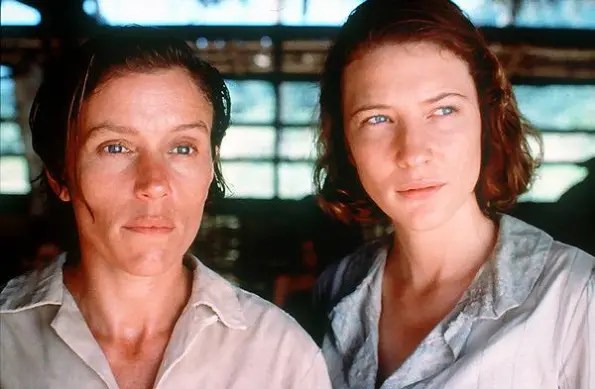
ENSEMBLE EFFORT Frances McDormand (left) and Cate Blanchett

The Australian film industry’s strongest female ensemble since Picnic at Hanging Rock (1975) was headed up by multi Oscar-nominated Close and 1995’s best actress recipient for Fargo, Frances McDormand. Pauline Collins (Shirley Valentine), Margulies (ER), Jennifer Ehle (Pride and Prejudice), Elizabeth Spriggs (Sense and Sensibility) and a swag of established and emerging Australians (including Cate Blanchett in her feature debut) joined an international supporting cast working in four languages.

Production values were extremely high, particularly as a shipload of escaping women and children get scuttled by Japanese pilots and end up in a civilian internment camp in Sumatra. As they enter its barbed-wire gates, this band of socialites, plantation owners and nurses must cohabit with Dutch women, missionaries, nuns and Asians. Hard labour, starvation and brutal physical punishments await, as does the expectation to serve as “comfort women” for enemy officers.

After the hubris of Raffles, their dignity now lies in tatters.

But when Pargiter is overheard crooning a snippet of Elgar before lights out, British missionary Margaret Drummond (Collins, in a beautiful performance with her usual light touch) suggests a plan to raise morale with a vocal orchestra.

“It’s just humming,” complains the camp’s serial spoilsport and comic relief Mrs Tippler (Pamela Rabe), “anyone could do that.”

Which is the point. The pulsating, otherworldly voices make even the Japanese guards hold fire when ordered to break up the first performance of the fledgling ensemble, which requires no language to work its magic. 

Wasn’t dinkum

The real shame of the film’s failure to connect with a wide audience is that the Women’s Vocal Orchestra of Sumatra was real. Pargiter was based on Singapore-born chorale conductor Norah Chambers (1905-1989), and Drummond on British missionary and poet Margaret Dryburgh (1890-1945), both interns of the civilian camp at Palembang, Sumatra. Yet even Close wasn’t sure why Beresford chose to fictionalise these characters.  

Australian critics were lukewarm. There was a sense that the storyline, purported to be well-researched from intern diaries and interviews, just wasn’t dinkum, in part because of the atrocities it omitted.

International critics admired the “grandly messy” production but disliked the lack of narrative, pointing to the “predictable” aspects of the “sprawling” and “linear” story. 

CLOSE CONDUCTING Glenn Close (centre) as orchestra leader Adrien Pargiter

Yet revisiting it recently I finally discerned what’s at work in this deeply moving film. The key is in the conducting, not just Close’s determined and noble portrayal of orchestra leader Pargiter, but Beresford’s.

Unlike many of his contemporaries, he’s had a long career as a director of opera. Adapting the wealth of stories about real-life women caught up in war into a 120-minute screenplay required compressing facts into a grand lyrical narrative, in which the exotic setting feels operatic.

So war crimes are punctuated by hummed music and poetry, not big speeches; but when we get those, Close’s English accent is delivered almost as recitative. Emotional instrumental refrains run from Raffles right to the impenetrable jungle, where ever-increasing numbers of handmade crosses mark the lives cut cruelly short by war. Privileged women in reduced circumstances are like a chorus, with plenty of rueful pathos between the big arias, particularly in the hands of stalwarts Wendy Hughes and Penne Hackforth-Jones.

This is no Orange is the New Black (2013-2019), female-driven prisoner stories with 91 episodes to foreground the lives of every ensemble member; Paradise Road is high tragedy shaped by Beresford’s broad baton strokes.

In the release of death or liberation for the camp interns, he conducted a grace note that fell flat in the late 1990s, too close to real events to get away with anything but the complete truth. Watching it in an era that’s in need of all the grace we can get, the way this movie restores the dignity of sworn enemies with “just humming” is sublime.

Paradise Road is streaming on SBS On Demand, ABC iView, Apple TV and Amazon Prime.

Production stills by Jasin Boland.