Beautiful, beautiful compost we had, the month you died,
And similar layers of dying colour
Have filled all my days since.
The dogs will turn when I say your name.
Not with their ardent wish,
But with resignation;
And I still say your name,
With resignation,
To anyone who will listen.
Your trail is turning cold. I hope you’ve found your footprint,
That I will get to follow,
And when I reach it, we will know.
That the last day of autumn, every year,
Is not the last of you.
SPACE PHENOMENON Patsy Trench (left) as Cadet Tina Culbrick in Phoenix Five.
A Writer explores the limits of the universe’s acceptance.
“WHEN I was nine years old Star Trek came on,” actress Whoopi Goldberg told Gene Roddenberry, creator of Star Trek, at a casting session for the show’s reboot in the early 1990s.
“I looked at it and I went screaming through the house: ‘Come here, mum, everybody, come quick, come quick, there’s a black lady on television and she ain’t no maid!’ I knew right then and there I could be anything I wanted to be, and I want to be on Star Trek.”
That ‘black lady’ was African-American actor Nichelle Nichols, in the role of Lieutenant Uhura, a character who inspired even Dr. Martin Luther King to follow the voyages of the Starship Enterprise.
Goldberg’s moment of validation and inspiration is now half a century behind us. In fifty years from now, will stories emerge about children today who saw themselves in the current crop of mainstream science fiction titles, or has Sci-Fi lost its edge within today’s asteroid belt of conservatism?
A bit of time travel might unearth some answers.
When George Lucas relaunched the Star Wars franchise in the late 1990s, he created a character whose name still draws ire across the geek chat rooms: Jar Jar Binks.
Designed to appeal to younger audiences in a similar manner to the Ewoks of Return of the Jedi, Jar Jar, a Gungan from the planet Naboo, with his exaggerated mannerisms and flamboyant voice, seemed to have the opposite effect, and he was subsequently toned down and written into the sidelines of two further prequels.
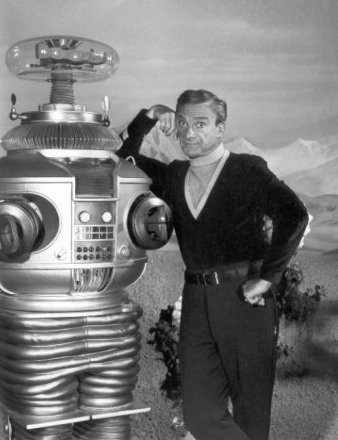
The fear of flamboyant space travellers and aliens was not always so keen. Doctor Zachary Smith in Lost in Space (played by Jonathan Harris) camped and shrieked his way through the series, defying any notion of being sidelined.
BUMBLING BOOBY! Jonathan Harris as Dr Smith in Lost in Space.
That he was a comically selfish villain, opportunistic in his attempts to get back to Earth, leaving the Robinson family behind, didn’t seem to matter. Flamboyant was fine, as long as you were the bad guy.
More recently the Doctor Who franchise (and its spin-off, Torchwood) experimented with alternate sexuality in the form of the bisexual Captain Jack Harkness (played by John Barrowman), but his intergalactic promiscuity, and the untimely death of his longest love, ensured audiences never had to countenance this high-profile non-heterosexual character in a relationship as progressive as a commonplace same-sex marriage.
Sci-Fi lesbianism is even more marginal, offering only a handful of onscreen same-sex kisses and a whole universe of subtext in everything from Alien: Resurrection to Xena Warrior Princess.
Here in Australia, TV producers were quick to jump on the bandwagon of popular TV series set in the future, with a crop of titles on our small screens by the end of the 1960s.
One of these was Phoenix Five produced by the Australian Broadcasting Corporation from 1968-69.
Amongst the show’s stars was Patsy Trench(now a London theatre guide) in the role of Cadet Tina Culbrick, the only female in a crew of three on the galactic space patrol ship of the show’s title, tasked with protecting the known universe from an evil humanoid and a rebel scientist in the year 2500.
“It was certainly not a progressive series, not in any sense,” Patsy said. “It made no social statements, it was just a series of adventures featuring three humans versus a number of weird aliens”.
“As for gender equality, the characters were all pretty well asexual. We wore identical clothing – a yellow tunic-type top (very cliché Sci-Fi) and very unflattering black ski pant-type trousers. There was absolutely no sense of sexual tension between the three of us and no sense of gender – equality or otherwise. Tina may have objected from time to time to being patronised by her male crew members, but that’s about as far as it went.
HIS AND HERS The key cast of Phoenix Five in their gender-neutral tunics (Clippings courtesy of Patsy Trench).
“Every single episode I had to say ‘space phenomenon ahead’, whatever that was supposed to mean.
“It became a running joke. I remember pressing a series of buttons without having a clue what they were or what I was supposed to be doing.
“Nowadays a director and actor might pay a bit of attention to that kind of detail, but not then.”
I asked Trench whether she believes Australia was capable in the 1960s of imagining a future that had racial/sexual equality?
“Probably not,” she said. “When I was living there in the late Sixties I did not get the impression the Aboriginal people featured much in people’s consciences, certainly not as they do now. I’m not sure when they were given full voting rights, but I think it was around that time, and I had no idea it had taken so long – the issue was never discussed.”
Does Trench think Sci-Fi has a role to play in imagining a more equal future?
“Of course, because the limits are as huge as our imaginations,” she said.
Territory upon which only the boldest equality explorers tread is one which has long been a source of some of Science Fiction’s most renowned characters: disability.
Few children of the Seventies will have missed the blind, wheelchair-bound Davros who first appeared in the 1975 Doctor Who ‘Genesis of the Daleks’ episodes, probably the most prominent example of a physically disabled humanoid character ever to feature on television screens in our living rooms at prime time.
In her enlightening feature ‘Disability in an alternative universe’ for the ABC’s Ramp Up disability discussion forum, Leah Hobson gets right to the point: “As a fan of science fiction and fantasy – genres which most often ask ‘what if?’ in more playful and profound ways – I notice the dearth of ‘good’ stories about disability”.
“If a character is portrayed with any sort of disability,” Hobson wrote, “a realistic depiction means you’re typically male, and you’re typically either bound to a bitter and/or evil existence with a good dose of sexual openness thrown in just to really show you’re evil.”
Exploring whether there is any positive purpose to depictions of Transhumanism (the human condition enhanced by technology) in Sci-Fi, Hobson found more questions than answers.
I started to enjoy Doctor Who whenRiver Song (played by Alex Kingston) became a regular character, and, in geeky conversations at work about the future of the show, I threw in my view that the show’s producers might be grooming River Song to be the series’ first female Doctor.
And why not? She was riveting, charismatic, intelligent and kept taunting viewers on her backstory with her cheeky warning: “Spoilers, sweetie”.
During 11th Doctor Matt Smith’s unsuccessful regeneration in ‘The Impossible Astronaut’ episode, I hoped to see River’s signature curls emerge from the amniotic glow to be reborn as his replacement. Sure, she was standing right there watching, but this is Sci-Fi, anything could happen, right?
But The Doctor was killed (to tell you more would be a spoiler), along with all my hopes for River Song, who joined Amy, Rose, Martha, Tegan and Sarah Jane, playing second fiddle through time and space.
Dr King made a resounding point when he learnt that Nichelle Nichols wanted to leave the cast of Star Trek. As she recalled, he said: “Gene Roddenberry has opened a door for the world to see us. If you leave, that door can be closed, because, you see, your role is not a black role, and it’s not a female role, he can fill it with anything, including an alien.”
Until mainstream science fiction producers start opening a few more doors, and opening them wider than Roddenberry ever did, equality in Sci-Fi will remain far, far away.
SEA CHANGE ‘Miranda and the Tempest’, by John William Waterhouse.
A Writer encounters a new state.
IN 2012, my husband Richard and I decided to move from our home in the Blue Mountains of NSW, to a subtropical island off the coast of Brisbane in Queensland, a day’s drive to the north.
This rather major decision came about organically. We had an argument – one of those all-day, episodic ones where you get thinking time between confrontations. It wasn’t about what he said or what I said, in the end. It was about what we were doing in the Mountains, how we were managing our finances, who was happy in their job (or not), and where we were going.
We kissed and made-up, and decided to move. Just like that.
We told our family and closest friends, which made it real. Almost frighteningly real. They all kindly put up objections and perceived barriers, which only showed the love they have for us, and brought pangs of doubt.
But we still went through with it.
William Shakespeare invented the term ‘Sea-change’, not the Real Estate Institute of Australia. In what is believed to have been his last epic play, The Tempest, ironically set on an island, he wrote a song of comfort for the sprite Ariel to sing to Ferdinand, whose father has drowned …
“Full fathom five thy father lies,
Of his bones are coral made, Those are pearls that were his eyes, Nothing of him that doth fade, But doth suffer a sea-change, into something rich and strange, Sea-nymphs hourly ring his knell, Ding-dong. Hark! now I hear them, ding-dong, bell.”
The song speaks of something good, something new and unusual emerging from something that has been lost.
Our Blue Mountains house, where we’d renovated a stunning old garden, took less than 24 hours to sell once the ‘for sale’ sign went up, which was a sign indeed.
Synonymous with somewhere
Not long before we moved I noticed someone found their way to my blog via googling ‘Michael Burge Blue Mountains’.
Turns out my online profile has me digitally-linked to the place in which I lived, on and off (mainly on), since 1979.
For some reason that made me reluctant to move – I had become part of the fabric of the place, in a sense. Will I ever be as synonymous with another place in this lifetime?
Many Mountains people say: “You never leave the Mountains, you always end up returning”, and in my case, that happened five times in 33 years. It’s almost scary how often I slunk back up the hill, tail between my legs, and found solace in that unique part of the world, stuck on a gigantic rock surrounded by endless bushland.
I learnt, loved, lived, and lost here. I would still like my ashes scattered in the Jamison Valley when I am dead. Perhaps that may never change.
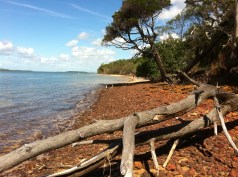
MAGIC MORETON A bay full of stories.
What country, friends, is this?
Richard grew up in south-east Queensland, including time in Kenmore, Brisbane, so he knows this country.
From he and his family I’ve picked up a bit of a Brisbane north-south divide (in Sydney it’s east-west), with the Brisbane River being the borderline.
We’re technically living the south side, but, being on an island, I claim to have moved offshore altogether.
In the lead-up to the 2013 federal election, we were faced with having to vote for someone in our new electorate, the division of Bowman, which is also known as Redland City. I decided to interview all the local candidates for a political website – No Fibs – so I could understand more about this region though its politics. What I found was eye-opening.
I didn’t understand why those on north of the Brisbane River look down on those in the south, until we went to an exhibition at the Museum of Brisbane about our new home, Moreton Bay.
There within the records and artefacts were the stories of the men and women, Aboriginal and European, who carved out an existence on the archipelago off the seaboard of Greater Brisbane – the convicts, lepers, outcasts and misfits of a penal colony, and the Quandamooka people who came before all of us.
I got goosebumps learning about the courageous ones who reached out to people in need across these islands, and this misfit felt a sense of place, after being here only just over a year.
There’s a whole lot more to Australia than the little patch of land clustered around Port Jackson, which some people have convinced themselves is worth an average of a million dollars for a tiny patch. Islands are places of mythology, and there’s plenty of local myths about Coochiemudlo and its neighbours. Many of us like to keep it that way, because it means our reality ranks amongst Australia’s best kept secrets.




 Until mainstream science fiction producers start opening a few more doors, and opening them wider than Roddenberry ever did, equality in Sci-Fi will remain far, far away.
 Michael Burge Media