All posts by Michael Burge

Journalist, author, artist

John Tebbutt – southern stargazer

images
NOTING TEBBUTT John Tebbutt (1834-1916) on Australia’s first one-hundred-dollar note.

A Writer’s encounter with a scientist’s story

I’D already seen the mysterious Tebbutt’s Observatory from a horse-drawn carriage tour of Windsor, in NSW’s Hawkesbury region. The combination of the rhythm of my ride, and the mist rising off local fields on a warm spring morning, gave this encounter a magical feel, as the low-set, Grecian-style string of buildings that comprise Tebbutt’s workplace appeared, dominating the Colonial landscape of this part of the Hawkesbury without needing to try at all.

As soon as I had the opportunity, I went to have a look for myself, and encountered the descendants of astronomer John Tebbutt (1834-1916) in their ongoing custodianship of his life’s work. This article was published in Blue Mountains Life (Aug-Sept 2010).

TEBBUTT'S TELESCOPE John Tebbutt (1834-1916) and the telescope which he used to chart the return of Halley's Comet in 1986.
TEBBUTT’S TELESCOPE John Tebbutt (1834-1916) and the telescope used to chart the return of Halley’s Comet in 1986.

Southern stargazer

Inside the Hawkesbury observatory of John Tebbutt

As a Windsor school boy who showed a flair for astronomy, John Tebbutt also had the good fortune to grow up in a home with excellent views of the southern sky at night – Peninsula House.

Completed c.1845 and set on a low hill overlooking the major bend in the Hawkesbury, to the present day the property (and the three observatories Tebbutt designed and built) have commanding views towards all points of the compass.

For the lad who went on to discover two comets and create a critical mass of astronomy in the southern hemisphere, early stargazing took place on the verandah of Peninsula House, which is still in the Tebbutt family today.

“It’s well known my great-grandfather set up his first marine telescope on the verandah of the main house,” current owner John Tebbutt outlines, “but the only remaining verandah faces due north, whereas the southern sky was his domain. When you come to think of it, he must have set-up on the southern side of the house which has long since changed.”

Peninsula House and the two remaining observatories emerge from the mist of a typical Hawkesbury winter morning, as John Tebbutt and daughter Angela lead the way into the workplace in which their ancestor spent thousands of hours making accurate celestial observations and recordings.

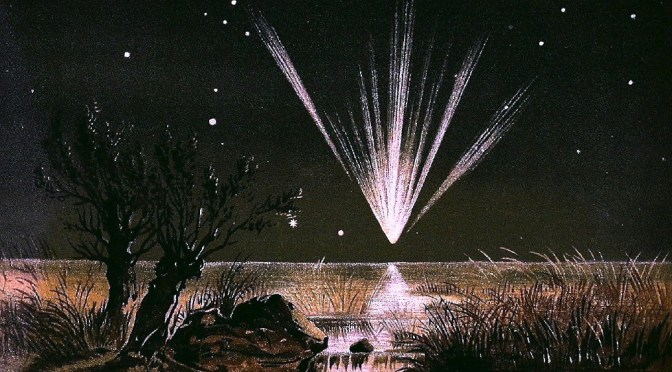
COMET COMING The Great Comet of 1861, on Tebbutt's radar in Windsor.
COMET COMING The ‘Great Comet’ of 1861, on Tebbutt’s radar in Windsor.

Tebbutt’s achievements in astronomy are well-documented.

Just shy of his twenty-seventh birthday, before acquiring complex telescopic equipment or building a designated observatory, Tebbutt discovered the ‘Great Comet’ of 1861 and accurately predicted that the Earth would pass through the visible tail, news which created a wave of mild hysteria in June of the same year.

The discovery led to the building of his first weatherboard observatory in 1864 (demolished in the 1930s), and, by 1879, the beautiful brick observatory which still stands.

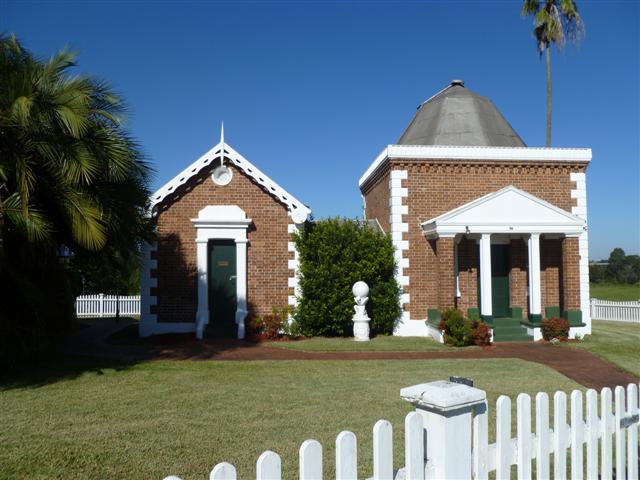
Although Tebbutt never left Australia, “he would have read about designs from overseas,” the current John Tebbutt outlines as we stand before the two neo-classical porticos of his grandfather’s 1879 observatory.

Reminiscent of the Royal Observatory in London (hotbed of all things astronomical and timekeeper of the western world), Tebbutt’s Observatory served a similar purpose.

“For many years he provided a time service for Windsor,” John says, “and many believe he wanted to create the equivalent of Greenwich for the southern hemisphere.”

That’s easy to believe looking through the beautifully designed brick buildings, appearing like Greek temples in the distance as you approach the property.

“There were many more statues,” Angela Tebbutt explains, “but this one of Atlas is the last one we have.”

Accessed through two heavy iron doors is Tebbutt’s library.

“We found the doors below inches of dirt in a shed,” John explains, “and for a while we weren’t sure what they were, then we realised they fit these door frames exactly. They were for security, because he housed quite a collection of books and instruments here, spending hours making his observations, and would often have to leave the instruments for a period of time. For the accuracy of recordings, things needed some protection.”

“He also had seven children,” Angela laughs, “and we think he liked to keep things safe from them.”

Heavy iron doors seem like overkill when protecting recordings from little fingers, and when I inquire as to whether any significant event might have made Tebbutt wary, both John and Angela immediately talk of the fire which destroyed the property’s granary, thought to have started in an outdoor oven. The full-brick walls and iron doors of Tebbutt’s library speak of someone who knew the consequences of losing irreplaceable work.

GRECIAN-STYLE Tebbutt's Osvervatory (Photo: http://convictstock.wordpress.com/
GRECIAN-STYLE Neo-classical facades of Tebbutt’s Observatory (Photo: convictstock).

Between the two main structures of the 1879 observatory is Tebbutt’s transit room, aligned like everything else on a true north-south axis.

This leads through to a room in which a large pier is the central feature.

“We rebuilt that,” John remembers, “because it had been removed for the tenants. It sits below where the large telescope was on the top floor, but it’s not particularly weight-bearing. It’s more for preventing too much vibration in the building when taking readings through the telescope.”

The current John Tebbutt inherited the property from an uncle in the 1960s, and set about restoring the observatories during the astronomical renaissance prior to the return of Halley’s Comet.

“He came out of retirement for Halley’s in 1910” John explains, “and worked on predicting the path for its return in 1986. By then he’d appeared on Australia’s first one hundred dollar note, and there was interest from the local council in restoring his place in our history before the Bicentenary.”

John regales the story of finding his grandfather’s Irish ‘Grubb’ equatorial telescope, which was sold after Tebbutt’s death in 1916 and ended up at an observatory in New Zealand.

“Councillor Rex Stubbs had a lot to do with getting it back here,” John remembers, “they organised to have it flown back by the RAAF in a training exercise, then trucked from Richmond Air Base out here. Exactly a century since my grandfather set the telescope up here in Windsor, it was returned.”

Tebbutt’s 8-inch equatorial refractor is now housed in his third observatory, a more primitive structure now half hidden by greenery, speaking less of Greenwich-like aspirations and more about the sheer hard work observing and recording Tebbutt completed once he was able to see further into the universe (in all directions) than he had before.

“I think we came pretty close,” John says when I ask if he achieved what he set out to do with restoring the setting of his great grandfather’s life’s work.

“People who used to live here have come back for weddings or other events, and they can’t believe what it now looks like,” Angela adds.

© Michael Burge, all rights reserved.
The face that fell

STAY THAT WAY If you pull faces! (Photo: Tadas Černiauskas).

I’D been down with a terribly sore throat for days, and I woke late, feeling as though I’d slept very deeply. In my stupor, I noted that I was due to meet a friend at a local cafe in less than half an hour; showered lightning fast; jumped in the car; and as I looked in the rear vision mirror to reverse out the driveway, I noticed my face looked weird.

It felt perhaps that my face was still asleep, so I gave myself a gentle slap. 

At the bathroom mirror, the truth revealed itself subtly: the whole right hand side of my face was slumped, including my eyelid. I could feel the muscles trying to lift internally, but nothing was happening on the surface.

I called my friend and said I’d have to cancel, then went back to bed, thinking that by the time I woke up, all would be well.

But it wasn’t. 

I had woken up with a case of Bell’s Palsy.

George Clooney had it before he became the world’s sexiest man. Rosanne Barr’s had it too. Even Allen Ginsberg woke up with it one day.

Remember when you were young, and an older relative, perhaps a great aunt, warned that if you pulled faces, and the wind changed, you could get stuck like that?

Bell’s Palsy makes a shocking reality out of that old wives’ tale.

At the hospital, the first of many practitioners failed to look at my face. I was prescribed a course of steroids, and told things might get better after a few weeks.

I went to my GP and he looked up his notes on this condition, which has been afflicting people with varying states of permanency for millennia, yet he didn’t once look at my face.

I went to see an acupuncturist, who assured me that his modality has been getting faces moving forever, yet over two weeks of treatments, he failed to look at the problem. After I caught him giving me a strange glance when he thought I wasn’t looking, I didn’t go back.

A fallen face is an aberration, apparently.

At the grocery shop, the shop assistant slowed down her speech, obviously thinking I was stupid. 

At the takeaway shop, an old acquaintance either didn’t recognise me, or did but fled in shock.

A good friend looked pained by my sunken features, especially my difficulty with speaking, and just nodded, concerned yet remote.

Without my usual speed, or courage, of response, I stopped going out of the house.

And after a few weeks of that cold, nerve pain coursing through my head and shoulders, I wondered if this was going to be my new life from now on?

Worst of all, I’d only recently started a new relationship, and presenting with a permanent facial disfiguration was not an ideal prospect.

It wasn’t until a friend of a friend heard about my Bell’s Palsy that a solution reared it ‘ugly head’. She’d had Bell’s Palsy herself, and her advice was simple and a little shocking: “If you want your face back, change your life”.

GWffF5Q
VILLAGE IDIOT John Cleese giving his best impersonation of a Bell’s Palsy sufferer.

My great new job was only six months old. My dawning relationship even younger.

These were not circumstances I wanted to change, but a fortnight of being treated like the village idiot or a special needs case weighed heavily on me.

I decided the relationship was not up for negotiation. The job, however, was, so I resigned, and got myself to a naturopath.

Kay was the first practitioner to look me in the eye, name my condition out loud without fear, and tell me with surety she knew she could fix me. With higher than usual doses of omega 3 oil and vitamin B, she got to the essence of the cause of many Bell’s Palsy cases – strangulated nerves.

Our facial nerves emerge from the brain via a small hole in the skull near each ear, and if something, in my case a virus, causes swelling in the region, the nerves can get pinched, and will simply shut down.

Much of the condition’s nature remains a mystery, especially the reason some people recover fully, some partially, and some (the minority) never, but advice from someone who’d been there was all I had to go on. 

Luckily my new partner Richard opened his house to me when my income suddenly diminished. His open heart told me that he was just as interested in what lay under my surface. I took courage than work would come my way at the right time, and focused on eating well and resting.

My true friends seemed to relax with my new-found approach, and one afternoon, after spending time laughing with me on the back deck, Naumi noticed the slightest corner of my fallen mouth started to lift.

I ran to the mirror, and she was right. The next day, more progress, and the nerve pain began to subside.

Within another month, my face was back to normal on the surface, and by the end of the year, it felt as it used to below the surface.

I became a Bell’s Palsy survivor, but I have never acted since and I was careful to avoid being photographed. Vanity, tinged with residual shock, I suppose.

Sometimes when I am very tired, I feel a tingle of that nerve pain, a reminder that I must not overdo things, and rest.

Sometimes I have seen a fellow sufferer, bravely trying to communicate with less mouth mobility than they’re used to, at a checkout, or a bank, and I notice the other person simply refuse to look into the Bell’s sufferer’s face. I always try to make eye contact, to see the real person inside.

We’re a shockingly surface-oriented society, I suppose, but the line between ‘it’s all good’ and whatever the opposite is, is nerve-thin, and touchy.

Play | COMING SOON
BUY NOW
 eBook | Paperback

To be honest, part of me enjoyed frightening certain uber-cool shopkeepers and ‘friends’ with my motionless ‘bad’ side.

But my month as the village idiot was a challenge. Coming as it did two years after the sudden death of my partner, it served to separate the men from the boys as far as friends were concerned, and was perhaps the ultimate manifestation of a ‘new me’ emerging.

© Michael Burge, all rights reserved. 

An extract from Merely Players.

Eating your words

FOOD FOR THOUGHT Meryl Streep as food writer Julia Child in Julie & Julia.

I FELL into food writing when the publisher of a magazine I worked for sacked the food writer and asked me to take over.

I never knew the reason, but I learned overnight that food, and the media that goes with it, is one of the most hotly contested and controversial sectors of the media industry.

Food took the baton from home renovation about a decade ago and became the Next Big Thing.

We might think readers and audiences are interested in politics and current affairs, but I’m here to tell you such subjects attract mere crumbs compared to the millions who devour food media in some form.

It’s no mystery – food is primal, like shelter (the drive behind home renovation’s popularity).

As a result of my two-year stint on the food pages, I learned a few tips about how to keep serving up the flavour in food writing.

Purple Prose will free you to write with flare

If you stop and really digest food writing, even at its best, it’s a form of Purple Prose, because this overblown, flowery language comes into its own when applied to food. A reader cannot taste the food when it’s just words and a photo on the page, so the food writer must use heightened language to impart the flavour. It’s been achieved to great effect in the wine tasting industry for centuries, with all those: “Top notes of autumn leaves”, and: “A nosey bouquet with bursts of citrus” superlatives. Abandon all notions of literary genius and invent new ways to describe the experience of taste.

Many chefs will try to tell you they invented Apple Pie

Chefs are the food industry’s gods, with their own celebrity hierarchy. A chef’s recipes are often closely guarded secrets, but the more ambitious will expect cries of “How Original!” when they reveal their secret ingredient in pumpkin soup, or their special take on fish and chips. Truth is, celebrity chefs rip one another off all the time, because staple recipes are like the fairy tales behind all archetypal stories, in that they belong to us all. Give credit where it’s due, but expect fireworks if you leave a chef’s name off her recipe for baked potatoes.  

Now and again you’ll strike an expert who blows you away

Mine was a sales rep for one of Australia’s largest and most successful wine growers, who welcomed journalists to a wine tasting evening at a top-notch restaurant attended by the region’s literati. I was ready to make notes on the rep’s welcome address, preparing for the usual platitudes, but the guy simply ripped the cork out of the bottle, poured himself a glass, drank it in front of the expectant crowd, exhaled and said in his genuine French accent: “With wine this good, you can say nussing!”. It was a refreshing lack of bullshit.

Recipes are full of mistakes

Even Aunty Eileen’s jam recipe will have errors in it when she wrote it down for your mum’s book of recipe clips. When transposing recipes, particularly the method, imagine making it yourself, because there is every chance there is something missing, or too much of this or that. Be vigilant, and expect plenty of communication from irate readers about faulty recipes. Clever food editors generate enormous readerships from recipe correction feedback. Everyone’s a food expert in their own kitchen, remember? Let ‘em tell you off a little and they’ll spread the word about you.

FOOD FAKE Styling often goes to extremes.
TASTY FAKE Styling often goes to extremes.

Food styling is fakery

It’s true, French fries in fast food commercials are turmeric-rubbed polystyrene. Remember, the reader cannot taste a photograph, it only has to look sumptuous. There are staple stand-ins for everything, from lobster (mashed potato) to rabbit (chicken), especially on the limited styling budgets provided by the majority of lifestyle titles. Food styling is about heightened sense of flavour and freshness, and a quick spritz from a water bottle is often the last nuance before photography begins. 

Stay ahead of the season

In this paddock-to-plate world of food media, it’s essential to pre-empt the seasonal availability of certain ingredients – when mushrooms are on the shelves, it’s really too late to be writing about them, because they’ll be out of season before long. Food media is attached to the marketplace, and the marketplace pre-empts itself all the time. Stay ahead of the game. Work captured this year might be best released a month before the earliest season next year.

Don’t be afraid to keep it simple

WRITE REGARDLESSFood is a little like art, in that people know what they like and like what they know. You can recommend all the activated almonds and moon-harvested saffron you want, but if winter’s coming people might want to be inspired by a few old favourite comfort foods. Never confuse diet and nutritional content with food writing. Food is fantasy. Diet is cold hard fact. People don’t read lifestyle titles for the facts, they want to indulge a little.

© Michael Burge, all rights reserved.

An extract from Write, regardless!