FOOD FOR THOUGHT Meryl Streep as food writer Julia Child in Julie & Julia.
I FELL into food writing when the publisher of a magazine I worked for sacked the food writer and asked me to take over.
I never knew the reason, but I learned overnight that food, and the media that goes with it, is one of the most hotly contested and controversial sectors of the media industry.
Food took the baton from home renovation about a decade ago and became the Next Big Thing.
We might think readers and audiences are interested in politics and current affairs, but I’m here to tell you such subjects attract mere crumbs compared to the millions who devour food media in some form.
It’s no mystery – food is primal, like shelter (the drive behind home renovation’s popularity).
As a result of my two-year stint on the food pages, I learned a few tips about how to keep serving up the flavour in food writing.
Purple Prose will free you to write with flare
If you stop and really digest food writing, even at its best, it’s a form of Purple Prose, because this overblown, flowery language comes into its own when applied to food. A reader cannot taste the food when it’s just words and a photo on the page, so the food writer must use heightened language to impart the flavour. It’s been achieved to great effect in the wine tasting industry for centuries, with all those: “Top notes of autumn leaves”, and: “A nosey bouquet with bursts of citrus” superlatives. Abandon all notions of literary genius and invent new ways to describe the experience of taste.
Many chefs will try to tell you they invented Apple Pie
Chefs are the food industry’s gods, with their own celebrity hierarchy. A chef’s recipes are often closely guarded secrets, but the more ambitious will expect cries of “How Original!” when they reveal their secret ingredient in pumpkin soup, or their special take on fish and chips. Truth is, celebrity chefs rip one another off all the time, because staple recipes are like the fairy tales behind all archetypal stories, in that they belong to us all. Give credit where it’s due, but expect fireworks if you leave a chef’s name off her recipe for baked potatoes.
Now and again you’ll strike an expert who blows you away
Mine was a sales rep for one of Australia’s largest and most successful wine growers, who welcomed journalists to a wine tasting evening at a top-notch restaurant attended by the region’s literati. I was ready to make notes on the rep’s welcome address, preparing for the usual platitudes, but the guy simply ripped the cork out of the bottle, poured himself a glass, drank it in front of the expectant crowd, exhaled and said in his genuine French accent: “With wine this good, you can say nussing!”. It was a refreshing lack of bullshit.
Recipes are full of mistakes
Even Aunty Eileen’s jam recipe will have errors in it when she wrote it down for your mum’s book of recipe clips. When transposing recipes, particularly the method, imagine making it yourself, because there is every chance there is something missing, or too much of this or that. Be vigilant, and expect plenty of communication from irate readers about faulty recipes. Clever food editors generate enormous readerships from recipe correction feedback. Everyone’s a food expert in their own kitchen, remember? Let ‘em tell you off a little and they’ll spread the word about you.
TASTY FAKE Styling often goes to extremes.
Food styling is fakery
It’s true, French fries in fast food commercials are turmeric-rubbed polystyrene. Remember, the reader cannot taste a photograph, it only has to look sumptuous. There are staple stand-ins for everything, from lobster (mashed potato) to rabbit (chicken), especially on the limited styling budgets provided by the majority of lifestyle titles. Food styling is about heightened sense of flavour and freshness, and a quick spritz from a water bottle is often the last nuance before photography begins.
Stay ahead of the season
In this paddock-to-plate world of food media, it’s essential to pre-empt the seasonal availability of certain ingredients – when mushrooms are on the shelves, it’s really too late to be writing about them, because they’ll be out of season before long. Food media is attached to the marketplace, and the marketplace pre-empts itself all the time. Stay ahead of the game. Work captured this year might be best released a month before the earliest season next year.
Don’t be afraid to keep it simple
Food is a little like art, in that people know what they like and like what they know. You can recommend all the activated almonds and moon-harvested saffron you want, but if winter’s coming people might want to be inspired by a few old favourite comfort foods. Never confuse diet and nutritional content with food writing. Food is fantasy. Diet is cold hard fact. People don’t read lifestyle titles for the facts, they want to indulge a little.
THE CAVE GIRLS An image which may include Katie Webb, her sister and mother.
A Writer’s day job leads to an encounter with a legend.
IN late 2008 when I trained as a guide at Jenolan Caves, probably Australia’s best-known cave system, I embarked on a fascinating journey.
Jenolan is a world of its own, with its own folklore, and within the network of caverns resides a collection of intriguing stories.
“I was enveloped in a dreadful skirt that made me look like some disreputable old charwoman.”
For a theatre worker, the task of taking tickets at the door, leading guests on adventures in the dark, retelling stories, playing with light and sound to enhance the experience, in underground chambers of acoustic perfection, often followed by a round of applause, felt like a return to the magic backstage world of a real theatre.
Jenolan guides, when I trained, were given little written material on the history of the place. We needed to glean the legends of the caves from our more experienced peers. I realised very quickly that the men and women who hold Jenolan’s stories were taught the same cycles by their peers, and that I was being given access to a unique oral history with a very immediate link to the past.
The story which intrigued me the most was that of Katie Webb, and her cave exploring sisters, long ago dubbed ‘The Cave Girls’.
This article was published in Blue Mountains Life (Vintage Press) in October-November 2010.
CAVE ART Possibly the earliest surviving image of the Grand Arch of Jenolan Caves, known in 1861 as Fish River Caves.
What Katie Did
The Legend of Katie Webb & Jenolan’s female explorers.
Of his visit to Katie’s Bower in Jenolan’s Left Imperial Cave during the 1880s, Samuel Cook wrote: “Descending 14 steps into the Bower there is a fountain full of lime-water, and a plate suitably inscribed conveys the information that Katie’s Bower was discovered on the 7th February, 1881, by Jeremiah Wilson (guide), C. Webb, H. Fulton, C. West, J. Bright, E. Webb, E. T. Webb, J. Thompson, W. H. Webb, E. Bowman, W. Thompson, J. M’Phillamy, R. Thompson, J. Webb, and S. Webb. The before-mentioned gentlemen were the first to enter the Bower after its discovery”.
Despite the placement given to Jeremiah Wilson, persistent legends credit the second name on the list – ‘C.Webb’ – with the discovery of the chamber.
This person was not a ‘before-mentioned gentleman’, but Catherine, or ‘Katie’ Webb.
For the 170 years that Jenolan has attracted tourists, there has been a hunger for guides to interpret their mysteries, and cave discovery tales rank amongst the most retold.
Years of tradition have made Jenolan’s guiding staff into the keepers of the Caves’ stories.
Rebecca Lewis has been a Jenolan guide since 2006, and has collected information about the first woman credited with the discovery of a Jenolan cave.
“This story is all oral history, and it varies depending on who you talk to,” Beck says.
“I believe Katie and her family were visiting the Left Imperial Cave (the original name of the Chifley) with Jeremiah Wilson, who had discovered the cave the year before. The group was admiring the beauty of the Lucinda Cave, named after Jeremiah’s wife. Jeremiah was about to lead the group out, but Katie, about 19 at the time, decreed that she did not wish to return the way they entered. Instead, she wished to continue down a large and steeply sloping passage that none had yet been down. Jeremiah, who was a curious man himself, decided to lower her down the passageway with a rope tied around her waist. With only a candle to light her way as she slid down the passage into the unknown, she found the largest chamber yet to be discovered in that area.”
Katie Webb was not the first female explorer at Jenolan. Thirty years before, legend tells of the caving exploits of Jane Falls.
“Everything we know about her is basically guesswork from piecing together the signatures she left behind in the caves,” Rebecca explains. “It was common practice for the visitors of her time to sign their names on the cave walls to prove they had been there, like leaving our names in a visitors’ book today”.
“The most talked-about signature of Jane is at a place called ‘Signature Rock’ in the Elder Cave (also referred to as ‘The Plughole’).
“The signature reads ‘J Falls 27th December 1854’,” Beck outlines.
“The interesting fact about this particular signature is that she did not sign her name ‘Jane’. She probably did this because she knew it might not remain on the rock if passing visitors realised it was a woman who wrote it. Writing ‘J. Falls’ leaves the assumption that the writer was a male. We know it is Jane’s signature because we have found her name in other caves and we can match dates and handwriting.”
One appearance of a ‘J. Falls’ signature has challenged the discovery of Jenolan’s popular Lucas Cave.
“A signature of hers remains in the original entrance of the Lucas Cave, known as the ‘Sole of the Boot’. It’s been sighted many times over the years, however, every time we mount an expedition to photograph it we cannot relocate it to do so!” Rebecca says.
According to some guides, the signature is dated 1858, predating the established discovery of the Lucas Cave by Nicholas Irwin and George Whiting by two years.
While researching for newspaper reports of the Lucas Cave’s discovery (which might clear up the mystery), Jenolan guide and historical researcher, David Hay, found that the originals in Sydney’s Mitchell Library have disappeared. “It’s almost as though someone pinched them,” he laughs.
Tantalising myths and very little evidence leaves us to explore the possibilities.
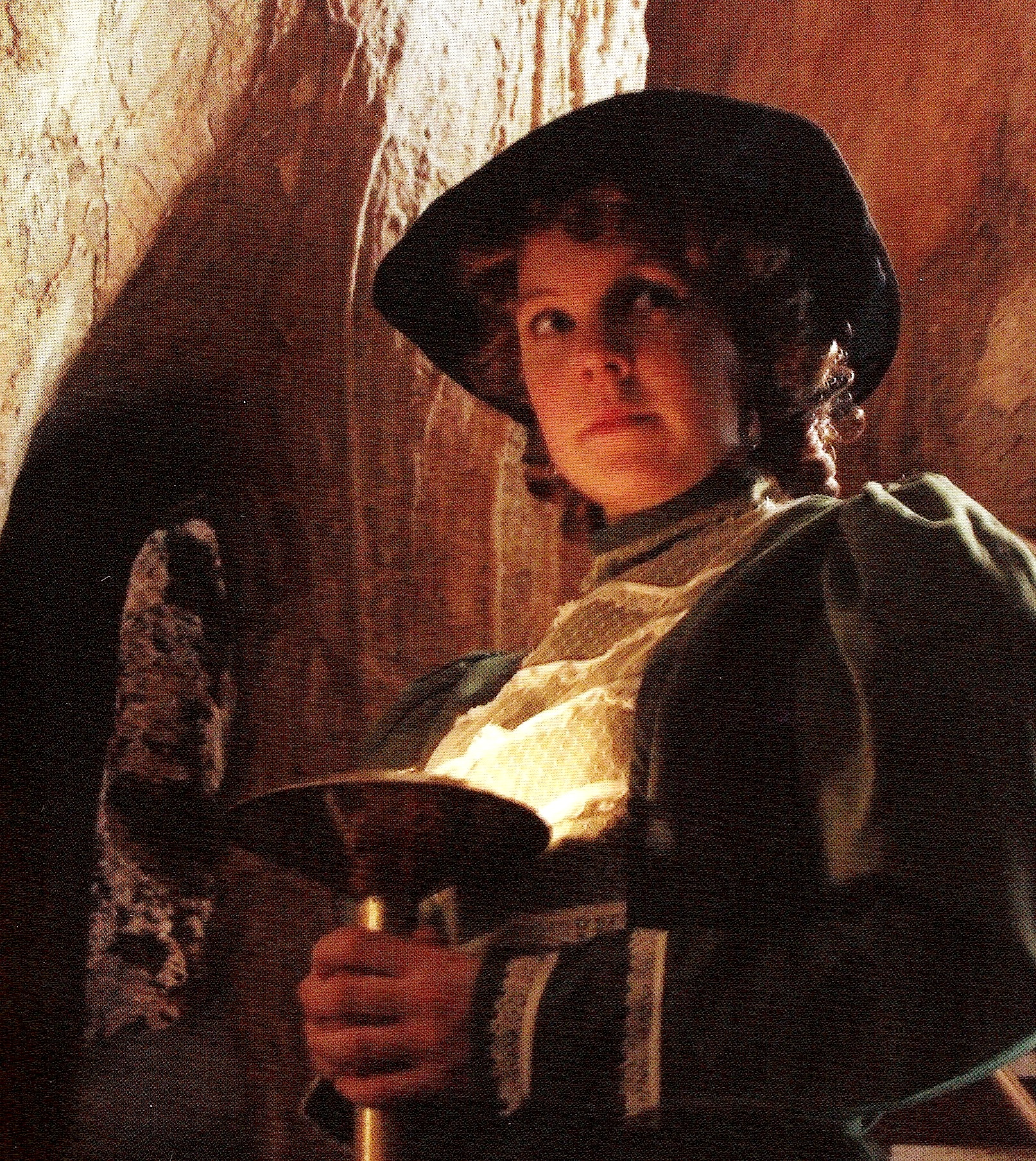
CAVE DISCOVERER Rebecca Lewis as Catherine ‘Katie’ Webb, the woman who discovered Jenolan’s Chifley Cave in the 1880s.
“‘The Cave Girls’ is a name that was given to a group of women in an old photo and the name just kind of stuck!” Rebecca explains.
“The thing that we all find interesting is that they are all wearing men’s clothing! We don’t know for certain who any of the women are, but we believe Katie and her sister Selena are amongst them.
“They must have been fairly influential women for their time not only to be wearing men’s clothing in the first place, but to also have a photo taken wearing them.”
Comparison with later photographs suggests Katie and Selena (known as Nellie) are the central figures seated on rocks, with their mother (also Selena) standing at the left.
Katie Webb’s father Edmund Webb accompanied his family to Jenolan on the day of Katie’s discovery – his name and those of Katie’s siblings Selena and Edmund Thomas Webb appeared on the plaque seen by Cook.
Webb was a prominent Bathurst businessman and politician, whose empire included the supply of clothing, footwear and millinery to the Central West. The uniform clothing of the three women at the top of the ‘The Cave Girls’ image might indicate they were supplied by Webb specifically for the purposes of cave exploration.
In her often humorous Letters from Samoa (1891-1895) Margaret Stevenson (mother of writer Robert Louis Stevenson) sheds light on how visiting female tourists were attired at Jenolan.
“We had to take off our good dresses and get the loan of dirty old clothes; Miss B- wore a pyjama suit, and made a very nice boy, but I absolutely declined to go to that length of juvenility. In consequence I was enveloped in a dreadful skirt that made me look like some disreputable old charwoman.”
Described as a “dedicated Wesleyan Methodist”, if Edmund Webb was anything like American Wesleyans, the rights of women would have been firmly entrenched in his family principles, enough for his daughter’s name to be forever linked with her discovery in the way Jane Falls’ may not have been.
The plaque observed by Cook in the 1880s is long gone, but a signature which may be Katie’s remains by the steep entranceway to her bower, reading ‘C. J. Webb’.
In what is now known as ‘Upper Katie’s Bower’, someone wrote ‘Katie’s Bower’ and the date matching the plaque. The original floor level below the writing was lowered in the 1920s to allow for a new exit from the cave. Allowing for this alteration, the writing would originally have been about the right height for a young woman to record her own name and the date of her discovery.
Jenolan guides’ oral histories vary on the approach Katie took from Lucinda’s Cave into the bower which still bears her name, with two possible routes.
One is the steep slope with a very deep chasm at the bottom (now followed by the stairs). The other is a hole below what is known as Lucinda’s Column, which requires a significant abseil.
The two dates recorded allow for the possibility that Katie’s discovery over more than one day’s exploration, and that both passageways were attempted.
And what did Katie do next?
Another name on the original plaque was ‘E’ or Ernest Bowman, the man Katie married just over a year after her discovery of Katie’s Bower. The two lived their married life in the Central West, and as Catherine Bowman, Katie was awarded an MBE in 1924 for “her many years of devoted service to the community”. In 1925 she and her daughter were presented to King George V at Buckingham Palace.
The next time a woman was credited with the discovery of a cave at Jenolan was almost 130 years after Katie.
“Deborah Johnson, a member of the Sydney University Speleological Society, discovered a cave in Jenolan’s Southern Limestone in January 2009,” Rebecca explains.
Within Jenolan’s Guides Office an honour board lists long serving guides back to Jeremiah Wilson. Both men and women are identified only by their first initial (the same as most signatures on cave walls), making it hard to identify the first female guides employed in the 1980s.
CAVE GUIDES Rebecca Lewis (top, middle) and a group of long-term female cave guides.
“It wasn’t until 2005 that the number of female and male employees reached equilibrium, with female staff undertaking all the same regular duties as male staff,” recalls Domino Houlbrook-Cove, who started as a guide in 1989 and is now manager of corporate, functions and events.
On occasion, visitors to Jenolan can still experience the courage of Katie Webb, played by Rebecca Lewis on a history tour.
“It’s so much fun! I get a great response from people who even today are amazed at what Katie did, especially for her time,” Beck enthuses. “People love stepping back in time to do a tour with someone from that era. I find I get asked more questions about the women cavers when I’m dressed as Katie than what I do when I’m guiding normally”.
“Jenolan has been a great place to work for a number of reasons. Mainly, though, it keeps you on your toes. It’s never like giving a speech where the words are there in front of you, you have to always be ready to answer any question that comes your way. It means you have to hold a huge store of information ranging from geology to history to everyday guiding and maintenance activities. You’re always learning and updating your information as a guide, not to mention ~the physical side of things.
“Of course the Cave Girls, whoever they were, would have all been great cavers, there is no doubt about that! Women make great cavers, and we have proof of that today.”
Thanks to Jenolan guides David Hay (cultural initiatives) and Keith Painter for historical information. Details about Catherine Bowman from ‘Written in Gold: The Story of Gulgong’ by Eileen Maxwell (1978).
FOUR months and 70 applications since my last job, I gave up applying for work using the internet and employment agencies, doubtful of the software used to scan applications for keywords. Instead, I turned to my local paper.
There was no shortage of positions advertising a “no more commuting” lifestyle and I could have applied for any of them using pen and paper … but I’d have to think laterally about my skills. My interview drought broke.
First time was a local antique shop seeking a part-time sales person. With experience in design and decorative arts, in addition to sales, I had skills to sell. The interview began as most do, but out of the blue I was asked for one word which described me positively and negatively.
Keywords, again.
I panicked, blurting out “perfectionist”. That seemed to go down well. But the next day I got a message saying I’d come a “very close second”. It was during the Olympics, so I wondered if my bank would accept a silver medal for a mortgage repayment.
INTERVIEW INSIGHTS try not to be as weird as they are!
My second was for a part-time administration job with a local training company. I was interviewed by the vice-principal and the CEO, who was so enthusiastic about his company that I worried I might be asked to invest. It proved difficult to sell my training and admin skills against that energy, and as I left I was presented with a corporate-branded showbag full of company merchandising.
Lovely. They’d get back to me in a few days.
Over a week later I got a call saying they’d found someone excellent. The showbag went into the recycling bin.
A group interview for a housekeeping job at an eco-lodge started late when two of us got lost in the bush on the way. The manager scanned our physical fitness for bunk-bed making abilities, and said there was no probation – you were either an expert bed maker or not. One applicant immediately excused herself, citing back problems, , and the manager all but gave the jobs to me and the other guy, saying he wanted to increase the male staff.
Maybe I wasn’t man enough, since I got turned down. I saw the other guy at the supermarket later that week with his young family, beaming with new-found buying power, while I still had to budget.
A fantastic job requiring every shred of my communication skills taunted me throughout this period. I spent a week preparing the application but heard nothing for two months, when a call came with an apology for the delay and an offer of an interview. To me, a “delay” is a train 20 minutes late, whereas a two-month silence could be concealing a shemozzle.
Well after the appointed time I was left waiting, fending off annoyance by soaking in the wonderful natural surroundings of this cultural organisation. Finally I was in front of a panel and almost an hour of scenarios and questions. They took notes, asked me to extend on my resume and discuss my future plans and dreams working with them.
By then I really wanted the job, based on the human contact alone. At last I was being genuinely scanned by other souls, not computers or employers who felt they were the only ones with needs.
Two weeks later I got the offer. Relief flooded through my bones as I arranged my start date, which is not for another two weeks. But I think this will be a long, mutually beneficial association worth a lot of patience.
Since my job-seeking began the economic crisis has kicked in and I am no longer in the minority – I have crossed paths with many others desperate for interviews. Employers are advertising fewer jobs and asking staff to move sideways or take pay cuts.
PANEL SHOW Sometimes they’re a relief.
Employment agents are attaining minor celebrity status as they are asked how to secure a job in the current crisis. No wonder I had problems earlier on.
But I have come to understand that people get jobs in many unconventional ways. My friend who first told me about the application scanning software recently had a great position created for her because her company “just liked her” at an interview, even though the advertised job went to someone else.
Human contact, not human-computer contact, seems to be the real key – presenting yourself as you are, not allowing yourself to be filtered by technology. I was lucky that my search led me to a company which still expects its human resources staff to select candidates using gut feelings alone.
I’ve been asked my advice about online job seeking, keywords and application scanning, but since none of these involves human contact I avoided them, and stopped applying for any job which did not provide access to a real person within the company. It’s been a challenge to swim against the tide.



 Food is a little like art, in that people know what they like and like what they know. You can recommend all the activated almonds and moon-harvested saffron you want, but if winter’s coming people might want to be inspired by a few old favourite comfort foods. Never confuse diet and nutritional content with food writing. Food is fantasy. Diet is cold hard fact. People don’t read lifestyle titles for the facts, they want to indulge a little.






 Michael Burge Media