All posts by Michael Burge

Journalist, author, artist

The truth about writing commercials

TURN IT ON But don't throw the baby out with the bathwater.
TURN IT ON But don’t throw the baby out with the bath water.

THERE once was a time when I wrote corporate fantasies and advertising bumph with the best of them. Heck, I even won an award for one of the television commercials I wrote, and I learned a few tricks along the way which made the process easier on my artist’s soul.

Here’s my tips for writers in the advertising and corporate world …

Nobody really knows what makes some products sell

Advertising is all experimentation, and good products sell themselves, but no ad rep, account manager or spin doctor will ever admit that to a writer. Coming up with a brilliant advertising concept is more akin to creating the world’s best joke or ghost story in mixed company: it only relies on making the most people laugh (or feel afraid) at the same time, and it’s got to be so good that it makes people tell and re-tell the story to all their friends.

Word of mouth is the only effective form of marketing

And it’s a free distribution network once it’s been accessed. The key word here is: ‘word’. A creator of words is a: ‘writer’, the designer of the message, but also the least influential player in the advertising business. Work out why that is and you’ll earn yourself millions. Meanwhile, just write stuff that real people can talk about, and you won’t go far wrong.

Ad writers need to be great actors

You’ve got to sell your ideas. Be brave, be enthusiastic. Stand in front of the board and sock it to ’em. Shrinking violets need not apply for ad writing positions.

Write flexibly

Always ensure you have a few ideas in the air, because no final decision on wording or dialogue will be made until broadcast day of a television commercial, or publishing deadline day. Keep slogans fluid with multiple options that will work in the ad’s design. Ensure all your ideas are those you’d be happy to occupy the final spot in the ad, and make it look like you came up with the alternatives on the spot. That’ll get you rehired.

Play the accountability game

Fact is, no-one really wants to claim they had the idea behind an advertising campaign until it sells product and wins an award, and if that happens, suddenly it’s everyones! If you want to claim ownership of your ideas (and I assure you, you won’t always want to), make sure that your name is attached to the earliest appearance of the idea, in an email, or in the minutes of a meeting. That way, when it comes to award time, you’ll have proof, but be warned: claiming ownership before an idea floats is fraught with danger.

Nobody reads

This assertion is going to make some people very angry, but it’s certainly true in advertising. Every one of the players in an ad campaign will wait for the writer to write the ad and put it in the mouths of actors on set, or in the hands of a designer, long before reading it. Even then, they may only be scanning the words. First time ad writers are fooled into thinking they’re having a dream run because nobody is giving them any feedback, then, in the studio, they’ll hit a wall as all the stakeholders suddenly see how to ‘make it right’. That’s where the writer needs to have written flexibly (see above).

The client is always right

Even when they’re wrong, even when they’re very, very wrong, they’re right. It’s always best to get a client’s decisions in writing for this reason. Many will try to avoid this moment of accountability, but it’s essential that you get it. It’s called ‘sign-off’. If they waver at sign-off, you’ll know that they know they’re not right, and they’re about to change their minds. Back to your suite of excellent alternative ideas.

The account manager is always right

See above. Seeing a pattern here?

The writer is always wrong

Even when they’re very, very right. The best thing to do with your total lack of currency is to make allies along the production chain. There are plenty of other players with a bit of currency they can trade with you: designers who can tweak your ideas to make them outstanding; and video and audio editors who can give you more options than you thought you had. You’ll find these players working late in editing suites and darkened offices, and they’re usually happy to hear from the writer. Foster such alliances like war comrades, and buy them lots of drinks.

WRITE REGARDLESSDon’t stay too long in advertising

Unless you think you can maintain being right for your entire career.

© Michael Burge, all rights reserved.

An extract from Write, Regardless!

Bill Moseley, Genevieve Carroll & the creative type

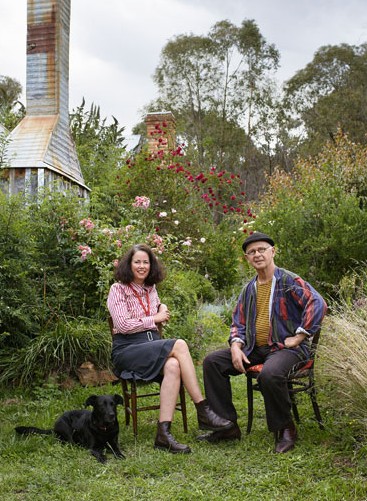
ARTISTS' END Genevieve Carroll and Bill Moseley of Hill End Press (Photo: Martyn Thompson, Vogue Living).
ARTISTS’ HILL Genevieve Carroll and Bill Moseley of Hill End Press.

A Writer’s encounter with Artists in residence.

ONE of the most enjoyable interviews I’ve ever done involved a journey to Hill End, hub of the NSW Gold Rush, to meet a pair of artists who’d taken on an unwanted printing press and set up their own print floor.

Bill and Genevieve are a creative powerhouse, artists each in their own right and in collaboration. Their responses to the textures, cultural heritage and ‘feel’ of Hill End rank amongst the finest in the Hill End Artists in Residence program, because they not only ‘do’ art in Hill End, they live it.

Their devotion to an old printing press, furthering the distribution of the written word, makes these two honorary writers in my book.

This article was published in Blue Mountains Life magazine in October-November 2010.

Artist’s print

Bill Moseley and Genevieve Carroll on the ‘unlimited addition’ to their Hill End studio.

On the day Julia Gillard became Australia’s first female Prime Minister, I drove to Hill End, catching radio reports on the leadership change at various high points across the ranges, further from the reach of mass media with every bend in the road. It struck me that I might have an old-fashioned ‘scoop’ on my hands for Hill End.

I was indeed the one to break the news to Genevieve Carroll and Bill Moseley of Hill End Press, an arts destination which very recently acquired that vintage tool of the print media – a letterpress printer.

Art and artists have been the staple industry in Hill End for long enough to rival the town’s first boom: gold.

Bill and Genevieve have lived and worked here for the past six years, exploring a variety of media, which, as is the case with many artists, is hard to define. It’s obvious after only minutes that their art extends from photography and textiles through to making great coffee and cakes in a building which is at once a studio and a cafe.

Genevieve is a mixed-media practitioner whose work in textiles, painting, drawing and sculpture touch on the theatrical at every turn. Hers is an exploration of how texture, design and form dominate the fabric and tools of our entire lives.

She generously shows me a large textile work (in preparation for a Bathurst Regional Art Gallery Exhibition in 2011) laying like a map of fields on her work bench, golds and yellows achieved through her own dyeing process. “This will just keep growing until it’s as large as the wall behind me,” she says.

Bill’s black and white photographs grace the entire wall of another work room – surreal, often comic studies whose subjects range from unsettling horror to mesmerising beauty. Many are created using a pinhole camera, a time-consuming process requiring exposures of 45-minutes instead of a split second, a medium which will be employed in his own 2011 show at BRAG. In addition, he’s a shipwright, a training-ground which, “equipped me for life,” Bill says.

“Bill’s also our master printer,” Genevieve adds, leading us into the printing room inside a classic Hill End shopfront which once belonged to Bernard Holtermann, the man who discovered the world’s largest gold nugget nearby in 1872.

The room has an immediate feeling of industry – shelves of ink and trays of movable type dominate a work bench surrounded by a variety of printing presses.

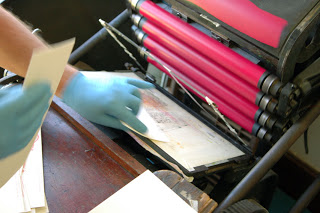
FAST HANDS An operational platen printing press makes like work of print runs.
FAST HANDS: An operational platen printing press makes light work of print runs.

Genevieve and Bill are largely self-taught printers. “We’re very low tech,” Genevieve confirms. “You can’t learn to use a letterpress anymore, even at TAFE, mainly due to OHS concerns,” Bill adds, “but we’ve learnt a lot from other letterpress printers online.”

In the corner by the door is Bill and Genevieve’s Gordon Platen Press. Like a larger-than-life treadle sewing-machine it has the mechanical brilliance of an era long-gone, the kind of machinery transported in pieces to remote areas during the industrial revolution.

When no-one else wanted it, Bill and Genevieve were given this press by an auction house in Waterloo and transported it to Hill End in a box trailer. “It once belonged to Clement Meadmore,” Genevieve says. When I suggest the artist known for his large-scale metal work owned a printing press because it had a sculptural quality regardless of its use, Genevieve says: “that’s why we thought we’d accept it. We had no idea we’d eventually know how to use it,” she says, laughing.

“There would have been one of these presses in every town. In the old papers you see plenty of advertisements for ‘letter press feeders’,” Bill explains.

“They’d have to be someone very quick with their hands,” Genevieve adds. “My job is to stand in the background when Bill’s printing and say: ‘hand out, hand out’ at the right time. There’s an old saying about printers ‘coming-a-cropper’ which was to do with getting their hands caught in the presses.”

We choose some brightly coloured rubber ink and set about printing Hill End Press business cards. Bill uses a spatula to scrape a line of ink onto the large circular plate, and pumps the pedal to get the rollers spreading it evenly. The sound is a well-oiled melody akin to the pistons of a steam train. En masse on an old printing floor it must have been deafening.

Beautiful Italian ‘Fabriano’ stock made from 100 percent cotton is loaded and pressed against the inked ‘platen’. After only a moment Bill retrieves our first print, saying, “Gutenberg would have known how to use this,” of the man who invented the printing press in the 15th Century.

The impression on the paper is firm and sharp, and the satisfactory first sample is left on broad wire drying racks to the side. Achieved with little more speed than placing an original on a photocopier and pressing a button, the finished product has a three-dimensional quality which no photocopier seems capable of producing. “You can do a print run of 100 in a pretty quick time,” Bill adds.

MOVEABLE TYPE A plate of type prepared for print.
MOVEABLE TYPE: A plate of type prepared for print.

“There were pieces missing when we got it which you can’t buy anymore,” Bill outlines, “and certain tools which we needed to either make or have made, like the roller gauge which you use to ensure the rollers are at the right type-height. Without that you get furry or streaky print quality”.

“We had help from skilled friends to complete the press, but we also had to be quite self-sufficient, to persist and find ways to make it work. It took about 8 or 9 months to get it to print,” Bill adds.

Graduates of the National Art School, “we had an art-school romance”, Genevieve says of the life partnership which was a result of their meeting. Their individual art practices are startlingly different, but what they now have in common is the press.

“We’re inspired by Leonard and Virginia Woolf,” Genevieve relates. “They set up their own publishing house – Hogarth Press – and would have had a very similar press to ours. It gave them the ability to print and publish their own work, and that of others, and that’s what we want to do,” she explains.

PRESSED FOR TIME The Hill End Press rabbit is a recurring symbol of the place.
PRESSED FOR TIME: The Hill End Press rabbit is a recurring symbol of the place.

Hill End Press’ first venture into publishing has seen them create a range of gift cards which are available from Bathurst Regional Gallery and a number of Sydney outlets.

The cafe is open “whenever we’re here” Genevieve laughs. It’s the opposite of a cafe with art on the walls – the walls are art, and every inch is filled with expression.

Genevieve’s suspended papier-mâché creations get mistaken for gold nuggets, “they are wattle” she explains of the ‘clouds’.

When Holtermann got rich from his gold nugget, he poured his time and money into a unique photographic record of the goldfields of his day. That a building associated with him continues to thrive as a destination replete with art, photography and now printmaking seems quite apt.

And the Hill End Press symbol of the rabbit above the door? “That’s easy to answer” Bill says, smiling, “they’re like us and our press – all about mass reproduction.”

© Michael Burge, all rights reserved.

Writing my way into my relationship

RAINBOW COURT Same-sex attracted people are exponentially earning our human rights, be warned!
RAINBOW JUSTICE Same-sex attracted people are exponentially learning our human rights, be warned!

A Writer’s first affidavit.

ONE of the most challenging and important pieces or writing I ever executed was the affidavit I wrote for the Supreme Court of New South Wales in application for the estate of my late partner, Jono.

Sitting across the desk from my solicitor, she tasked me with this ‘commission’ using some weighty words of her own, because an affidavit, particularly one relating to your deceased spouse, is not something to get wrong.

“You must relate the incidents of your relationship as though people are listening to it, with quote marks, and everything,” she explained, “and you can’t use his name, you must write ‘the deceased said this, and did this …’.”

It sounded like a scene from a script. In the midst of those dark days, compounded not only by my grief after losing Jono, but also by his family’s denial of the existence of our relationship, writing was something I knew how to do.

I’d been writing dialogue for years, and here was a story with a beginning, middle, and, sadly, an end which nobody saw coming.

My motivation was a simple one. Primal, in a way.

I’d been duped. I’d trusted bad people. In the midst of my shock, Jono’s mother and brother had bullied the funeral director into removing my name and any reference to our relationship from his death certificate. They did it in secret. They did it at a time I would least suspect them, and they remained unmoved by my entreaties to undo what they had done.

I won’t go into the reasons they did what they did, that is for another piece of writing at another time. Suffice to say they did everything in their power to prevent the creation of any official document which linked their son/brother to me, and that it was, as is so often the case, for financial reasons. Laced with the pervading stench of homophobia, the treatment became a rare mix reserved for only a few of the widowed left vulnerable by lax laws and outmoded thinking.

Whatever their motivations, it was the shittiest, lowest, most devastating action anyone has taken against me. It hit me in my deepest places, and smarts to this day.

Faced with this denial, I wondered what exactly did they say Jono and I were to one another? The legal documents they’d falsified to deny my relationship with Jono carried weighty fines and/or jail time for false representation. What term could they get away with if pressed on the truth?

SPECIAL FRIENDS Comedy writers have made light of gay couples for decades.
SPECIAL FRIENDS Comedy writers have made light of closeted gay couples for decades.

‘Travelling companions’ is the definition comedy writers have placed into the mouths of homophobes for decades.

Yes, in times past, two men in love would have passed for ‘special friends’, but not me and Jono.

We were everything to one another apart from legally married, and the law did not (and still does not) extend to that. Everyone who loved us knew the strength of our commitment.

So, when I learnt to refer to Jono as my deceased spouse, I took our long-term relationship and all its episodes: fun, challenging, confronting and downright hilarious, and wrote it with as much fervour as I would a piece of drama, only I didn’t need to make anything up.

Using old diaries and our joint bank account, I managed to trace our relationship to its dawn. The words were easier to recall off the cuff than the dates, because it’s rather unforgettable when someone leans their head gently on your arm, looks you in the eye, and says: “I’m besotted with you.”

That night, at the alpine-style sunken lounge of Leura’s Fairmont Resort Bar in the winter of the year 2000, was memorable not just for our first kiss, but also the inebriated woman who was sitting near us, saying: “What a lovely couple you two are, awwww, you’re so well suited”. We laughed, because our relationship was just beginning, but it was a great affirmation for what was to come. This woman made it into my affidavit as an indicator of public knowledge of our relationship: one of the more than ten inescapable benchmarks when defining its existence legally.

TRAVELLING COMPANIONS? Yeah right, if you live on Planet Homophobe!

Over thirteen pages I recalled how we’d expressed our love and care for one another enough to move in together after two years.

I related our journey through running our own business after only a month together, and all its highs and lows, but also the way that our support for one another saw us blossom as creative individuals.

I also revealed our slightly embarrassing pet names for one another.

There was no happily ever after to the journey Jono and I took, only a surprise ending which no-one would have believed if I’d ever written it into a screenplay.

But my written work could not simply end with Jono’s sudden, unexplained collapse in the middle of a dance rehearsal, because it was an affidavit, not a screenplay.

I needed to add the disenfranchisement I was subjected to after his death. I needed to explain to the court that I had been kept from Jono’s death certificate, and it was with no small embarrassment that I had to explain why I was asking them to bend the rules and allow the presentation of a less legally binding death certificate extract: because his relatives were homophobic.

In time, my affidavit did everything I needed it to do legally. It was an indelible, detailed document which shone a glaring light on the omissions purposely rendered on the one piece of paper where the details really mattered when I needed them to the most.

“Why do you need a piece of paper to prove your love for one another?” same-sex attracted people who want the right to marry are pressured to explain, to justify our argument for equality.

Well, because thirteen pages (and almost 60 supporting documents) is a mammoth effort, unless you’re a writer, especially when you’re grieving, and you’re fighting insidious, invisible homophobia. One simple marriage certificate would be my choice, every time.

The Supreme Court has no choice but to uphold that, which is exactly what the homophobes are scared of, because it might be just a piece of paper, but a marriage certificate places a great obstacle in the way of prejudice.

© Michael Burge, all rights reserved.

Michael’s story is published as Questionable Deeds.