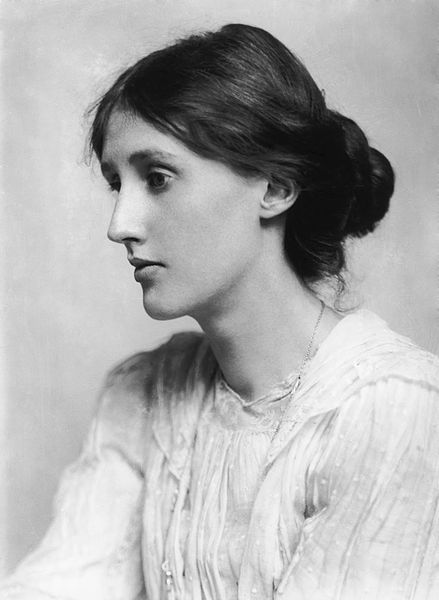
CRITICAL EYE Virginia Woolf (1882-1941) edited and published novels independently (Photo: George Charles Beresford).
ONCE I finish the first draft of a book, and I’ve left it alone for at least a month or two while spending time reminding myself what makes a great plot, there’s no more excuses: it’s time for me to read my own work for the first time.
I take great comfort and inspiration from writers like Virginia Woolf, who edited and published most of her idiosyncratic and enduring novels independently.
Embarking on the first edit of a manuscript could be seen as an insurmountable problem, or it could be seen as an inspiring fact-finding mission.
Read your manuscript like a reader would
I sit and read my work as though it was created by someone else. If I’m bored with the writing, I’ll acknowledge it, and find out why. This is crucial in the first twenty pages or so. If I’m engaged, I’ll analyse what sparked my interest.
Don’t over-read just yet
I’m going to be working on this manuscript for months to come, so I don’t want to get bored with it too soon. I’ll leave some of the alterations until another edit and just enjoy the fruits of my labour. I’ll also seek to understand the structure of my work before I decide anything needs fundamental alteration.
Keep tabs on your characters
Have I been consistent? Did I just use inserted names, like “A Policeman” when I didn’t want to upset my writing flow by looking-up the name I’d given this character earlier in the book? Have my characters evolved across my first draft so that certain things need to be altered? I jot these issues down in another place for addressing later, or adjust them as I read through.
How is the plotting?
This is the big one at this early stage. Usually, I’m afraid to embark on my first edit because I am worried I may have either stuck too closely to ‘the rules’ or lost touch with them altogether. What I am looking for is whether I’ve got a decent exposition that will benefit from some cutting down the track, several serviceable and intriguing rising actions, a great climax, and a battle between my protagonist and antagonist. I also looking to see if I’ve bent the plotting ‘rules’ in ways that stand to make my work different to others.
Rewrite when it’s easy to do so
I resist getting bogged down in major structural changes – I don’t know my work well enough yet to make those kinds of calls. However, when something quick and obvious comes up, such as a small set of paragraphs that can successfully bridge a missing plot point, I just write them in and will polish during another draft.
Check the blows are landing
When things happen to my characters, do they express the impact to other characters, or to me, the reader? This is a big one for scriptwriting especially. The blows must land, be felt, and registered, otherwise it’s like nothing’s really happening.
The final act is the hardest to get right
Just about every piece of writing advice I have come across maintains that most writers can write great set-ups and climaxes, but our plotting often falls over in the third act. I recognise this and will always read my dénouement anyway, right through, before I decide if I’ve got it wrong.
Practice good housekeeping
I never delete original work, or rewrite over my original computer files. Sometimes things need only be moved, not cut. Design yourself a filing system for all your subsequent drafts, archive them, and back them up onto a memory stick. I’ve done this ever since I wrote an entire film script and accidentally deleted the only copy!
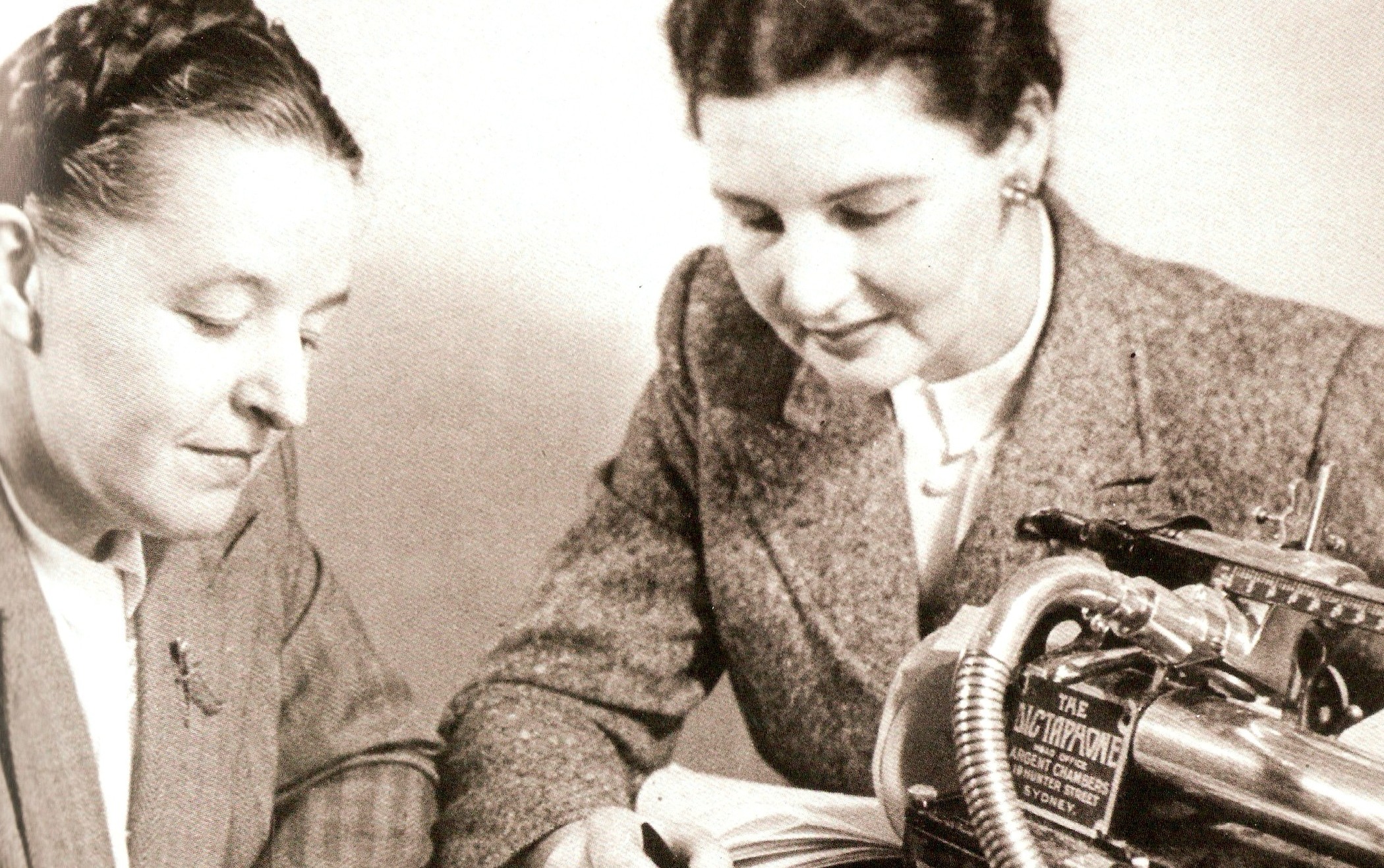
YARN SPINNERS Dymphna Cusack and Florence James, working at Dymphna’s dictaphone (Photo: University of Melbourne Archives).
A Writer has another look at an Australian classic.
LITERARY analysis of the Blue Mountains in NSW tends to focus, perhaps a little too much, on the works of Eleanor Dark and Norman Lindsay, the enduring foundation for writers which bears her name, and the iconic gallery featuring his.
Other writers’ works also emerged from the cool climate heights of the region, in fact one of Australia’s most popular and enduring novels was written in the tiny town of Hazelbrook, in a home which never became a writers’ retreat.
The story behind its creation is the story of two women, their daughters and niece, who escaped the wartime city in order to live and write, and in doing so, created a literary milestone…
This article was published in the June-July 2011 edition of Blue Mountains Life.
Come Home Spinner
The Hazelbrook tenants who created Australian Chick Lit.
In the aftermath of the Japanese attack on Sydney Harbour in May-June of 1942, Sydneysiders woke-up to the reality of imminent attack, and many headed for the Blue Mountains to ‘see out’ the war.
With two generations of men fighting in Europe, job opportunities for women were on the increase, and the city was flooded with American troops. Right in the thick of this changing world, two writers — Dymphna Cusack (1902-1981) and Florence James (1902-1993) — rekindled the friendship they’d started as undergraduates at Sydney University in the 1920s.
Florence had been ‘caught by the war’ in Sydney with daughters Julie and Frances while on a visit from London, and Dymphna was living with her sister and family at Coogee. In spring, 1944, the women hatched an escape plan of their own: to write full-time in the sleepy Blue Mountains village of Hazelbook.
Dymphna had retired early from teaching, suffering with multiple sclerosis. Florence needed a place to live while her husband Pym served in Europe. Combining Cusack’s small pension and periodic literary grants with Florence’s ‘allotment’ from Pym, in January, 1945, the families moved to ‘Pinegrove’ on the south side of Hazelbrook.
In this unassuming fibro cottage with views to the Sydney basin, James’ and Cusack’s ruminations on literature and social justice gave birth to the first international bestseller to present contemporary Australian women to the world.
They started with a children’s book — Four Winds and a Family — created in autumn, 1945.
An allegorical telling of the adventurous episodes of the Pinegrove residents, complete with writers Tess and Topsy (Florence and Dymphna), and youngsters Fan (Frances), Jay (Julie) and Dee (Dymphna’s neice, also called Dymphna), and various cats, goats and other animals, the book maps their ever-growing world of friendly neighbours and unfriendly school teachers.
FAMILY PICTURES Nan Knowles’ illustrations show an allegorised Florence and Dymphna.
They commissioned Nan Knowles to illustrate and sent the manuscript to a publisher the same year. Knowles’ work included a naive map (eventually the front endpaper) illustrating the part-real part-fantasy realm of Four Winds. It’s an enduring symbol of the secure world mother and aunt sought for daughters and niece at Pinegrove.
Emboldened by their success in juvenile fiction, Florence and Dymphna soon embarked on their magnum opus, the book they’d been talking into existence ever since leaving the city: Come in Spinner.
“We picked everyone’s brains,” Florence recalled when interviewed by Marilla North (editor of Yarn Spinners – A Story in Letters the letters of Dymphna Cusack, Florence James and Miles Franklin).
“Everyone” included local cleaning help Mrs Catherine Elliot (who regaled the authors about the realities of working as a barmaid in the inner city); and Blue Mountains Mayor Tom Walford (who explained the rules of popular gambling game ‘Two-Up’ in which ‘Come in Spinner’ is the call ending all bets before two pennies are spun).
Through the author’s letters, Marilla North was able to pinpoint the exact day that work on Come in Spinner began at Hazelbrook – Monday July 30, 1945, only a fortnight before the end of the Pacific War.
“Addressing issues like abortion, rape and prostitution, Cusack and James’ second collaboration placed female protagonists in the real world.”
“It took us two-and-a-half years to write,” Florence explained, “we didn’t write by each exclusively developing one character’s story. If one of us had an inspiration about it then she’d do that bit of the writing. Then everything had to be interwoven”.
“We worked five days a week when the kids were at school. At the weekends we had friends up and kept in touch with what was going on in Sydney. We went down there occasionally and very reluctantly…” Florence said.
In order to write without causing pain to her hands, Dymphna made use of a dictaphone she nick-named ‘Delphi’ (probably a reference to the Delphic Oracle in ancient Greece into which prayers were whispered). Tom Walford arranged for local typist Joan Gray to produce manuscripts from Cusack’s reels.
The story of a trio of resident beauticians at the fictitious Marie Antoinette salon of the Hotel South Pacific, Come in Spinner explores their lives and relationships against a cross section of Sydney’s working and elite classes.
Seen objectively, beauticians Deb, Claire and Guinea are the natural evolution of the three girls in Four Winds and a Family, placed in a world much less secure, with no map to guide them save whatever moral compass their upbringing had given them.
Each of the women takes a journey through wartime Sydney, juxtaposed against the innocence that came before shortages and the black market, and a new world of gaining an advantage by any means.
In Four Winds and a Family the breeze is never strong enough to blow the girls into too much trouble, whereas Come in Spinner suggests life’s fortunes can be decided in a gamble. Addressing issues like abortion, rape and prostitution, Cusack’s and James’ second collaboration placed female protagonists in the real world, making it hot property even before publication.
Entered anonymously into TheDaily Telegraph’s novel prize of 1946, the families remained at Pinegrove while the authors edited their manuscript. In 1947, the cottage was sold, meaning eviction by June, even as editing continued.
Florence and her daughters sailed for England to be with Pym. A separation of almost a decade (apart from occasional leave visits) saw the marriage unable to survive the reunion. Dymphna moved back to Sydney and continued work on other novels, sailing for Europe herself in 1949.
HOME SPUN First edition cover (1951).
Come in Spinner eventually won The Daily Telegraph award but was never granted the promised publication, considered too controversial for Australian release. The authors were awarded the thousand-pound prize, but had to extricate their work from the newspaper for Florence to offer it to publishers in the United Kingdom.
The William Heinemann company published Come in Spinner in 1951. It proved an instant international bestseller after a series of rave reviews in the United Kingdom and has never been out of print.
With its cast of female protagonists, and its omission from most literary criticism (despite an enduring popularity), the novel ranks amongst the first true examples of Chick Lit in the world.
In deference to regular Pinegrove visitor and the author of My Brilliant Career, Come in Spinner was dedicated to the woman whom Dymphna Cusack described as the godmother of the collaboration – Miles Franklin (1879-1954).
The drawn-out publication and success of Come in Spinner has tended to overshadow the other works which came out of Pinegrove. Two other novels by Dymphna Cusack (Say No to Death, exploring the affliction of tuberculosis, researched in part at Bodington TB sanatorium in Wentworth Falls where one of Dymphna’s friends was a patient; and Southern Steel, set in the industrial city of Newcastle) were substantially written while at Hazelbrook.
Another collaboration of sorts was Caddie – the story of a Barmaid written by the woman who came once a week for laundry and chat – Catherine Elliot. It was Dymphna and Florence who suggested to Elliot that she write her memoir in her own ‘voice’. Dymphna edited the manuscript, assisted Elliot in finding a publisher, and wrote the forward for the novel which became a classic and a popular movie in 1976.
In her capacity as an editor and literary agent, Florence James encouraged two further generations of female Australian authors, including Mary Durack and Nancy Phelan.
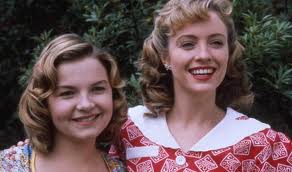
Justine Clarke and Rebecca Gibney in the ABC’s production of Come in Spinner (1989).
Come in Spinner was adapted as a mini series by the ABC in 1989. Times had changed enough for an unabridged version of the novel to be published in Australia by Angus and Robertson.
Dymphna had died in 1981, after spending three decades travelling and writing, mainly abroad, which meant Florence was tasked with editing controversial sections of the collaborative work which were removed before publication in the 1950s.
Pinegrove still stands at Hazelbrook, although its original acre is somewhat diminished by development and many of its pines are gone. It was renamed ‘Four Winds’ after becoming the home of Sheryl and Geoff Smith three decades ago.
There are traces of the literary hotbed the home was in the 1940s – the wall where Florence and Dymphna pinned-up a plan of the plot, characters and eight-day storyline of Come in Spinner is still there, off the sizeable living room which attracted the women to the house for their growing girls. The same room inspired Geoff and Sheryl to buy the house on first inspection.
The autumn weekday afternoon of my visit comes with an almost complete silence which must have been a godsend for a pair of writers, nestled as the place is away from the highway and railway.
Sheryl shares with me a copy of Four Winds and a Family given to her son by Florence James herself, who revisited the home for the making of a documentary not long before her death. On the fly leaf, a dedication reads: “A happy life at ‘Pinegrove’ – where Dee, Jay and Fan used to live – also did Tess – Florence James.”
“Why oh why did we leave Pinegrove?” Dymphna wrote to Florence, on the brink of an international career which took off in a cottage in Hazelbrook. It is not known if she ever returned.
Extracts from Yarn Spinners – A Story in Letters edited by Marilla North (published with the permission of University of Queensland Press). Now available in a collector’s edition.
I LOST my eldest dog at the weekend. Olive was my constant companion for fifteen years.
Without her, our household is a little lost. It’s because we live as a pack, and one of us is missing, buried in the corner of the backyard, a tree where once the old lady made her daily wobbly journeys following the patches of sun across the grass.
Tully, our other dog, has that questioning look. Richard’s home from work early with hay fever that won’t budge. I’m just floating along in denial, glad of any distraction.
On the day Olive died, I was drawn to my bookshelf in search of my old copy of Richard Adams’ Watership Down (1972). I was of the generation who loved not only the book, but also the animated film of this tale of the survival of a warren of rabbits in the English countryside.
Long before I came to understand its Holocaust metaphors, I also suspect this book coloured some of my views of animals, and mortality.
An expatriate farm boy, I became a vegetarian at the age of 15. I knew exactly how animal products were manufactured from a very young age, but I wanted to remove myself from a marketplace which still widely rests on the suffering of animals.
Because I could see plainly that animals are, like us, sentient beings. Our dairy cow would come to our call, but she would flinch at barbed wire. The retired sheepdogs were our companions, but I remember the cries as Gertie gave birth to her pups. Feral kittens in the shearing shed were fun to play with, but their confusion as they were killed-off by ticks still haunts me a little.
Naively, I thought my stand against suffering would be seen as courageous, but coming out as a non-meat-eater in my teens was an eye-opener.
In my religious school environment I endured lectures from adults about how uncivilised humans would be unless we’d eaten meat. Any respect for an animal’s welfare was perceived as weak. They were simply a soulless commodity.
But my history classes suggested civilisation as we know it did not come about until humans ceased wandering and began farming grains in one place. Archaeology showed animals were revered and even worshipped, imbued with souls no less capable of transitioning into an afterlife as humans.
Dogs were an integral part of those early communities, drawn to the fireside by offers of scraps, providing protection from invaders in return.
My resolve was sharpened: I quietly underlined that eating animal flesh, and animal suffering, do not have to go hand-in-hand.
Once we start down a pathway to animal suffering, the next step is inevitably the suffering of humans. The Nazis were inspired to herd people into train carriages for transportation to concentration camps by the same practice being used on livestock. That’s what makes Watership Down so believable, and not merely a story for children about rabbits.
LIVE TRANSPORT Interior of a boxcar used to transport people in World War Two (Photo: US Holocaust Memorial).
I find little solace in religion. Christianity offers many allusions to animals, often symbolic – the wolf laying down with the lamb, and, from the book of Matthew, references to God’s care of even the smallest sparrow.
I love gospel music, and “His Eye is on the Sparrow” (1905) is a favourite, but buried in the lines is an exhortation to think ourselves more than animals.
So I return to literature. Alice Sebold’s revelatory portrayal of the afterlife in The Lovely Bones (2002) contains a passage in which Susie, the main character, sights the family dog:
“At evensong one night, while Holly played her sax and Mrs. Bethel Utemeyer joined in, I saw him: Holiday, racing past a fluffy white Samoyed. He had lived to a ripe old age on Earth and slept under my father’s feet after my mother left, never wanting to let him out of his sight … I waited for him to sniff me out, anxious to know if here, on the other side, I would still be the little girl he has slept beside. I did not have to wait long: he was so happy to see me, he knocked me down.”
“Having experienced the unconditional love of a dog, I strongly suspect that the songs need rewriting.”
Knowing what was coming as Olive aged, I called her The Lovely Bones, whispering it into her ear as I carried her increasingly skeletal form up the back stairs in the dark after her dinner. She never gave up trying to climb them herself – such was the courage she showed in her desire to sit with us in the evening.
Olive protected us well, in the unseen territory of the heart. I can offer no proof that dogs have evolved after millennia of living with humans, apart from the love they show through their actions.
I remember the very moment she transitioned from puppy to watch-dog; the love she taught a flatmate who needed herding back to the hearth; the solace and constancy she showed me after my partner Jono died, and the courageous way she demanded I snap out of it when my grief saw her and Tully so neglected they both had fleas, ear-mites and knotted coats that needed my attention.
Faced with having to help her in her ultimate transition, my memories of the death of Richard Adam’s lapine protagonist, Hazel, were already in my fibre.
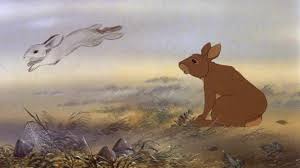
HAZEL’S JOURNEY from Watership Down (1978).
So, I’ll admit it, I called on souls already departed to come, like the Stranger did for Hazel in Watership Down.
“It seemed to Hazel that he would not be needing his body any more, so he left it lying on the edge of the ditch … (the Stranger) reached the top of the bank in a single, powerful leap. Hazel followed, and together they slipped away …”
Having experienced the unconditional love of a dog, I strongly suspect that the songs need rewriting: his eye is not on the sparrow, the sparrow’s eye is on him.

 I never delete original work, or rewrite over my original computer files. Sometimes things need only be moved, not cut. Design yourself a filing system for all your subsequent drafts, archive them, and back them up onto a memory stick. I’ve done this ever since I wrote an entire film script and accidentally deleted the only copy!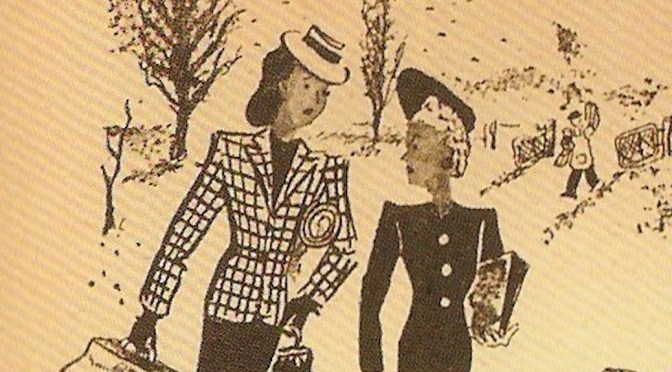





 Michael Burge Media