
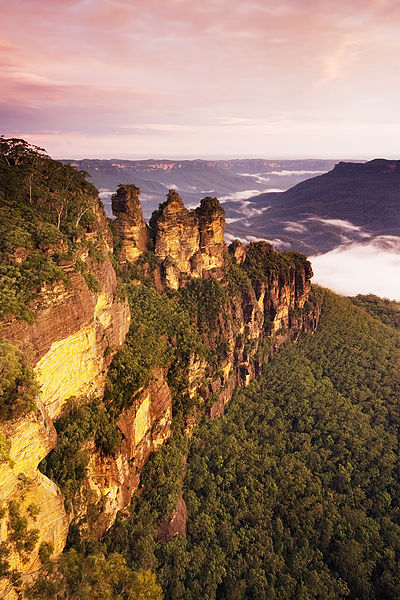
A short look at a tall story
WHEN I arrived back in Australia after living in the UK for most of the 1990s, I was attracted back to the region where I did most of my growing up – The Blue Mountains, a World Heritage wilderness only 100 kilometres west of Sydney.
I eventually settled there and fell in love with the place all over again, embarking on a research and writing cycle that would continue for the next twelve years.
This all began with the news that the region’s ‘original’ story, the so-called ‘Legend of the Three Sisters‘, which had been taught to generations of Australian children as a genuine Aboriginal myth (and sold to millions of international tourists), had in fact been made up by a non-Aboriginal man.
I was eventually given the opportunity to publish a feature article on this subject in the December-January 2011 edition of Blue Mountains Life Magazine (Vintage Press).
Aboriginal and Torres Strait Islander readers are warned that the following article contains images and references to deceased persons.
Legends, Interrupted
How the Aboriginal legend of the Three Sisters trumped a tall story
Across the Mountains of the late 1970s wonders were common – a witch’s shadowy profile cast across rocks, colourful mountains devil ornaments, and a train ride straight down a cliff. My young imagination also lapped up a legend told on postcards, tea towels, a fountain, and an illustrated book.
The legend told of three Aboriginal sisters who disturbed a bunyip in the valley and were saved by their father who turned them into stone using a magic bone. He transformed himself into a lyrebird to escape, but in doing so lost the bone, leaving him to search the undergrowth (as lyrebirds do) so that one day he might find it and turn them all back into human form.
This story held more intrigue for me than explorer’s achievements, which were taught with a sense of pride at school. But there was a silence on local Aboriginal heritage, and I grew to assume there was little to know about the tribe in the Three Sisters legend.
Fifteen years later I attended a reconciliation meeting and met Gundungurra and Darug people mobilising to work on Native Title claims. Around that time a story hit the local media that the Aboriginal legend of the three sisters was created by a non-Aboriginal man. In the fallout, even that claim turned-out to be untrue – the first fake was actually written by a caucasian schoolgirl with a rather apt surname – Patricia Stone.

“None of that was a revelation to Gundungurra people around here,” Gundungurra Elder Sharyn Halls says at Echo Point this year. “We always knew what the tourists were told was a made-up story. Many of us thought it was quite funny what visitors were willing to believe.”
The day is just dawning and already flocks of tourists are arriving to take in the panoramic view which is one of the Blue Mountains’ biggest drawcards.
“My father Lenny McNally used to stand me and my siblings here and tell us the stories about the land all around,” Sharyn says, sweeping her arms from east to west. “The story of this place is much, much more than the Three Sisters, from here you can see all the waterways and pathways of our traditional land.”
Sharyn grew up in Bankstown, but spent weekends and holidays in the Blue Mountains. “We’d go camping out to the Megalong Valley with Dad and our immediate and extended families. After a while we realised we were only being taken to places that were important, we were being shown our country. During those trips I learnt how to catch and gather food, and other skills to do with family life, from my Nana Lindsay.

“Dad liked to travel, to the Southern Highlands and out to Jenolan. He was a jockey and he’d round-up the wild brumbies from the valleys. In the Megalong he’d break them in, then muster them into Camden for sale.
“He knew the best way to get there through the mountains – he’d been taken out there with the old men who still spoke traditionally, and they knew the routes between all these places. But Dad wasn’t taught his language, only bits and pieces. Unfortunately he and his generation had to change to survive.”
Survival for Gundungurra people meant making difficult decisions when forced to leave their country.
“People ended up in Katoomba in a place they already knew and used called The Gully,” Sharyn relates. “They made a conscious decision to come, because there were resources here, and they could avoid the mission system. If you ended up in a mission you were only encouraged to settle down. The movement of Aboriginal people was restricted right into the 20th century.”
Gundungurra man Ron Fletcher recalls: “Our family lived for two periods in The Gully in about 1940 and 1949. Everyone got on really well down there because we were all battlers”.
“Our Aunty May and Uncle George Hannah, and Uncle Jack Brooks were still living in The Gully when they built the Catalina Racetrack,” Ron recalls of devastating events in 1957, when Gully residents’ homes and community were demolished to make way for a commercial racing development.
“It wasn’t until 1988, when they put up a memorial at the old Megalong cemetery, that my sister Dawn was reminded that our great grandparents were buried down there. That got her curious about our Aboriginal heritage. Dawn was never a backwards kind of person,” Ron smiles. “She felt very strongly about that side of her, and many people with Aboriginal blood were starting to take notice of how things were changing.”
Dawn Colless (1932-2003) became ‘Aunty Dawn’, elder of the Katoomba Clan of the Gundungurra at a time when local indigenous people began reclaiming their place in the Blue Mountains. One point of focus was The Gully, where the Catalina racetrack had long since fallen into disrepair.
An excellent speaker heard by many giving Welcomes to Country, Aunty Dawn told anyone who would listen about the significance of Gundungurra places and sacred sites. She was also the keeper of a secret she’d been entrusted with as a girl by her mother and grandmother – a legend about the Three Sisters.
“Our Aboriginal family had to be very careful when telling us about the old ways – they were frightened we would be taken away,” Dawn’s brother recalls. “I can remember the inspectors coming to our house twice,” Ron smiles, “I think when they saw we all looked well-fed, that we were being looked after”.
“Not many people realised how ill Dawn was in her last years,” Ron remembers. “She was determined to do what she could in the time she had left. Not long before she died, she agreed to meet some visiting indigenous women. They told her the Three Sisters were linked to the Seven Sisters, and a sacred site as important as Uluru.”
In 2002 Dawn told what she knew of the legend of her mothers to the Gundungurra Native Title hearing. Local authorities began to consult with Gundungurra people about public versions of the legend of the Three Sisters. The Gully, or ‘Garguree’, was proclaimed an Aboriginal place in the same year.
Sharyn Halls is adamant that: “It’s about time the traditional people of The Blue Mountains take a leading role in tourism here, to get out there and understand their country, to be independent, not reliant.”
“So much information about our stories has been lost because we didn’t really have anyone to ask,” Ron says. “We are the last to remember our Aboriginal side. It was always in me, but I was very reluctant at first. Dawn was so passionate about Aboriginal affairs that she inspired me.

“Sometime I go to The Gully to interpret it for visitors as part of the Reconnecting to Country project, with some of the other Gully elders. I’ve been on trips down to the Burragorang, and it makes you feel strong, and you feel they’re walking with you, your family who have been there long before you.”
Today, many tourist destinations in the Blue Mountains assiduously avoid interpreting the Three Sister story at all, but a public version of the Gundungurra legend is available. What’s interesting to note is the inclusion of Patricia Stone’s names for the sister – Gunnedoo, Wimlah and Meenhi – the result of a variety of spellings over the years.
“Because of what happened to Gundungurra people, the continuity of our stories was broken. Our stories were diluted with other stories. The structure is there, but it’s in a different form,” Sharyn Halls outlines. “The important thing is that you don’t interpret someone else’s story on their behalf, you only tell your own. Patricia Stone’s story is one version, many people don’t really care it got told so much”.
“The legend of the Three Sisters is just basic practical education for youngsters not to stray from the safety of their home. It’s a thread that runs through all the versions I know of,” Sharyn explains. “Some of the names are a bit strange,” she laughs, “but nevertheless people have used them. I believe one hundred percent that’s what the legend is.”
© Michael Burge, all rights reserved.
Secret Means Business

Milestones in the commercialisation of the fake Aboriginal Legend of the Three Sisters.
1931 The Sydney Morning Herald publishes ‘The Three Sisters’ by Patricia Stone (who visited Katoomba c.1925). The names ‘Wimalah’, ‘Meeni’ and ‘Gunedoo’ first appear in print. The sisters are giants turned to stone by Yooma (a tribal wizard) to protect them from a neighbouring tribe during a battle.
1949 Outdoors and Fishing Magazine publishes ‘Legends of the Mountains’ by naturalist Charles Melbourne (‘Mel’) Ward (1903-1966), who moved to the Mountains in 1943. Patricia Stone’s version is used uncredited in reworded form, including her names for the sisters.

1950’s Mel Ward distributes Legends of the Mountains from his museum in the grounds of the Hydro Majestic hotel in Medlow Bath, claiming to have been told the legend by Aboriginal people.
1967 Bondi Mermaid sculptor Lyall Randolph’s Three Sisters fountain is installed at The Scenic Railway, telling a variation of Stone’s legend with coin-operated narration punctuated by water spouts. The money is donated to charity.
1972 Golden Books publishes The Legend of the Three Sisters by Victor Barnes, a new illustrated version of the transformation of the three sisters into stone by their father to save them from a bunyip.
1997 The Blue Mountains Gazette published ‘The Three Sisters story Untrue?’ in which linguist Charles Illert proposes: “The story behind Katoomba’s Three Sisters may be a myth created by white men with large imaginations.”
2000s A new (as yet incomplete) sculpture by Terrance Plowright replaces Lyall Randolph’s at Scenic World (formerly The Scenic Railway) in Katoomba.
2013 Various non-Aboriginal versions of The Three Sisters legend still disseminated in written form to Blue Mountains tourists.

2014 During the 10-minute visit of the Duke and Duchess of Cambridge to Echo Point, local business identities Randall Walker (interim CEO of Blue Mountains Lithgow and Oberon Tourism) and Anthea Hammon (joint managing director of Scenic World) interpret the Jamison Valley for the royal couple.
Gundungurra and Darug elders and tourism representatives meet the Duke and Duchess but are not visibly seen to interpret their traditional lands for the visitors.

(Source and further reading: ‘Aboriginal Legends of the Blue Mountains’ by Jim Smith, Den Fenella Press, 2003).
This article appears in Michael’s eBook Creating Waves: Critical takes on culture and politics.



 Michael Burge Media