
Category Archives: My Story

Drama School Dream Factory – Act 3

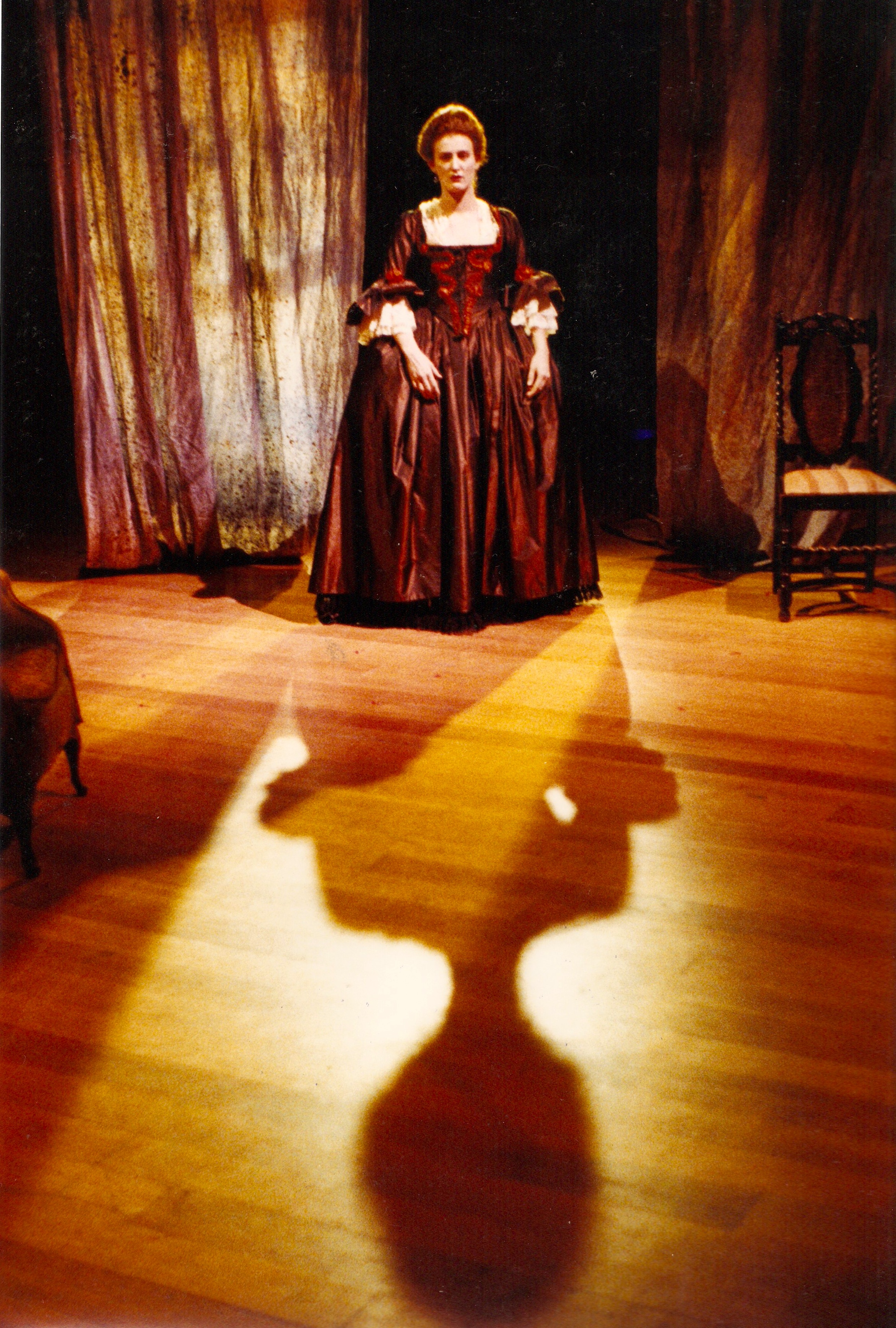
LESS IS MORE Jennifer Kent in Lindy Davies’ production of ‘Miss Sarah Sampson’ (Photograph by Marco Bok).

A Writer’s first lesson in the odds.

Theory was left swiftly behind during my third year at NIDA, and we were on show in a series of productions, the budgets for which were so high I have never worked on any theatre so richly supported since.

I got to work with a great director – Lindy Davies – on a production of Gotthold Lessing’s Miss Sara Sampson, a story akin to Dangerous Liaisons, and set in the same period.

Lindy encouraged me in a ‘less is more’ approach, and we co-created a very simple design which evoked the period through costume, but didn’t belt the audience over the head in terms of the set.

This was mainly achieved through the use of fabric, rope, and shadows, sketching a sense of the beams and walls of an English coastal town in the late 18th Century.

I will forever remember Lindy fondly for being the first person to break through my reserve, by demanding, assertively, yet with respect, that I not shut-down and internalise my thought process when we encountered an issue during the technical rehearsal.

It was a refreshing shock, prefacing the kind of collaborator I would eventually become. In some ways it was the greatest lesson I got at NIDA, and it took about 30 seconds to impart.

I was then designated the set design for Stephen Sondheim’s rarely-staged Merrily We Roll Along, with the late Tom Lingwood mentoring me through what was a massive undertaking.

Tom was originally from Britain, designer of the first production at the Sydney Opera House. One of the first things I ever learnt about him was how he survived the bombing of his home during The Blitz. When describing the worst moment of fear he’d ever experienced, Tom recalled having to leap an entire flight of steps in one go, bursting with adrenalin.

Not surprisingly, there was something very grounded about Tom. He championed my ideas, helped get my head around a massive list of scenes, and guided me in taking a positive approach to mopping up the mess made of our work after the director put his stamp on the show’s design.

Tom also responded when my mother started chemotherapy in the midst of that production, not with commiserations, but with action. He covered for me when I needed to get on the train and go home, by painting the entire theatre floor with a detailed texture for me, and saying I’d done it!

MORE IS MORE Poster from the original Broadway production of Stephen Sondheim’s complex musical.

In the end I didn’t hit the mark with this show, as a ‘less is more’ designer. I was criticised because the expected level of detail was not there. I suppose it takes passion to reach that level. It also takes emotional involvement, and probably a greater sense of security than I had at the time.

I caused frustration, because I was not open to creative whims at the ‘right’ time, or in the ‘right’ way. I just wanted to cover all the bases. If they wanted icing on the cake, they needed to look elsewhere.

But Tom was always an ally – he’d been in the trenches with me, after all.

My last NIDA production saw me tackling the design of costumes for Spring Awakening by Frank Wedekind, a truly wonderful play which I should have paid more attention to at the time, since it spoke of the kind of experiences I was going through in my life.

By that time I just hid myself away in the wardrobe department and just put it all together as best I could, counting down the days until I could leave and see to my family.

I also had my eyes on another option. I think working with Lindy was the catalyst – surely there was a way to be creative like her, but perhaps not in Australia? I was about to graduate as a designer, and that was all that was expected of me. The NIDA ‘brand’ was fairly limiting in that regard. Being only 21 I wanted to explore more options, so I looked to England, found a course at a place called ARTTS International, and applied for a scholarship to get myself over there.

Thinking about it now, I can’t believe I had my head together to make such a big plan at that time. Mum was getting sicker, and yet none of us were really talking about it. There may be a kind of ‘future instinct’ when the death of a loved-one is imminent, where you leap-frog, in your imagination, past the death and start creating a new life.

I was successful in getting into ARTTS, and secured a scholarship to get me there. I finished my NIDA course by working in the art department of a feature film as my secondment, and then went home. What I found was about as real as it gets.

NIDA graduate Jeremy Sims once described the Australian Theatre as a ‘cottage industry’, which I thought was very apt. It doesn’t disparage us, but it puts our industriousness into the correct commercial context.

At the time I was at NIDA, we must have been amongst the most funded students in the country, yet we graduated into a world in which the scope did not match the numbers of qualified workers, not by a very, very long shot.

Yes, they tell you that 99% of you will be out of work 99% of the time. Where, in a dream factory like NIDA, did they think they were going to find anyone to listen to odds like that?

© Michael Burge, all rights reserved.

Drama School Dream Factory – Act 2

HIGH STAKES DRAMA Thalia Theatre Hamburg’s production of Woyzeck.

A Writer’s first lesson in high stakes.

WHILE reading the paper one morning in a cafe during the summer break, I took-in a story about how the city’s best and brightest theatre professionals were being cut down by AIDS. One of the names was John, my NIDA design classmate.

I knew John sometimes struggled to keep up with the physical work, but I’d seen him only weeks before his death made the news, looking well, to all intents and purposes.

Back at NIDA, nobody seemed willing to talk about his death.

The start of my second year saw me in the most receptive space I was ever in while a student. We had a few weeks with industry designers Tom Lingwood and Kym Carpenter, workshopping designs for inspiring plays like Georg Büchner’s Woyzeck, and the Greek tragedy Oedipus.

I moved-in with other students, got myself a job at a local cafe (check out my day job in A Waiter’s Revenge Tragedy), and wasn’t such a slave to commuting as I’d been the previous year.

As a result of a little stability, my design skills began to flourish, and I found there was space to actually learn, from experts, how effective designs were executed. I felt stretched, challenged, and supported. Overcoming a few ‘mistakes’ was considered part of the learning process.

But design theory is one thing. Executing those designs on a living, breathing production is an entirely different process. The year’s idyllic start took a very different turn when the stakes started to get higher, and designers-in-training had to start proving our mettle.

As a direct result, a sense of competition began to creep its way into our classroom.

There were two schools of thought in our year. The first was heady, resisted limitations, aimed very, very high and was quite self-serving. The second was more rational, understood creative restrictions, was very grounded, but just a little puritanical.

I never saw myself as the champion of either of these energies, just a necessary participant in both. But battle lines had been set, and lasted until we all graduated, which actually we nearly didn’t, since every one of us was threatened with expulsion if we didn’t find a way to work together harmoniously.

Whether NIDA’s production schedule could have continued without an entire year of design students was dubious, but it was a timely real-world reminder to ‘keep the drama onstage’, as they say.

What was less clear (although this incident tells me it should have been startlingly obvious), was that the trainers at NIDA had a sharp eye on second year students in all disciplines, analysing who had the potential (in their view) to make good in a challenging industry, and who didn’t. The knives were out.

In the middle of this, my mother was having tests for some health problems. She laughed off the constant ambiguous results, was booked in for exploratory surgery, and on the afternoon her three children arrived simultaneously for a visit, she told us all she’d had a huge amount of cancer removed, with part of her bowel, one kidney and both ovaries.

GEEK’S TRAGEDY (L-R) Susan Prior, Annie Burbrook & Emily Russell in Rachel Landers’ production of Antigone, NIDA 1990 (Photo by Marco Bok).

The reality of this situation had no place in the ‘dream factory’ of NIDA. I think mum knew that – she was a keen supporter of the place, donating her original 1970s clothing to the wardrobe department for an Alan Ayckbourn play, and assisting me in scenic painting during an open day. She eschewed chemotherapy, and, as her children’s lives progressed in new directions, to all intents and purposes, nobody was sick.

But my attention was permanently split, from exactly half way through my course. When some of my classmates whined about their difficult personal lives, I wanted to shout at them to just get on with things … at least nobody had cancer.

I completed that year at NIDA designing a student director’s production of Antigone, Sophocles’ tale of a daughter for whom life’s stakes got very high indeed.

Hanging out at student parties, trying to find some way to fit in, still deeply closeted in a gay-friendly environment, I became the kind of person who got very angry if  anyone started to ask me the ‘wrong’ kind of questions.

The bad news about my family, and the stark realities about making a career in the theatre, had settled into my consciousness, just slightly beneath the surface.

Life was getting very ‘high stakes’, but the final act was yet to be played …

© Michael Burge, all rights reserved.

The dingo’s not a maybe

GUILTY VERDICT The disappearance of Azaria Chamberlain has at last been explained (Photo by The GirlsNY)

A Writer’s first lesson in injustice.

I HAVE been obsessed by the Azaria Chamberlain case since I was ten years old. When others in my family would cry ‘change the channel’, I wanted to follow the legal process which led to Michael and Lindy Chamberlain’s conviction in 1982.

It’s hard to get your way at that age, especially when you’re in the minority.

I was the only person I knew who believed the Chamberlains were innocent and was willing to say so. My great-uncle (a retired lawyer) was sure, based on the forensic evidence, that Azaria had not been taken by a dingo but had been killed by her mother. Not surprisingly, his influence was quite strong amongst our circle, and it swung other generally sensible adults over to the ‘Lindy is as guilty as hell’ way of thinking.

A collective energy against an individual has often been called a ‘witch hunt‘, and Australia willingly engaged in one.

I remember the T-shirts at the Sydney Royal Easter Show, the word ‘Azaria’ written in fake blood around the neck.

I remember the time a friend’s mother told me that I wouldn’t be welcome in their home unless I changed my mind and believed that Azaria was killed by her own mother.

I remember getting onto a plane in Sydney bound for Darwin in July 1985, as Michael Chamberlain boarded and bravely ignored the wall of hushed emotion from every single passenger as we craned our necks to stare at him.

I remember the vitriol leveled at Fred Schepisi and the filmmakers behind A Cry in the Dark for producing a movie which told the Chamberlain’s story based on eyewitnesses accounts of events on the night of August 17, 1980, at Ayer’s Rock.

I remember a scene in that movie, when Lindy Chamberlain (portrayed by Meryl Streep) shakily emptied her bottle sterliser as the family packed-up and went to a motel, since Azaria had not been found.

I remember how my mother shuddered next to me in the cinema, as it dawned on her (recalling her own experience of losing a child), that a baby had died that night.

I remember how seeing the accurate portrayal of eyewitness evidence changed her mind about the case.

I remember that one of her friends admonished her for being so easily swayed by something as ‘flimsy’ as a movie.

I remember reading Justice Morling’s 1988 Report, as he unravelled every single rumour about the Chamberlains, and thinking it should be essential reading for anyone who had an opinion about the family.

In 32 years I don’t remember anyone ever coming up with a credible explanation for why they believed Lindy Chamberlain would kill her baby.

I will always remember June 12, 2012, as the day Australia grew up a little, and became a slightly safer place because justice was finally granted to a family who only wanted a truthful explanation for their trauma. Safer not because the dingo had finally gone on record as a predator capable of hunting humans in the Northern Territory, but because our justice system upheld the accounts of eyewitnesses over forensic errors.

No piece of writing could ever rival the case of the taking of Azaria Chamberlain by a dingo. We have lived through events that, if told as a piece of fiction, would be written off as unbelievable.

But it happened. Truth is far stranger, as they say.

© Michael Burge, all rights reserved.