Category Archives: My Story

Literary Death Match knocked out my self-publishing shame

I WAS STILL packing for my long weekend away at the Bellingen Readers & Writers Festival, where I was to present my debut novel Tank Water (MidnightSun Publishing), when I got a slightly desperate call from one of the organisers, asking whether I had any short stories to my name.

I did, so the next question was whether I’d be up for a round of Literary Death Match. I’d never encountered this movement before, which has been entertaining readers and writing fans globally since 2006. A big-name author had to drop out for urgent dental work, meaning one place in the Bellingen LDM was available. So I said yes before I really understood what the whole thing was.

For an un-agented author who started out independently published and operates as my own publicist, even having a traditional book deal under my belt doesn’t stop me agreeing to everything a literary event asks of me. Such offers are so rare you’ve got to take what you get, and make the most of it.

I needed a short piece of fiction that I’d be prepared to read aloud in front of a crowd on Sunday evening. The right one popped into my mind immediately, so I grabbed my copy of my short story collection Closet His, Closet Hers and shoved it into my luggage.

Bellingen’s annual literary event is a gem of a way to spend the June long weekend. Situated in the coastal hinterland of the Mid North Coast, the community turns out in force for a huge number of visiting authors and wordsmiths.

Over the first two days of the festival, a few authors told me with great relief that they’d turned down the spare spot in the LDM on the final evening. I didn’t reveal I was the mug who’d said yes when everyone else was either too nervous or not prepared to stick around. Anyone who’d ever competed in a LDM, or who’d seen one take place, was effusive about it being “just a bit of fun”.

I sensed that was true, but my inner boy scout said: Be prepared!

So I honed the delivery of my short story ‘A Quick Fix’, which I wrote in the form of an email from a schoolgirl to her father, traversing some bitter family dynamics about an estranged gay uncle. Partly based on experience, I imbued this work with all the teenage brevity I recall from my own school years.

Bellingen’s glorious riverside parkland was the perfect place to sit in the winter sun and practice. Acting and broadcasting training goes a long way in such situations, and I needed to make a few cuts to deliver in the seven-minute time allocation, plus annotations to emphasise certain characteristics of this clarity-filled teen who delivers a dose of equality into a terrible situation.

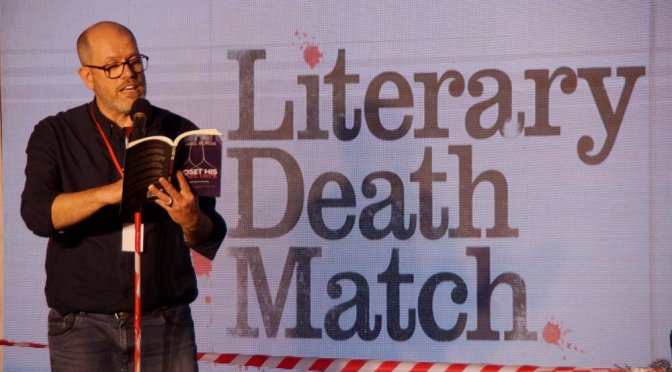
LITERARY CHAMPS: (L-R) Sofie Laguna, Sophie Overett, Michael Burge, Thomas Keneally, Adrian Todd Zuniga, Alison Gibbs, Robbie Arnott and and Costa Goergiadis at Bellingen Reader & Writers Festival Literary Death Match, June 2022.

When I met the competition – my fellow LDM authors Sophie Overett, Robbie Arnott and Alison Gibbs – in the green room, we were a herd of nervous deer about to meet a very large headlight.

I’d already been on a panel in the huge marquee we were suddenly being led to, lit up in the darkness with a capacity crowd expecting to have a blast, so I knew this was big.

Judges Sofie Laguna, Thomas Keneally and Costa Goergiadis walked up to the stage at the invitation of LDM host and creator Adrian Todd Zuniga, leaving we writers crouched down the back in the shadows. By the looks on our faces, we’d have preferred to stay there.

DEATH WATCH: The crowd at LDM

Yet we managed to go two rounds, reading to the crowd and getting bombed by literary questions. I barely remember any of it, just the glare of the spotlight and the silence as I started to read, my voice pitched slightly higher and rather quietly, to ensure I got their attention.

Paragraph by paragraph, every middle-aged one of my six feet very publicly embodied that teenage girl on the brink of discovering what equality means in this world.

And with my final line, I brought the house down, a tsunami of laughter and applause washing every bit of shame away about self publishing a collection of short fiction that no editor, agent or publisher in the country had ever thought enough of to get behind.

The judges awarded me a win in my round, but I was finally KO’d by the lovely Sophie Overett in a spelling bee finale.

In the aftermath, my copy of Closet His, Closet Hers was torn from my hand so that a reader could look up where to buy it. A big name author asked me in the green room who published it. I pointed to myself, which is what I did once at another event, when a bestselling author asked me who my publicist was.

Eyebrows go up in such moments, mine more than anyone’s, because for a short time it’s not about the luck, the opportunity, the contacts, the networking, the five-year plan or the affirmations… it’s simply about the writing.

That’s the beauty of Literary Death Match, writing really is the winner.

Here’s my top tips for anyone recruited into LDM:
– It is fun, and the rules are there to be massaged, purely for entertainment value. When Adrian called time on me, three times, I waved him off and kept reading
– Be bold and read with all the characterisation you can muster
– The crowd is pumped and on your side, they know writers are very often shy and retiring and LDM is a raucous big deal
– It’s fast, and will flash by in a heartbeat!
– You can read self-published, emerging work, so give the crowd an early literary experiment!

A moment in the spotlight

Well this is very exciting. I have been nominated as a finalist in the ACON 2023 Honour Awards media award for my collected writing about rural LGBTIQA+.

I am gobsmacked about the company I am in, including some of the giants of gay-hate crime reporting. I’m also extremely proud to be acknowledged for two decades’ writing about LGBTIQA+ issues.

It’s hard to explain the difficulty in getting work published about us. Certainly in my early writing career I had many bites, only for gatekeepers to get cold feet about the subject matter.

This was (and is) the era of #OwnVoices in which we are supposed to write what we know by lived experience. That’s all very well if the publishing and media industries have a tradition of publishing what you are… but in my case, they weren’t, so it was DIY or remain silent.

Change has finally come, although it’s still challenging to get agents, publishers and industry gatekeepers to have courage when it comes to platforming queer stories. Initiatives like the Honour Awards give our work a spotlight, thanks to media category sponsor NBCUniversal, which is a beacon of diversity and inclusion.

The gatekeepers who green-lit my work should really share in this citation: Margo Kingston and her No Fibs project; Anna Solding of MidnightSun Publishing; Gabrielle Chan of the Guardian Australia Rural Network; and James Bennett, co-editor of a special edition of the Journal of Australian Studies

Take a look at the two decades of writing that landed me this citation, in my bookshop.

If you’d like to come along to the 2023 Honour Awards, click through to my events page for all the details.

And, as always, thanks to readers!

The (lost) road to Sheep Station Creek

THERE MUST BE a hundred or more Sheep Station Creeks in Australia. The one I know is in Kamilaroi Country, and I recently went back to find it because I’m working on a novel about a town that disappeared.

My exploration was a reminder of just how quickly such a thing can happen.

As a kid I regularly traversed the black soil lands west of Delungra, and I recall being told that Dufty’s Lane, on which our farm ‘Paxton’ stood, once ran between the Bingara Road and another place deeper in these blue hills, decades before we moved in.

That destination was Sheep Station Creek, a generous watercourse that often flooded, according to the oral history, cutting off residents of the village with the same name once too often.

Their solution was to head up into our valley along Dufty’s Lane, which runs straight to the Bingara Road crossing creeks close enough to their source to let most of the water get away. From there, it’s a short run into Delungra where there was a railway station, school and post office.

Armed with a map and memories of landmarks (there’s no phone signal out there) I headed west from Delungra to Kaloona. Here, I turned south onto Reserve Creek Road where Gragin Peak sits distinctly almost directly to the north.

After slowly and subtly dropping into a valley, a crusty signpost pointing to Sheep Station Creek greeted me not far south of where Reserve Creek flows into it. The water was flowing beautifully, creating wide, shaded pools as it winds through the district. With plenty of properties along the way, it seems the perfect place to put down roots; but there’s little sign this was once a place with a name.

‘This little spot’

It seems the closest Sheep Station Creek ever got to being recognised was in century-old reports. One, published in The Inverell Times three weeks after the Australian Imperial Forces’ landing at Gallipoli in 1915, called the region “this little spot” in “the corners of Inverell, Warialda and Bingara districts”.

The write up reads as though it was penned by a local, speaking of a rifle club and tennis meets; and thousands of sheep, cattle and horses agisted in the valley during a “recent dry spell”.

The annual minutes of the local “F&S Club” branch were reported, mentioning the arrival of the telephone service, a rise in rates, the plan for a local polling booth, and various road repairs.

“The Shire Council has effected an agreement with St Clair Bros, in regard to the road through their properly, which, though not final, puts residents, on a more satisfactory footing,” the report reads.

The St Clairs were Percival and Harold, second joint owners of Paxton. A 1916 report in the Tamworth Daily Observer mentions the success the brothers were having in the cultivation of various grains on Paxton, with a particular focus on Sudan Grass, a highly nutritious fodder sorghum they were selling as seed. Harold was also doing well out of breeding horses for the track.

The writer of that report didn’t mention Dufty’s Lane by name. They called it “the Road to Sheep Station Creek”.

It certainly sounded like a place that was burgeoning, so what happened?

A changed world

The day I passed though. the weather-beaten pointer to Sheep Station Creek was hidden in the shadow of a signpost to a place with a more notorious name.

I followed it and soon ended up at the old Myall Creek Hall, where, with my siblings and friends, we once played on the swings and performed on the raked wooden stage at Christmas. I’d arrived at this place by another route in 2015 for the annual memorial of the Myall Creek Massacre.

A local volunteer was mowing the lawns, so I got to have a slow look inside.

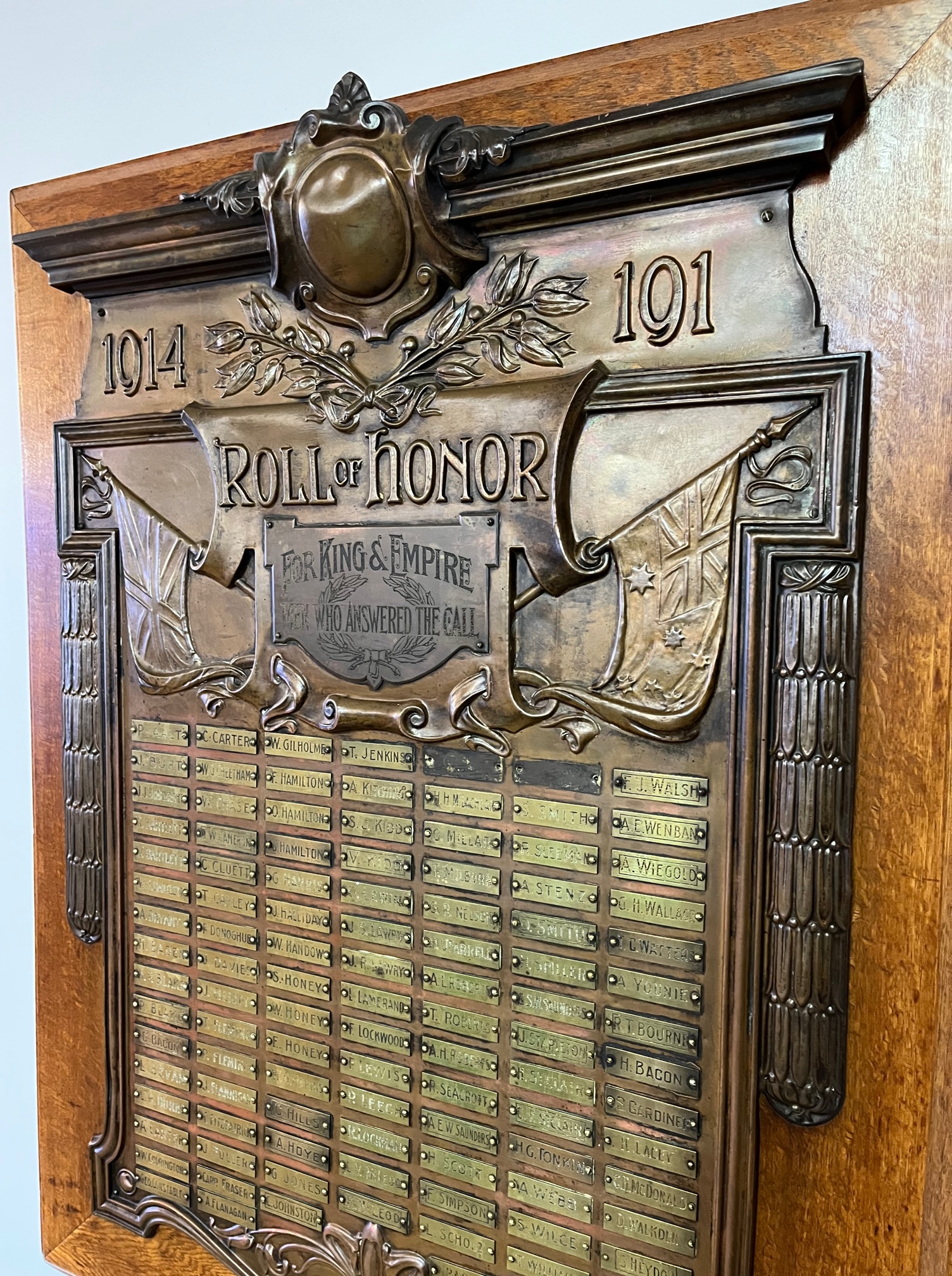
In the dusty light, I noticed an honour roll, which likely goes some way to explaining the disappearance of Sheep Station Creek. Two of the four St Clair brothers – Harold and Christoper – appear on it. After enlisting late in a war that no-one knew would end soon (a similar board at Delungra was embossed “1914-191_‘), Harold returned but his younger brother did not.

The weekly papers of the New England region are filled with the lists of the war dead and wounded across these years. Harold St Clair’s bushman’s skills were exploited in Palestine, not the racetrack. He returned to a changed world in 1919.

If the residents of Sheep Station Creek – just getting a foothold on their lands in 1916 – were impacted at the same rate of loss as the rest of the New England community, is it any wonder the hopes in those branch minutes were blown away like sorghum seeds no-one was around to harvest?

Out of place

I continued on the Myall Creek Massacre memorial site, taking the short walk to remind myself of the story of the Wirrayaraay women, children and old men whose lives ended so brutally at the hands of colonial settlers in 1838.

The Wirrayarray’s custodianship of Myall Creek was forever interrupted by this episode of Australia’s Frontier Wars. It’s not clear what the residents of Sheep Station Creek knew or understood of the massacre, although I was told about it as a child while playing at the Myall Creek Hall in the 1970s.

War stories tend to get handed down the generations. The loss of large parts of some generations due to conflict is something all cultures have in common. Hopefully we can remember all the fallen on the one honour board before long, by including the Frontier Wars in our ceremonies.

Despite my hunt along every rut, track and open gate, the road down to Sheep Station Creek from Dufty’s Lane appears to be long gone.

Perhaps Sheep Station Creek survives in other memories and family stories? These remote hills and valleys are filled with place names that exist only on maps, or remnant signposts standing by old roads to nowhere, travelled by dreamers like me who are drawn by legends and century-old meeting news clippings.

In that sense, the fictitious town that disappears in the manuscript I’m currently reworking is hardly out of place. It’s just another bend in another creek somewhere.