

WHEN I was fourteen living in the Blue Mountains of NSW, Australia, two life-changing things happened to me: I developed the ability to draw and paint well; and I realised I was gay.
“Capturing and generating emotion – not validation – is the real skill in all arts.”
One of these led me to years of study and training in visual, fine and applied arts, with others fostering my nascent skills. The other led me to fifteen years’ profound fear and confusion. It’s likely you’ve already worked out which is which.
Creative skills and homosexuality are traits I was born with. Although I had relatives who were artistic and same sex-attracted, both states came out of nowhere for this kid, who in the early 1980s had become quite accustomed to blending in with the furniture.
But when I sold my first artwork at the age of 14 and started receiving regular commissions, I was coaxed from behind the sofa. My single mother wouldn’t let me accept money, initially, but when I reached the age when others in my school year were earning pocket money pumping fuel or at the checkout, she shrugged and said that I should be paid for the work I was producing.
Exhibiting in group charity shows I earned a decent sum after the commission and framing was paid for. At the time, the Blue Mountains had a booming arts scene with prolific artists whose work was instantly recognisable, names like David Brayshaw, Robyn Collier, Fiona Craig and plenty more were sources of great inspiration for me.
It didn’t take long for people to open avenues for my artwork. One of the earliest was the encouragement from a teacher for me to enter the annual Gould League art awards, with a particular focus on the subject of birds. I entered several works and received three prizes.

There was a huge resurgence of wildlife art during the 1980s and despite my youth I rode the wave. Commercial prospects for my art opened wide when a school trip to New Zealand required a fundraising effort, and stationary was printed with a range of my wildlife studies. It sold like the proverbial hot cakes and suddenly my bespectacled, pimply demeanour had a creative context.
But to anyone paying close attention, I was entering an extremely dangerous phase.
Subtle poison
As the decade ended and I went off to tertiary studies that included a design diploma at Australia’s National Institute of Dramatic Art, I felt the creeping need for something to be done with my innate skills. Arts are defined as ‘fine’ or ‘applied’, after all, but my grasp on validation slipped during the post-recession era of the 1990s.
Validation… what a subtle poison it was for me, allowing one side of me to be singled out at the expense of the other. HIV/AIDS was tightening its terrible grip and while homosexuality had been decriminalised in NSW in 1984, any sign of it in my conservative community was treated with disdain.
I recall believing that if I could express myself in other places I might find true acceptance, and part of my journey to tertiary studies in Sydney and in the United Kingdom was an attempt to shuffle off the kid who could draw in order to find the adult in another art form altogether.
But it was harder than it should have been, and trying to manifest other skills and dreams led me down several blind alleys, because every one of them brought me face-to-face with myself, and, being deeply closeted, my basic composition was squeezed into a frame that left me looking and feeling terrible.

For years I didn’t paint or draw. Living in the United Kingdom and trying to earn a crust in the post-Thatcher economy, I eventually picked up the paintbrush and generated a portfolio that no-one I showed it to was the least bit interested in.
Art wasn’t enough. The talents of the kid meant nothing in Thatcher’s world, which also trampled on LGBTIQA+ rights at every opportunity.
Brushtrokes
So I came home, came out, and did something outrageous: I went and studied acting. I was determinedly playing catch-up and wasn’t content to replicate what I saw on canvas, I wanted to be the art, in every cell.
Life outside the closet got suddenly very tough when my partner Jono died in 2004. I struggled for creative direction for many years. It wasn’t until I found myself in a new relationship that I started, quite tentatively, to paint again.

It was stop/start for a few years, and it took a while for others to get their heads around my artwork, which was often staunchly abstract instead of a replication of nature. I came to realise that my realistic works were not much more than the ability to keenly observe what I saw, and that capturing and generating emotion – not validation – is the real skill in all arts.
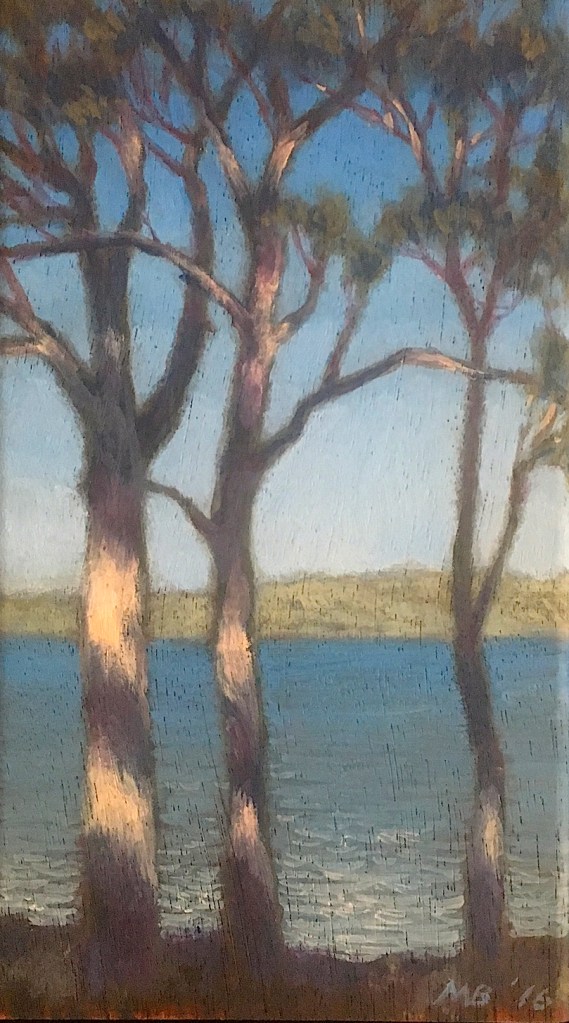
In 2016, friend and artist Ellen Paxton gave me some paints and told me to just get going. She purchased the first work I executed and I have not stopped painting since.
The smell of oils when I squeeze colour onto my palette is a great motivator, because it calls to mind almost four decades of art as second nature. All those years of discipline in composition, perspective, colour theory, life drawing; all those exhibitions when work walked off the walls, and all those when it didn’t… every single part of the journey is a brushstroke on my psyche. I wouldn’t be without a single one.
Carelessly cut
This month, some of those 35-year-old Gould League-winning works came back to me. They arrived in a dangerously inadequate envelope with a miserly amount of postage, but thankfully the postie alerted me before delivering, saying he’d have had to fold it if I hadn’t been home.
When I opened the completely uninsured, unregistered correspondence, my past came rushing at me in these original sketches. I recall the hours spent solo in my childhood bedroom, every line of the Artline pen (I went through hundreds of the things in the 1980s); but also the loneliness, confusion and the desperate need to hide in that room.

Their appearance in my letterbox is a timely lesson in validation, because I have watched young, artistically-skilled people rise into the world in the decades since I did, and I have quietly reminded people – emotionally immature teachers and mentors, particularly – to take great care with them.
It’s hypocritical to validate someone for their innate skills, yet refuse to respect something equally as innate, such as their sexual orientation. In the case of the people who were gifted these artworks, returned to me after being carelessly cut from their frames, acceptance of my sexuality (and that of many others in our community) was painfully piecemeal.
But I’m very glad to have these precious early brainchildren of mine back. Considering the open-hearted manner in which I donated the reproductions to send clueless private school kids to New Zealand 35 years ago, then gave the originals to people who no longer value them, or me, they’re wonderful proof that I have always been much bigger creatively and emotionally than the narrow frame others envisaged for me.
Depths of acceptance
A decade ago, while paying for new tyres, the bloke who’d done the job read the name on my credit card and asked: “Are you Michael Burge, the artist?” and I nearly fell over. He described the pen-and-ink sketch of galahs that he and his wife had been gifted for their wedding and shook my hand with gratitude for a piece of art they love, another from my Gould League-winning collection.

It was a pivotal year when more of my teenage works came to the surface, including my first work of non-fiction, which failed to launch because of jealous adults but came rushing at me while on assignment for a piece of journalism. “Could you please sign my copy of your book?” a guest at the same event asked. Again, the shock was profound since I’d lived for many years without the validation of such moments.
Validation… too many are unaware of just how much of it you relinquish when you come out, but I have lived long enough to learn how shallow it really is when compared with the depths that flow with just a little acceptance.
Coming on top of a self-determined life that includes the right to marry and the broadest equality rights Australian LGBTIQA+ have had in our history (despite there being much, much more to achieve), these days I treat validation as more of an incentive.
It’s a reminder to keep up the hard work and the difficult, vital process for creatives to put ourselves right out there in a way that very few who live within the safe walls of validation will ever understand.
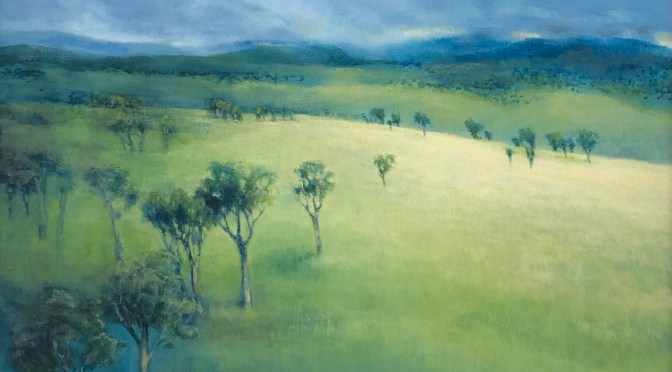

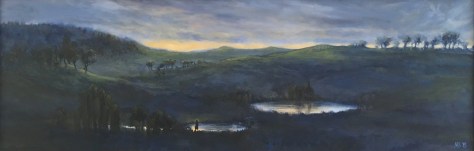


 Michael Burge Media