Category Archives: Politics

We need to talk about Pauline

“One Nation sends mixed messages, and its followers are able to live with policy blind spots, just like other Australians.”

WITH no result on election night, it wasn’t too surprising when people came up to our market stall at Cleveland in South East Queensland on Sunday morning asking who’d won. We weren’t selling anything, but petitioning voters in the federal electorate of Bowman about marriage equality. Recognising the rainbow flag and the symbol of national lobby group Australian Marriage Equality, many assumed we were a good bet to talk politics.

I did an eye roll after I mentioned to a punter that one thing was sure: Pauline Hanson had been elected to a Queensland Senate spot. This shopper jumped in with a couple of perceived positives about Pauline. “Not many people really take the time to find these things out,” she said. A bit chastened, I back-pedalled behind my concerns about how Hanson will vote on marriage equality.

But it bugged me. The petition I have been championing since April across the region I’ve lived in for almost four years has led me to feel I have a place in this community, whereas my sudden education about Pauline Hanson’s popularity reminded me with a thud that the place I am living is Queensland, One Nation’s spiritual home.

Screen shot 2016-07-05 at 10.27.27 AMWith nothing new to report on vote counting, the media flocked to Pauline Hanson’s press conference on Monday. Twitter exploded. The mainstream media followed. News Corp’s was the first lead story I saw, with the headline: “What Pauline Hanson thinks”.

As a former sub-editor, I thought it was either a lazy header or one dripping with irony. The story behind it proved to be no story at all, just a list of direct quotes from Hanson’s presser (sourced from Australian Associated Press) interspersed with capitalised sub-headings. The only journalistic intervention was filtering out the clearest quotes from the Hanson press conference and packaging them in easy-to-consume bites.

I scanned through the list to find meaning. It was in the last two lines: “ON MEDIA TREATMENT ‘Don’t take me out of context what I’m saying here at all’.”

Irony, then. One way to capture Pauline, unfiltered.

Not quite believing what I was reading, I sought a recent precedent for what I saw as a dumbed-down approach to reporting Hanson. Buzzfeed wasn’t as stripped-back as NewsCorp, but in late 2015 it ran with what looks like dialogue in a screenplay when seeking more information on James Ashby’s role on Hanson’s staff. Their reason: Hanson Redux is big on the legal threats.

Twitter storm

No Fibs’ editor-in-chief Margo Kingston took to Twitter Monday afternoon with her eyewitness accounts of Hanson from the late 1990s:-

She also linked One Nation to the growing popularity of offshore processing of asylum seekers:-

Margo followed this up with an opinion piece in The Guardian – her debut on that news source – in which she appealed to Australians to “have the conversation” with Pauline.
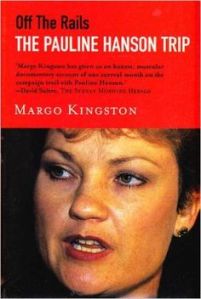
da16197630f4974d2bc7fad3b990db88Despite Margo’s experience in the Hanson space (she wrote the definitive book about Hanson – Off The Rails: The Pauline Hanson Trip) her suggestions garnered Kingston a lambasting on social media.

Somewhere between Hanson’s second chance in parliament and Kingston’s experience of the real woman, is there a way to understand what One Nation wants without getting labelled a Hanson apologist or a sneer?

An education

Overnight, a German friend posted Pauline Hanson’s infamous “Please Explain” 60 Minutes video on Facebook, which I had never seen in full. When it was first broadcast I was living in the United Kingdom, unaware, as so many were, that the seeds of Brexit were already growing in the widespread dissatisfaction of the post-Thatcher years.

I watched it Tuesday morning with great interest, Margo’s appeal in my mind, seeking any evidence of commentators or others giving Hanson the chance for a dialogue.

I found it in the last third of the clip (after 22’00”). To her credit, Hanson visited Palm Island in 1996 as the independent Member for Oxley after Charles Perkins (deputy chairperson of the now defunct ATSIC – The Aboriginal and Torres Strait Islander Commission) challenged her to see the region in addition to having such strong opinions about it.

Hanson met a group of Aboriginal and Torres Strait Islander (ATSI) women, perhaps community elders. One addressed Hanson calmly and said: “You are a very young person. You’ve quoted your age as 42, that is still very young. Not so much in age, I’m not talking about years, but knowledge. What I would like you see you do, Pauline, is get educated.”

This was before the international media’s presence at the Sydney Olympics raised Australians’ level of awareness about ATSI language groups. The concept of Aboriginal Knowledge (that which you seek from community Elders) was not widely known enough for the journalist – or Hanson – to realise how uninitiated we all were in the way ATSI communities operate.

Hanson’s immediate reaction was not recorded in that interview, but by the time she was back on the couch answering Tracey Curro’s quite calmly-delivered question about xenophobia, Hanson was not about to admit she was proposing simple solutions to complex problems.

“Those people are there because they want to be there, and it is causing problems, because they want to live there,” she said of the generations of Palm Island residents, descendants of the penal colony created there.

“Where would you suggest they go?” Curro asked, neutrally.

“I’m not saying they up and leave, but they’ve got to accept it, that they are away from mainstream Australia,” Hanson relied.

A telling precursor to former prime minister Tony Abbott’s 2015 description of ATSI communities as a “lifestyle choice” two decades later.

For many progressives, that’s the end of the conversation.

Let’s talk

In the past two days, I’ve been trying to find a primary source for the positives that the punter at Cleveland used to convince herself that a vote for Pauline Hanson was justified, and I just cannot find one. They’re an urban myth that wouldn’t bear publishing here.

trudeI could have asked her why she voted for Hanson – ‘had the conversation’ with her – but on reflection she was defensive, and so was I. What would I have said if I found her misquoting incomplete half truths? What would she have done if I’d pressed her to come up with proof?

When pressed to give answers in 1996, Pauline Hanson retreated into an old saying about having to be cruel to be kind when it came to Palm Island, and perhaps nothing has changed in two decades.

The divide between ‘ordinary’ and ‘privileged’ Australians observed so effectively in Kath & Kim served as a more palatable way to have the conservation in the wake of One Nation’s demise, but it’s disappeared from our screens in time for Pauline’s return.

Hanson Redux is moving at pace, although it is fluid. On Tuesday’s ABC Radio National morning radio news, One Nation supporters distanced themselves from the racist and anti-Muslim elements of Pauline Hanson’s Monday press conference.

Labelling such differences as hypocrisy isn’t helpful. Like all political parties, One Nation sends mixed messages, and its followers are able to live with policy blind spots, just like other Australians. Labor’s policy match with the Liberal’s on offshore detention of refugees comes to mind.

But I am not so sure about having the conversation.

Perhaps conversations are not on Pauline’s agenda this time? During a hung parliament, do conversations revolve around listening and understanding, or do opposites simply thrash out the horse trading in the pursuit for power, legislation by legislation?

Talk is cheap, and if we were brave enough, we’d admit we just don’t like having conversations with other ideologies. We leave that to those we elect, Pauline Hanson included.

If we cannot live with what the politicians are saying to one another, we do something, like petitioning in public, or creating new political parties… hey, did I just find common ground with One Nation through nothing more than a conversation with myself?

This article also appears on No Fibs

© Michael Burge, all rights reserved.

Go beyond the like button (you know you want to)

“Westerners have lost touch with one of our strongest power bases: we are consumers.”

PROGRESSIVES internationally are being hit with some hard facts, from the reality of the United Kingdom’s vote to end its politico-economic links with the European Union (EU); through the rise of Donald Trump as the Republican United States presidential candidate; to Australia’s problem catching up with both nations on the human rights inherent in Marriage Equality.

It’s become impossible to participate on social media without also being hit with online petitions.

“But is it realistic?” I saw one concerned Remain voter ask her Facebook friends, of yet another public vote attempting to reverse the Brexit result.

It could be, I wanted to reply, if only you’d just sign it.

But I didn’t write that response (I just said “sign them all, in only takes a few minutes”) because we keyboard warriors and slacktivists get very sensitive about doing much more than ‘liking’ stuff.

Liking is good. It’s a show of hands sweeping through our Facebook feed, but let’s be real for a minute: Liking really achieves nothing. No-one has to show up. At best, it’s little more than virtual loyalty over morning coffee.

I was reminded this week (by another Facebook post) of the principles of the civil rights movement, and the way it continues to define change in Western nations where politicians and corporates have stymied communities and left us feeling speechless and disenfranchised.

Rosa Parks on a Montgomery bus on December 21, 1956, the day Montgomery's public transportation system was legally integrated.
BACK SEAT BOYCOTT Rosa Parks on a Montgomery bus on December 21, 1956, the day Montgomery’s public transportation system was legally integrated.

I also reminded myself of some fundamental tenets of most democracies, proven long before the social media came along. People generally have the right of assembly, demonstration and petition – that is, we should not fear meeting, protesting with and canvassing other members of the public for common views.

From the Montgomery Bus Boycott triggered when African-America Rosa Parks refused to give her seat up for an Anglo-American passenger in 1955; to the Sudanese Civil War Sex Strike, when Samira Ahmed encouraged wives to abandon sexual relations with their husbands until the second Sudanese Civil War ended, people have been taking relatively peaceful, simple stands to enact lasting change.

It was a pamphlet distributed by community leader Jo Ann Robinson that reminded African-Americans of a mathematical reality – that they were the majority of Montgomery’s bus ticket-buying marketplace – and they reacted with courage. Bus travel was out, replaced by car-pooling and other simple efforts actioned by individuals, and by 1956 the Montgomery racial segregation laws were ruled unconstitutional.

It’s never completely simple, it’s never totally peaceful, yet withholding what a large number of people want has proven to move mountains, particularly when what they want is our money.

“International corporate and individual brands are already making such decisions easier for consumers.”

Perhaps it’s the weight of all our first-world problems, but Westerners have lost touch with one of our strongest power bases: we are consumers with an array of choices when it comes to everything from the weekly groceries, to clothing, entertainment and countless other products and services.

Nationalistic movements like Brexit, populist candidates such as Trump, and human rights outcomes linked to a nation’s economy (Malcolm Turnbull’s commitment to spend $160 million on an unnecessary plebiscite on Marriage Equality) leave themselves wide open to economic boycotts.

The internet makes it relatively easy to find where products originate and which corporates support or political candidates and movements. Some are politically savvy and hedge their bets, but most are not.

In just a few clicks, you can choose between banks, department stores, communications companies, financiers and even restaurants that support causes you’re aligned with.

In just a few well-directed emails, you can ensure other companies know why you’re making the choice to spend your money with their competition.

Although sites are cropping up that make it very easy, there’s no need for blanket bans on buying British or American products – remember, not everyone in the United Kingdom wanted to leave the EU and not everyone in America is voting for Trump.

Harry Potter creator J.K. Rowling went public on Brexit.
HARRY’S WAY Harry Potter creator J.K. Rowling went public on Brexit.

But one of the most powerful things you can do is to ask a simple question of the management in these companies. Are you supporting Trump? Do you want to leave the EU?

They’ll be affronted, no doubt. They might not even give you a clear answer, but it’s your money, right? You get to choose where you spend it.

International corporate and individual brands are already making such decisions easier for consumers. Richard Branson came out early as a Remain supporter in the Brexit fallout on behalf of Virgin Group. British celebrity chef Jamie Oliver likewise made his Remain stance crystal clear for his followers.

One of Britain’s most lucrative (and nationalistic) cultural exports of the past two decades is the Harry Potter brand, yet Harry Potter wants to stay in the EU! Author J.K. Rowling is one of the highest-profile Remain advocates in the unfolding Brexit landscape.

Silicon Valley CEOs went public earlier this year about their concerns over Donald Trump’s presidential nomination. Large US retailers, media outlets and sporting and cultural events led the way a year ago.

A snapshot of Australian corporates that support Marriage Equality.
CORPORATE BACKING A snapshot of Australian corporates that support Marriage Equality.

National Lobby Group Australian Marriage Equality has published a growing list of more than 1000 corporate entities that support changing Australia’s Marriage Act to allow equal access to same-sex couples. I’ve been using it for more than a year to make high-street choices that sit better with my equality activism.

Consumer boycotting often gets negative attention, amid suggestions that it’s ineffective, or a form of trade protectionism; whereas in actual fact, it’s already proven itself to have deep impact at the highest corporate level in Australia.

Australian telecommunications giant Telstra wavered on its public expression of its support for Marriage Equality in April this year, reportedly under pressure from Christian organisations threatening a boycott of Telstra services across Catholic organisations.

But the consumer backlash was fast and profound, and Telstra was forced to reassert its public support for legal reform of Australia’s Marriage Act.

There’s a whole world of consumer boycotting going on – check out the site that claims to be: “The most comprehensive English language list of progressive boycotts”.

There isn’t a ‘dislike’ button on the majority of social media platforms. Facebook has no plans for one. If there was, social media shareholders might lose their grip on this lucrative new wave of media – and millions in advertising revenue – when participants grow sick of their thoughts and opinions garnering the type of protests that a thumbs-down would attract.

Perhaps that leaves some hope for progressive politics? With no way to give the thumbs-down at the keyboard, the only thing left – if you’re still frustrated – is to do something.

© Michael Burge, all rights reserved.

Don’t fund my art, just grant me access

“Australian artists will never be silenced by cuts to funding.”

MUCH is being made of the recent wholesale cuts to arts funding in Australia. We knew it was coming, it’s shocking to witness, but does it mean anything to the average Australian artist?

Well, if you’re an independent Australian artist, probably not.

There is a simple reason for this, and it’s going to be hard for many commentators and readers to accept: for decades now, arts in Australia have been funded in a trickle-down manner that Margaret Thatcher would be proud of.

I’m an artist who practices several art forms. I am a fiction and non-fiction author, playwright and painter, and I’ve also worked as an actor, illustrator, designer and filmmaker.

Funding? Yeah, tried to get that many times, but I failed far, far more often than I succeeded. I genuinely wonder what it’s like to have public funds to practice my art. I imagine it’s a bit challenging, especially being accountable to the funding body (and the public), but I’ve never been in that right time at that right place to get my ticket to the top floor of Australia’s arts sector.

Although I haven’t let that stop me. Ever since graduating two decades ago, with two art diplomas, I’ve worked a string of day jobs to support myself while I practice my art. I thrive while telling stories, it’s in my DNA and I’ll never give it up; yet if I’d had to rely on the meagre income generated from my art, I would have given up long ago.

That’s not to say I subscribe to the notion that my output should have no currency just because it comes naturally. Far from it! Artists should be paid well for our skill and our time. The trouble is, creating a market for art in this country right now is almost impossible whether you’re funded or not.

The problem for independent artists is not funding, it’s access.

image-20151207-22703-1rg73ma
HERE’S AN IDEA Malcolm Turnbull wants innovation, but not from artists.

My ears prick up when I hear Malcolm Turnbull talk about Australians needing to be agile enough to ride his ideas boom, because to date he’s never thought enough about the arts to include it in his revolution.

But artists are in it up to our eyeballs, already risking everything with the best of them. I innovate, particularly as an author. In the past two years I’ve been agile enough to teach myself how to publish quality books – my own – using the online tools that are at the fingertips of any burgeoning writer.

In many art forms, from literature to live performance, it’s now possible to create content and generate sales channels via the internet and social media. There’s a sense that artists harnessing these continually expanding innovations have no known boundaries, but unfortunately this is not the case. Audiences simply don’t know we’re there, and for artists, no audience equals no consumers (and therefore no income) for our art.

Anyone who’s self-published books will tell you how hard it is to interest the mainstream media in their titles. It simply doesn’t matter how excellent and innovative the product is, if it hasn’t been fostered by a major publishing house it’s unlikely to make it into the critical context of mainstream book reviews, literary festivals and awards.

This is no surprise. The major publishers created this critical mass decades ago to sell their titles within, and they don’t want competition from the thousands of writers who annually get rejected by mainstream publishing and turn to the DIY book revolution.

Yet we are the first ones expected to be outraged and up in arms when Australian literary icons call for a halt to some dodgy-sounding import rules.

I’ve been selling my books into a market with no such protections for my work, as have countless other independent Australian writer-publishers. If authors supported by the Australian publishing industry are taking a hit, join the queue behind the rest of us! You’ll get a higher return per sale of every book if you self-publish, so what’s stopping you from going it alone?

That’s an easy one to answer: artsworkers – those employed to facilitate art. In the case of book publishing, these are the editors, designers, proofreaders, publicists and other professionals who put writers’ books together for the marketplace.

Some artsworkers are also artists (I’ve been known to cross over more than once), and they’ve been highly visible of late, expressing disappointment at funding cuts that will impact their bottom line and their forward estimates.

“It’s past time for getting real about arts access and distribution in Australia.”

In a sense, artsworkers have more to lose than artists, although many have framed these lean times as the contributing factor in employing less artists. I suspect many companies will cut art rather than cut artswork, at least initially, but many will simply run out of funds for both, and that is where the greatest shame lies in this debate. As a result, artists will have to learn to stop relying on artsworkers to develop our careers.

I abhor wholesale cuts to the arts, but we’ve been on the frontline of the blade for centuries, seen as a frivolous, non-essential extra. The argument against that definition is too obvious to construe here, but I encourage artists to do what we have always done: keep making art.

Artsworkers have a different challenge, and it’s past time for getting real about arts access and distribution in Australia. If our political leaders want innovation in the publishing sector, then a literary competition in this country need only launch an independent book-publishers’ award. The rest will follow.

But right now, literary awards have a snobbish, unnecessary block to independent authors making a decent splash in Australian publishing by locking us out of competition, publicity, exposure and opportunity.

5960284-3x4-340x453

Actor and playwright Kate Mulvany (pictured) used multi-story metaphors this week when she urged major theatre companies to notice what is being amputated on the lower floors of an already struggling performing arts sector in Australia, and to do something about it by keeping the top floor open.

“We need to keep those voices on the ground floor and middle floors ringing out with Australian stories or our much-loved house will collapse beneath us,” she said. “If they’ve been evicted from the middle and ground floors, then invite them upstairs.”

Consumers of art could do a lot better too. If you are really outraged by arts funding cuts in this country, you should already be buying independent Australian art.

Have you ever purchased an independently published book, created by an author who has self-funded their entire enterprise? Do you buy from high-street shops or from independent Australian artisans who are innovating as best they can in a marketplace dominated by cheap imports?

Do you support independent Australian films at the box office? Are you aware of burgeoning independent theatre festivals in Australian cities?

1460862671Are you signing-up to The Arts Party to make your concerns heard in our parliament?

I’m all for innovation spreading new-wave tendrils into the arts sector – who would be foolish enough to attempt stemming the flow anyway?

But if politicians want to support the arts, while butchering funding for artists, ‘there’s never been a better time’ for them to make small budget-neutral changes with big impact by starting with opportunities at their fingertips.

I look forward to ‘having a go’ by entering an Innovation in Independent Publishing Award at the 2017 Prime Minister’s Literary Awards, personally guided into existence by whichever leader wins the next federal election. The state Premier’s literary awards will follow suit, of course, by creating categories that no major publishing house will be eligible to enter books into, and I can’t wait to buy every title on that shortlist.

Art happens regardless of politics, and Australian artists will never be silenced by cuts to funding. Many of us are already proving our durability in the independent sector… if you can’t hear us, you’re just not looking in the right places.

© Michael Burge, all rights reserved.