Category Archives: Politics

Ballerinas, blue poles and budget week

CREATIVE ACCOUNTING Image from
CREATIVE INCOME Image from Frieze magazine.

A Writer on creative accounting.

I HAVE never paid much attention to the fallout of budget week, simply because the Arts are always sufficiently financially knocked-around long before the Treasurer makes our economic disenfranchisement official.

If a body like The Arts Council or Screen Australia were to be closed, that would register. Hearing they’ve had cuts only blends into the usual budget week white noise.

“Somehow, the Arts seem to exist outside of the economy.”

Many artists subsist on a combination of incomes derived from our arts practice and our day jobs, spreading the risk between catering and painting, or admin and acting, like artist friends of mine; or journalism and writing, as I do. This means we can absorb multiple knocks and bonuses across our income. We can generally survive in good times and bad.

It’s always a lottery, and the media is usually slow to report the impact. Often artists will find out about budgetary changes weeks or months after the fact.

Treasurer Joe Hockey’s first budget last year had the Arts buried beneath the Attorney-General’s department budgetary top-line, with ballerinas leaping above it, because the only headline news for artists was that the Australian Ballet School in Melbourne will get new student digs.

FAME
REACHING FOR FAME Scene from the 1980 movie.

This was excellent news. The only person I know who went to the Australian Ballet School, in the late 1970s, was left to his own devices with other teenagers in shared suburban accommodation. The experience sounded like a mix of Number 96 and Fame, without a shred of government funding in sight.

A new accommodation block sounds a little boring by comparison, but the key to interpreting the use of this ‘dance move’ of the Abbott Government’s is that it will be a building, which will employ people to build it.

An architect will ideally get a gig, and an interior designer or two, and hopefully other building industry-related creatives, but the overwhelming majority of people who will financially benefit from this pledge of one million dollars will not be artists, they will be from the construction industry.

Major Arts bodies took big hits last budget – $87 million was stripped from the industry at large – but I know of only a few practising artists who have ever been able to secure government funding of any kind, so this news won’t impact on your ‘average’ artist.

We’ll call ‘the average artist’ someone who is courageous enough to work outside the nine-to-five paradigm as a result of some inner need to express themselves creatively.

“Governments are not all bad news for artists.”

Whoops, I slipped into subjective, indefinable territory, sorry. I don’t know which column of the budget the ‘average artist’ should go in, which only proves my point about not really caring about the fuss on budget week, because it only applies to us if it’s a broad measure such as a medicare co-payment, in which case the ‘starving artist’ should be concerned.

Speaking of starving, let’s look at the latest figures on artist incomes, albeit over a decade old. The Australia Council for the Arts’ report Don’t give up your day job says it all – artists just don’t earn enough to see us impacted by things like debt levies and Paid Parental Leave salary caps.

Yet we earn little enough that medicare co-payments will make a difference.

But artists have inured ourselves to the lingering feeling of numbness about what funding opportunities may or may not be around in financial years to come. I’ll take a wild guess: under this government, they’ll be lean.

Another indirect effect will be that the ‘average’ art buyer will, no doubt, have less disposable cash after this budget to buy our art, if we can get buyers out to a group show sometime during the year. That’s a worry, but then again, that’s always a worry.

I have seen group exhibitions rake in money during tough times, and I have seen empty theatre seats during good times. Somehow, the Arts seem to exist outside of the economy, constantly taunting and baffling the number crunchers.

Proof: some paint splashed across a board by some American was sold to the Australian people under the personal leadership of Gough Whitlam for A$1.3 million, and is now worth anywhere between 20 and 100 million dollars.

But governments are not all bad news for artists. One of the kindest changes a government made for creatives came under John Howard, after we were permitted to present our taxable incomes by combining day jobs and artist incomes … and something to do with deductions.

I am simply not going into detail in case it gives someone within the ATO a crazy idea about changing it back to the way it was for decades. Just know that it’s a little help at tax time.

Readers should also not confuse artists with artsworkers, who reap a large share of Arts funding in the Australian economy.

Occupying salaried positions from federal through to local government, the nation’s artsworkers are perhaps the ones to ask how Mr Hockey’s Great Big Surprise New No Excuses Budget Emergency Measures will impact on the Arts, because they are now in the frontline of job cuts.

All I really know about the Arts right now is that I completed my writing schedule this week, the bargain I have with my artist self to create despite Mr Hockey.

Therein lies the powerlessness, and the power, of the artist. Try putting a dollar value on it.

© Michael Burge, all rights reserved.

France, a country driven by différence

A Writer’s dose of Francophilia.

IT’S safe to assume our Treasurer Joe Hockey would not have enjoyed a trip to France with Prime Minister Tony Abbott in 2014.

There’s just too many wind turbines across the French landscape. Hockey would have been offended every few kilometres.

“The locals are not afraid of heritage or design.”

I should know, I spent hours admiring the French commitment to clean wind-generated energy as endless, slender, spinning white needles slid past on my high-speed rail journey into the heartland of the country’s southwest. In the region known as the Lot (with its capital Cahors), massive forests reach wide green arms into built-up areas and quickly swallow visitors into an ancient rural landscape which still sustains its farming industries.

These abundant forests are not national parks, but a regularly harvested source of timber and firewood, large and well managed enough that supply is not threatened and wildlife has a permanent refuge alongside livestock.

MARKET FRESH White asparagus at Cahors farmers' market.
MARKET FRESH White asparagus at Cahors farmers’ market.

Supporting the regional agricultural economy, serious fresh food markets take place in most towns a few days every week, a vibrant and profitable exchange of local produce and other goods for the benefit of residents. Compare that to token farmers’ markets once a month, begrudgingly permitted by local chambers of commerce in Australia.

Every day, street sweepers (teams of people with brooms employed by the local council) clean the towns. Not just a cursory brush here and there, but every cigarette butt and scrap of paper.

Far from major cities, reliable service connects people to the internet without the same dropout I regularly encounter at home, a mere 35 kilometres from the central business district of Brisbane.

But the greatest surprise, for me, came with the palpable sensation of creativity happening all around me.

“They know that they’ve got, culturally and environmentally, and they are busy protecting it.”

Millennia-old heritage architecture abounds. Wherever recent building work has been undertaken, it complements townscapes instead of fighting against them. Modern repairs are completed with ancient building techniques. New properties are built in the same manner as homes that are hundreds of years old. Satellite dishes and solar panels are positioned to blend in. From their homes, to their public spaces and their everyday items, the locals are not afraid of heritage or design.

Local theatres, cinemas, galleries and ateliers (artist ‘workshops’) are in high saturation. Their output is not tourist fodder, but art for art’s sake.

In a region whose food export relies heavily on dubious animal welfare principles (foie gras, anyone?), and where hunting is commonplace, I spotted the word ‘vegetarian’ more often in advertising than I have ever encountered it in Queensland, where I’ve had a worse time as a veggo than a homosexual.

Travelling with my husband, we didn’t sense a hint of homophobia. Same-sex marriage has been legal in France for a year.

About now, you might be thinking: “If it’s so great, why don’t you move there?”, along the lines of the ‘Australia: love it or leave it’ principle.

Well, we did go into a real estate agent in the Medieval town of Gourdon, only to find that our dream home (a flat above a 15th century shop) was on the market for 55,000 euro (just under AU$80,000). Tempting enough to admit that I really don’t love Australia to the point that I would never leave it.

As we left the region, I got the sense that I was returning to a world that is busy destroying itself. There is no doubt in the Lot they know that they’ve got, culturally and environmentally, and they are busy protecting it.

I felt bereft as this special place disappeared in the wake of the high-speed rail journey back to Paris, where the sight of cars plugged into electrical recharging points, which have become part of the very infrastructure of the streets, was a sign that even French cities are connected to an alternative present, not just dreams of a different future.

FRENCH PRIDE The Louvre's French masterpieces are just the tip of the iceberg.
FRENCH PRIDE The Louvre’s French masterpieces are just the tip of the iceberg.

No one demographic dominates the Paris population. Mass immigration has resulted in the kind of melting pot of cultures which goes well beyond tolerance of unfamiliar cuisine. Both days we were in the city, loud, peaceful political protests for Sri Lankan and other refugees occurred. Australia’s base fears about racial and cultural differences, and our government’s cry that we are being overrun by asylum seekers, simply fade into the multicultural Parisienne haze.

At The Louvre, all the great Western masterpieces are on show, but included in this ‘greatness’ were acres of decorative arts from the Muslim world in the museum’s permanent collection.

Yes, I could be accused of seeing the grass as greener through my rose coloured glasses, but before leaving the Lot I asked a couple of local British expats about the region.

Wages are low. The economy is seasonal and almost shuts down over the deep winter. To counter this, most residents live well within their means. Perhaps that is what people did before economies relied so heavily on debt, deficit and the need for everyone to spend, spend, spend?

I don’t know why France and Australia are the way they are. Penal colonies, bloody revolutions and wars feature in the histories of both countries. Both have elected conservative governments for most of the years since the turn of the millennium. Something is at work in France which is beyond political ideology.

I left with far more questions than answers: What lies about the environment, immigration, culture, heritage and development have we believed, that such vast differences have become the reality in two Western economies?

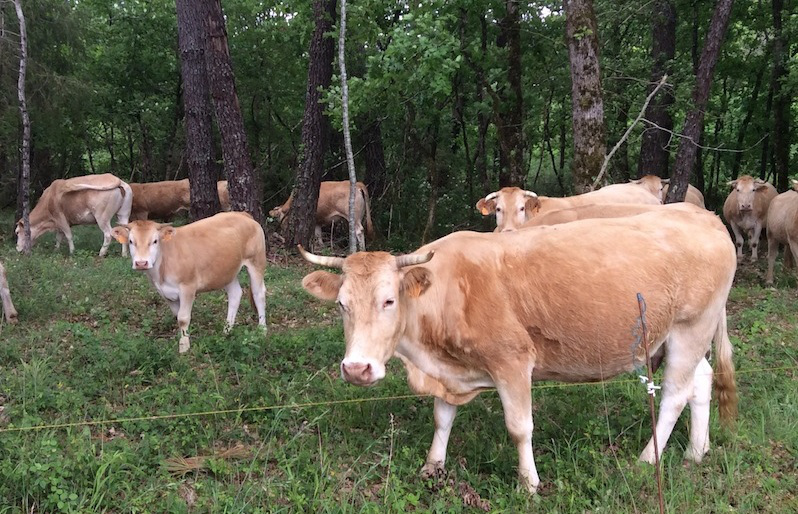
FREE RANGE Cattle in the woods near Prayssac.

What makes it possible for Australia’s Treasurer to be so vehemently offended by something which is already deeply embedded in France’s way of life? Are France’s wind turbines more or less offensive to Joe Hockey than Australia’s tradition of exporting uranium to France for their nuclear electricity generation program, which is Europe’s largest?

The French have a term for it – vive la différence (‘long live the difference’) – and perhaps they have learnt to say it about themselves more than others?

A much younger nation with an ancient first population, Australia doesn’t yet have words to express the same sentiment, and that is a telling difference indeed.

© Michael Burge, all rights reserved.

A Murdoch-free household is a galaxy too far

A Writer on Murdoch media.

NEWS sites are getting harder to access for free of late. Paywalls are up and apparently profitable for News Corp and Fairfax. Crikey has had one for years and last year Wendy Harmer’s flagship site The Hoopla shut the gate on free reads with its 34-cent per day subscription.

“Some of our most enduring book titles are in the Murdoch stable.”

Media-hungry online consumers are faced with a choice about where to get value for our money, but despite there being much more on offer than the old Fairfax vs Murdoch choice, the landscape is still dominated by these two big players.

This doesn’t matter if we’re not interested in reading anything published by the mainstream media. After all, progressive digital online media consumers have standards, right?

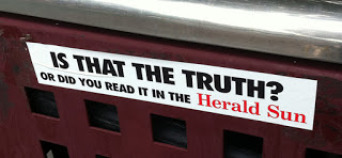
STICKER IT TO 'EM at News Limited.
STICKER IT TO ‘EM at News Limited.

Since I started participating in the social media I’ve seen plenty of lashes given to News Limited (the former name of News Corp). The bumper stickers: “Is that true, or did you read it in the (insert your state’s Murdoch daily/weekly)?” did the rounds. We all had a laugh and a chuckle, and called them ‘News Corpse’ when they changed names in 2013.

Seems newspaper reading is as much of a team sport as politics. Media hubs tend to pick sides on the major issues, and we follow their leads willingly.

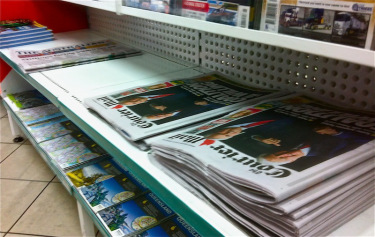
But here in Queensland we’re hard-pressed to secure any kind of Fairfax title at a service station or shopping centre. If there are any copies of The Sydney Morning Herald or The Financial Review left by late morning, they’re down there in the shadow of the enormous stack of The Courier Mail which dominates the newsstands. I asserted as much on Twitter once and got rather angry responses from disbelieving right-wingers in the southern states, even after I posted the photographs which proved my point.

We have The Brisbane Times, a Queensland-focused online Fairfax news site (with no paywall as yet), but online news sites do not ‘hit the stands’ where three-word slogans are concerned.

WHERE'S FAIRFAX? 6.45am at the service station near my day job, no copies of SMH or The Financial Review available.
WHERE’S FAIR FACTS? 6.45am at the service station near my day job, no copies of SMH or The Financial Review available.

Clearly, Rupert rules the newsstands in Queensland, where voting habits tend to support his team, but what if I told you the coffee tables, magazine racks, DVD collections and bookshelves of staunch anti-Murdoch slacktivists across the country would reveal reading habits and literary choices replete with Rupert?

News Corp (and News Limited before it) is a lateral-thinking publishing company, not limited to news print or online hubs. Some of their lifestyle choices may shock you, from Gardening Australia magazine to MasterChef.

Movie production and DVD publishing are also a great forums for Murdoch’s 21st Century Fox empire striking back, so check your purchases of the Star Wars franchise if you want to be a Murdoch-free household.

Literature is not off the hook either. Some of our most enduring book titles are in the Murdoch stable. Lemony Snicket was borne of HarperCollins publishing in the years after 1989, when Murdoch acquired the company, along with the publishing rights of J.R.R. Tolkien. Who knew? Gandalf and Gollum turned team Murdoch!

I’m far from innocent, I hasten to add. The first job I managed to secure after a year of postgraduate study in the United Kingdom was a temp position at the enormous HarperCollins office in Hammersmith, west London, as a mail despatch boy pushing his trolley all day for a month in the late English winter of 1993.

Off the despatch room, entire skips of remaindered books sat outside, and we mail boys were allowed to take whatever we wanted before the contents went off to landfill. I retrieved plenty of Murdoch-owned titles by the likes of Janet Frame and C.S. Lewis.

My first freelance journalism income came from The Weekend Australian, when I managed to sell two stories to the Weekend Professional section. I’m acutely aware that for certain social media purists, me getting 75 cents per word from Rupert Murdoch is tantamount to betrayal.

Great English playwright Alan Bennett, the quietly spoken Yorkshireman who gave us The Madness of King George and The History Boys, had much higher standards than me when he made an admirable stand against Rupert Murdoch in 1998.

Offered an honorary degree by Oxford University, Bennett wrote to the institution which had accepted him (to read history) and Rupert Murdoch (to read philosophy, politics and economics) in the 1950s, to explain why he would have to decline due to the university’s creation of the Rupert Murdoch Chair in Communications, funded by the graduate himself.

Being a playwright, Bennett added his own brand of literary flair for the Vice Chancellor: “If the university thinks it’s appropriate to take Rupert Murdoch’s money perhaps they ought to approach Saddam Hussein to found a chair in Peace Studies.”

Bennett had more cause than me for Murdoch disdain, having watched his friend – British television personality Russell Harty – exposed in The News of the World for alleged association with rent boys.

At Harty’s 1988 funeral, Bennett delivered a eulogy which revealed how Murdoch-employed reporters harangued his friend in his hospital room. They were after a ‘Harty Has AIDS’ headline, but they did not find it. ‘Harty Has Hepatitis’ would have had a better (and more factual) ring to it. Bennett is surely gleeful at the demise of The News of the World 15 years on, its criminal invasions of privacy the cause.

So, where does all this leave the average punter who doesn’t want to line Rupert’s pockets with purchases of online subscriptions, books, DVDs, movie tickets and the like?

To avoid new versions of Murdoch’s HarperCollins titles, your local second-hand bookshop would be a great start. Old mags are piling up in op-shops – try them for back issues of Rupert titles like Inside Out and Donna Hay magazine.

For news, perhaps fork out for a subscription to the non-Murdoch source of your choice. Try one of the indies, or make a donation to No Fibs.

3175132-darth_vader2Going to the movies and buying DVDs is going to be fraught with potential hypocrisy – do your research in the broad-ranging licensing network of Murdoch’s media empire.

Or you could just get over it and accept that somewhere, somehow, if you read you’re probably going to be lining Rupert’s pockets, even just a little.

Don’t feel bad, just don’t take it out on Bilbo Baggins – like the cornered Luke Skywalker, he’s possibly in shock at revelations about his new ‘father’, Rupert.

This article first appeared on NoFibs.

© Michael Burge, all rights reserved.