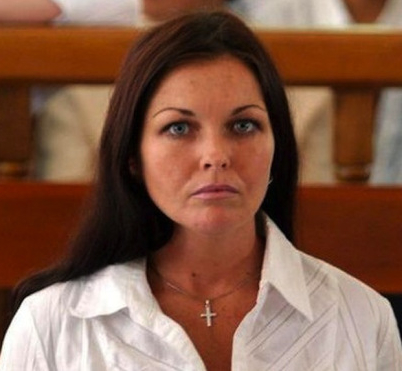
CHEERS MATE Schapelle Corby and her brother the day of her release on parole in February 2014.
A Writer on Aussies in Asia.
SINCE convicted drug smuggler Schapelle Corby’s parole from Bali’s Kerobokan Prison in Indonesia a year ago, speculation about the legal ramifications of her public behaviour has resulted in a long silence from the Corby family.
In contrast, a visibly desperate public relations campaign, underpinned by political and diplomatic representation, is hoping to sell a story of the reformation of the Bali Nine’s Australian ‘ringleaders’ Andrew Chan and Myuran Sukumaran, on death row in Corby’s former place of incarceration for their role in drug trafficking.
The collective public opinion of two sovereign nations are in play, and the outcomes of this legal and culture war are set to be devastating.
On the day of her release, the beers Corby and her brother thrust at the camera were seen as a symbol of Western excess. Not so in Corby’s native Queensland, where a beer in the hand is considered a human right in many quarters.
‘GANJA QUEEN’ Schapelle Corby.
Victim. Villain. Money-hungry. Misunderstood. Everyone has a slant on the woman the Indonesian media dubbed ‘The Ganja Queen’. But how do Australians really see Bali, the tropical Indonesian island often dubbed ‘Perth’s Northernmost Suburb’?
Like Aussie jokes about the ‘Bangkok Hilton’, this one is only half funny. A large number of Australians would probably let themselves off the hook for thinking Bali is an unofficial Australian state.
It was there the terrorism of the Bali Bombings cut an unwelcome gash through the Australian psyche.
“Public opinion – Indonesia’s, primarily – is the strongest judge.”
We have deep connections to the Asian nations to our north. Some have become symbols of national pride or shame which can be referenced using only one word: Kokoda, Balibo, Changi.
Over time, a sense of ownership and entitlement has crept into our dealings with these sovereign nations, particularly Indonesia.
Nothing seems off-limits in this neighbourly relationship, from live export of Australian livestock to asylum seekers.
But when convicted drug smugglers like Corby, the Bali Nine, and Barlow and Chambers before them get caught up in Asian justice systems, many Australians take the tide of opposing public opinion in Asia personally.
These cases highlight that while foreigners are welcome to party in places like Kuta, and relax in regions such as Ubud, they are also expected to conduct themselves according to the laws and sentiments common within the world’s largest Muslim population.
Corby escaped life imprisonment and the death penalty, but her release into the Bali community is an ongoing test for her, and all Australians.
Chan and Sukumaran have lived with death penalties since 2006, and, if accounts are to be taken at face value, they have made a valiant go of their death row lifestyle, insofar as it’s possible to show their advocates and the authorities that they have been reformed while on the inside.
And it’s that difficult-to-impart message which may or may not save them from the firing squad, or see Corby return to Australia after a further two years’ parole.
Public opinion – Indonesia’s, primarily – is the strongest judge, prison guard and executioner for all of them.
The outcomes of both cases will challenge notions that Australians have about Indonesians, threatening the idea of a tourist-friendly population intent on pleasing us with the reality of a people who have opinions, thought and beliefs of their own, in addition to a thriving tourism industry.
In a sense, Corby is now having the Bali holiday which was so suddenly curbed in 2004, although it’s undoubtedly less of a beer-soaked boogie-board ride and more a mindful retreat from Australian public social mores.
If Indonesia permits her to come home, she might teach Aussies a thing or two about the real Bali.
Whether they survive or not, Chan and Sukumaran will do the same.
A Writer interviews George Georgiadis, refugee advocate.
THE Australian twittersphere freaked out when refugee advocate @VanessaPowell25 was threatened with legal action by the Department of Immigration and Border Protection (DIBP) in April, 2014.
Unless she removed a post on her Facebook, which documented one moment at a protest outside the Villawood Detention Centre in Sydney’s Western Suburbs, the DIBP would “consider our options further”.
“What else are detention centres, if not concentration camps?”
Public servants tweeted about looming changes in policy on the use of social media for political critique, and warned the Abbott government’s $4.3 million in contracts for research companies to trawl the social media, ostensibly to seek “perceptions”, was actually the force behind ‘dob in a mate’.
Talk of tweet deleting did the rounds. Powell removed the post, and her Twitter following tripled to over 800 across the weekend.
Like a few other journalists, I picked over the traces to find the facts, because a comment on Powell’s post by another refugee advocate, George Georgiadis, was the underlying focus of the DIBP.
So I took a gamble and friended him on Facebook. A few weeks later, George replied.
Turns out the man who posted the “offensive” comment was continuing to do what he has done for the past five years, visiting detainees at Villawood twice every week in between his shifts as a mental health nurse.
Yes, George Georgiadis is a public servant, and in the midst of the social media storm, he dobbed himself in on Facebook. This week, I became his 18th Twitter follower.
He didn’t want to talk about ‘that comment’ because, George said, it’s “bleeding obvious” he’s under surveillance, and this issue is not about him, it’s about the men, women and children incarcerated in Australia’s detention centres.
Listen-up slacktivists, we have a lot to learn.
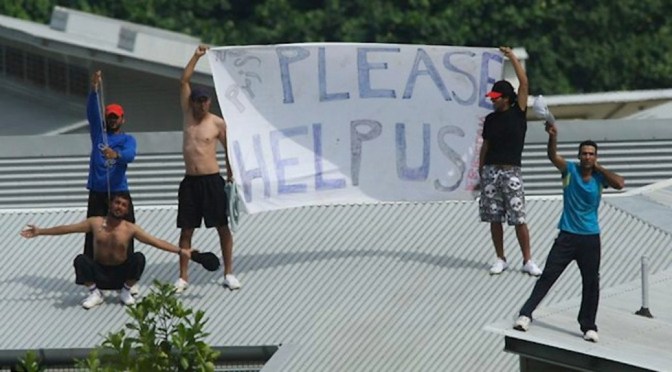
POLITICAL PRISONER A child behind Australian wire (Photo: Asylum Seeker Resource Centre)
I started by asking George if five years of visits to Villawood had allowed him to witness any change in governmental approaches to mandatory detention.
“What do you mean by ‘a different government’?” George asked. “Both major parties are now almost indistinguishable, we simply have different politicians doing the same thing the previous politicians did”.
“Nor can it be claimed that one party is worse than the other in their cruelty toward asylum seekers. It was the Labor Party’s then Minister for Immigration, Gerry Hand, who introduced mandatory detention in 1992.
“It was the Labor government which reopened the Nauru and Manus Island detention centres. It was the Howard government which worsened conditions for people in detention, however, they also removed children from detention, but it was the subsequent Labor government under Julia Gillard which placed children back into detention,” he said.
“Things have been getting worse, but it’s not because one party’s policies are worse than the other, but rather because we as a nation have become worse.”
In 2011, George Georgiadis appeared in Detention Centre, an SBS interactive documentary in which his barely concealed emotion for asylum seekers’ plight illustrates the passion behind his words.
“I stated that we as a nation had lost our compassion. Now it’s worse, we have lost our empathy by dehumanising asylum seekers in the media, breaking their spirits, returning them to where they have fled from,” George said this week.
“I mean, for God’s sake, we are now trying to send Syrians back to the horrors of Syria! Children born in detention are being kept in detention! People Australia recognises as refugees have been held in detention for five years and will continue to be held indefinitely.
“There are over a thousand children being held in detention centres, pregnant women and newborns are being sent to detention on remote islands lacking facilities. How is any of this acceptable to people who supposedly pride themselves on living in the land of ‘a fair go’?
“You can’t just continually blame the government in a democracy. The Australian peoples’ hands are not clean in this either,” he said.
Touché.
“A concentration camp is ‘a guarded compound for the detention or imprisonment of aliens, members of ethnic minorities, political opponents’, etcetera,” George said. “That is precisely what detention centres are”.
“They are not ‘processing centres’, because there are asylum seekers being held in indefinite detention because they are ‘Stateless Persons’. What ‘process’ can they go through other than being granted a nationality?
“They are not ‘processing centres’ because there is no ‘process’,” he said. “Since Manus Island was re-opened, not one asylum claim has been processed, not one”.
“This is not ‘administrative’ detention as is claimed in order to justify its indefinite nature, it is quite obviously punitive detention, and worse, it is the punishment of innocent people seeking refuge in Australia with the aim of deterring other innocent people from seeking refuge here,” George said.
“They are being punished for not only their own innocence, but the innocence of others.
“This nation has gone mad, and is completely insightless about its madness. People who have broken no law are indefinitely locked up in detention, they are dehumanised, cut off from society, denied freedom, denied access to legal assistance or trial, they are killing themselves, cutting themselves, hanging themselves and now they are being murdered.
“What else are detention centres, if not concentration camps?”
Why does George believe successive Liberal and Labor governments have sanctioned this treatment of people?
“It’s simple,” he said. “It’s scapegoating. There is a brilliant story by Ursula K. Le Guin entitled The Ones Who Walked Away From Omelas which describes a ‘utopia’, a city in which everything is idyllic and whose inhabitants are intelligent and cultured. But the happiness of Omelas depends on one thing: a single, unfortunate child must be kept imprisoned in filth and darkness and must not be shown any kindness”.
“If any kindness were to be shown to the child, the peace and prosperity and happiness of Omelas would end. Each citizen of Omelas learns of the existence of this child at their coming of age. Most are shocked and horrified at first, but soon learn to accept the child’s fate.
“A few, however, choose not to accept, and they walk away from the ‘bliss’ of Omelas which they realise is, in reality, a dystopia because of the abused child.
“This is much like what is happening now in Australia,” George said.
“If you want people to vote you into power, the easiest way is to create an imaginary enemy for people to fear and then promise to protect them from the bogey man.
“‘Border Protection’ sounds impressive until you realise we live in a nation which has no borders with any other country, yet now has a government department responsible for protecting those imaginary borders. It’s advertising hype to buy votes, nothing more.
Five years of visiting asylum seekers has given Georgiadis a deep awareness of detention experiences. How has this impacted on him?
“I was actually scared about what I was getting myself in to, and that fear, in some ways, has proved to be justified,” George said. “When I saw for myself what was happening to fellow human beings, I couldn’t go back to not seeing it. My life has changed dramatically as a result, and I’m glad it has”.
“The despair of the situation, the hopelessness, the apparent indifference of the majority of Australians to their plight, not knowing the reason why you are imprisoned and having no redress, the years of young lives wasted away, being separated from contact with family and friends,” he said of what he has seen as a visitor to Villawood.
“I have to be very careful here because there is a genuine fear that cases which are discussed in the media are unofficially punished with adverse assessments. This climate of fear has, in my opinion, been deliberately created to prevent cases coming to light which show the cruelty and inhumanity of the system.
“It is not safe to do so now, perhaps in years to come when the concentration camps are closed, individual cases will be able to be openly discussed.”
What can ‘average’ Australians do to help asylum seekers?
“They need to stop being average. Average people are the most destructive to the world in my experience,” George said. “The average Australian couldn’t care less about our inhuman treatment of asylum seekers”.
“If we think of it as a bell curve, about 20 per cent of the population care about what is happening and want the inhumanity to end. On the other end of the curve, another 20 per cent hide their racism and bigotry under the guise of ‘Border Protection’ and ‘saving lives at sea’.
“The middle 60 per cent – the ‘average Australians’ – try to reassure themselves that their silence on the issue is neither condoning nor condemning,” he said.
“Asylum seekers have become political footballs and have been demonised in this nation, and this dehumanisation has allowed us to lock them in prison indefinitely – even children and newborns – without charge or trial.
“To remain silent in the face of this is like remaining silent when you see a child being molested. There is now no ‘morally neutral ground’ on the issue of the treatment of asylum seekers in Australia,” George said.
“Ultimately, each person has to decide for themselves whether or not to ‘walk away from Omelas’, but I recommend making the decision that you will wish you had made when looking back on your life on your deathbed, and once you make that decision, act on it.”
For those who act, is there a way to gauge the impact of their actions?
“What makes a difference to the issue of our treatment of asylum seekers are the peaceful protests around Australia, the candlelight vigil for Reza Barati (the asylum seeker killed during a riot on Manus Island) which drew 15,000 and the Palm Sunday rallies around Australia which drew more thousands,” George said.
“Trying to stop the buses from taking handcuffed asylum seekers to remote detention centres is an act of love by a friend for a friend, but angry violent protests will never achieve anything in my opinion.”
It was George Georgiadis’ comment on Vanessa Powell’s public image of a bus intended for detainee transport from Villawood to Curtin, Western Australia, which drew the attention of the DIBP. I asked George if he recalled his comment before it was deleted.
“Actually, no, I can’t, but if you read the three DIBP’s tweets, they differentiate between the comment and the post, and insist that the whole post, not just the comment, be removed.
“The post was a photo of the back of a private coach being used to transport handcuffed detainees and the name of the bus company and their contact details were on the back.”
How did it feel to be singled out in this way?
“Laughable. If the aim was to have the post removed, why on earth would you make a public tweet about it to draw attention to it instead of sending a private message? If this is a result of the $4.3 million taxpayer dollars spent on social media research, I’d be asking for my money back,” he said.
“It’s ironic that for a department which insists on keeping the public in the dark about operational matters, it has managed to publicly disclose the names and identifying information about detainees in its care and also publicly draw attention to a post they supposedly wanted removed.”
George cites a Sydney Morning Heraldreport on the Abbott government’s contracts for social media analysis about border protection as the reason his comment came to the DIBP’s attention.
When asked about whether being a public servant should prevent him from commenting on government policy, George Georgiadis simply said:
“Yes I am a public servant. I was always under the impression that, in a democracy, a public servant serves the public and that the government is supposed to do the same.”
A Writer talks to the political party for artists, coming to an election near you!
MOTORISTS, shooters and fishers have all got one, so have sex enthusiasts and christians … why not creatives?
Micro political parties have leapt into the Australian voters’ consciousness like never before – some would say they’re running the joint – so when one of my readers tipped me off about the formation of a new party named The Australian Arts Party (TAP), I was all ears.
They’ve been getting their act together, the people behind Australia’s newest micro party, but what else would we expect from a collective of creatives?
Meet digital producer and TAP founder and registered officer, PJ Collins.
ACTIVE ARTIST Digital producer – the Arts Party’s PJ Collins.
Michael Burge:Why an Arts Party?
PJ Collins: To provide something that’s long overdue – a dedicated voice to support and encourage arts and creativity for all Australians. We want a more unified and economically prosperous Australian society, built on thriving, vibrant communities, which benefit and improve the quality of all our lives. A thriving arts sector is a key component of preparing us for this future, as it creates a ripple effect of seemingly unconnected benefits throughout the community, both socially, technologically and economically.
Australia’s creative economy already generates billions of dollars in revenue each year and that is set to grow substantially, as it must do – we can’t base our future on the global price of iron ore or coal. The future of Australia will be decided by the quality of our ideas, and the skills we develop among us to make them happen. The best investment this country can make is in its own people. When we encourage creative activity we plant the seeds for innovation, and that is what will power Australia’s future prosperity.
Finally, after the last decade of watching and listening to our federal representatives in Canberra, we’ve grown tired of waiting for a positive win-win, cross-party parliamentary voice to appear in Australian politics, so we’ve created it.
MB: Is there a gap in representation for Australia’s artists?
PJC: Artists and our creative industries are certainly in need of a committed voice. There are many support organisations that do the best they can to help them within limited mandates, but there has been no committed political and federal voice to speak on their behalf until now. Like all Australians, these companies and individuals just want a fair go, the opportunity and support to achieve their potential – hand-ups not hand-outs. We all gain as a society when creative individuals and organisations fulfil their potential.
MB:Which parts of the current funding models for Australian arts needs to be overhauled?
PJC: What we need is a more efficient, better supported arts industry, funding more creativity, taking more risks and offering greater opportunity for all Australians, as both creators and audiences, to get involved. The amount of pure funding that reaches artists and communities is simply too low, once all the ancillary administrative costs are deducted, and sadly no art or community project is funded on merit alone – there are just so many conditions to access funding. In fact there is no real autonomy for any of our arts funding bodies, and that needs to change.
We also want to see the audience, the actual funders, given central importance. Public investment should come with the proviso of connecting with as many members of the public as possible. For certain areas, such as major film funding, we’re even considering a crowdsourcing approach to deciding what projects get significant investment. We’re throwing around a lot of ideas at the moment!
MB:Regarding accountability for artists in receipt of government funding, what is TAP’s motivation for supporting an increase in responsibility?
PJC: We feel that artists have a duty to complete their publicly funded work, and that funding bodies have an equal obligation to create as large a public audience for that work as possible. Admiring our art and creativity should be a communal activity wherever possible. It should happen in neighbourhoods across the country and be as accessible as possible to the general population, so we all gain. So to us the responsibility rests with us all as a community.
MB:What sparked the idea to start TAP?
PJC: It was a discussion with friends over beer, about how hard it was to get any funding for an arts festival, which segued into the sorry state of the Australian film industry – hardly unusual conversations among Australians interested in those areas. In fact I think the idea of an arts party has been discussed literally thousands of times in bars and cafes over the years, but for some reason no-one actually got up the next day and did anything about it. Until now.
MB:What does TAP believe most artists want from the political process in this country?
PJC: Recognition, acknowledgement, respect and support. A fair go. It’s generally not a viable path to enter an arts career full-time, outside of administration. We would like to see tax breaks for those who create value with their minds above and beyond their daily work, and the opportunity for unknown artists to easily access small-scale funding to complete and share the fruits of their work. Creating value with your mind is not limited to fine arts either.
ARTY FARTY Minister for the Arts George Brandis.
MB:How does TAP view the current state and federal Arts Ministries?
PJC: It’s terrible to see the closure of so many arts departments across the country, and the provocative comments made by the federal Minister for the Arts (George Brandis) surrounding the biennale controversy. It’s hard to imagine any fundamental shift in the treatment of Australian arts and creativity in the current political climate, but don’t worry, we’re on our way!
MB:What has the process of founding TAP been like for you personally?
PJC: Well it was great to find that so many people shared my belief, that the arts needed a united voice, and cared enough to actually join and get this party going. We funded the party by way of a crowdfunding project, started by a couple of us emailing friends with the message – and that message just kept going. We then put together a committee of like-minded people with proven track records in the arts to help our progress. We needed 500 paid-up members to validate the campaign and ended up with over 700. The official paperwork is lodged and we’re just waiting to hear back from the AEC. Inspiring.
MB:Which electorates is TAP planning to stand candidates in?
PJC: Ultimately, we would like to be able to stand candidates across all states and the federal parliament, but our focus right now is on the next federal election.
MB:What does TAP offer to voters who do not identify as artists?
PJC: Well this party is about the audience just as much as it’s about the artists and creatives. You can’t have one without the other! We want to give voice to the countless Australian creators who are desperate to gain the recognition they deserve and share their work to widest possible audience. By repeating this across the country, in neighbourhoods large and small, we will ultimately strengthen the entire Australian community. We are about community first and foremost, and all of us contribute to that.









 Michael Burge Media