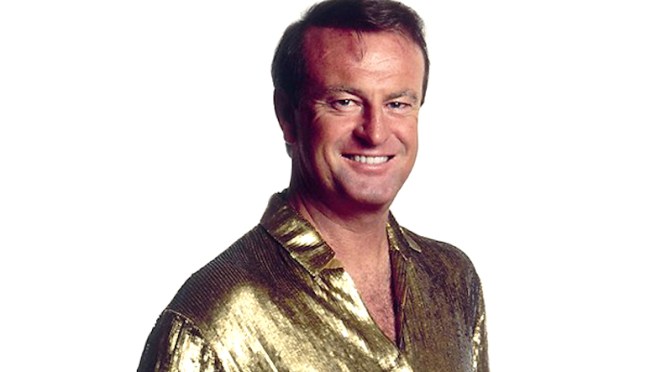
WHEN he returned to Australia in 1971 after being based overseas across the late 1960s, performer Peter Allen would have been forgiven for wondering if his career was over. But an unexpected piece of family history became the inspiration this boy from the bush needed to succeed on the world stage.
It had been a very long journey home for the ‘Boy From Oz’. Work offers were getting scarce for Peter Allen by the early 1970s. His mentor Judy Garland, who’d opened doors on both sides of the Atlantic for the young performer, was dead. His wife, Garland’s daughter Liza Minnelli, had asked for a divorce.
Allen had been performing for two decades and was at the age when many former child stars find themselves washed up. Even Australia didn’t appear to have many work prospects looming on the horizon for him that year.
His first self-titled album had bombed and gigs to promote it had been hosted by a Manhattan venue known as The Bitter End, which would have seemed terribly ironic to the man who’d been introduced to enormous audiences in the company of iconic musicians throughout the late 1960s.
BOY’S BIOG The definitive biography of Peter Allen.
According to Allen’s biographer, journalist Stephen MacLean (author of The Boy From Oz) it was an offer to perform in Australia that led Peter to “look his past in the eye”.
Ensconced at his mother Marion’s Bondi unit in that 1971 winter, Allen spent hours writing on the rooftop overlooking the ocean.
“One day, while Marion was out at work,” MacLean wrote, “Peter found himself fossicking about the flat. In the course of this he came upon an aged newspaper clipping from his near-forgotten birthplace of Tenterfield.”
The snippet recorded that Peter’s grandfather George Woolnough, whose High Street saddlery was already renowned, had a library at the University of New England named after him.
Memories came rushing at the 27-year-old performer. Key to his life experience to that point was the shooting suicide of his father and the grief that led to his immediate family’s gradual departure from the Australian bush. The fast-paced city had been Allen’s home since the mid 1960s, but his country roots held the seeds of an idea for this budding songwriter.
Emboldened by his modest start in New York, Peter Allen took this family history up to that Bondi rooftop and penned a new song.
‘Tenterfield Saddler’ was the result, a ballad that has bridged Australian bush poetry and international show-business ever since he recorded it in 1972.
‘Applause rolled on and on’
Mixing lyrical rhymes in a tale about long journeys down a country track replete with kangaroos and cockatoos, ‘Tenterfield Saddler’ is every inch a bush ballad in the tradition of Banjo Paterson.
It brings to the fore a lesser-known character in the cast of bush legends: the saddler, responsible for the safety and comfort of your ride, but also a storyteller.
Like all the best bush yarns, ‘Tenterfield Saddler’ has a dark side. In his grandson’s lyrics, the saddler holds the key to everyday life in a country town, but what George Woolnough couldn’t unlock were the reasons his son had died at his own hand.
It is the suicide at the heart of ‘Tenterfield Saddler’ that gives it a place alongside one of Australia’s most enduring ballads ‘Waltzing Matilda’. In that song’s climax, the hero of the story, a swagman, drowns himself to avoid capture for sheep rustling.
When Allen recorded his song for the 1972 album of the same name, it made a small splash in the American music industry, which labelled the track a folk song. But what this quirky ballad did, according to Stephen MacLean, was get Peter Allen noticed as a songwriter.
After a move to California in the early 1970s, despite having the barest of credentials, Peter Allen kept penning songs. He worked hard at his craft with other emerging writers and allowed the results to be recorded by artists on the brink of bigger singing careers.
In 1974, he eventually landed a hit when Olivia Newton-John released ‘I Honestly Love You’, co-written with Jeff Barry. The track garnered Allen his first of two Grammy Award nominations.
GOLDEN BOY Peter Allen (right) with co-writers Burt Bacharach, Carole Bayer Sager and Christopher Cross at the 1982 Oscar ceremony.
When he trialled the song at a live performance, long before Newton-John’s international number one single, Allen recalled: “Everything stopped. Even the waiters didn’t move. The air was still and when I finished you could have heard a pin drop. Then they all began to applaud and the applause rolled on and on.”
Allen went on to write with a range of collaborators, including Carole Bayer Sager. The two were part of the team that won the 1981 Academy Award for Best Original Song with ‘Arthur’s Theme’ from the soundtrack of the Dudley Moore film Arthur.
Yet Allen’s bush ballad ‘Tenterfield Saddler’ eventually took its place in the annals of songwriting. As fame saw him tour internationally, it became an audience favourite and graced the Australian charts multiple times. Bette Midler reputedly requested the song every time she saw him perform, and sang it at his memorial service.
By the end of his life in 1992, a result of AIDS-related throat cancer, lyrics about travelling had become a Peter Allen hallmark. Even his Oscar-winning track has at its heart the memorable chorus, “When you get caught between the moon and New York City”, a line Allen dreamed up while his flight was in a holding pattern over John F. Kennedy Airport, according to MacLean.
But it was his enduring 1980 homecoming ballad ‘I Still Call Australia Home’ that saw the boy from the bush – who’d spent his life wandering – finally embraced by a nation.
WHEN Australian same-sex couples were finally granted equal access to the Marriage Act in December 2017, the widespread expression of relief was tempered by a growing awareness of a legal minefield.
“Here we were on the other side of the world not being able to have clarified which of our relationships was valid.”
Brisbane couple Elaine Crump and Sharon Dane let the emotions in, but the status of their long-term relationship remained in limbo. Like many same-sex couples seeking legal documentation during the interminable wait for Australia to pass marriage equality, Elaine and Sharon had already taken their chances in countries where equality was accessible.
The pair first solemnised their relationship with a civil partnership at the British Consulate in Brisbane during 2006 — in fact they were the first lesbian couple to do so in this country — but neither could have predicted that was merely the start of an arduous legal journey.
“It gave us some credibility among our family and peers,” Elaine, a tradesperson, remembers.
“We were no longer just a couple living together but had some form of formal recognition, albeit in another country; and both our families are British.
“There was a level of excitement about it, as it was something we were finally sharing together that others were able to take for granted.”
IN THE SPOTLIGHT Sharon Dane and Elaine Crump.
Sharon, a psychology researcher, agrees: “There was no other way back then of us formalising our relationship”.
“The only thing we had to show we were a couple prior to that was a ‘stamp duty free’ declaration form from the Department of Transport.
“As we were British citizens, we felt that at least we were being legally recognised in a country that was part of our identity,” she adds.
According to Sharon, just before the couple were civilly-partnered, staff at the consulate required them to officially acknowledge that they understood the ceremony was not a marriage.
“That was hard to swallow,” she says.
“We were well aware of that, but to have it emphasised on our special day was upsetting.”
The ‘Best Wedding’
The ceremony attracted significant media attention during the Beaconsfield Mine collapse in Tasmania. Elaine and Sharon recall the sudden scrutiny brought on by the media’s need for alternate content during the lengthy wait before the trapped miners were brought to the surface.
“We allowed the media into that occasion and there was a sense of politics about it which somewhat detracted from the very personal nature of what we were doing,” Elaine says.
“For this reason, I drew the line in not allowing the media at our reception.”
Sharon believes the spotlight came as a result of being one of the first same-sex couples to enter into a UK civil partnership in Australia.
“Interestingly, we weren’t allowed many people to attend the ceremony at the consulate, only immediate family and our witnesses,” she says.
“So there wasn’t that sense of celebration you would normally experience at a wedding.
“Instead, the media filled the room taking photographs.
“While this took away from some of the personal nature of it, it also gave it some sense of celebration, with it being acknowledged as something historic and special.”
According to Elaine, the bulk of the ceremony was at home with close friends and family: “I do remember my mum saying it was the best wedding she had ever been to.”
Time Capsule
By 2008, overseas civil partnerships between same-sex couples were still not recognised in Queensland. That process would not begin until 2011 or be settled into law until 2016.
Elaine and Sharon’s relationship recognition had therefore reached an impasse, but they saw an opportunity in another country.
“Part of it was opportunism, as Sharon had to go to Rhode Island for a conference and I decided to go with her for a holiday,” Elaine recalls.
“We decided we would use the opportunity to drive up to Canada to marry, as it was another step in our journey.
“Marriage felt far more normalising. It would allow us to say we are married couple now, not civilly-partnered.
“We could come home and say that at least somewhere in the world we are a married couple.”
Sharon remembers her critical concern was about she or Elaine dying before they had the opportunity to marry or have a civil partnership recognised at home.
“If that happened, you couldn’t turn back the clock,” she says.
“There would be no way of the surviving partner showing we were ever married.
“I felt it was like putting it in a time capsule, ready to pull out once the laws had changed.
“It was also because people got it when you said you were married, they didn’t get it when you said you were civilly-partnered.”
Marriage Activists
SPEAKING OUT Dr Sharon Dane speaking at a PFLAG Brisbane event in 2014.
By the time of Elaine and Sharon’s 2008 marriage in Toronto, Canada, the couple had become involved in marriage equality activism, although both remember how entering into their second relationship certification was not in any way political.
“We were doing it for us,” Sharon says.
“However, letting the media tell our story was politically motivated, as we wanted to get the message out there that we were a normal couple that just wanted to be treated like everyone else.”
Elaine agrees: “From a political perspective it was great that our ceremonies helped highlight the issues in the press.”
Sharon’s role as a psychology researcher working on the relationships and wellbeing of LGBTIQ Australians was extended into her activism, which strengthened her views on why having the choice to marry was so important.
“As the research strongly indicated, it was simply about being respected and included in society,” she says.
“The desire to marry was a personal one, but to have the choice was critical in terms of feeling treated as an equal.”
Spare Bunk
Elaine and Sharon met through the Brisbane entity of the social group Older Wiser Lesbians (OWLS).
“I was away in Darwin on a work trip and when I came back Sharon was a new member and we became friends,” Elaine says.
“Eventually, and when I was no longer in a relationship, we found a mutual attraction to each other.”
Sharon recalls the pivotal weekend the relationship began: “A group of us women went camping at a lake. Elaine had a small sailing boat which you could sleep in. Everyone was deciding what tent they were going to sleep in and Elaine said ‘I’ve got a spare bunk in my boat’.
“Well I quickly put my hand up for that offer, and just as well, as it was in that boat where we expressed a mutual attraction,” she adds.
“That was almost 17 years ago. We no longer have that boat but a picture of her hangs proudly in our house as a reminder.”
It’s Complicated
After their 2008 Canadian marriage, Sharon and Elaine continued to campaign for marriage equality in Australia, including staunch opposition to the Turnbull Government’s planned plebiscite on the human rights issue throughout 2016.
According to Sharon, their interest in laws regarding civil unions and same-sex marriages across the world made the couple aware that it wouldn’t be possible to have two formal relationships — even if to each other — recognised in the same country.
“As the UK later changed its laws in 2014 to recognise overseas same-sex marriages, we started to wonder which of our two relationships — the civil partnership or the Canadian marriage — it would recognise,” she recalls.
“To complicate matters further, Canada changed its laws in 2014 to recognise an overseas civil partnership as equivalent to a marriage, with a Canadian lawyer advising us that our civil partnership would be viewed as the true marriage because it happened in 2006, two years prior to our 2008 Canadian marriage.”
The couple quickly realised they were in the same position as countless other same-sex partners in Australia: in need of legal and/or consular advice about the status of their relationships.
“We first contacted the Foreign and Commonwealth Office of the UK government,” Sharon says.
“They told us that it was complicated because we didn’t live in England and therefore they weren’t sure which of our relationships was valid.
“This meant we were not allowed to have our civil partnership converted to a marriage in case the Canadian marriage had rendered the civil partnership void in the UK.”
The couple corresponded with the United Kingdom Government for over three years while remaining in what they describe as “legal limbo”.
“Finally, they agreed that if we could seek the expert opinion of specialists in English family law, they would consider our case,” Sharon recalls.
“This was a costly exercise that we feel we should not have had to go through.
“We felt we had no choice but to pay for the services of a London lawyer specialising in same-sex marriage law.”
Sharon did an internet search for “Family Law, England, LGBT”.
“Luckily we found A City Law Firm, a wonderfully supportive and knowledgeable legal firm in London,” she remembers.
“They, with counsel on the matter from a barrister, made it clear to the UK government that it was our Canadian marriage that was void under English law, not our civil partnership.”
Reality Check
“The reality set in: Were we really legally married?”
In late 2017, the Turnbull Government conducted a compulsory postal survey to gauge public sentiment on allowing same-sex couples equal access to the Marriage Act.
Sharon was present in the House of Representatives at Parliament House, Canberra, when marriage equality was voted on and passed on December 7 that year.
“I remember calling Elaine right after and us crying over the phone, and that we were ecstatic this had happened,” she says.
“I think the passing of the law at that time was when I experienced the huge emotional outpouring.
“But then within a week of that, the reality set in: Were we really legally married?
“That put a real damper on things.”
According to Sharon, words can’t adequately describe the frustration and powerlessness that she and Elaine went through while they waited on a response from the UK Foreign and Commonwealth Office.
“Here we were on the other side of the world not being able to have clarified which of our relationships was valid,” she says.
“This meant we couldn’t confirm if we were already married, nor could we get married in Australia in case the Canadian marriage was deemed valid.
“I couldn’t help but feel bitter, as if we had the right to marry in Australia in the first place we would not have had to have gone through this unnecessary stress and expense, which was of no fault of ours but as a consequence of same-sex marriage laws changing around the world.”
When the news finally came through from the UK government in February, 2018, that the couple could convert their civil partnership to a marriage, Sharon and Elaine recall being overwhelmed with joy and relief, particularly because the certification was back-dated to take into account the total number of years of their marriage.
“This was the relationship we entered into first, 12 years ago, and the one that involved all our friends and family in Australia,” Sharon says.
“It was the one with a wedding album, flowers, a cake and our loved ones.”
Sense of Peace
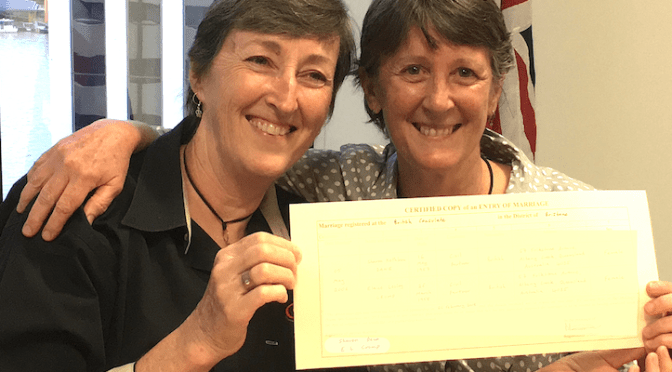
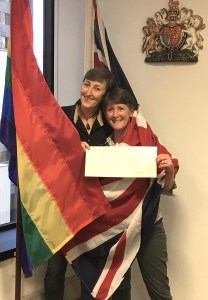
AT LAST Elaine Crump and Sharon Dane with their marriage certificate after converting their UK civil partnership to a marriage, at the British Consulate in Brisbane, February 2018.
This year, Elaine and Sharon returned to the British Consulate in Brisbane to have their 2006 civil partnership converted to a marriage that was automatically recognised in Australia.
The certification was likely to have recorded theirs as the first lesbian marriage in this country.
For Elaine, the overriding feeling was relief: “It’s been such a battle for so long,” she says.
“We finally know it’s legally binding and recognised in the place we call home.
“When we go out now and introduce each other as ‘this is my wife’, I don’t get that feeling that people think ‘oh yeah that’s nice, but they are not really married’.
“After all these years of exclusion, I’m able to say ‘yes I’m part of this, I am legally married, you are my wife’.”
Sharon recalls the conversion as an experience of happiness on two fronts, the “huge relief” of ending a drawn out legal battle, and that having the marriage recognised in Australia gave the couple “closure and a sense of peace”.
“All the boxes are now ticked,” she says.
“There is no more fighting on an Australia level, no more fighting on a British level, or any other level.
“We are now like any other couple who can say ‘okay we are married’ and that’s the end of it.”
IF YOU’VE ever been caving, even one of those walk-in-walk-out tours where you don’t have to get your feet too dirty, you’ll know the experience does something to the soul.
“I was about to turn back as my light passed over a patch of stone higher up when I thought I spotted a cursive ‘F’.”
Perhaps it’s primal, a DNA memory from millennia ago when our ancestors found shelter underground? Perhaps it’s all those fairy tales reminding us that once upon a time there might have been something more in the dark than our elders were letting on?
It’s a frisson that people across the globe subject ourselves to daily, as tourism cave operators everywhere will tell you.
I had the chance to work at a cave system, one of the world’s largest, when I was a cave guide at NSW’s Jenolan Caves. Taking people into the dark recesses of the mountain was always a thrill, and I was lucky enough to be guided on a very special tour recently that was a real highlight.
Jenolan’s Arch Cave has been closed to the public since the 1930s, but late in 2017 I was granted access during a scientific inspection in order to find one name written on the cave wall in the 19th century.
Finding J. Falls
As a guide, the most intriguing stories I came across in my time at Jenolan are those that tell the tales of the people who went into the dark long ago.
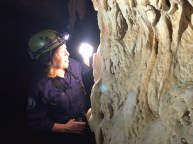
SIGNATURE SPOTTING Dr Anne Musser, paleontologist and Jenolan guide, reading names on the crystal.
The first people of the area, the Gundungurra and Dharug, had long traversed the passageways and underground rivers, and their Dreamtime mythology included several of the cave systems in the NSW Central West.
By the middle of the 1800s, settlers were regularly visiting the caves under the guidance of the local Whalan family, whose property at Oberon was one of the closest ‘gateways’ to the valley. They started the tradition of leaving names to record visitation, and, on occasion, the discovery of caves.
Most of what Jenolan guides related at the time I worked there came from the surviving oral traditions handed down by generations of guides before them, and one of the strongest stories concerned the discovery of a major section of the cave system by a local woman, Katie Webb.
I explored as much of her story as I could find, but there was another name that interested me, that of Jane Falls, whose legend at Jenolan include the possibility that she was one of the explorers to discover the system’s largest publicly open cave, the world-famous Lucas Cave, in around 1860.
The name Jane Falls polarises Jenolan guides. I’m not going to beat around the bush, it’s been bit of a male-dominated place in its time. Women have only been officially guiding tours since the 1980s, and between Katie Webb’s exploration in the 1880s and the next discovery of a cave by a woman there is a gap of more than a century.
The very idea that a woman might have discovered the Lucas Cave is confronting for some, which is one reason I suspect the issue of where Jane Falls’s signatures are remains a bit of a muddle.
‘J. Falls’ is credited as being one of the first European visitors to enter the Lucas Cave in newspaper reports from January 1860, but if that was Jane, she presents a conundrum for researchers. As was common practice, many of the signatures on Jenolan’s walls are initials only, so any appearance of ‘J. Falls’ could be one of three people: Jane Falls, her mother (also Jane), or Jane’s brother James, all Irish emigrants in the 1850s.
Nevertheless, a former colleague came across one trace of the Falls family in the Arch Cave, and so we went to see it for ourselves.
Graffiti
What became quickly apparent in the Arch Cave is that it’s a signature-rich chamber. Situated high in the Jenolan limestone, it was one of the earliest caves entered by European settlers, since it was easily accessed from the surface.
Like all caves, the major formations were named. By the time we were standing at the Assyrian Lion, identified as such for its similarity to those in the British Museum, we were looking at signatures scrawled in every direction, on walls, on crystal, and on the ceiling.
People left their mark using graphite pencil, or charcoal, or even the smoke from their candle, and in some places the names have quickly deteriorated.
I was struck by the possibility that we’d never find Jane’s name in this mass of graffiti!
A couple of side chambers required us to squeeze through into a narrower space where 19th century explorers had gone before, and I immediately saw the name ‘Edwin Whalan’ written boldly on a promontory of rock.
It made me chuckle. The Whalans earned their place in Jenolan lore, no doubt, but compared to some tiny signatures, the size and passion of this lustily scrawled Whalan moniker smacked of ownership.
A sweep of the torch above revealed other familiar names, but once again there were just so many. The Arch is a small cave but even so it would take hours and hours to search them all.
Some visitors had inscribed more than just names, also. Short poems, or expressions of how they felt, were touching reminders of the mysteries of the underworld, begging that question again, about why we come to gather in the dark and remember those who were here before us?
Curlicues
I was about to turn back as my light passed over a patch of stone higher up when I thought I spotted a cursive ‘F’. I stepped up for a closer look, and a shadowy word came into sharper focus. Most definitely ‘Falls’… my heart thumped. Most definitely a ‘J’ and an ‘A’. This was it! But standing there in wonder I had to admit immediately, this could be ‘Jane’ or ‘James’ Falls.
JANE’S NAME? The elusive signature of Jane or James Falls in Jenolan’s Arch Cave.
I grumbled at myself, and at poor handwriting, and the passage of time, then got a bit hopeful at the possibility of another name starting with ‘J’ and ‘A’ slightly above. Could this be Jane and James Falls, siblings on an expedition?
We took plenty of pictures and mused over the curlicues of the Falls signature. Nobody wanted to dash my hopes, but as our tour concluded and we journeyed out, I had to admit that it was not a conclusive sighting of Jane, not yet.
My search for her goes on, and will feature in plenty of writing to come, but to have stood in the dark where the Falls name was written, I feel closer than ever.







 Michael Burge Media