Category Archives: Rebels

Katy Cropper – showgirl shepherdess

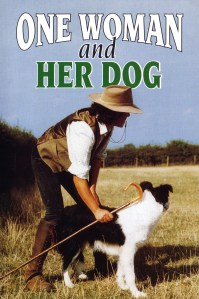
ONE WOMAN & HER DOG

THE first time I met Katy Cropper and her champion Border Collie Trim, we were screen-testing both for a program about Katy’s dog training techniques.

With her slightly wild edge, Katy Cropper belongs to the outdoors, and is at her most focussed when working with a team of sheepdogs to lift a flock from the far edge of a field and bring it back, in a majestic manner, right to her feet.

She’s also got a winning smile, and, as a friend of mine who watched the screen test said, a “great set of pins”. So we edited the footage into a ten-minute clip, and played it on rotation at The Royal Show in Warwickshire in the summer of 1996.

The crowds that gathered to watch showed us we’d chosen a very popular subject, and so we got the green light to capture the story of Katy’s new trainee sheepdog – Splash – over the next two trialling seasons.

Scheduling eighteen months of filming with Katy turned out to be a great way to tour the rural counties of England, simply because this successful (and often controversial) shepherdess never stays in one place for very long.

The first woman to win the prestigious BBC sheepdog handling title One Man and His Dog, Katy led us on a merry chase through some of the most beautiful farmland between Yorkshire, the Lake District, Gloucestershire, and The Midlands.

The only time I was guaranteed of finding Katy where I expected her was for her scheduled appearance at the Royal Show the following year. At other times I would anticipate a call from wherever she was working at the time, and she would give me detailed directions to which field on which farm she’d be shepherding on which day.

True to form, Katy was always there waiting and ready, decked-out in her latest take on what I’ll call ‘sexy-tweed’. When asked about what she is really like (and I was asked a lot over the years), I came to describe Katy Cropper as a combination of Toad of Toad Hall, and Sarah Duchess of York – she’s got boundless energy to burn, she sometimes gets into a bit of a pickle, and she’s usually kitted-out a bit like a country gent.

Predictably, her indefinability has seen Katy cop plenty of flack over the years – anyone who enters a sheepdog trial with a three-legged border collie, or appears in a trialling event in a two-piece bikini, or who tilts at any male-dominated, traditionalist world like sheepdog handling, is going to be the butt of jokes and barbs.

But Katy struck me as a great survivor who has overcome a few hurdles that would have stopped many others. She is steeped in the hedgerows and country pubs of England’s heritage, using phrases like “crow pie” and “the sun always shines on the righteous”, and all the traditional sheepdog commands like “that’ll do” and “bide there”. She’s rarely seen without her shepherd’s crook, and has a great collection of hats.

At her Royal Show appearance, Katy also showed a touch of Madonna, with her wireless microphone and her showgirl streak.

She arrived with a horse float full of animals – dogs, ducks, turkeys, pigs, a pony, and sheep, of course. The dogs, not fully animal in Katy’s world, were up front in the truck, and they helped her set-up the routine.

At that time in her retirement, Katy’s most famous dog, the predominantly white-faced Trim, followed Katy around and checked on all the details of the hurdles and fences. If something wasn’t right quite right, Katy looked to Trim to let her know.

Katy’s performance is a mish-mash of herded ducks, a range of fine dog handling and herding techniques, and an over-reaching sense of fun, which is why I think some country traditionalists could take or leave Katy Cropper, whereas city folk can’t get enough of her.

Splash progressed through her monthly filming sessions into a contender for a range of nursery trials, and it was there that we got a first-hand look at how the whole sheepdog trialling world works. There are so many events throughout the country that you can enter one in the morning, then drive over the range for another one at lunch time.

In between, your dog (and you) can go from a loser to a winner, and that’s exactly what happened to Katy and Splash in our program One Woman and Her Dog.

I raved so much about the special energy of female Border Collies that eventually I was tipped-off about one which needed a home. Five years later, I saved another from the pound. Fifteen years on, both my girls are still with me, and have made me look like a great dog trainer, simply because Border Collies are just so intelligent.

The rest of my training tricks I learnt from Katy Cropper.

Mind you, even though I say “that’ll do” and “bide there” to my dogs, I’ve never unleashed them on a flock of sheep in a field the size of ten football ovals. Katy Cropper has, and despite what you think about her, she knows how to train sheepdogs to bring in the sheep.

One Woman and her Dog was released by United News & Media but is currently unavailable to buy. It is occasionally available on eBay and kept in the collection of Australia’s National Library.

© Michael Burge, all rights reserved.
 

Dearborn, death & American dreams

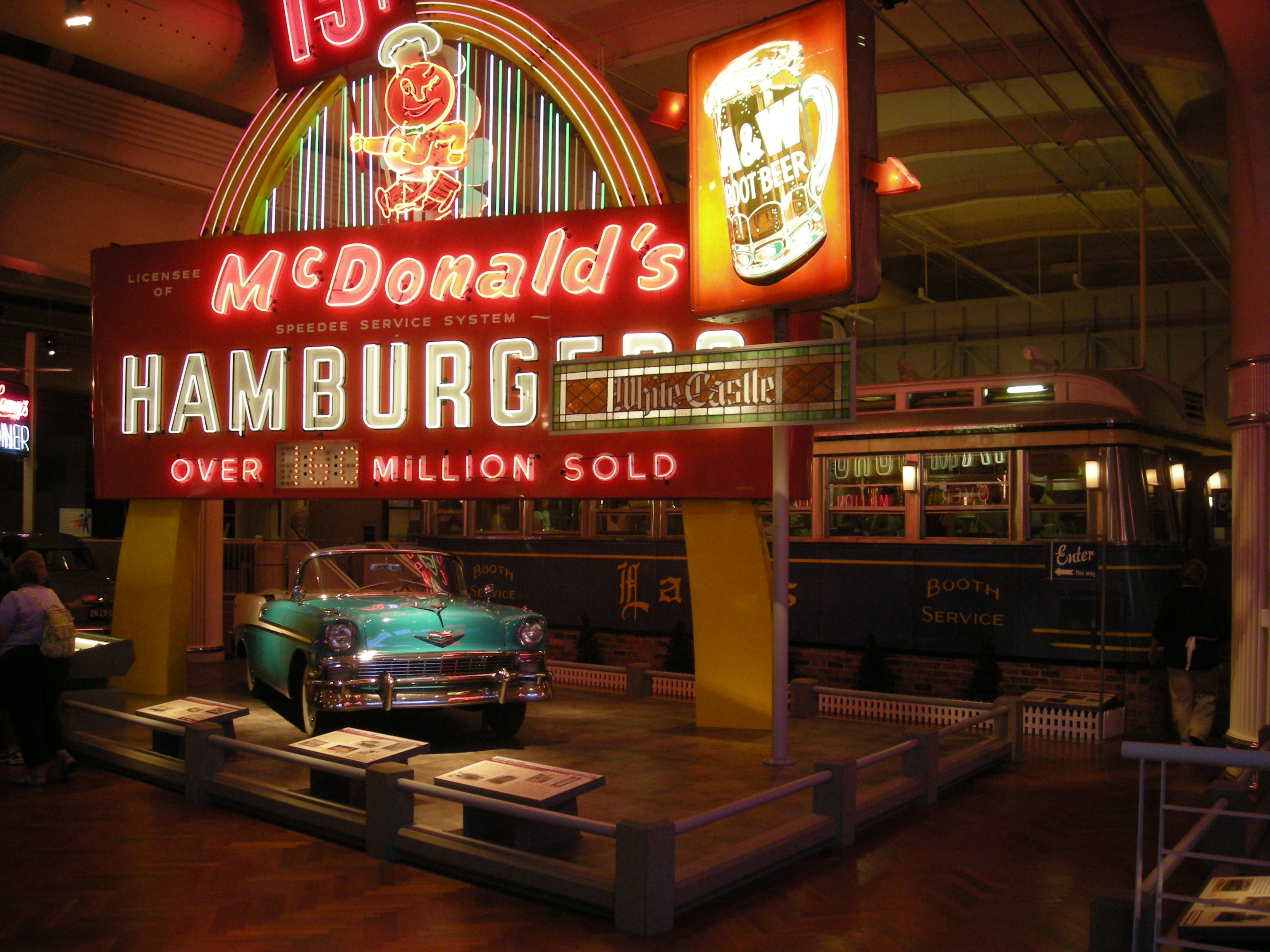
NEON DREAMS The Henry Ford Museum, Detroit.

A Writer’s Midwestern adventure.

SEEKING the childhood haunts of farming icon Henry Ford, on arrival in the great city of Detroit, we (me, a cameraman and a presenter) headed not for Motown (unfortunately) but to the city fringe and the Dearborn area.

There, the Motor City puts on a veneer of rural respectability, but on the many occasions we got lost in our hired Buick, street upon street of homely clapboard stoops in everyday neighbourhoods revealed themselves, where no-one cared much for Ford and the quiet revolutions he spearheaded.

All that is on ostentatious display at the Henry Ford Museum, our first port of call.

It would be hard to name a more complete exhibition anywhere in the world. As an entrée to life in the American heartland, this place is the veritable cherry on the pie.

Acres of halls burst with memorabilia on a huge scale – the neon sign display must be the world’s best, and there’s an entire Holiday Inn which was moved brick-by-brick as an homage to the original American road trip.

A Museum staffer showed us to another building on the far side of the exterior exhibition (filled with entire villages – Ford loved the whole brick-by-brick thing), where he pulled-up a garage door and trundled a rather strange looking machine into the daylight.

This was Henry Ford’s 1907 ‘Automotive Plow’ – the prototype for the mass-produced Fordson tractor.

This tractor changed farming practices dramatically after centuries of hard labour and heavy horses. Ford didn’t invent it, but he made it affordable for most.

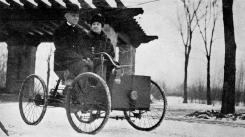
MAN OF EXTREMES Henry Ford and his wife in his first car.

A documentary shown at the Museum detailed Ford’s deep regret that his vehicle production technologies helped inspire the military tank, which tore through troops in the slaughter that was WW1.

Turns out Henry Ford (1863-1947) was not just a farmer and industrialist – he was also a pacifist and a vegetarian. Now that got me interested.

As we left the Museum, a formal line of Presidential vehicles revealed itself, from beautiful carriages to limousines. The last one was roped-off, because people respectfully leant across to touch the rear right passenger door.

I wanted to see why, but the sign explained the patently obvious – this was the car in which President John F. Kennedy was killed. Surprisingly, it had been remodelled and used by other presidents for many years after the assassination.

Quite close by, the upholstered chair in which President Abraham Lincoln was shot to death is also on display.

Such a strange, endearing collection of dreams, death and the pinnacle of farming achievements. The dichotomy says much about the man behind the collection, loved and reviled in equal measure. Say what you want about Henry Ford: he was a collector like no other.

Ford’s early tractors were manufactured the world over, and many have become collectors’ items, so we hit the road in search of them, heading south into the great farming state of Ohio, on the very edge of America’s Midwest.

As we embarked, another journey was just beginning in California. Young high flier, 7-year-old student pilot Jessica Dubroff’s ‘Sea to Shining Sea’ flight was going to rewrite history and make her the youngest person to fly across the United States, assisted by her pilot trainer and her father. The Ohio and Michigan media were anticipating seeing Jessica cross their skies any day now.

Passing through the endless city limits of mighty Cleveland, I checked our itinerary, and realised a colleague back in Suffolk, England, had booked us to do an interview in east Ohio, then travel a day and a half back to Michigan, only to turn around and drive back south into Ohio again. The English have no idea about distances! I grumbled, before calling and asking for the dates to be changed.

Meanwhile, we visited affluent farms where Ford tractors that had not tilled the soil for decades were stored like precious objects in huge, pristine sheds.

We interviewed farmers who ran thousands of head of cattle on prairie-like pastures. Here, my vegetarianism was something even I questioned, since these cows lived a life of liberty, with just their ears tagged before they were set free to graze the hills until it was time to bring them in for slaughter.

We met an Amish man who ran a sawmill entirely without electricity, just a pair of heavy horses who he treated like the precious commodity they were.

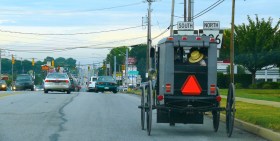
LAND OF EXTREMES A traditional Amish buggy makes its way into town (Photo: Ad Meskens).

The sight of Amish carriages crossing the landscape in the distance was an eerie link with America’s past. The culture of the Plain People contains the last vestiges of a rural romanticism that every country child can relate to.

In Ohio’s land of abundance, everything was larger than I had ever experienced. To reach the arms of the chairs in restaurants, you needed to put your arms out wide!

Then the nation awoke to terrible news that Jessica Dubroff’s plane had gone down shortly after takeoff from Cheyenne in the state of Wyoming. A brief life cut short. A dream broken in this land of big, record-breaking dreams.

Thankfully our itinerary had been adjusted, but we were asked not to delay – the subjects of our interview back in Michigan were heavily pregnant, due any day now. They couldn’t guarantee what we’d be greeted with. So we completed a long night drive across the border into Portland, Indiana, then back up to Michigan to the city of Flint, home of another great American, film maker Michael Moore.

Flint, and in fact that whole section of Michigan, was emerging from a harsh winter. Nevertheless it’s not just the climate that caused a certain down-at-heel quality.

Unlike the vasty fields of Ohio, that part of Michigan seemed rather poverty-stricken. The farmers were less welcoming and more suspicious of travellers. We got lost a few times, and the idea of knocking on doors and asking for directions was more than a little frightening.

This was long before Michael Moore’s films pricked the conscience of the western world – we were only there to interview a goat breeder.

Her flock of Boer goats was in the process of birthing its next generation, so we waited patiently while the mothers bleated. New life within a toughened landscape brought all the cheer we needed to feel better about Henry Ford’s macabre collection, about Jessica Dubroff’s life cut short, and about ourselves in the midst of a thawing state of disbelief … and more beautiful footage of brand new kids has rarely been captured, I’m sure.

© Michael Burge, all rights reserved.
Don’t f**k with Judy Davis

LOVE or hate Judy Davis, chances are you’ve seen one of her acerbic, riveting onscreen meltdowns – they’re synonymous with the media-shy Australian actress who’s long been preceded by an offscreen ‘difficult’ tag.

Already a staple in period dramas by the time of Charles Sturridge’s 1991 production of E.M. Forster’s debut novel Where Angels Fear to Tread, Davis had breathed life into array of heroines on the brink of brave new worlds, and used a decidedly English voice to do so.

“Davis levelled the F-word at the director, and she hit a sore point.”

Her debut in Gillian Armstrong’s My Brilliant Career saw Davis as Sybilla Melvin quite matter-of-factly assert to her suitors that she will never marry. Her Adela Quested, when pressed on Doctor Aziz’s crime in David Lean’s A Passage to India, eventually and quite calmly enunciates the truth.

Perhaps it was Sturridge who saw something more in Davis than polite colonial girls when he cast her as the boorish Harriet Harriton, one of Forster’s best-drawn wowsers who will not be broken down by Italy’s disarming romantic freedom.

DON’T JUDGE JUDY Davis in Woody Allen’s Deconstructing Harry (Photo: John Clifford).

After admonishing the cheering crowd at the local opera as “babies”; banging around the pensione in tears and rage, and delivering the final devastation of Forster’s story, with this Harriet Harriton, 1991 became the year the Judy Davis ‘volcano’ was finally able to erupt on the screen.

She moved on to a comic romance as 19th century French author George Sand in James Lapine’s Impromptu. The best scenes are those in which Sand verbally explodes, elucidating how it might have felt to be a woman in the period without the filmmaker having to resort to all the usual corset-tightening symbolism.

But the shrewish screen potential of this actress was fully realised when Davis appeared in Woody Allen’s Husbands and Wives as the woman who finds true love by losing it, literally…

pluck-cover
BUY NOW

300 of 1266 words. Unlock the rest of this article by purchasing Michael’s eBook Pluck: Exploits of the single-minded.

© Michael Burge, all rights reserved.