“Fans of Michael’s Tank Water will be delighted with Dirt Trap as all the signature tension and intrigue continues, two decades on from the year that his debut was set,” she said.
“Dirt Trap will no doubt also attract new fans to the rural setting where prejudice lingers against anyone slightly different.
“Michael has spun a new story that works as a standalone crime thriller and an exploration of justice for the loved ones left waiting after gay-hate crimes were swept under the rug.
“Readers who encounter Dirt Trap first can then read Tank Water as a prequel,” Solding said.
“The inimitable wry voice of main character, journalist James Brandt, is juxtaposed with two strong female voices in Sergeant Therese Lin and podcaster Rita Dillon.
“We can’t wait to share this exceptional new novel with you.”
Edgy Books
Described by crime novelist R.W.R. McDonald as, “Crime fiction at its most vital,” the award-winning author of The Nancys said Dirt Trap is, “A fearless reckoning with queer history and institutional failure.”
I’m very grateful to Rob. It’s a wonderful validation to get such a supportive early endorsement for a novel, and I’m always fired-up about working with MidnightSun.
Anna and her team create beautiful, edgy books that tell important stories.
Her company is a truly independent outfit that punches well above its weight, and I’m elated to be continuing the storytelling cycle we started with Tank Water.
I started to type my answer when it struck me that there was a novel in it.
While reporting on that world-first inquiry into gay-hate crimes, I’d interviewed surviving family of some of the men caught up in the crime wave, and I’d witnessed their resilience and grief first-hand. It felt critical to explore these themes in fiction, which allows an emotional depth that’s not often possible in journalism.
Dirt Trap is set for a November release, distributed by NewSouth Books
NOT FAR FROM genteel St Mary Mead where Miss Marple resides, less than two hours by car from Hercule Poirot’s London pad, is an essential crime readers’ destination that even staunch fans of Agatha Christie have probably forgotten about.
As the name suggests, Market Basing is a typical English market town. The wide central square is the main clue about that, although a slow tractor on any road approaching the place will likely be your first encounter with local farmers.
But Market Basing is no backwater: Christie delved into the district regularly throughout her oeuvre.
Poirot and his sidekicks Captain Hastings and Inspector Japp took a short break there in the 1920s; and Poirot and Hastings returned in the 1930s. Superintendent Battle worked a case linked to the town in 1929. Miss Marple probably never went, but she did know of a bus conductor who serviced the St Mary Mead to Market Basing service in the 1950s; and amateur spy duo Tommy and Tuppence Beresford got embroiled in a scandal there a decade later.
SALES SQUARE: Shrewsbury, an English market town
With its growing outer-urban population, the town has a general hospital (which features in Crooked House, 1949). There’s a police command (called upon in The Secret of Chimneys, 1925); a thriving high street (which inspired a shopping trip in The Seven Dials Mystery, 1929), and Hellingforth Film Studios (a key location in The Mirror Crack’d from Side to Side, 1962) is just six miles away.
But the town’s perennial industry is real estate, and the streets are replete with busy agents offering desirable farms, manor houses for rent or purchase, and large tracts of land.
Some reckon Market Basing is Christie’s stand-in for Basingstoke in Hampshire, or an homage to her final home in the Oxfordshire village of Wallingford; but true fans know full well the township is actually in the county of Melfordshire, and if you don’t know where that is you have some reading to do.
Nobody Knows Us
Start with Christie’s 1923 short story The Market Basing Mystery (published in Poirot’s Early Cases, 1974) in which Poirot, Hastings and Japp take a weekend away from the London rat race.
The story opens with a hearty pub breakfast while Japp celebrates the benefits of a gents’ country break in a place where, “Nobody knows us and we know nobody,” he says. Hastings is narrator and he makes deft observations about men, appetites and rabbits before the renowned sleuths are called on to investigate a local locked-room mystery.
Most of the action in Dumb Witness (1937) takes place in Market Basing after local spinster Emily Arundell writes to Poirot, apparently after her death. The Belgian detective recruits Colonel Hastings to drive him out to the town on the scent of a clever poisoner Poirot refers to as a rabbit.
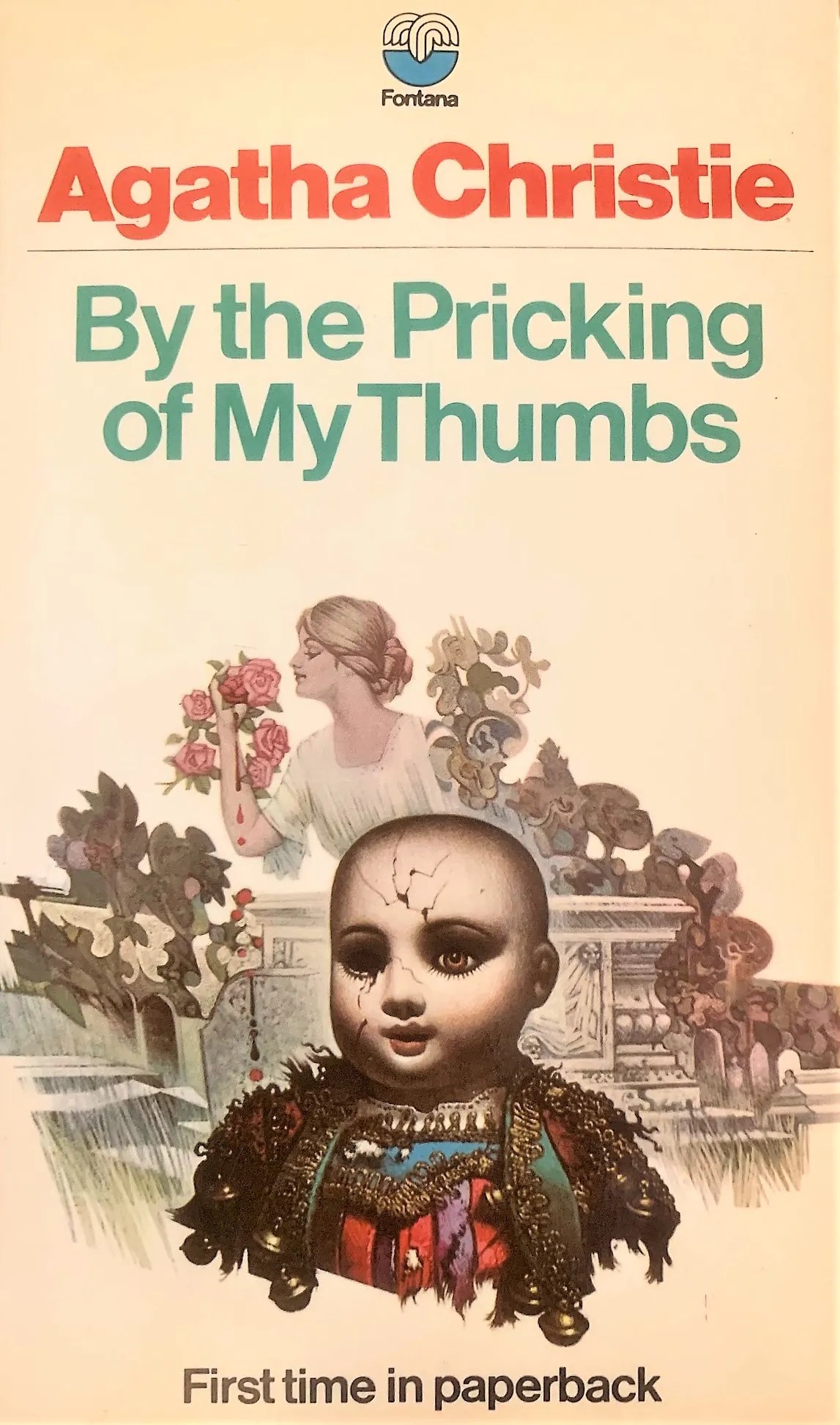
A generation after World War Two, the progress of Market Basing can be observed by joining Tommy and Tuppence Beresford in By the Pricking of My Thumbs (1968), an intriguing chase that begins in a nursing home and leads back to Market Basing, flushing out several hares responsible for missing women, jewel heists and derelict houses.
It’s here, in the last decade of Christie’s life, that she may have left clues about a rather brazen rabbit hole at the core of English country life.
Ending Nowhere
Analysis of Christie’s massive literary output often draws accusations of lacklustre storytelling. Crime author Robert Barnard’s review of By the Pricking of My Thumbs is one example:
“Half-realised plots and a plethora of those conversations, all too familiar in late Christie, which meander on through irrelevancies, repetitions and inconsequentialities to end nowhere (as if she had sat at the feet of Samuel Beckett).”
I suspect Barnard missed the point of a novel that employs meandering, memory loss and ageing as major themes; but love or loath her work, Christie was a shrewd observer of English society and documented what she perceived as its decline in the late 20th century.
She was careful to add a new county name – Melfordshire – for the setting of By the Pricking of My Thumbs, considering the changes she witnessed under the Local Government Commission in the mid-1960s; and the threat of a dormitory town being built on major landholdings in the Market Basing district in that novel.
But the Queen of Crime could be accused of a major plot hole in her collected works when she gives Poirot and Hastings absolutely no recollection of their 1923 weekend in Market Basing when they revisit the place in 1937.
Did Dame Agatha simply forget her earlier work, or are we supposed to take this crime fiction author as she presents herself, alleged ‘errors’ and all?
Rather deliciously, if we do take her at her word, Market Basing becomes even more sinister than it first appears.
Awful Things
Let’s start with a fact: Hercule Poirot rarely, if ever, forgets.
Since neither he nor Hastings refer to their 1923 weekend in Market Basing while revisiting the town twice during 1937 in Dumb Witness, they must be avoiding the memories for a reason.
RABBIT HOLE: Collection of Rabbits and Hares, 1897
Could it be embarrassment, an “I won’t mention it if you don’t” pact? Clues lie in Hastings’s 1923 pub brekky musings from a Belle Époquepoem with suggestions of depravity.
“That rabbit has a pleasant face, His private life is a disgrace. I really could not tell to you The awful things that rabbits do.”
At first glance, Hastings, upstanding gentleman that he is, appears to be comparing Market Basing’s residents to randy, big-eared, four-legged herbivores. But the depravities he euphemistically refers could be those of the men around the table.
Read the opening page of The Market Basing Mystery through this lens and the hearty breakfast devoured after a night in a town where “nobody knows us” has the vibe of the morning after a boys’ night out.
None of the men reacts to Hastings’s rabbit reference. Japp actually changes the subject back to the food. The trip was all his idea because he’s “an ardent botanist” able to reel off the botanical names of “minute flowers”.
But what if Japp’s botany is a way for a Scotland Yard gumshoe to describe his weekend predilection for plucking specimens of the two-legged variety?
If so, it’s hardly a surprise that Poirot and Hastings never again mentioned their lost weekend in Market Basing.
Specimens in the Hedgerows
Four decades on from this short story, Christie returns to the botany of Market Basing in By the Pricking of My Thumbs when Tuppence Beresford meets the vicar of Sutton Chancellor (a village in the parish) who is searching for a lost headstone in the churchyard in 1968.
At that stage, the novel is shaping up to be a beguiling, sinister tale with references to clandestine outdoor trysts, pretty young women visiting strangely empty houses and “getting into trouble”, and a serial killer who attacks girls in the woods.
So when Tuppence asks about one particular house, just like Japp in 1923 the vicar changes the subject: “… you can find quite rare specimens. Botanical, I mean,” he says.
Tuppence refuses to be fobbed off by botany, but all the talk of flowers in the hedgerows along the lonely roads around Market Basing in the 1960s might be coded language from a devout man warning Tuppence of local “goings on”.
Masterful Illusion
Rabbits and hares, flowers and hedgerows… if it all sounds like a mare’s nest, that’s because it’s supposed to.
Read Christie’s three major Market Basing stories in sequence and you’ll see the masterful illusion she wove around this district. There are no spoilers to be had (Christie took great care in that regard), but you’ll be one step ahead of Tuppence Beresford in the 1960s throughout By the Pricking of My Thumbs when you’ve had a taste of the town’s depravity from the 1920s in The Market Basing Mystery.
It’s now over half a century since Market Basing last cropped up in crime fiction. Since then it’s no doubt been absorbed into another county, the hedgerows have been bulldozed, and several dormitory towns raised and renovated many times over.
But you can still enjoy the botanical ‘specimens’ and ‘wildlife’, now you know what you’re looking for.
Main image: A Hare in the Forest, Hans Hoffmann, c.1585 (Getty Museum)
I WAS STILL packing for my long weekend away at the Bellingen Readers & Writers Festival, where I was to present my debut novel Tank Water (MidnightSun Publishing), when I got a slightly desperate call from one of the organisers, asking whether I had any short stories to my name.
I did, so the next question was whether I’d be up for a round of Literary Death Match. I’d never encountered this movement before, which has been entertaining readers and writing fans globally since 2006. A big-name author had to drop out for urgent dental work, meaning one place in the Bellingen LDM was available. So I said yes before I really understood what the whole thing was.
For an un-agented author who started out independently published and operates as my own publicist, even having a traditional book deal under my belt doesn’t stop me agreeing to everything a literary event asks of me. Such offers are so rare you’ve got to take what you get, and make the most of it.
I needed a short piece of fiction that I’d be prepared to read aloud in front of a crowd on Sunday evening. The right one popped into my mind immediately, so I grabbed my copy of my short story collection Closet His, Closet Hers and shoved it into my luggage.
Bellingen’s annual literary event is a gem of a way to spend the June long weekend. Situated in the coastal hinterland of the Mid North Coast, the community turns out in force for a huge number of visiting authors and wordsmiths.
Over the first two days of the festival, a few authors told me with great relief that they’d turned down the spare spot in the LDM on the final evening. I didn’t reveal I was the mug who’d said yes when everyone else was either too nervous or not prepared to stick around. Anyone who’d ever competed in a LDM, or who’d seen one take place, was effusive about it being “just a bit of fun”.
I sensed that was true, but my inner boy scout said: Be prepared!
So I honed the delivery of my short story ‘A Quick Fix’, which I wrote in the form of an email from a schoolgirl to her father, traversing some bitter family dynamics about an estranged gay uncle. Partly based on experience, I imbued this work with all the teenage brevity I recall from my own school years.
Bellingen’s glorious riverside parkland was the perfect place to sit in the winter sun and practice. Acting and broadcasting training goes a long way in such situations, and I needed to make a few cuts to deliver in the seven-minute time allocation, plus annotations to emphasise certain characteristics of this clarity-filled teen who delivers a dose of equality into a terrible situation.
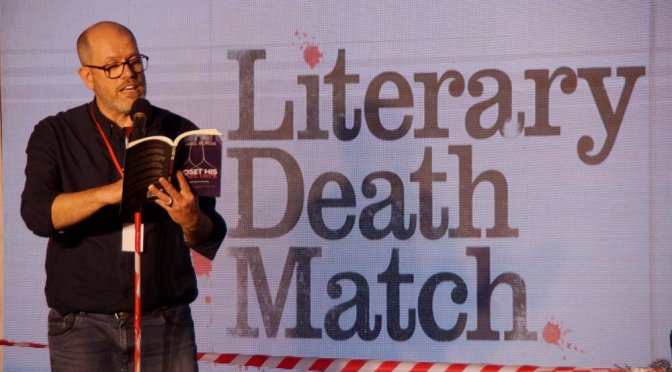
LITERARY CHAMPS: (L-R) Sofie Laguna, Sophie Overett, Michael Burge, Thomas Keneally, Adrian Todd Zuniga, Alison Gibbs, Robbie Arnott and and Costa Goergiadis at Bellingen Reader & Writers Festival Literary Death Match, June 2022.
When I met the competition – my fellow LDM authors Sophie Overett, Robbie Arnott and Alison Gibbs – in the green room, we were a herd of nervous deer about to meet a very large headlight.
I’d already been on a panel in the huge marquee we were suddenly being led to, lit up in the darkness with a capacity crowd expecting to have a blast, so I knew this was big.
Judges Sofie Laguna, Thomas Keneally and Costa Goergiadis walked up to the stage at the invitation of LDM host and creator Adrian Todd Zuniga, leaving we writers crouched down the back in the shadows. By the looks on our faces, we’d have preferred to stay there.
DEATH WATCH: The crowd at LDM
Yet we managed to go two rounds, reading to the crowd and getting bombed by literary questions. I barely remember any of it, just the glare of the spotlight and the silence as I started to read, my voice pitched slightly higher and rather quietly, to ensure I got their attention.
Paragraph by paragraph, every middle-aged one of my six feet very publicly embodied that teenage girl on the brink of discovering what equality means in this world.
And with my final line, I brought the house down, a tsunami of laughter and applause washing every bit of shame away about self publishing a collection of short fiction that no editor, agent or publisher in the country had ever thought enough of to get behind.
In the aftermath, my copy of Closet His, Closet Hers was torn from my hand so that a reader could look up where to buy it. A big name author asked me in the green room who published it. I pointed to myself, which is what I did once at another event, when a bestselling author asked me who my publicist was.
Eyebrows go up in such moments, mine more than anyone’s, because for a short time it’s not about the luck, the opportunity, the contacts, the networking, the five-year plan or the affirmations… it’s simply about the writing.
That’s the beauty of Literary Death Match, writing really is the winner.
Here’s my top tips for anyone recruited into LDM: – It is fun, and the rules are there to be massaged, purely for entertainment value. When Adrian called time on me, three times, I waved him off and kept reading – Be bold and read with all the characterisation you can muster – The crowd is pumped and on your side, they know writers are very often shy and retiring and LDM is a raucous big deal – It’s fast, and will flash by in a heartbeat! – You can read self-published, emerging work, so give the crowd an early literary experiment!








 Michael Burge Media