Category Archives: Writers

The tale of a legend

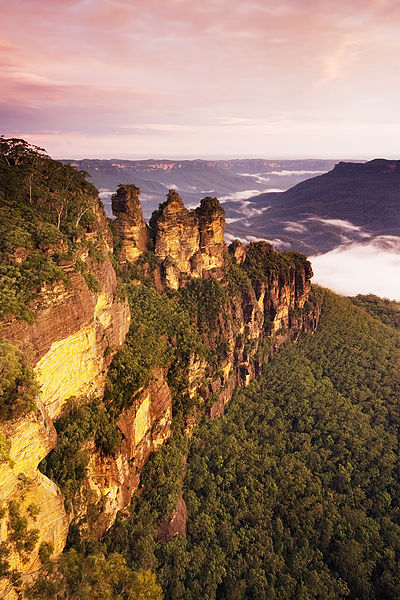
STONE SISTERS The Three Sisters rock formation abive the Jamison Valley, Echo Point, Katoomba, Blue Mountains, Australia (Photo: JJ Harrison).
STONE SISTERS The Three Sisters rock formation above the Jamison Valley, Echo Point, Katoomba, Blue Mountains (Photo: JJ Harrison).

A short look at a tall story

WHEN I arrived back in Australia after living in the UK for most of the 1990s, I was attracted back to the region where I did most of my growing up – The Blue Mountains, a World Heritage wilderness only 100 kilometres west of Sydney.

I eventually settled there and fell in love with the place all over again, embarking on a research and writing cycle that would continue for the next twelve years.

This all began with the news that the region’s ‘original’ story, the so-called ‘Legend of the Three Sisters‘, which had been taught to generations of Australian children as a genuine Aboriginal myth (and sold to millions of international tourists), had in fact been made up by a non-Aboriginal man.

I was eventually given the opportunity to publish a feature article on this subject in the December-January 2011 edition of Blue Mountains Life Magazine (Vintage Press).

Aboriginal and Torres Strait Islander readers are warned that the following article contains images and references to deceased persons.

Legends, Interrupted

How the Aboriginal legend of the Three Sisters trumped a tall story

Across the Mountains of the late 1970s wonders were common – a witch’s shadowy profile cast across rocks, colourful mountains devil ornaments, and a train ride straight down a cliff. My young imagination also lapped up a legend told on postcards, tea towels, a fountain, and an illustrated book.

The legend told of three Aboriginal sisters who disturbed a bunyip in the valley and were saved by their father who turned them into stone using a magic bone. He transformed himself into a lyrebird to escape, but in doing so lost the bone, leaving him to search the undergrowth (as lyrebirds do) so that one day he might find it and turn them all back into human form.

This story held more intrigue for me than explorer’s achievements, which were taught with a sense of pride at school. But there was a silence on local Aboriginal heritage, and I grew to assume there was little to know about the tribe in the Three Sisters legend.

Fifteen years later I attended a reconciliation meeting and met Gundungurra and Darug people mobilising to work on Native Title claims. Around that time a story hit the local media that the Aboriginal legend of the three sisters was created by a non-Aboriginal man. In the fallout, even that claim turned-out to be untrue – the first fake was actually written by a caucasian schoolgirl with a rather apt surname – Patricia Stone.

SIXTIES SISTERS Lyall Randolph's water sculpture of the Three Sisters graced the entrance of the Scenoc Railway from the 1960s to the 2000s (Photo: Tim Driver).
SIXTIES SISTERS Lyall Randolph’s water sculpture of the Three Sisters (Photo: Tim Driver).

“None of that was a revelation to Gundungurra people around here,” Gundungurra Elder Sharyn Halls says at Echo Point this year. “We always knew what the tourists were told was a made-up story. Many of us thought it was quite funny what visitors were willing to believe.”

The day is just dawning and already flocks of tourists are arriving to take in the panoramic view which is one of the Blue Mountains’ biggest drawcards.

“My father Lenny McNally used to stand me and my siblings here and tell us the stories about the land all around,” Sharyn says, sweeping her arms from east to west. “The story of this place is much, much more than the Three Sisters, from here you can see all the waterways and pathways of our traditional land.”

Sharyn grew up in Bankstown, but spent weekends and holidays in the Blue Mountains. “We’d go camping out to the Megalong Valley with Dad and our immediate and extended families. After a while we realised we were only being taken to places that were important, we were being shown our country. During those trips I learnt how to catch and gather food, and other skills to do with family life, from my Nana Lindsay.

LOCAL KNOWLEDGE Gundungurra Elder Sharryn Halls.
LOCAL KNOWLEDGE Gundungurra Elder Sharyn Halls.

“Dad liked to travel, to the Southern Highlands and out to Jenolan. He was a jockey and he’d round-up the wild brumbies from the valleys. In the Megalong he’d break them in, then muster them into Camden for sale.

“He knew the best way to get there through the mountains – he’d been taken out there with the old men who still spoke traditionally, and they knew the routes between all these places. But Dad wasn’t taught his language, only bits and pieces. Unfortunately he and his generation had to change to survive.”

Survival for Gundungurra people meant making difficult decisions when forced to leave their country.

“People ended up in Katoomba in a place they already knew and used called The Gully,” Sharyn relates. “They made a conscious decision to come, because there were resources here, and they could avoid the mission system. If you ended up in a mission you were only encouraged to settle down. The movement of Aboriginal people was restricted right into the 20th century.”

Gundungurra man Ron Fletcher recalls: “Our family lived for two periods in The Gully in about 1940 and 1949. Everyone got on really well down there because we were all battlers”.

“Our Aunty May and Uncle George Hannah, and Uncle Jack Brooks were still living in The Gully when they built the Catalina Racetrack,” Ron recalls of devastating events in 1957, when Gully residents’ homes and community were demolished to make way for a commercial racing development.

“It wasn’t until 1988, when they put up a memorial at the old Megalong cemetery, that my sister Dawn was reminded that our great grandparents were buried down there. That got her curious about our Aboriginal heritage. Dawn was never a backwards kind of person,” Ron smiles. “She felt very strongly about that side of her, and many people with Aboriginal blood were starting to take notice of how things were changing.”

Dawn Colless (1932-2003) became ‘Aunty Dawn’, elder of the Katoomba Clan of the Gundungurra at a time when local indigenous people began reclaiming their place in the Blue Mountains. One point of focus was The Gully, where the Catalina racetrack had long since fallen into disrepair.

An excellent speaker heard by many giving Welcomes to Country, Aunty Dawn told anyone who would listen about the significance of Gundungurra places and sacred sites. She was also the keeper of a secret she’d been entrusted with as a girl by her mother and grandmother – a legend about the Three Sisters.

“Our Aboriginal family had to be very careful when telling us about the old ways – they were frightened we would be taken away,” Dawn’s brother recalls. “I can remember the inspectors coming to our house twice,” Ron smiles, “I think when they saw we all looked well-fed, that we were being looked after”.

“Not many people realised how ill Dawn was in her last years,” Ron remembers. “She was determined to do what she could in the time she had left. Not long before she died, she agreed to meet some visiting indigenous women. They told her the Three Sisters were linked to the Seven Sisters, and a sacred site as important as Uluru.”

In 2002 Dawn told what she knew of the legend of her mothers to the Gundungurra Native Title hearing. Local authorities began to consult with Gundungurra people about public versions of the legend of the Three Sisters. The Gully, or ‘Garguree’, was proclaimed an Aboriginal place in the same year.

Sharyn Halls is adamant that: “It’s about time the traditional people of The Blue Mountains take a leading role in tourism here, to get out there and understand their country, to be independent, not reliant.”

“So much information about our stories has been lost because we didn’t really have anyone to ask,” Ron says. “We are the last to remember our Aboriginal side. It was always in me, but I was very reluctant at first. Dawn was so passionate about Aboriginal affairs that she inspired me.

GULLY GUIDE Gundungurra Elder Ron Fletcher showing local dignitaries the entrance to Guragaree, 'The Gully', Katoomba.
GULLY GUIDE Gundungurra Elder Ron Fletcher.

“Sometime I go to The Gully to interpret it for visitors as part of the Reconnecting to Country project, with some of the other Gully elders. I’ve been on trips down to the Burragorang, and it makes you feel strong, and you feel they’re walking with you, your family who have been there long before you.”

Today, many tourist destinations in the Blue Mountains assiduously avoid interpreting the Three Sister story at all, but a public version of the Gundungurra legend is available. What’s interesting to note is the inclusion of Patricia Stone’s names for the sister – Gunnedoo, Wimlah and Meenhi – the result of a variety of spellings over the years.

“Because of what happened to Gundungurra people, the continuity of our stories was broken. Our stories were diluted with other stories. The structure is there, but it’s in a different form,” Sharyn Halls outlines. “The important thing is that you don’t interpret someone else’s story on their behalf, you only tell your own. Patricia Stone’s story is one version, many people don’t really care it got told so much”.

“The legend of the Three Sisters is just basic practical education for youngsters not to stray from the safety of their home. It’s a thread that runs through all the versions I know of,” Sharyn explains. “Some of the names are a bit strange,” she laughs, “but nevertheless people have used them. I believe one hundred percent that’s what the legend is.”

© Michael Burge, all rights reserved.

Secret Means Business

TALE FOR SALE Victor Barnes' 1972 Golden Book.
TALE FOR SALE Victor Barnes’ 1972 Golden Book.

Milestones in the commercialisation of the fake Aboriginal Legend of the Three Sisters.

1931 The Sydney Morning Herald publishes ‘The Three Sisters’ by Patricia Stone (who visited Katoomba c.1925). The names ‘Wimalah’, ‘Meeni’ and ‘Gunedoo’ first appear in print. The sisters are giants turned to stone by Yooma (a tribal wizard) to protect them from a neighbouring tribe during a battle.

1949 Outdoors and Fishing Magazine publishes ‘Legends of the Mountains’ by naturalist Charles Melbourne (‘Mel’) Ward (1903-1966), who moved to the Mountains in 1943. Patricia Stone’s version is used uncredited in reworded form, including her names for the sisters.

TALE TELLER Naturalist Charles Melbourne ('Mel') Ward was resposible for disseminating the fake legend of Katoomba's Three Sisters.
TALE TELLER Naturalist Charles Melbourne (‘Mel’) Ward.

1950’s Mel Ward distributes Legends of the Mountains from his museum in the grounds of the Hydro Majestic hotel in Medlow Bath, claiming to have been told the legend by Aboriginal people.

1967 Bondi Mermaid sculptor Lyall Randolph’s Three Sisters fountain is installed at The Scenic Railway, telling a variation of Stone’s legend with coin-operated narration punctuated by water spouts. The money is donated to charity.

1972 Golden Books publishes The Legend of the Three Sisters by Victor Barnes, a new illustrated version of the transformation of the three sisters into stone by their father to save them from a bunyip.

1997 The Blue Mountains Gazette published ‘The Three Sisters story Untrue?’ in which linguist Charles Illert proposes: “The story behind Katoomba’s Three Sisters may be a myth created by white men with large imaginations.”

2000s A new (as yet incomplete) sculpture by Terrance Plowright replaces Lyall Randolph’s at Scenic World (formerly The Scenic Railway) in Katoomba.

2013 Various non-Aboriginal versions of The Three Sisters legend still disseminated in written form to Blue Mountains tourists.

ROYAL INTERPRETATION The Duke and Duchess of Cambridge with Anthea Hammon and Randall Walker at Echo Point.
ROYAL INTERPRETATION The Duke and Duchess of Cambridge at Echo Point.

2014 During the 10-minute visit of the Duke and Duchess of Cambridge to Echo Point, local business identities Randall Walker (interim CEO of Blue Mountains Lithgow and Oberon Tourism) and Anthea Hammon (joint managing director of Scenic World) interpret the Jamison Valley for the royal couple.

Gundungurra and Darug elders and tourism representatives meet the Duke and Duchess but are not visibly seen to interpret their traditional lands for the visitors.

(Source and further reading: ‘Aboriginal Legends of the Blue Mountains’ by Jim Smith, Den Fenella Press, 2003).

This article appears in Michael’s eBook Creating Waves: Critical takes on culture and politics.

Beth Chatto – a natural subject

A GARDENER'S PLACE Award winning plantswoman Beth Chatto (Photo: Alamy).
A GARDENER’S PLACE Award winning plantswoman Beth Chatto.

A Writer’s year with a great gardener.

WHEN I first arrived at the Beth Chatto Gardens in midsummer 1996, a bright, animated woman called Rosie greeted me and showed me into the house, where gardener and writer Beth Chatto hosted me for morning tea.

I was there to investigate the viability of producing a documentary on Beth and her work, and what struck me immediately was her gracious nervousness. Taking nothing whatsoever for granted, this multiple Chelsea award-winning gardener was as vulnerable as an auditioning actor.

She’d loved the program one of my colleagues had made about another respected local gardener – Suffolk’s Peggy Cole – because it had captured the truth about what it takes to nurture an English garden, and she hoped I could do the same for her.

Once outside, and more relaxed within the fluid environs of her garden, Beth related that she’d made a program about her garden before, but to date, she felt, no-one had captured what the Beth Chatto Gardens was really all about.

We walked, we talked, and Beth encouraged me to get right within the garden itself, to tread through beds to see the workings of the water garden or the structure of the gravel garden.

Passing a small group of visitors, she introduced herself, directly but politely, to a woman who was taking cuttings, not by reprimanding the culprit, but by saying, “Please, feel free …”, despite the well stocked nursery on the other side of the hedge.

That mixture of shock at her garden being picked-at, and her inner turmoil at wanting to share it without rancour, showed a complex woman with a very interesting story. All I wanted to know was when could we start?

I read as much as I could about Beth’s work and her place in post-war English gardening. She patiently gave me time to catch-up, but underlined that we’d need to spend time in the garden, perhaps an entire year, to film it in its fullness.

As a producer new to the company he worked for, that meant I needed to test budgetary terms, and face questions about when the product could be ready for the marketplace. Could the execs wait another Christmas? Had this territory already been covered enough by another company?

GULLY TRANSFORMED The water garden at The Beth Chatto Gardens (Photo: The Beth Chatto Gardens).

The best thing I could think to do was simply to start. A cameraman, Alan James (another Essex gardener in his own right), and me, just filmed as the seasons cycled, as they do so dramatically in England. Along the way, I felt sure I would find a way to make the project work for all the stakeholders.

Beth Chatto’s ornamental garden is just one part of her work. Situated at the end of a farm lane, not far from the Essex town of Colchester, it occupies a small gully between working farm fields which Beth and her husband Andrew transformed into their world famous garden.

A commercial nursery makes up almost half of the property, and much of that is taken up by large-scale compost production. I recall Beth’s delight when we proved ourselves willing to film tractors at work on steaming piles of leaf litter. Her approach to our company, with its track record for making programs about farm machinery, was paying off.

On one day’s filming in winter, a quiet, well-dressed man (who looked a bit like I’d imagine a Russian philosopher would) was seated on the other side of the fire in the garden office when I arrived. Rosie asked me to take a seat to warm myself, and Andrew Chatto gently introduced himself.

Beth credits her husband Andrew Chatto with the original inspiration behind their garden for one very simple reason. It was Andrew who came up with the idea of finding plants from across the temperate world, and to grow them in England under conditions that were suited to their needs. This was Beth Chatto’s ‘right plant, right place’ concept in a nutshell.

To explain why such a basic philosophy became so revolutionary, you’d need to tackle centuries of horticultural collecting conducted by the great botanists who accompanied Britain’s explorers on dangerous voyages to bring seeds and cuttings back home.

The famous glasshouses of Kew were built to house this booty, and to keep it alive against the cold climate. The movement eventually encouraged generations of ordinary gardeners to buy whatever plants we liked, stick them in our back yards, and hope for the best.

Beth and Andrew were every bit as exploratory, not just because of their plant-inspired travels, but also because the climate and soil in Essex are not what you’d call typically English. Certainly the annual rainfall is not what other counties enjoy. The Chattos were also not afraid to wait many years to see what happened.

And what happened speaks for itself … the scrubby gully is now a stunning series of gardens that descend almost imperceptibly along a natural water-course. Preceding Beth’s well-loved books on water and shade gardening, these immaculate green spaces were her laboratory in an ongoing love affair with plants.

DROUGHT CONDITIONS Beth Chatto's Gravel Garden.
DROUGHT CONDITIONS Beth Chatto’s Gravel Garden (Photo: Alamy)

Our filming coincided with the peak early years of Beth’s latest project at the time – her gravel garden. In an ongoing experiment, quite ahead of its time, she vowed to never irrigate this garden, to test the boundaries of gardening under drought conditions, well aware of the tussle to come between farmers and gardeners over access to water.

Here was something an Australian could really get his head around – the gravel garden at the Beth Chatto Gardens reminded me of home, with its sparse, elemental feel and the heat that emanated from the ground, literally inches thick with small stones and filled with plants familiar to me from roadsides in the Outback.

As the months passed we got to know Beth’s staff quite well. I would often catch a glimpse of her observing our filming processes from a distance, and once she saw her gardeners chatting with us and surrendering to the often annoying process of, “now, could you just do that again, and we’ll film it from this angle …”, she would disappear into the house to get on with other work.

As an interviewee on camera Beth Chatto proved a natural. I realised very quickly that I’d only need to capture her in conversation and get Alan to just turn the camera on. Years of communicating her story had given her an edge that needed no other commentary.

In the last few months of filming, Beth kept gently reminding me that she’d like some group shots of the staff, and on one day in the Summer of 1997 we got everyone to down tools and take part in a photo shoot that we committed to tape. As the centre-piece to those moments, I saw Beth about the happiest I’d ever seen her.

She also understood innately what I was doing when I asked one of our execs to be an extra in a whole day’s filming, our one ‘big budget’ spend, working with a crane to capture high-angle motion shots. Beth guided my boss through the highly repetitious process of take after take, until we had it just right.

I became a gardener as a result of my year with Beth Chatto. What I know about gardens I learned from her, particularly about how to live in a garden and not be too precious about the life that runs through it – pets, visiting wildlife, and people who like to take cuttings.

15143985-item-main-cover-4

The Beth Chatto Gardens DVD is available from BecksDVDs.

© Michael Burge, all rights reserved.

Helene Hanff – lady of letters

MISTRESS OF MISSIVES Helene Hanff (1916-1997) made a career of letter writing.

COULD there be a better proponent of written communication, a smarter wordsmith, a more ‘writerly’ writer than New York denizen, Queen of the day job, rejection letter collector, and one of the world’s biggest fans of English Literature – Helene Hanff (1916-1997), author of 84, Charing Cross Road?

Of all the writers I admire, I cannot think of one who deserved more to have lived long enough to write in the age of blogging.

It could be argued that Helene Hanff invented the style of writing now employed almost blindly by bloggers the world over – the confessional epistolary genre, studded with emotion, was embedded in her genes, and her unbeatable use of it was borne of her own life experience.

“I’m a great lover of i-was-there books,” she wrote in her most famous work.

“That her nature often resulted in alienation gives her story all the more pathos.”

Overwhelmed by a sense of failure and loneliness in her fifties, after the collapse of some long-held dreams about becoming a Broadway playwright (not to mention the four decades she spent trying), Hanff received news that one of her oldest friends had died.

This was bookstore manager Frank Doel of Marks & Co. at the address made famous by the title of her book, in the city of London, England.

The two had known one another since 1949. Hanff was devastated.

Forget that she had never been to London. Forget that they had never met face to face. Through their two decade correspondence, Doel and Hanff had developed a unique long distance friendship.

There was no overt romance, but there was a great and tender mutual love of English Literature – Hanff the reader, and Doel her literary scout, seeking-out affordable copies of the classics for a writer of limited means eking out an existence in New York City.

Compelled to document what may have felt like one of the more meaningful relationships in her life, Hanff embarked on what she thought would be a very small work.

MEETING OF MINDS First edition cover of Hanff's most famous book.
MEETING OF MINDS First edition cover of Hanff’s most famous book.

It’s hard to put a finger on why 84, Charing Cross Road resonates with readers. Beyond the letters between the main characters, Hanff (and Doel, in his replies) recorded the early post-WWII years on both sides of the Atlantic, through to the revolutionary late 1960s. On the journey, they held steadfastly to literature as the world changed around them.

I first encountered this story in its 1987 film adaptation, starring Anne Bancroft as Hanff and Anthony Hopkins as Doel.

What spoke to me was the idea that Hanff fed her soul without really leaving her living room, which some might consider limited, but which struck me as profoundly imaginative.

She really was an armchair traveller who reassured people the world over that where we were, right at that moment, was neither limited or mundane, if only we could read and access our imaginations.

I felt I was starting to understand Hanff better when I read one of her most revealing paragraphs in the sequel, The Duchess of Bloomsbury Street, when she described how she stumbled into what is known as the Actors’ Church in London’s Covent Garden, and promptly burst into tears at the sight of the small plaque in memory of Vivien Leigh.

It also says a lot that Hanff doesn’t explain why. Her sentiment was very personal, but it was also very private. She seemed to take plenty of secrets to her death in 1997, leaving behind much speculation about her life.

Although readers and fans got a rare glimpse into Helene Hanff’s life in a 2014 tribute written by her cousin, writer Jean Hanff Korelitz, who recorded her first meeting with her famous relative.

“Helene turned out to be a small woman with the wiry build of a preadolescent boy, and she dressed in a style that had seen her through decades of a writer’s life: wool trousers, cardigans, flat sneakers, everything well worn and often less than scrupulously clean,” Korelitz wrote.

“She had a barking voice, a wry perpetual smile, and a pageboy haircut that veered in colour towards a not entirely natural rust.”

These observations make Hanff sound like a short Katharine Hepburn, but it was Hanff’s response to her young cousin’s first published book that is the more revealing memory. According to Korelitz, when Hanff questioned, brusquely, why Korelitz wrote something “like that?”

“Five minutes later she called back, in tears. ‘I’m sorry,’ she wailed. I was stunned, and tried to persuade her that it was nothing, but she didn’t believe me, and she was right; when she died the following year there was still that skein of discomfort between us.”

These moments are reminiscent of similar turning points in 84, Charing Cross Road that do not appear in the correspondence, but rather provide the links between Doel and Hanff’s letters.

For example, when Hanff writes of sending a food package to the staff at the London bookshop in the middle of Britain’s postwar rationing, only to realise that the six-pound ham in it may have meant any kosher Jewish staff would miss out, she cares enough to write and make other arrangements.

In these anecdotes, Hanff reveals herself as an ‘act first, think second’ character, but one who was never afraid to try better next time.

Confronted with her younger cousin’s publication success, the woman who’d waited until she was almost fifty to make her own literary splash, and only did so by writing primarily about herself, Hanff’s response to Korelitz is understandable.

But it’s this combination of a strong individual who showed actions of great empathy that provides the dynamic attractive force in Helene Hanff, and, by extension, her work. That her nature often resulted in alienation gives her story all the more pathos.

A loyal respondent to the thousands of fan letters she received (and, according to her obituarist, kept in relative poverty for a few years from the postage costs), Hanff’s true life’s work was probably in these letters, surely scattered across the globe by now.

One day, Hanff’s replies to these fan letters may provide an even deeper account of this intensely private woman who preferred to put things in writing – after all, her breakthrough work (and certainly her most enduring), is ‘just’ an edited collection of letters.

If only the rest of her missives could be collected.

Her correspondence style was direct, humorous, polite, punctuated by outbursts in capitals and underlinings for emphasis (you can hear the clack of her typewriter in the execution), and you’ll never catch her abrevi8.

It’s tempting to imagine what Hanff would think of all the communication problems modern internet participants encounter in their use of written language. I’d like to think she’d write: “GET OVER IT and just READ, for God’s sake!” and: “TONE, you think I used a TONE with you? Of course I did …”

pluck-cover
BUY NOW

If she were alive today, Helene Hanff would preside over the world’s most followed literary blog, from which she’d broadcast her wry empathy to the world from her kitchen table. Would Twitter’s 140 characters have given her the space to say what she wanted? I am sure she’d have found a way; but emoticons? NEVER!

© Michael Burge, all rights reserved.

This article appears in Michael’s eBook Pluck: Exploits of the single-minded