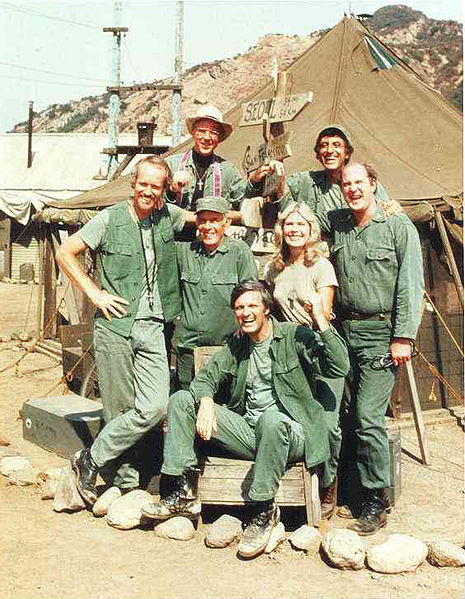
SERVING OF M*A*S*H The cast of the long-running TV sitcom during its 8th season.
A Writer’s first lesson in comic timing.
WHILST participating in a television interview, Cate Blanchett apologised for answering a question about acting using an American accent, explaining that to her, ‘American English’ is the language of comedy, after years of watching M*A*S*H.
Being of exactly the same generation, I can only agree with her.
This long running sitcom, set in a Mobile Army Surgical Hospital during the Korean War of the 1950s, was my very first ‘adult’ experience of television.
As the child of a nurse, it was considered appropriate viewing for my first years of staying up late.
“It’s a well-known maxim that all great comedy springs from the worst situations of human deprivation.”
The fun-filled yet desperate world the characters inhabited worked its way into the very fabric of my writer’s brain, just as it was in the process of forming.
When I am writing comedy, all the classic scenarios of M*A*S*H spring to mind, because between 1972 and 1983 the writers explored every comic angle they could think of. Thanks to syndication, the series has been playing across the world’s television screens for four times longer than it aired originally, and counting.
The secret of the comedy lay not in what was overtly funny, but rather in what was deadly serious about life for Americans stuck in Korea patching-up the wounded.
It’s a well-known maxim that all great comedy springs from the worst situations of human deprivation. Pathos tempers farce. Sadness frames wit. Laughing in the face of death is always more three-dimensional than laughing or crying alone. The two states are very close in the human experience.
M*A*S*H capitalised on those extremes, from the original book MASH: A Novel About Three Army Doctorsby ‘Richard Hooker’ (a pseudonym for Dr. H. Richard Hornberger and W.C. Heinz), where the basics of the show’s characters were created, to Robert Altman’s 1970 satirical black comedy feature film M*A*S*H and the series it inspired.
But the TV series had the time and the following to explore the dynamic to its extremes, and evolved from slapstick (think ‘Hot Lips’ Houlihan and Frank Burns cavorting, as though no-one knew they were having an affair), to a kind of black comedy that was borderline drama by the time the show took its final curtain call in the feature-length series finale Goodbye, Farewell and Amen (1983).
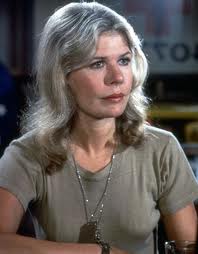
For me, the array of three-dimensional male characters who joked, sported, laughed, cried, cross-dressed and generally expressed themselves in ways that it was rare to see men behave in the ‘real world’, were beautifully countepointed by one of my all-time acting heroes – Loretta Swit.
MAJOR HERO Loretta Swit, who played Major Margaret ‘Hot Lips’ Houlihan for the entire run of M*A*S*H.
Stunning, prickly, sympathetic, quick-witted, great at her nursing job, devoted to the army and her country, yet willing to take emotional risks at the drop of a hat, how could you not love Margaret Houlihan, the winning smile that lit up the khaki cloud of Korea?
Swit’s work as Major Houlihan ranks amongst the best-drawn television performances ever, but she had her work cut out for her. Alan Alda (who is the only actor to perform in more M*A*S*H episodes than Swit, as Captain ‘Hawkeye’ Pierce), paid tribute to her achievement in transforming the ‘sex bomb’ tag that the role was originally drawn with, by turning ‘Hot Lips’ Houlihan of 1972 into simply, ‘Margaret’, by the show’s end in 1983.
Interestingly, this change coincided with the women’s liberation movement, and remains one of Pop Culture’s best examples of the metamorphosis of a stereotype.
Apart from being the best education in comic timing I can think of, the series is also a great example of time economy in a script. Next time you watch an episode, notice how the half-hour format restricts the use of too much foreshadowing and requires simple, fast set-ups to every laugh.
If you’re re-writing a script and you need to touch-base with how it should be done, whether it’s a comedy or a drama, watch an episode of M*A*S*H.
We arrived on time, were seated amongst an array of other school groups, and waited for the performance to begin.
Eventually, a lone figure – one of the actors – walked sheepishly onstage to deliver an apology.
One of the school groups (a busload of students from the Central West, apparently) was late, and the stage management had decided to wait for their imminent arrival. It seemed a little inappropriate that one of the actors was selected to give us the news.
Whether he was playing Vladimir or Estragon was not clear – he wore the Chaplin-like baggy pants and bowler hat of Beckett’s main characters, and he sat on a chair, like the rest of us, and waited.
And waited … and waited … and waited.
As teenagers, we all did what teenagers do while they’re waiting. We got impatient. We gossiped. We heckled one another. We heckled the actor. We did everything we’d predictably do. I recall going inside myself, my outer shell not showing impatience, but I was seething inside, thinking: “Typical country school, couldn’t leave home on time … now we won’t have any shopping time before we have to go home on the train.”
Eventually, it seemed even the actor had waited enough. He sat upright and addressed us, but not to make a further announcement. The lights went down suddenly, leaving only a spotlight on his face, and, using Beckett’s words, he berated us all for being so foolish as to believe his cunning little trick of making us understand, whether we liked it or not, what this classic piece of Absurdist Theatre is really about.
And that wasn’t all. There were no other actors to this production. Usually, Waiting for Godot has a cast of five. Very quickly it became apparent that we were going to be roped-into this production, quite literally.
And there was no such thing as personal space. The actor proceeded to push his way along certain rows, unravelling a rope as he went, thick rope that weighed into our laps. No amount of complaining got through to him, as he sectioned-off an entire block of the audience to evoke the roped-by-the-neck character Lucky, by whipping the rope with each hand. Many of the lines were delivered directly to people in the front row. “Poor them,” I thought, “lucky we weren’t seated down there.”
The effect got right under my teenager’s shell, cut through all my boundaries, and made me respond against my will.
ABSURD THEATRE Sydney Theatre Company, housed in a wharf on Sydney Harbour.
I don’t think the actor took a curtain call. We poured out into the foyer, and I quickly disappeared on foot. I couldn’t wait for the bus – I just walked.
I strode through the city, walking over two kilometres, trying to rid myself of the feelings. Muttering how ‘bad’ the show was. Questioning why they couldn’t have done ‘Godot’ traditionally, whatever that meant.
I eschewed the shops, too unsettled to think about more than these feelings, got on an early train by myself, and settled into my seat feeling like a bit of an idiot.
The rhythmical rocking of the train unravelled me bit by bit, until I could reflect, at a distance, on what a brilliant production I had experienced.
It lead to me following a career in the performing arts, hoping to be a part of an industry which could affect people that way.
In two decades, I have never been quite so literally ‘moved’ by a piece of theatre.
AT the age when society would have preferred I formed a teen crush on Arnold Schwarzenegger, I developed an addiction to the work of Meryl Streep.
It started with a video night for my mother and one of her nursing friends. The film was Sophie’s Choice (1982). I plonked myself down in a bean bag, thinking it would be a bit of a distraction. Then the magic began …
As the layers of grief were stripped away in this story, Streep took her flaying knife and removed the last of my outer shell, piece by piece, as she led me through the guilt of Holocaust survival.
In many ways, the experience opened my heart, and my willingness to allow this idea of pain to be planted in my consciousness came with the stark realisation that I was quite different to other boys.
But Streep’s work was always a great solace for that realisation, and I devoured it all, willingly.
By the time she played Sophie Zawitowski’s devastating journey, she’d already portrayed a few ‘difficult women’ – a terrible pop-culture term to describe complex female characters. Female protagonists, basically.
Think Joanna in Kramer vs. Kramer (1979), the mother who does the unthinkable and leaves not only her husband, but her child. Think Sarah Woodruff in The French Lieutenant’s Woman (1981), the governess who entraps a society gentleman in her web of melancholia.
Sophie Zawitowski was every bit as elusive, with her escapist surrender to the sensations of sex and play in the wake of her years in Auschwitz.
Soon after, Streep took on the role of Susan Traherne in the screen version of David Hare’s Plenty (1985) – perhaps one of the most ‘difficult woman’ characters in postmodern theatre. Perpetually dissatisfied, Susan tries to make herself happy through work, motherhood and relationships, but none of it matches the adrenalin rush of her years as a WWII resistance fighter in France.
This role was eclipsed by Streep’s turn as the more romantic Karen Blixen in Out of Africa(1985). Although Blixen was just a less abrasive ‘difficult woman’, with her corrupt marriage, her refusal to bend to colonial rules, and her devotion to a man who expressed little more than a transitory connection to her.
VILIFIED MOTHER Streep as Lindy Chamberlain (Photo: Vivian Zink).
Streep’s portrayal of Lindy Chamberlain, accused of fabricating the abduction of her baby by a dingo in the Australian desert in A Cry in the Dark(1988) was her most stunning transformation to that point. A woman of strong faith who disdained the role of victim, Chamberlain was vilified, tried, jailed and exonerated for the murder of her daughter Azaria.
By the end of the 1980s, Streep went on to play the intriguing role of sex queen Mary Fisher in She-Devil (1988), based on Fay Weldon’s novel about a ‘difficult woman’s’ revenge; and was the ultimate female control freak in her portrayal of President’s wife Eva Peron in Oliver Stone’s political musical masterpiece Evita (1989).
This unstoppable run continued with Streep’s turns as Miss Kenton, the housemaid who niggles at the heartstrings of the head butler in Mike Nichols’ production of Remains of the Day (1991); and as formidable poet Joy Gresham, who opens C.S Lewis’ heart in Shadowlands (1993).
Hang on … is that right? This writer’s got it wrong, hasn’t he? Check your facts, Mike! Meryl did chase the dingo from her tent, but you’re treading on the careers of Emma Thompson, Debra Winger and Madonna!
Okay, rewind …
To date there has been no comprehensive biography of Meryl Streep. If there ever is, to be complete, it must explore her ‘wilderness years’, where critics and film buffs rather generously describe her as experimenting with comedy and the action genre.
British film critic Barry Norman interviewed Streep in 1993 and asked her outright why she agreed to be part of She-Devil at all. Drawing him with one of her sharp stares, she put on a slightly comic voice and said: “Because I liked the one they did over here …”, referring to the BBC’s 1986 adaptation of Weldon’s novel, The Life and Loves of a She-Devil.
What might have attracted Streep was the original atmosphere, and climax, of the book and the TV series, which required the actress playing Mary Fisher to also play the very She-Devil herself. It was a plot twist like no other, and to have seen it in Streep’s hands would have been a real cinematic treat, but it was left out of the schlocky Hollywood version.
Streep’s preparation for the role of Eva Peron – singing and dancing rehearsals, and the recording of some of the musical’s tracks for Andrew Lloyd Webber’s approval – are well documented. A 1989 New York Timesarticle cited security concerns about planned location work in Argentina, and an escalating budget complicated by Streep’s salary demands during delays in the doomed Oliver Stone production.
Mike Nichols was to direct Harold Pinter’s adaptation of Booker Prize winning novel Remains of the Day, and screen tested Jeremy Irons and Meryl Streep for the leads. In an incident which has had only cursory exposure, Nichols did not believe this casting would work. Why that might have been the case (especially since both appeared to widespread acclaim in The French Lieutenant’s Woman a decade before), is unknown. A 1994 New York Timesinterview with Streep outlined how nobody had the guts to inform her, and confirmed that she sacked her longtime agent as a result. The Nichols-Pinter version was shelved until Merchant Ivory picked up the material, with new leads.
So why did Meryl Streep – a two-time Oscar winner at this point – find it difficult to land the roles she wanted? Had demanding a ‘pay or play’ clause during production delays on Evita labelled Streep as ‘difficult’ as her characters?
In the absence of any objective analysis, we’ll have to wait until Streep opens up.
By the time Clint Eastwood was on board to direct and star in The Bridges of Madison County (1994), plenty of other actresses had been talked-up for the female lead, but Eastwood got Streep’s number from Carrie Fisher (screenwriter of Postcards from the Edge), circumvented any Hollywood agent protocols, and asked the actress if she was remotely interested?
Streep reportedly upped-sticks and arrived in Iowa for filming at the drop of a hat.
The role of farm wife Francesca Johnson does not seem like a ‘difficult woman’. At first glance, she appears anaesthetised by her circumstances, but she’s a kind of dormant volcano, much like I imagine Streep was at the time.
The movie gave her another chance at a slow flaying of the viewer’s hide, in the role of another European woman, seemingly exiled in America.
By the time she’s removing the last layers, the similarities between Sophie Zawitowski and Francesca Johnson are obvious. The emphasis on significant life choices for both characters was a reminder for audiences of Streep’s other great characterisation of a decade earlier.
The Bridges of Madison County was also a return to relatively low production budget for Streep, and she remarked on Eastwood’s relaxed shooting style, which relied less on rehearsals and post production and more on the ability to come prepared and turn on the skill for the cameras.
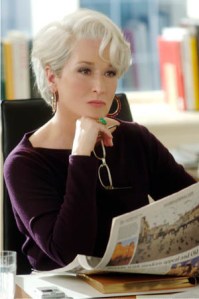
DIFFICULT DEVIL Streepin ‘The Devil Wears Prada’ (Photo: Barry Wetcher).
Over the next five years she worked her way through a series of more veiled ‘difficult women’ like Francesca – Kate Mundy in Dancing at Lughnasa (1998) stands out as the strongest of these.
But she broke through into her old territory as Roberta Guaspari in Music of the Heart (1999), another ‘won’t take no for an answer’ protagonist.
By The Devil Wears Prada (2006), audiences were responding in a way they hadn’t at the box office since Out of Africa two decades before. Streep recalls reaching a new male audience with this movie, playing magazine editor Miranda Priestly as a serenely powerful figure, who maintains control even when everything is crumbling around her.
The takings of this movie and the smash-hit Mamma Mia paved the way for Streep’s masterstroke as Margaret Thatcher in The Iron Lady (2011).
At last we got to see her claim a third Oscar for making us come to terms with the human being behind a Baroness who once ruled a nation.
As usual, not everyone was happy to see Streep shine – she’s always had her detractors. But despite not getting votes from film critic Pauline Kael (who always reserved a special kind of venom for Streep), and Katharine Hepburn (who claimed to hear the mechanics of technique ‘clicking’ with a Streep performance), legions of fans voted Streep’s role as Sophie Zawitowski into third place (and highest position for an actress) in Premiere Magazine’s poll ‘100 Greatest Movie Performances of All Time’.




 Michael Burge Media