The tale of a legend

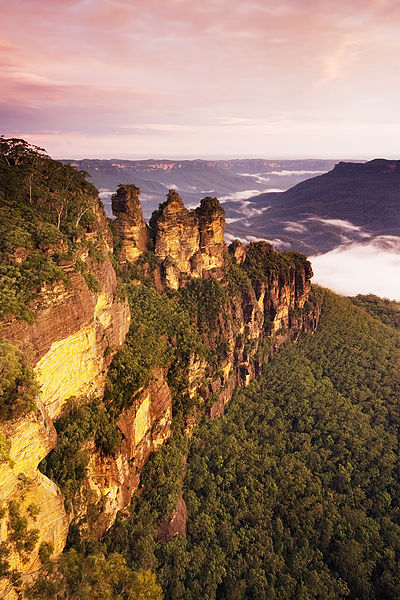
STONE SISTERS The Three Sisters rock formation abive the Jamison Valley, Echo Point, Katoomba, Blue Mountains, Australia (Photo: JJ Harrison).
STONE SISTERS The Three Sisters rock formation above the Jamison Valley, Echo Point, Katoomba, Blue Mountains (Photo: JJ Harrison).

A short look at a tall story

WHEN I arrived back in Australia after living in the UK for most of the 1990s, I was attracted back to the region where I did most of my growing up – The Blue Mountains, a World Heritage wilderness only 100 kilometres west of Sydney.

I eventually settled there and fell in love with the place all over again, embarking on a research and writing cycle that would continue for the next twelve years.

This all began with the news that the region’s ‘original’ story, the so-called ‘Legend of the Three Sisters‘, which had been taught to generations of Australian children as a genuine Aboriginal myth (and sold to millions of international tourists), had in fact been made up by a non-Aboriginal man.

I was eventually given the opportunity to publish a feature article on this subject in the December-January 2011 edition of Blue Mountains Life Magazine (Vintage Press).

Aboriginal and Torres Strait Islander readers are warned that the following article contains images and references to deceased persons.

Legends, Interrupted

How the Aboriginal legend of the Three Sisters trumped a tall story

Across the Mountains of the late 1970s wonders were common – a witch’s shadowy profile cast across rocks, colourful mountains devil ornaments, and a train ride straight down a cliff. My young imagination also lapped up a legend told on postcards, tea towels, a fountain, and an illustrated book.

The legend told of three Aboriginal sisters who disturbed a bunyip in the valley and were saved by their father who turned them into stone using a magic bone. He transformed himself into a lyrebird to escape, but in doing so lost the bone, leaving him to search the undergrowth (as lyrebirds do) so that one day he might find it and turn them all back into human form.

This story held more intrigue for me than explorer’s achievements, which were taught with a sense of pride at school. But there was a silence on local Aboriginal heritage, and I grew to assume there was little to know about the tribe in the Three Sisters legend.

Fifteen years later I attended a reconciliation meeting and met Gundungurra and Darug people mobilising to work on Native Title claims. Around that time a story hit the local media that the Aboriginal legend of the three sisters was created by a non-Aboriginal man. In the fallout, even that claim turned-out to be untrue – the first fake was actually written by a caucasian schoolgirl with a rather apt surname – Patricia Stone.

SIXTIES SISTERS Lyall Randolph's water sculpture of the Three Sisters graced the entrance of the Scenoc Railway from the 1960s to the 2000s (Photo: Tim Driver).
SIXTIES SISTERS Lyall Randolph’s water sculpture of the Three Sisters (Photo: Tim Driver).

“None of that was a revelation to Gundungurra people around here,” Gundungurra Elder Sharyn Halls says at Echo Point this year. “We always knew what the tourists were told was a made-up story. Many of us thought it was quite funny what visitors were willing to believe.”

The day is just dawning and already flocks of tourists are arriving to take in the panoramic view which is one of the Blue Mountains’ biggest drawcards.

“My father Lenny McNally used to stand me and my siblings here and tell us the stories about the land all around,” Sharyn says, sweeping her arms from east to west. “The story of this place is much, much more than the Three Sisters, from here you can see all the waterways and pathways of our traditional land.”

Sharyn grew up in Bankstown, but spent weekends and holidays in the Blue Mountains. “We’d go camping out to the Megalong Valley with Dad and our immediate and extended families. After a while we realised we were only being taken to places that were important, we were being shown our country. During those trips I learnt how to catch and gather food, and other skills to do with family life, from my Nana Lindsay.

LOCAL KNOWLEDGE Gundungurra Elder Sharryn Halls.
LOCAL KNOWLEDGE Gundungurra Elder Sharyn Halls.

“Dad liked to travel, to the Southern Highlands and out to Jenolan. He was a jockey and he’d round-up the wild brumbies from the valleys. In the Megalong he’d break them in, then muster them into Camden for sale.

“He knew the best way to get there through the mountains – he’d been taken out there with the old men who still spoke traditionally, and they knew the routes between all these places. But Dad wasn’t taught his language, only bits and pieces. Unfortunately he and his generation had to change to survive.”

Survival for Gundungurra people meant making difficult decisions when forced to leave their country.

“People ended up in Katoomba in a place they already knew and used called The Gully,” Sharyn relates. “They made a conscious decision to come, because there were resources here, and they could avoid the mission system. If you ended up in a mission you were only encouraged to settle down. The movement of Aboriginal people was restricted right into the 20th century.”

Gundungurra man Ron Fletcher recalls: “Our family lived for two periods in The Gully in about 1940 and 1949. Everyone got on really well down there because we were all battlers”.

“Our Aunty May and Uncle George Hannah, and Uncle Jack Brooks were still living in The Gully when they built the Catalina Racetrack,” Ron recalls of devastating events in 1957, when Gully residents’ homes and community were demolished to make way for a commercial racing development.

“It wasn’t until 1988, when they put up a memorial at the old Megalong cemetery, that my sister Dawn was reminded that our great grandparents were buried down there. That got her curious about our Aboriginal heritage. Dawn was never a backwards kind of person,” Ron smiles. “She felt very strongly about that side of her, and many people with Aboriginal blood were starting to take notice of how things were changing.”

Dawn Colless (1932-2003) became ‘Aunty Dawn’, elder of the Katoomba Clan of the Gundungurra at a time when local indigenous people began reclaiming their place in the Blue Mountains. One point of focus was The Gully, where the Catalina racetrack had long since fallen into disrepair.

An excellent speaker heard by many giving Welcomes to Country, Aunty Dawn told anyone who would listen about the significance of Gundungurra places and sacred sites. She was also the keeper of a secret she’d been entrusted with as a girl by her mother and grandmother – a legend about the Three Sisters.

“Our Aboriginal family had to be very careful when telling us about the old ways – they were frightened we would be taken away,” Dawn’s brother recalls. “I can remember the inspectors coming to our house twice,” Ron smiles, “I think when they saw we all looked well-fed, that we were being looked after”.

“Not many people realised how ill Dawn was in her last years,” Ron remembers. “She was determined to do what she could in the time she had left. Not long before she died, she agreed to meet some visiting indigenous women. They told her the Three Sisters were linked to the Seven Sisters, and a sacred site as important as Uluru.”

In 2002 Dawn told what she knew of the legend of her mothers to the Gundungurra Native Title hearing. Local authorities began to consult with Gundungurra people about public versions of the legend of the Three Sisters. The Gully, or ‘Garguree’, was proclaimed an Aboriginal place in the same year.

Sharyn Halls is adamant that: “It’s about time the traditional people of The Blue Mountains take a leading role in tourism here, to get out there and understand their country, to be independent, not reliant.”

“So much information about our stories has been lost because we didn’t really have anyone to ask,” Ron says. “We are the last to remember our Aboriginal side. It was always in me, but I was very reluctant at first. Dawn was so passionate about Aboriginal affairs that she inspired me.

GULLY GUIDE Gundungurra Elder Ron Fletcher showing local dignitaries the entrance to Guragaree, 'The Gully', Katoomba.
GULLY GUIDE Gundungurra Elder Ron Fletcher.

“Sometime I go to The Gully to interpret it for visitors as part of the Reconnecting to Country project, with some of the other Gully elders. I’ve been on trips down to the Burragorang, and it makes you feel strong, and you feel they’re walking with you, your family who have been there long before you.”

Today, many tourist destinations in the Blue Mountains assiduously avoid interpreting the Three Sister story at all, but a public version of the Gundungurra legend is available. What’s interesting to note is the inclusion of Patricia Stone’s names for the sister – Gunnedoo, Wimlah and Meenhi – the result of a variety of spellings over the years.

“Because of what happened to Gundungurra people, the continuity of our stories was broken. Our stories were diluted with other stories. The structure is there, but it’s in a different form,” Sharyn Halls outlines. “The important thing is that you don’t interpret someone else’s story on their behalf, you only tell your own. Patricia Stone’s story is one version, many people don’t really care it got told so much”.

“The legend of the Three Sisters is just basic practical education for youngsters not to stray from the safety of their home. It’s a thread that runs through all the versions I know of,” Sharyn explains. “Some of the names are a bit strange,” she laughs, “but nevertheless people have used them. I believe one hundred percent that’s what the legend is.”

© Michael Burge, all rights reserved.

Secret Means Business

TALE FOR SALE Victor Barnes' 1972 Golden Book.
TALE FOR SALE Victor Barnes’ 1972 Golden Book.

Milestones in the commercialisation of the fake Aboriginal Legend of the Three Sisters.

1931 The Sydney Morning Herald publishes ‘The Three Sisters’ by Patricia Stone (who visited Katoomba c.1925). The names ‘Wimalah’, ‘Meeni’ and ‘Gunedoo’ first appear in print. The sisters are giants turned to stone by Yooma (a tribal wizard) to protect them from a neighbouring tribe during a battle.

1949 Outdoors and Fishing Magazine publishes ‘Legends of the Mountains’ by naturalist Charles Melbourne (‘Mel’) Ward (1903-1966), who moved to the Mountains in 1943. Patricia Stone’s version is used uncredited in reworded form, including her names for the sisters.

TALE TELLER Naturalist Charles Melbourne ('Mel') Ward was resposible for disseminating the fake legend of Katoomba's Three Sisters.
TALE TELLER Naturalist Charles Melbourne (‘Mel’) Ward.

1950’s Mel Ward distributes Legends of the Mountains from his museum in the grounds of the Hydro Majestic hotel in Medlow Bath, claiming to have been told the legend by Aboriginal people.

1967 Bondi Mermaid sculptor Lyall Randolph’s Three Sisters fountain is installed at The Scenic Railway, telling a variation of Stone’s legend with coin-operated narration punctuated by water spouts. The money is donated to charity.

1972 Golden Books publishes The Legend of the Three Sisters by Victor Barnes, a new illustrated version of the transformation of the three sisters into stone by their father to save them from a bunyip.

1997 The Blue Mountains Gazette published ‘The Three Sisters story Untrue?’ in which linguist Charles Illert proposes: “The story behind Katoomba’s Three Sisters may be a myth created by white men with large imaginations.”

2000s A new (as yet incomplete) sculpture by Terrance Plowright replaces Lyall Randolph’s at Scenic World (formerly The Scenic Railway) in Katoomba.

2013 Various non-Aboriginal versions of The Three Sisters legend still disseminated in written form to Blue Mountains tourists.

ROYAL INTERPRETATION The Duke and Duchess of Cambridge with Anthea Hammon and Randall Walker at Echo Point.
ROYAL INTERPRETATION The Duke and Duchess of Cambridge at Echo Point.

2014 During the 10-minute visit of the Duke and Duchess of Cambridge to Echo Point, local business identities Randall Walker (interim CEO of Blue Mountains Lithgow and Oberon Tourism) and Anthea Hammon (joint managing director of Scenic World) interpret the Jamison Valley for the royal couple.

Gundungurra and Darug elders and tourism representatives meet the Duke and Duchess but are not visibly seen to interpret their traditional lands for the visitors.

(Source and further reading: ‘Aboriginal Legends of the Blue Mountains’ by Jim Smith, Den Fenella Press, 2003).

This article appears in Michael’s eBook Creating Waves: Critical takes on culture and politics.

The thing about Britain

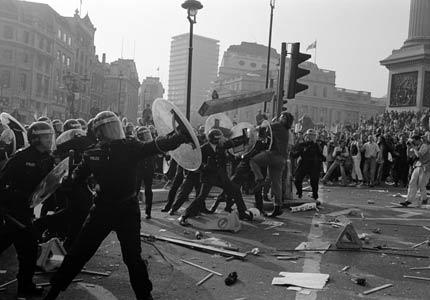
BRITAIN AT WAR The 1990 poll tax riots in Trafalgar Square.
BRITAIN AT WAR The 1990 poll tax riots in London’s Trafalgar Square.

TOWARDS the end of my second year working for United News and Media, the staff received news that our company was in the final stages of broad economic reforms that would cut right through the Farming Press office at Ipswich.

Signs of this began when an all-staff memorandum indicated that only one bottle of wine was permitted at business lunches, a message met with glee from people like us who worked at the fringes of this multinational company and had no idea we could even put wine on the company tab!

Perhaps it was our new-found business-lunch rights that finally tipped the company into financial free-fall? I doubt it, because it turned out the mechanics of change were underway years before my position was ever advertised.

By the end of 1997 the writing was on the wall. With no new employees since I’d started, I was faced with being ‘last on, first off’. So I took stock, decided it was time, for many reasons, to return to Australia, and accepted an offer of voluntary redundancy.

Having lived in a permanent state of debt for five years, my payout would be enough to buy a one-way ticket home and pay off my credit card. It was an easy decision to make.

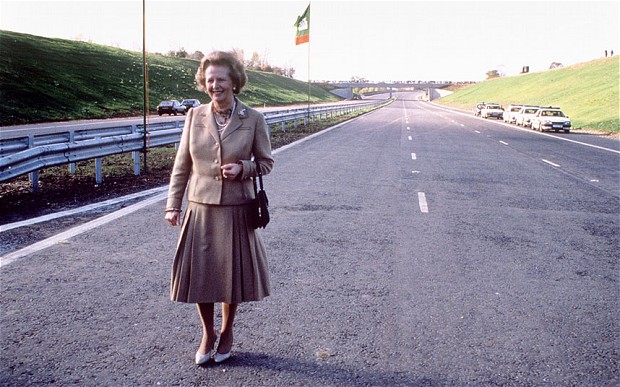
NO SOCIETY LADY Baroness Thatcher on the newly opened M25 Motorway in 1986.

Being part of a folding company was the last in a long list of eye-opening experiences of living in Great Britain’s economy.

The late Baroness Thatcher made no secret of not believing in society, which seemed to stand in the way of her penchant for the free market.

Having landed first in Yorkshire and then South London, I experienced life first-hand in territories where Thatcherism had left its mark on formerly cohesive and supportive communities.

I would later say, with regularity, that everything I learnt about economics and politics I learnt from living in Britain, simply because I joined the ranks of everyday people trying to earn a living in the immediate post-Thatcher years.

Here are some other observations about Britain in the 1990s:-

No-one could afford a day out at the beach. In Australia we call this a human right, but in England day-trippers were faced with whopping public transport costs. Few people I knew could afford cars, but a one-way train ticket for the short trip to London from Ipswich was well over twenty pounds for one person. This was solely due to the privatisation of every possible segment of the railways – one company owned the carriage, another the rails, another the station, and they all wanted to profit from ticket sales. A similar journey in Australia still costs far less than half that, twenty years later.

When buying an electrical appliance, the cable cost extra. What better way to gouge a bit of extra profit than to make the mains cable of most electrical appliances a separate item the customer must buy to use the equipment?

The country was full of criminals. Speaking as a citizen of the nation invaded to set up the penal colony of New South Wales, I have to say the common sight of colleagues being marched out of the office by a pair of police officers says a lot about the British criminal disposition as opposed to the Australian. These were never ‘bad’ people, they were just trying to keep their family afloat in the economy. Every single company I worked for contained employees who were on the take, and I don’t just mean the toilet paper.

Many people were closeted. Perhaps it’s a case of like attracting like, but most men I became friends with in England turned out to be gay. From the married father of two to the tough-as-nails London busker, they all came tumbling out of the closet in the wake of my own coming out. It was an eye opener about the choices faced by the British male under the infamous Section 28 of Britain’s Local Government Act, which embedded disapproval of gay lifestyle and relationships into the country’s law. For a nation which had decriminalised homosexuality in 1967, this was a mean-spirited regulation which was seen by many as a knee-jerk reaction to the HIV/AIDS epidemic of the 1980s and 1990s.

British food was crap. When you think about the proximity of Britain to the fresh produce of continental Europe, the lack of affordable nutritious food was a terrible side effect of euro-phobia and economic rationalism, and an indictment on the ‘Grocer’s Daughter’ who had contributed to the scarcity. The only ‘fresh’ fruit and veg I saw in my first month were lumpy potatoes, mouldy onions, and bunches of silverbeet, withered and pricey. Most people I knew ate everything out of tins, and ‘boil in the bag’ meals were the norm.

You could still sense the war. People would still queue uncomplainingly for things that were freely available in other western nations. Avoidable diseases were still common in England’s north, and childhood mortality was higher-than-average.

The tenant paid the council rates, not the landlord. Thatcher’s infamous poll tax was well and truly in place when I became a renter in London, and my Yorkshire flatmates showed me the clever ways their parents taught them to avoid the payment as long as was possible. Often, it was the catalyst for moving house.

No-one answered their front door. Due to avoiding paying the poll tax (see above) and the TV licensing charges (see below), I was always under strict instructions from every flatmate I ever had to never open the door to a knocking visitor in case it was someone coming to collect taxes. I was once fooled by the TV license man when he pretended he was delivering a parcel to the first floor flat I shared in Lewisham. He launched himself through the front door into the foyer, and I had to pretend I was a visiting friend who had no idea if the flat had a television or not. Luckily I had some acting training under my belt.

MEN IN SUITS The notorious TV License man and his Doctor Who-like scanner.
MEN IN SUITS The notorious TV License man and his Doctor Who-like ‘scanner’.

It cost a lot to watch the tele. A hefty annual television license fee comes with the pleasure of tuning in to the BBC, oh, and all the other channels who would appear to be doing quite well already with all the advertising revenue they’re getting from the endless commercials, of course. The jury is still out on whether the mysterious vans driving around Britain’s streets are capable of telling who is receiving a TV signal are real, or some kind of psychological warfare. It’s all very Doctor Who. Another reason to avoid answering the front door (see above).

This list is cursory and might seem glib. But it’s also true. I will always remember many colleagues in Britain who worked long hours for the same very low rate of pay I was on, only they had mouths to feed and backs to clothe. I don’t know how they did it, but most worked with a ready smile and by doing without luxuries that most people in Australia take completely for granted.

But I also recall how few of them thought it was worth getting off their backsides on election day and voting.

By May Day 1997 Tony Blair seemed determined to sweep away two decades of Thatcherism, convincing the nation of the merits of ‘New Labor’. I can remember where I was when I heard the news – working on location in the Yorkshire Dales. Never had I experienced such a sense of palpable hope and imminent change amongst the British as I did across that summer. Princess Diana’s death knocked most of that energy out of the British only a few short months later, but I witnessed the brief smile on the nation’s face.

Ever since I returned home I have been vocal about the P-word. Privatisation has not spread its destructive fingers into every Australian industry, yet. I know what an impact it will have on that day trip to the beach if public transport is ever extensively privatised in a nation where long distances are the norm.

I will be eternally grateful for the support I received to travel overseas in the first place, but ‘travel’ is a great distraction. Living and working in another country, for more than a stint fruit picking, is what I call an education.

© Michael Burge, all rights reserved.
Dry stone country

BOTH SIDES NOW Stephen Harrison, master waller, instructing on one of his dry stone walling courses.
BOTH SIDES NOW Stephen Harrison, Master Waller, instructing on one of his courses.

A Writer’s encounter with Britain’s boundaries.

ON the property where I grew up, porous volcanic rocks covered a little peak near the farm-house, the hundreds of holes in their sides the perfect dwelling place for the fairies we imagined lived there. Hours of exploration ensued on that hillock, from which the edges of the wider world could be seen, but not yet explored.

For exiled Europeans living in the pastoral dream of New South Wales, stone boundaries and homes were a link to the lands we had come from. The Northern Tablelands are scattered with flints, shales, and granite boulders. In parts, where the scrubby trees are scarce, and the skies large, you could swear you were on the Yorkshire Dales.

So when the opportunity to produce a program about dry stone walling came up, I leapt at the chance. The directive included the name of artist Andy Goldsworthy, who could be credited with taking the ancient craft and making it into a fine art.

We turned first to the Yorkshire Dales Field Centre, where Master Waller Stephen Harrison taught weekend courses in walling for anyone wanting to have a go.

This was the dawn of the reality show era, and it was suggested that we find a television presenter to send on one of these courses, to ‘throw them in the deep end’. We approached Dylan Winter, a country-based broadcaster. He was willing, we set a date in the Dales’ village of Settle, and went to build walls.

Cameraman Alan James got to ride in a hot air balloon filming the network of walls across part of the Dales. We went to an all-day walling competition. The whole thing was so much fun it hardly felt like work!

The true art of dry stone walling is in the word ‘dry’ – Stephen showed us places on the high ridges of the Pennines where walls had been built and maintained over centuries which you could kick and not make a dent in, yet they stood without a trace of binding mortar.

Very often there is little sign of human habitation, apart from the walking track, and then you’ll crest a hillock and suddenly see lines of stone – barriers – running across everything in their path for miles and miles.

The beauty of stone walls belies terrible times in the nation’s past – Hadrian’s Wall in the north might not technically be mortar-free, because it was built to keep people out of England, but dry stone walls are also evidence of a great ‘keeping out’ movement.

CLOSING-UP An English enclosure notice of the 18th Century.

It was almost four centuries of Enclosure Acts that fenced-off the shared common lands of the countryside, starting in and around villages, but extending over time across every patch of farmland. Eventually the entire landscape was owned by someone, and it was walls (or hedgerows, where stone was scarce) which marked where the boundaries were deemed by law to be.

Men and women who once worked common land found themselves fenced out of it. Many eked-out new livings on the crews who built the walls. It’s a skill which has been handed down through generations.

Sourcing archival images and footage of walling crews at work in the early 20th century proved an adventure in itself, but between the libraries of the Lake District, and private collectors, we unearthed some very unique footage for our program. The interesting thing about the photographs in particular is how they revealed walling was a family pastime – men, women and their children were taught to wall in certain communities.

Stone is an effective barrier – if used correctly it can halt flood or fire, it looks better than barbed wire, and it’s not hard to work with.

Which is the message Stephen Harrison and the Yorkshire Dales Field Centre were keen to spread to city slickers like us. Dylan made some classic errors in his section (or ‘stint’) of wall, but, as Stephen pointed out, even a flawed wall will outlast most modern wire fences.

ART OF STONE Andy Goldsworthy at one of his Cumbrian Sheepfold projects.

We travelled to Cumbria to meet Andy Goldsworthy’s assistant at an agreed time in a remote pub car park. She led us up into the foothills nearby, to a sheepfold – a square or round enclosure of stone designed to pen sheep. Andy was nowhere to be seen, but his work, on that occasion an arrangement of straw on the ground inside the stone enclosure so that it would catch the light from different angles, was incredible.

We all drew breath. Someone said “wow”. I noticed a scrap of woolly grey from behind the wall at the far side, and thought perhaps it was a stray Herdwick sheep, but when the sheep stood up it revealed itself as the artist.

“Good reaction,” he said, before I told him I thought he had Herdwick-coloured hair. He laughed, and within the stunning setting of a Cumbrian valley, we interviewed Andy Goldsworthy about his work with dry stone walling, and dry stone wallers, particularly on the long-term Sheepfold Project of the 1990s.

Stephen Harrison is one of a group of British wallers who regularly work with Andy Goldsworthy on art projects both in Britain and North America, but the boundary between artist and waller is invisible. Goldsworthy started out a farm boy, after all, and Harrison is very much an artisan in his own right.

Very often they build stone structures (not always walls) in art galleries. More regularly they’ll work in farm land, or in the wilderness.

In addition to Cumbria and Yorkshire, we interviewed wallers in Wales, Scotland (where walls are known as ‘drystane dykes’), and Derbyshire. In each region the stone varies in colour and density – in parts of Wales you can chop it with your hand, in some places around Scotland you can barely break it with a hammer.

I can’t think of a more accessible way to participate in ongoing heritage than to repair or build your own dry stone walls. As soon as I had my own garden I started, and I learnt that if you follow a few simple guidelines, anyone can seem like they’ve been walling for years.

080524092650_l

Dry Stone Country is distributed on DVD by BecksDVDs.

© Michael Burge, all rights reserved.