
Dry stone country

BOTH SIDES NOW Stephen Harrison, master waller, instructing on one of his dry stone walling courses.
BOTH SIDES NOW Stephen Harrison, Master Waller, instructing on one of his courses.

A Writer’s encounter with Britain’s boundaries.

ON the property where I grew up, porous volcanic rocks covered a little peak near the farm-house, the hundreds of holes in their sides the perfect dwelling place for the fairies we imagined lived there. Hours of exploration ensued on that hillock, from which the edges of the wider world could be seen, but not yet explored.

For exiled Europeans living in the pastoral dream of New South Wales, stone boundaries and homes were a link to the lands we had come from. The Northern Tablelands are scattered with flints, shales, and granite boulders. In parts, where the scrubby trees are scarce, and the skies large, you could swear you were on the Yorkshire Dales.

So when the opportunity to produce a program about dry stone walling came up, I leapt at the chance. The directive included the name of artist Andy Goldsworthy, who could be credited with taking the ancient craft and making it into a fine art.

We turned first to the Yorkshire Dales Field Centre, where Master Waller Stephen Harrison taught weekend courses in walling for anyone wanting to have a go.

This was the dawn of the reality show era, and it was suggested that we find a television presenter to send on one of these courses, to ‘throw them in the deep end’. We approached Dylan Winter, a country-based broadcaster. He was willing, we set a date in the Dales’ village of Settle, and went to build walls.

Cameraman Alan James got to ride in a hot air balloon filming the network of walls across part of the Dales. We went to an all-day walling competition. The whole thing was so much fun it hardly felt like work!

The true art of dry stone walling is in the word ‘dry’ – Stephen showed us places on the high ridges of the Pennines where walls had been built and maintained over centuries which you could kick and not make a dent in, yet they stood without a trace of binding mortar.

Very often there is little sign of human habitation, apart from the walking track, and then you’ll crest a hillock and suddenly see lines of stone – barriers – running across everything in their path for miles and miles.

The beauty of stone walls belies terrible times in the nation’s past – Hadrian’s Wall in the north might not technically be mortar-free, because it was built to keep people out of England, but dry stone walls are also evidence of a great ‘keeping out’ movement.

CLOSING-UP An English enclosure notice of the 18th Century.

It was almost four centuries of Enclosure Acts that fenced-off the shared common lands of the countryside, starting in and around villages, but extending over time across every patch of farmland. Eventually the entire landscape was owned by someone, and it was walls (or hedgerows, where stone was scarce) which marked where the boundaries were deemed by law to be.

Men and women who once worked common land found themselves fenced out of it. Many eked-out new livings on the crews who built the walls. It’s a skill which has been handed down through generations.

Sourcing archival images and footage of walling crews at work in the early 20th century proved an adventure in itself, but between the libraries of the Lake District, and private collectors, we unearthed some very unique footage for our program. The interesting thing about the photographs in particular is how they revealed walling was a family pastime – men, women and their children were taught to wall in certain communities.

Stone is an effective barrier – if used correctly it can halt flood or fire, it looks better than barbed wire, and it’s not hard to work with.

Which is the message Stephen Harrison and the Yorkshire Dales Field Centre were keen to spread to city slickers like us. Dylan made some classic errors in his section (or ‘stint’) of wall, but, as Stephen pointed out, even a flawed wall will outlast most modern wire fences.
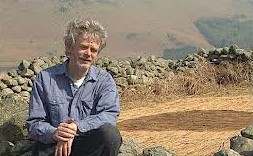
ART OF STONE Andy Goldsworthy at one of his Cumbrian Sheepfold projects.

We travelled to Cumbria to meet Andy Goldsworthy’s assistant at an agreed time in a remote pub car park. She led us up into the foothills nearby, to a sheepfold – a square or round enclosure of stone designed to pen sheep. Andy was nowhere to be seen, but his work, on that occasion an arrangement of straw on the ground inside the stone enclosure so that it would catch the light from different angles, was incredible.

We all drew breath. Someone said “wow”. I noticed a scrap of woolly grey from behind the wall at the far side, and thought perhaps it was a stray Herdwick sheep, but when the sheep stood up it revealed itself as the artist.

“Good reaction,” he said, before I told him I thought he had Herdwick-coloured hair. He laughed, and within the stunning setting of a Cumbrian valley, we interviewed Andy Goldsworthy about his work with dry stone walling, and dry stone wallers, particularly on the long-term Sheepfold Project of the 1990s.

Stephen Harrison is one of a group of British wallers who regularly work with Andy Goldsworthy on art projects both in Britain and North America, but the boundary between artist and waller is invisible. Goldsworthy started out a farm boy, after all, and Harrison is very much an artisan in his own right.

Very often they build stone structures (not always walls) in art galleries. More regularly they’ll work in farm land, or in the wilderness.

In addition to Cumbria and Yorkshire, we interviewed wallers in Wales, Scotland (where walls are known as ‘drystane dykes’), and Derbyshire. In each region the stone varies in colour and density – in parts of Wales you can chop it with your hand, in some places around Scotland you can barely break it with a hammer.

I can’t think of a more accessible way to participate in ongoing heritage than to repair or build your own dry stone walls. As soon as I had my own garden I started, and I learnt that if you follow a few simple guidelines, anyone can seem like they’ve been walling for years.

080524092650_l

Dry Stone Country is distributed on DVD by BecksDVDs.

© Michael Burge, all rights reserved.
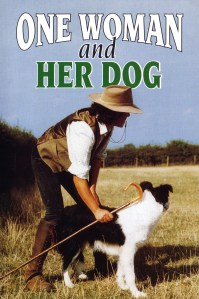
Katy Cropper – showgirl shepherdess

ONE WOMAN & HER DOG

THE first time I met Katy Cropper and her champion Border Collie Trim, we were screen-testing both for a program about Katy’s dog training techniques.

With her slightly wild edge, Katy Cropper belongs to the outdoors, and is at her most focussed when working with a team of sheepdogs to lift a flock from the far edge of a field and bring it back, in a majestic manner, right to her feet.

She’s also got a winning smile, and, as a friend of mine who watched the screen test said, a “great set of pins”. So we edited the footage into a ten-minute clip, and played it on rotation at The Royal Show in Warwickshire in the summer of 1996.

The crowds that gathered to watch showed us we’d chosen a very popular subject, and so we got the green light to capture the story of Katy’s new trainee sheepdog – Splash – over the next two trialling seasons.

Scheduling eighteen months of filming with Katy turned out to be a great way to tour the rural counties of England, simply because this successful (and often controversial) shepherdess never stays in one place for very long.

The first woman to win the prestigious BBC sheepdog handling title One Man and His Dog, Katy led us on a merry chase through some of the most beautiful farmland between Yorkshire, the Lake District, Gloucestershire, and The Midlands.

The only time I was guaranteed of finding Katy where I expected her was for her scheduled appearance at the Royal Show the following year. At other times I would anticipate a call from wherever she was working at the time, and she would give me detailed directions to which field on which farm she’d be shepherding on which day.

True to form, Katy was always there waiting and ready, decked-out in her latest take on what I’ll call ‘sexy-tweed’. When asked about what she is really like (and I was asked a lot over the years), I came to describe Katy Cropper as a combination of Toad of Toad Hall, and Sarah Duchess of York – she’s got boundless energy to burn, she sometimes gets into a bit of a pickle, and she’s usually kitted-out a bit like a country gent.

Predictably, her indefinability has seen Katy cop plenty of flack over the years – anyone who enters a sheepdog trial with a three-legged border collie, or appears in a trialling event in a two-piece bikini, or who tilts at any male-dominated, traditionalist world like sheepdog handling, is going to be the butt of jokes and barbs.

But Katy struck me as a great survivor who has overcome a few hurdles that would have stopped many others. She is steeped in the hedgerows and country pubs of England’s heritage, using phrases like “crow pie” and “the sun always shines on the righteous”, and all the traditional sheepdog commands like “that’ll do” and “bide there”. She’s rarely seen without her shepherd’s crook, and has a great collection of hats.

At her Royal Show appearance, Katy also showed a touch of Madonna, with her wireless microphone and her showgirl streak.

She arrived with a horse float full of animals – dogs, ducks, turkeys, pigs, a pony, and sheep, of course. The dogs, not fully animal in Katy’s world, were up front in the truck, and they helped her set-up the routine.

At that time in her retirement, Katy’s most famous dog, the predominantly white-faced Trim, followed Katy around and checked on all the details of the hurdles and fences. If something wasn’t right quite right, Katy looked to Trim to let her know.

Katy’s performance is a mish-mash of herded ducks, a range of fine dog handling and herding techniques, and an over-reaching sense of fun, which is why I think some country traditionalists could take or leave Katy Cropper, whereas city folk can’t get enough of her.

Splash progressed through her monthly filming sessions into a contender for a range of nursery trials, and it was there that we got a first-hand look at how the whole sheepdog trialling world works. There are so many events throughout the country that you can enter one in the morning, then drive over the range for another one at lunch time.

In between, your dog (and you) can go from a loser to a winner, and that’s exactly what happened to Katy and Splash in our program One Woman and Her Dog.

I raved so much about the special energy of female Border Collies that eventually I was tipped-off about one which needed a home. Five years later, I saved another from the pound. Fifteen years on, both my girls are still with me, and have made me look like a great dog trainer, simply because Border Collies are just so intelligent.

The rest of my training tricks I learnt from Katy Cropper.

Mind you, even though I say “that’ll do” and “bide there” to my dogs, I’ve never unleashed them on a flock of sheep in a field the size of ten football ovals. Katy Cropper has, and despite what you think about her, she knows how to train sheepdogs to bring in the sheep.

One Woman and her Dog was released by United News & Media but is currently unavailable to buy. It is occasionally available on eBay and kept in the collection of Australia’s National Library.

© Michael Burge, all rights reserved.


Tilting at windmills

WINDY HILL Jack and Jill Mills in Sussex (Photo: David Blaikie).

A Writer’s quixotic adventure.

THEY all said I was mad. Every Miller in England told me there would be no wind in August. If I was expecting the sails of their mills to be turning when I arrived in the languid late summer with a camera crew, I’d be wasting my time.

But I’d already scheduled a month’s worth of filming between Lincolnshire and Sussex, crisscrossing the country in search of some of England’s most treasured surviving windmills, in places where I’d just assumed there would be plenty of wind, all year round.

So I just sat on this wisdom quietly, because I’d already promised delivery of a one-hour program in time for Christmas. If it was going to happen, the footage needed to be in the can and edited by the end of September at the outside.

Our packed itinerary started close to home in the Cambridgeshire fen lands, where, on arrival at Wicken Fen drainage mill (managed by the National Trust), the little green canvas-covered sails of the smock mill were ripping around at a very pleasing pace.

Thinking that I’d struck the one day of late summer wind, I got cameraman Alan James to film just about everything we could see that was moving in the gale.

The next day we had two interviews scheduled. Ideally, I wanted windmills turning gently in the background. Apparently, they could be cranked around by hand, so at least I had that option up my sleeve if there was no wind.

First subject was Nigel Moon, Miller at Whissendine Mill in Rutland, who scratched his head when we turned-up as agreed, saying he couldn’t credit why the wind was blowing so well for the time of year.

As we embarked, the crew noticed something very interesting about wind.

When the sun comes out from behind a cloud, it brings with it a thermal gust strong enough to get a windmill’s sails turning, making a pretty picture behind the interviewee.

But for a film crew, bright sunlight means the interviewee will be over-exposed. A sudden gust of wind is also hazardous for sound recording. The crew handled this frustrating situation with great skill and patience. We all became instant weather watchers, recording only during the passing of very large, long clouds.

At Green’s Mill, right in the city of Nottingham, Miller and writer of our documentary, David Bent, took us through the entire workings of one of England’s best-preserved windmills.

We quickly completed every bit of filming that didn’t require turning sails, so I let the crew go for lunch. Meanwhile, I climbed up into the tower mill, surrounded by its fascinating internal workings, all so beautifully wrought from timber, stone and iron. Out on the balcony, where the Miller would set the sails on his mill, there was not a trace of wind. Had my run of weather-luck finally come to an end as predicted?

Ever-hopeful, I climbed higher again, to see tiny windows looking over the courtyard where the crew lunching far below.

UNHORSED BY WINDMILLS I felt a little like Don Quixote.

The pressure of the quixotic plan to bring my first full-length documentary in on time and budget was now palpable. I’d hitched my reputation to something as fickle as the weather, an energy I already had a love-hate relationship with. The realisation struck me with a feeling of anger and desperation, so I did something I rarely do … I prayed!

After a few resigned moments looking at the view, the noise of one of the large timber-toothed cogs inside the mill caught my attention. I watched it, oblivious for a few moments to what its movement meant.

A shadow slid across the small room from the window, and I realised the sails outside were turning.

I shouted out the window to the crew and got them back on deck within a minute. Across a nicely windy afternoon we got all the shots we needed.

After a great night’s sleep we headed north into Lincolnshire. With its endless skies capturing as much wind as any Miller would ever want off the North Sea, Lincolnshire was surely designed to harness wind power.

With its sleek black tower, the six-sailed Sibsey Trader Mill (stewarded by English Heritage) rises above the flat landscape like something straight out of Tolkien. I half expected to see Saruman stalking the wrought-iron balcony.

Alford’s beautiful five-sailed Mill put on a brilliant show for the camera. This tower mill was the first operating windmill where we saw windmill-ground flour for sale, and the point of the whole windmill revolution sank in.

In the summer of 1996, food was still fighting for attention in the midst of the media’s gardening and home renovating revolution. Operating mills, which had once been the centre of every town’s economy, were lucky to have survived the industrial revolution and the invention of the supermarket. At many of Lincolnshire’s mills, the seeds of the current paddock-to-plate movement had well and truly sprouted.

Wrawby Post Mill was the next quintessential timber post mill in our Lincolnshire leg, where the Miller kindly acquiesced to my requests for him to catch a ride on one of his mill’s sails for our documentary’s historical recreations.

The majestic span of the mighty eight-sailed Heckington Mill at Sleaford was turning so fast we were able to get excellent shots of the internal workings of a windmill without the essential (but not that attractive) caging required to prevent visitor injury.

In the heat and noise within the cap of a working windmill we got a great sense of the dangers that mill workers endured. Hundreds of timber teeth wait to capture every bit of loose clothing and each stray finger.

David Bent had researched some macabre extracts from The Stamford Mercury, relating the terrible deaths of Millers in centuries past. Once harnessed, wind power can be every bit a life-threatening as electricity.

We’d been warned by more than one Miller to watch out for low-passing mill sails, which are often so quiet they’re easy to forget about, as they come rushing up behind you.

(Photo: Jason Smith)
WILD MILL Halnaker Mill in Sussex (Photo: Jason Smith)

We reached the south of England in a more confident mood, and climbed the path to film the stunning Halnaker Mill in West Sussex, high on a wild hill where every blade of grass was bent by the wind.

The Clayton Mills on the South Downs are also beautifully situated on a hillside, which is why they got their names “Jack” and “Jill” mills. Like the Union Mill in the beautifully preserved town of Cranbrook in Kent, Sussex’s upland mills show the prominence that windmills had in most townscapes during the era when wind power was the major source of energy.

By the time we got home to Suffolk, every mill that was capable of having its sails turned by the wind was captured in motion. My sense of achievement helped in tilting-at a great voice for the documentary’s narration, so I approached Janet Suzman’s agent.

I arrived at the recording studio more than a little nervous. She just stepped out of a cab, rolled up her sleeves and dived-in, instantly capturing the feel I’d anticipated for the commentary, and in her character readings of those gruesome northern newspaper reports.

Maybe it was beginner’s luck, but since the making of Seven Centuries of the English Windmill, whenever I’ve been faced with outdoor location filming and performances, I have quietly invoked whatever spirit answered my weather prayer inside Green’s Mill in Nottingham. I’ve also become an advocate for wind turbines, because wind power has a longer, cleaner and cheaper track record than any other human-created power harnessing method we’ve ever mastered. No wonder it’s considered so controversial as it makes its comeback.

seven-centuries-of-the-engl

Seven Centuries of the English Windmill is distributed on DVD.

© Michael Burge, all rights reserved.