Garden’s latest book My Father’s Suitcase: A story of family secrets, abuse, betrayal and breaking free begins with a heartfelt exploration of growing up in New Zealand in the 1950s and ’60s in the shadow of her father Oscar Garden (1903-1997), a pioneering aviator who had an emotional ‘crash landing’ once his high-flying career came to an end.
BREAKING FREE Author and journalist Mary Garden
But it was Garden’s realisation that this dysfunction created fertile ground for sibling abuse which provides the centrepiece of her third work of non-fiction.
“I only became aware of the term a few years ago,” Garden, a freelance journalist, said.
“It is the most common form of abuse in the context of family violence, yet it is the ‘forgotten’ abuse.
“The problem is that sibling abuse is often dismissed as sibling rivalry, but they are very different. There is also this notion that you must get along with your siblings, they’re family, regardless of how they treat you.”
Described as, “a gripping tale of resilience and survival that offers hope to others who have experienced family violence and suffered at the hands of a sibling,” My Father’s Suitcase is Garden’s follow-up to her seminal biography of her father, Sundowner of the Skies.
But Garden’s latest book extends on Garden family dynamics, delving into the troubled relationship between Mary and her younger sister, Anna, who died in 2023.
Garden confessed to be “very nervous” about sharing her story and the responses it might inspire.
“But I’m so relieved,” she said.
“Every second or third person I talk to is either a victim survivor of sibling abuse or they know of someone who has experienced this kind of abuse.
“I’ve had interviewers, photographers and readers share their experiences. A few have broken down in tears.”
‘Pretending everything was fine’
Garden’s June 15 author morning tea at The Makers Shed will be her third visit to the Glen Innes region.
“I jumped at the chance to attend the High Country Writers Festival in 2020, and also again the next year, which was very exciting as my book, The Serpent Rising, won the High Country Indie Book Award,” she said.
“I also love the area. Glen Innes is the kind of region I would have liked to have brought my children up in.”
In My Father’s Suitcase, Garden recounts the struggle she had attending the 2020 event, soon after her sister Anna released a second, secret biography of their father.
“I had been looking forward to a holiday and being in my happy place, among writers and book lovers. How on earth was I going to cope with the long drive, then speaking at the festival, smiling and pretending everything was fine?” she wrote in her new book.
As is true of many literary events, putting writers together generates inspiration and insight, and it was memoirist Mary Moody who gave Garden clues about the true nature of her sister’s memoir, identifying it as a hagiography (a biography that treats its subject with undue reverence).
At this point in her narrative, My Father’s Suitcase becomes a gripping literary mystery as she peels back the layers in search of exactly how and why her sister embarked on a competing book so soon after her own.
It’s a searing journey, played out in the media, publishing and legal industries in Australia and New Zealand, yet Garden’s positive prose outshines every shadow in her search for the compelling truth.
Currently living at Chewton in regional Victoria, Garden has been resident of regional Australia for large parts of her life, and loves the affordability that comes with living outside major cities.
“I’m always hearing about full-time authors living in cities who are struggling to make ends meet,” she said.
“I can’t live in cities. I don’t even like visiting. They are too noisy.
“I need peace and quiet to write.”
Mary Garden in conversation with journalist Michael Burge on Saturday June 15 at High Country Books, The Makers Shed, Glen Innes. Book here.
“It’s time to get tough on yourself and put your plot through its paces.”
I’VE often been approached by writers struggling to keep a writing project moving, full of angst and desperate for a solution. Incredible as it might seem, this is invariably the point writers decide to show their work to a publisher, hoping that some clue will be found in the manuscript that will render it instantly better. All writers reach a point when negative thoughts come pouring in, telling us we must have been crazy embarking on writing something nobody wants to read. Often we feel the opposite, determined that our work is perfectly formed and needs no adjustment. When either of these extremes happens to you, it’s not time to submit your work or give up… it’s time to diagnose your manuscript.
Who is the hero?
Every effective story (fiction and non-fiction) needs a protagonist, someone to lead the action, to barrack for and relate to. This might sound blatantly obvious, but one of the main blocks to manuscript health is lack of a hero. Heroes don’t need to be ‘good’ (they can be anti-heroes) and they don’t need to be particularly heroic, they only need to be obvious. What would Gone With the Wind be without Scarlett O’Hara? Imagine any of Bill Bryson’s travel tomes without the author himself in the driving seat! Identifying your story’s hero is the most important first step in getting a manuscript match fit.
Heroes with a twist
Sometimes, stories have multiple heroes, such as Butch Cassidy and the Sundance Kid which, like all ‘buddy films’, has a pair of protagonists driving the action.
Plots with more than one protagonist often have one hero take an outer (physical) journey, while one takes an inner (emotional) journey.
TWO HEROES Geena Davis and Susan Sarandon in Thelma and Louise.
A great example of this is Thelma and Louise in whichThelma (played by Susan Sarandon) physically drives the car and has strongly plotted reasons for taking the route she decides on; whereas Louise (Geena Davis) is driven to an emotional transition in the passenger seat.
Protagonist teams (such as that in The Big Chill) ideally need to face the same conflicts (not strictly at the same time or in the same manner) in order to keep readers focussed on the plot.
Writers creating multiple-personality protagonists should consider either letting the audience in on the secret (as in Superman) or work the duality into an unfolding or complete surprise (as in The Talented Mr Ripley).
Protagonists in different time periods (like Julie and Julia) can intersect, but giving them complete story arcs of their own will create a more satisfactory experience for audiences.
Who is the villain?
All stories also need antagonists, those characters who get in the protagonist’s way, but don’t fall into the trap of thinking every villain must be ‘bad’. Two of literature’s greatest antagonists are Agatha Christie’s Hercule Poirot and Miss Marple, who qualify as antagonists because they obstruct protagonists (Christie’s murderers) through expert sleuthing. Take Christie’s detectives out of her novels and her protagonists would get away with murder, which is what happens in Patricia Highsmith’s series of Tom Ripley novels, with plots tempered by Ripley’s inner battle with himself as protagonist and antagonist. In fiction and non-fiction work, readers will smell a rat if the hero is pitted against a one-dimensional villain. A great test for a well-rounded antagonist is to ask yourself if your villain sees themselves as the hero of your story. Antagonists are simply protagonists on the opposing team. Both need to be equally three-dimensional.
“If you have opposing forces in play, your plot will have natural conflict.”
Is there a battle?
Once you’ve identified your heroes and villains, you need to put them in the same arena and let them at one another relatively early in your manuscript. If you have opposing forces in play, your plot will have natural conflict, whereas if you keep them apart, readers will quickly lose interest. Many first drafts take too long to get to the point of battle. Even non-fiction works need to reach a point of conflict to engage the reader. Check if your manuscript has a turning point around one-fifth into the word length, strong enough to create an ongoing battle between protagonist and antagonist.
Is there a winner?
You’ve spent months writing your manuscript, and you’ve taken the conflict to a certain point, but you can’t seem to land your story. This is an extremely common plotting debacle, borne of not knowing if you’re writing a tragedy or a comedy. Have no fear, there’s a really easy fix: you only need to decide who wins, and it can only be hero or villain who claims the victory. Classic plot structure dictates that if the hero is better off at the end of the story than they were at the beginning, you’ve written a comedy. If the villain wins, it’s a tragedy.
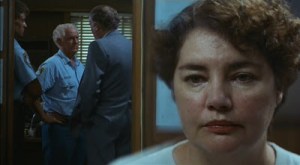
BLACK COMEDY Jeanie Drynan as Betty Heslop in Muriel’s Wedding.
Ever since William Shakespeare invented the black comedy by combining the opposing forces of Greek tragedy and comedy, there has been humour in the saddest tales (think the gravedigger scene in Hamlet), and tears in the joy (think Muriel’s Wedding in which Muriel’s mother kills herself). Readers are waiting, just pick a winner! Your hard-won resolution will flow as soon as you do.
So your manuscript has legs?
If you have a hero, a villain, you’ve pitted them against one another and decided who wins, good news: your fiction or non-fiction manuscript will live. Before sending it to a publisher, there are a few more elements to look at.
Who is speaking?
First draft manuscripts often suffer from multiple viewpoints and perspectives, or ‘voices’. Check that you’ve been consistent in your narration – there are several options for this which can be used exclusively or in combination. Narrative needs to be consistent in order to make an engaging experience for readers/viewers.
Where are we in time?
A very common confusing element for readers is time. If stories swing between time periods, or have subplots that take us away from the main action, writers easily let readers/viewers down by not giving clear reminders about where we are and who is who. Sometimes all it takes is a short recap of characters and storylines to keep readers in the loop of our unfolding stories, especially after you’ve taken your audience to another place for a chapter or two.
Equality calling
While re-plotting a manuscript, it’s wise to run a few tried and true plot tests. One of the best is the Bechdel Test, which will show you instantly if there is gender bias in your writing, and should make all writers aware of the need to create three-dimensional female characters. The ‘Smurfette Principle’ serves a similar purpose, and the ‘Russo Test’ is a watchdog for written representations of LGBTIQA+.
Engagement
Plenty of never-seen, unrealised, un-engaging writing languishes when writers seek to avoid connecting with audiences. Some of us do this out of a desire to be ‘literary’ instead of ‘popular’, but I suggest writers come to terms with entertainment taking many forms, everything from distraction to enlightenment. At this stage of your writing, be as objective as you can and analyse your manuscript for sheer entertainment value. Will people want to keep reading? I believe your gut will tell you where your work is getting slow and boring.
The memoir muddle
Many emergent writers begin with a memoir project, often at the behest of friends who have encouraged us that ‘there’s a book in you!’. It’s great to be supported by friends and family, who are our first audience, but when the hero of our work is us and the plot is the story of our lives, an extraordinary amount of objectivity is required. The temptation is to write a completely heroic version of ourselves and a totally villainous version of people we perceive have wronged us. An inability to see and record our own negative actions, and the positive actions of others, has brought many a memoir manuscript to a complete halt. If you think this might be the issue you’re having with your memoir, have the guts to record yourself as a ‘warts and all’ hero, and seek the reasons antagonists got in your way. It will give you more material and make for a better read.
You’ve read your manuscript. Congratulations. Now it’s time to get tough on yourself and put your plot through its paces. Get over all fears that plotting is a formulaic, restrictive process, and check your work has the ingredients of archetypal storytelling, the kind that successful authors have been engaging for centuries.




 Michael Burge Media