
Tag Archives: Writing Process

Beyond every dead body

I NEVER SET out to be a crime writer, it was something that crept up on me like the growing awareness of the killer in a whodunnit, and it all started with my early love of Agatha Christie novels.

The prospect of my debut novel Tank Water being consigned to the crime section of major bookshops was a little unsettling; but considering I was a debutante at the age of 51, I had little time to dissemble and embraced my place in one of the world’s highest-selling genres.

Crime has opened doors, not least the invitation to join the board of BAD Sydney, the writer’s festival that platforms journalists, academics, podcasters, broadcasters, film-makers and a myriad of professionals from the justice system.

It’s also led to reporting one of the more heinous crime waves that gripped the suburbs of Newcastle, Sydney and Wollongong from the 1970s to the 2010s, an era known as the Gay-hate Decades.

I’m often asked whether I struggle with the brutality of murder when reporting or writing fiction in which the body count mounts up. Consideration around this is so common (and empathic) that I thought it wise to put myself through a challenge a few years ago, to check if I was becoming desensitised.

Pain and trauma

I sought the most disturbing real-life crime I could find, and it didn’t take long to land on Helter Skelter, the seminal book on the Sharon Tate and La Bianca family murders in California in 1969, said to be the highest-selling true-crime publication ever.

Written by trial prosecutor Vincent Bugliosi and Curt Gentry, this incredible work lays bare the sad and sordid case in a manner that did spark anxiety in me, mainly because the killers – the so-called Manson family – had been part of the popular hippie counterculture of the era.

But I got through it intact, in some ways relieved that I was still able to be shocked by exploring shocking crimes, yet not stymied in my own work.

What drives my interest in crime writing and interviewing crime authors, is that crimes – murders in particular – rarely exist in a vacuum without other themes of grief and justice.

Dead bodies do more than throw up murder suspects, they cause pain and trauma to loved ones and communities. For me, the best crime writing delves into this territory with sensitivity and courage, because it can lift a crime novel’s significance above mere entertainment.

The exploration of grief in crime novels is rare, and although they say order needs to be restored by the end of a classic whodunnit, life is rarely as neat.

I’m also captivated by those aspects of victim/survivor’s lives that show resilience and endurance, where the hope of justice can sometimes be stronger than justice itself, posing the question: is justice ever really attainable?

It’s a fascinating concept, justice, a word with almost no effective synonym, one that means different things to different people.

It meant something to Doris Tate, Sharon Tate’s mother, who worked tirelessly to ensure the voices of surviving families were heard in the Californian judicial system. Her statements during the parole hearings for the convicted former members of the Manson family stand as a critical enduring addendum to Helter Skelter.

Restoring order

Agatha Christie loved a little order restoration at the conclusion of her books, although she didn’t always wrap things up neatly. In her works, lovers survive death and destruction while impatient philanderers get their just desserts. Family members are reunited even while others are split asunder. Most baddies get it in the neck, but some get off scot-free.

This tension between crime and punishment is one of the hallmarks that drives BAD Sydney, the festival that explores what crime can tell us about ourselves.

For this year’s event I’m delighted to be hosting two sessions: Bush Justice and Queer Crossroads, both explorations of how law and due process have been lacking in some of Australia’s marginalised and remote communities.

See you there!

BAD Sydney takes place at the State Library of NSW from August 11-14, 2024. Book now.
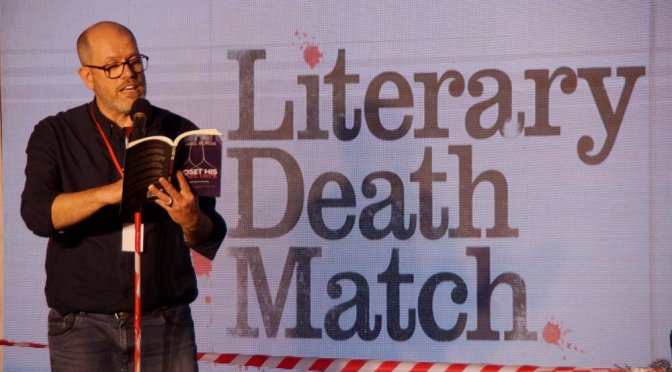
Literary Death Match knocked out my self-publishing shame

I WAS STILL packing for my long weekend away at the Bellingen Readers & Writers Festival, where I was to present my debut novel Tank Water (MidnightSun Publishing), when I got a slightly desperate call from one of the organisers, asking whether I had any short stories to my name.

I did, so the next question was whether I’d be up for a round of Literary Death Match. I’d never encountered this movement before, which has been entertaining readers and writing fans globally since 2006. A big-name author had to drop out for urgent dental work, meaning one place in the Bellingen LDM was available. So I said yes before I really understood what the whole thing was.

For an un-agented author who started out independently published and operates as my own publicist, even having a traditional book deal under my belt doesn’t stop me agreeing to everything a literary event asks of me. Such offers are so rare you’ve got to take what you get, and make the most of it.

I needed a short piece of fiction that I’d be prepared to read aloud in front of a crowd on Sunday evening. The right one popped into my mind immediately, so I grabbed my copy of my short story collection Closet His, Closet Hers and shoved it into my luggage.

Bellingen’s annual literary event is a gem of a way to spend the June long weekend. Situated in the coastal hinterland of the Mid North Coast, the community turns out in force for a huge number of visiting authors and wordsmiths.

Over the first two days of the festival, a few authors told me with great relief that they’d turned down the spare spot in the LDM on the final evening. I didn’t reveal I was the mug who’d said yes when everyone else was either too nervous or not prepared to stick around. Anyone who’d ever competed in a LDM, or who’d seen one take place, was effusive about it being “just a bit of fun”.

I sensed that was true, but my inner boy scout said: Be prepared!

So I honed the delivery of my short story ‘A Quick Fix’, which I wrote in the form of an email from a schoolgirl to her father, traversing some bitter family dynamics about an estranged gay uncle. Partly based on experience, I imbued this work with all the teenage brevity I recall from my own school years.

Bellingen’s glorious riverside parkland was the perfect place to sit in the winter sun and practice. Acting and broadcasting training goes a long way in such situations, and I needed to make a few cuts to deliver in the seven-minute time allocation, plus annotations to emphasise certain characteristics of this clarity-filled teen who delivers a dose of equality into a terrible situation.

LITERARY CHAMPS: (L-R) Sofie Laguna, Sophie Overett, Michael Burge, Thomas Keneally, Adrian Todd Zuniga, Alison Gibbs, Robbie Arnott and and Costa Goergiadis at Bellingen Reader & Writers Festival Literary Death Match, June 2022.

When I met the competition – my fellow LDM authors Sophie Overett, Robbie Arnott and Alison Gibbs – in the green room, we were a herd of nervous deer about to meet a very large headlight.

I’d already been on a panel in the huge marquee we were suddenly being led to, lit up in the darkness with a capacity crowd expecting to have a blast, so I knew this was big.

Judges Sofie Laguna, Thomas Keneally and Costa Goergiadis walked up to the stage at the invitation of LDM host and creator Adrian Todd Zuniga, leaving we writers crouched down the back in the shadows. By the looks on our faces, we’d have preferred to stay there.

DEATH WATCH: The crowd at LDM

Yet we managed to go two rounds, reading to the crowd and getting bombed by literary questions. I barely remember any of it, just the glare of the spotlight and the silence as I started to read, my voice pitched slightly higher and rather quietly, to ensure I got their attention.

Paragraph by paragraph, every middle-aged one of my six feet very publicly embodied that teenage girl on the brink of discovering what equality means in this world.

And with my final line, I brought the house down, a tsunami of laughter and applause washing every bit of shame away about self publishing a collection of short fiction that no editor, agent or publisher in the country had ever thought enough of to get behind.

The judges awarded me a win in my round, but I was finally KO’d by the lovely Sophie Overett in a spelling bee finale.

In the aftermath, my copy of Closet His, Closet Hers was torn from my hand so that a reader could look up where to buy it. A big name author asked me in the green room who published it. I pointed to myself, which is what I did once at another event, when a bestselling author asked me who my publicist was.

Eyebrows go up in such moments, mine more than anyone’s, because for a short time it’s not about the luck, the opportunity, the contacts, the networking, the five-year plan or the affirmations… it’s simply about the writing.

That’s the beauty of Literary Death Match, writing really is the winner.

Here’s my top tips for anyone recruited into LDM:
– It is fun, and the rules are there to be massaged, purely for entertainment value. When Adrian called time on me, three times, I waved him off and kept reading
– Be bold and read with all the characterisation you can muster
– The crowd is pumped and on your side, they know writers are very often shy and retiring and LDM is a raucous big deal
– It’s fast, and will flash by in a heartbeat!
– You can read self-published, emerging work, so give the crowd an early literary experiment!

Unlocking the secret life of (most) writers

WRITERS are living through tough times, and times are usually tough enough for wordsmiths.

“Of optimal use to writers who have at least one manuscript completed and the willingness to create another.”

Not since the invention of the printing press has it been easier to publish books using an array of affordable online publishing services, but these same systems and the distribution networks they feed have stripped the traditional currency of many of the same books to almost nothing.

Newspapers struggle to get readers to pay, and we now have multiple generations who do not expect any content should come with a price tag.

Yet it’s not all bad news. Despite the terrible odds stacked up against writing for fame, glory and riches, people still tell stories.

My lack of success in landing a traditional publishing contract for my work led me down this pathway, even as a log-jam of manuscripts was piling up in my head, heart and hard-drive. Write, Regardless! is the result of having many questions fired at me ever since I threw my cap in the ring and became a publisher who made a small splash.

I once worked in publishing and learned a thing or two about gauging what makes a good story, a savvy author and a win-win contract, but I needed to spend years researching online processes and social media in order to lay the foundations for this step into the partially unknown.

And I hasten to add I don’t have the answer to every question. I’m still learning, but after finding myself corresponding at length about my approach, and thereby losing time for my own work, I decided to look at how I achieved my limited success in order to have somewhere to direct queries.

“I was objective enough to make decisions as a publisher as much as I was making them as a writer.”

In my first year as an independent publisher I profited from the publication of four titles, which made money after significant sales to libraries of the paperback version of my strongest non-fiction title Questionable Deeds: Making a stand for equal love. This title had relevance to the news cycle in that it spoke considerably to the critical political journey of marriage equality legislation in Australia.

9780645270525The publication of Closet His, Closet Hers: Collected stories at the same time was no mistake. Fiction is a much harder sell, and I consciously floated my first fictional title on the same wave as Questionable Deeds. To put it plainly, I was objective enough to make decisions as a publisher as much as I was making them as a writer.

That is the key to Write, Regardless! It seeks to unlock publishing industry secrets, but it will also raise your awareness of what it takes to spend your precious time writing regardless of what the publishing industry thinks of all your hard work.

This book is not aimed at teaching you to write, although it has several encouragements to analyse your work to make it more engaging and entertaining to readers. It doesn’t offer short cuts. I started creating an online presence as a journalist twelve months before I started writing my first published book, and I encourage readers to give the process at least the same time as I have, which is now approaching five years.

Writing is about doing the work. Publishing is about even harder work. Marketing and promoting a book is the hardest work most independent publishers will ever do.

Write, Regardless! is the technique I applied to myself, and in doing so earned a third of a traditionally published writer’s average annual salary in my first year, without any support whatsoever from the traditional publishing industry or the mainstream media.

That might sound like very small fry, but weighed up with the high chance of getting ripped off thousands of dollars for the ‘one-stop-shop’ charlatans, or outsourcing the work to others, it’s a resounding success story. I made more than many authors receive from books that have been treated to the full suite of marketing and promotion, festivals and competitions.

As I write this, I am preparing to attend my first writers event as part of a panel discussion at Brisbane Writers Festival. For a self-published author in any country that is almost unheard of.

Write, Regardless! is available free online as a series of articles on my website, but I’m publishing it here with all the same links to other resources I created on the journey.

write-regardless-cover
BUY NOW

It will be of optimal use to writers who have at least one manuscript completed and the willingness to create another with a regular writing schedule of no less than a page of new material a week. It’s also designed for you to begin the work of becoming a publisher at the end of each chapter, before moving onto the next.

One page a week sounds like a small amount, but there is more to being an author than writing these days. Read on and courageously do the work!

An extract from Write, Regardless!