
Tag Archives: Writing Process

The call to action

UNCLE SAM WANTS you to get out of your comfort zone, for the sake of a good story (J.F. Flagg's 1917 poster).
UNCLE SAM WANTS you to get out of your comfort zone (J.F. Flagg’s 1917 poster).

THERE’S a nifty three-act dramatic structure, generally used by screenwriters (but drawn from the older five-act dramatic arc), which gets a plot moving a bit faster than a novel and contains a great plotting tool – the Call to Action.

One of the reasons we go to the movies, or distract ourselves by reading, is because we want to step outside our lives, temporarily, for entertainment.

It might sound incredibly obvious, but this distraction requires writers to create work so deliciously escapist that the reader/viewer is taken beyond the sphere of their own lives for a short time.

Writers don’t have to create an alternate universe (although some do, to great effect), we just need to suspend the reader’s disbelief. Even getting them a centimetre off the ground can be enough.

To achieve this disbelief, writers need to have their main character – the protagonist – step outside their world. The protagonist’s ‘call to action’ is the trigger for this step.

Situated at the heart of a plot’s exposition, the protagonist is going about the business of what seems like an average day, when something happens (an old friend calls with some unusual news; a car crashes into their front room; a stranger turns up at their door … it can be anything).

Those of us who live the average Western life, where most of our needs are taken care of, do not get wake-up calls like this, but we love to imagine what we would do if we did.

It’s this attractive energy that publishers, agents and eventually audiences crave, and it’s even become a marketing tool. It’s why we buy the book, or the movie ticket.

Now, I hear a bunch of literary fiction writers screaming: “Nooo, it’s all about the Art!”. Well, as a fan of literary fiction myself, I say let ’em scream: literary fiction writers need a call to action for their protagonist every bit as much as Agatha Christie did.

Would Nick Guest, the protagonist in Alan Hollinghurst’s The Line of Beauty, have gone on such a compelling emotional journey had he simply moved out of the Fedden family’s house the minute their daughter Cat started cutting herself? (he wanted to).

Would Stevens, the Butler of Darlington Hall in Kazuo Ishiguro’s The Remains of the Day, have decided to take a car trip to visit Miss Kenton, the former Housemaid, had his new boss Mr Farraday not ordered him to take some time off ? (he didn’t want to).

Of course they wouldn’t. Had Nick moved out, and Stevens never gone away, both storylines would simply peter out. Neither piece of ‘Art’ would have garnered the critical and financial successes of their Booker Prize wins.

The protagonist’s call to action is linked to a plotting device covered in my posts on the dramatic structures of two films – Guess Who’s Coming to Dinner, and The Sum of Us. This is the compelling question needed in every plot’s exposition, in fact, they are almost one and the same: if you get the protagonist’s call to action right, a compelling question will naturally be posed.

CROSSING THE LINE Protagonist Nick Guest in the television adaptation of Alan Hollinghurst's The Line of Beauty
CROSSING THE LINE Protagonist Nick Guest in the TV adaptation of The Line of Beauty (Photo: Nick Briggs).

By keeping Nick Guest in the Fedden’s home, exposing him to family secrets, and relying on his character’s already-established empathy, Hollinghurst poses the compelling question of his plot: When will the Feddens and their British upper class friends discover the reason for Nick’s empathy is his homosexuality?

By sending Stevens (who we already know is staid and a little unreliable in his recollections of his employment history) out into the world, Ishiguro poses his: Is Stevens so deluded he actually believes he can revive a stunted love affair that barely even began twenty years before?

Some authors, particularly crime writers, bury their protagonist’s call to action in mystery – a murder in the exposition is a particularly effective trigger for the most common of all plot questions – Whodunnit?

It’s for this reason that Miss Marple and Hercule Poirot are Christie’s great antagonists – they foil her murderers (read: protagonists) at each and every turn, showing how antagonists are also locked into the plot by the protagonist’s call to action.

WRITE REGARDLESSHead spinning? Just remember that plotting isn’t meant to be a formulaic set of rules. Stretching and manipulating these conventions, in interesting ways, is the real ‘Art’ of writing.

© Michael Burge, all rights reserved.

An extract from Write, Regardless!
The point of no return

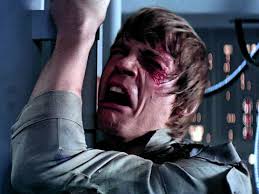
NEW TERRITORY Luke Skywalker takes the news of his parentage badly in The Empire Strikes Back.
NEW WORLD Luke Skywalker takes the news of his parentage badly in the classic turning point of The Empire Strikes Back.

SOME call it the mid-point, some the climax, others the reversal of fortune. Whatever you label it, what every great storyline needs is a point of no return.

As writers, we need to take our protagonists and antagonists, and place them in an environment where nothing is the same as it was at the start of the story.

Seeing how they fare in the aftermath makes for gripping storytelling.

In the film Gone With the Wind (1939) screenwriter Sidney Howard (and an uncredited team of extra writers) used the same mid-point as the original novel’s author, Margaret Mitchell, in the scene where the southern city of Atlanta is burnt to the ground.

Filmed almost two months before principal photography began, and long before famous names were cast as the leads, the scene was shot when the old sets of the 1930s King Kong movie were sent up in flames. Such was the need for a spectacular climax to this epic story of the American Civil War.

BURNING BRIDGES Atlanta goes up in smoke in Victor Fleming's Gone With the Wind (1939).
BURNING BRIDGES Atlanta goes up in smoke in Victor Fleming’s Gone With the Wind (1939).

In the wake of their escape from the city, no character in this story is the same – their world has turned upside down.

The formerly privileged Scarlett O’Hara needs to eke out an existence in the ruins of the war, and it is her climb back to wealth which occupies the central storyline from that point on.

In the original Star Wars (1977), Luke Skywalker is unwilling to leave his home planet Tatooine and travel with Obi-Wan Kenobi to support the rebel forces in their quest to overthrow Darth Vader and the Empire, that is, until he returns home to find that Imperial stormtroopers have killed his remaining family.

In one of this weighty science fiction franchise’s few moments of real pathos, Luke realises there is nothing for him at home anymore. His life will never be the same again, so he has nothing to lose in embarking on an interplanetary journey with powerful strangers.

And in Shakespeare’s Hamlet, self-doubt and hesitation become all too real in Shakespeare’s brilliant climax, when the tortured young prince lashes out at a silent observer behind a curtain, running it through with his sword, only to kill the earnest old courtier Polonius.

This grave error sets a tragic course for the rest of the play, and, after so much angst and inaction, is a devastating action which seals the fate of all the characters.

In a sense, attempting to write anything without a climax is always going to result in unresolved issues in a plot. Without the crucial mid-point, our protagonists remain untested and static.

The term ‘mid-point’ is often used for this moment because a climax should generally occur in the midst of proceedings, after the characters have been established in the audiences’ or readers’ minds, once we’ve formed opinions and loyalties about them, and experienced their pathways ignited by the ‘rising action’ of the plot.

Place a climax too early, and we risk having nowhere to go in a storyline. Place it too late, and we risk losing the interest of the audience or reader.

A point of no return need not be some sudden sequence where our characters survive a nuclear event (although action movies regularly place their protagonists in such external extremes, to great effect), it could be an internal crisis – an upsetting diagnosis, a letter containing bad news, or a guilty verdict in the dock.

WRITE REGARDLESSBurn your character’s bridges, cast them loose in undiscovered country, and record their responses to the shock. It can feel cruel, especially if you’ve travelled with them for some time, but go on, it’s make believe after all, and if the point of no return unsettles you, it’s bound to make your audience feel something too.

© Michael Burge, all rights reserved.

An extract from Write, Regardless!

The sum of a storyline

SPEAKING OF US Jack Thompson and Russell Crowe in The Sum of Us.
SPEAKING OF US Jack Thompson and Russell Crowe in The Sum of Us (Photos: Jimmy Pozarik).

WHEN Hal McElroy, one of Australia’s most prolific film producers, read the play script The Sum of Us by David Stevens, he described it as “absolutely irresistible” – the two words every aspiring playwright wants to hear from a producer after just one read.

The desire to create a film of Stevens’ script was so firmly implanted that it took only four years to bring the work to the screen as one of the iconic Australian films of the 1990s.

Inspired by my first post on dramatic structure (a breakdown of the plot of William Rose’s Guess Who’s Coming to Dinner), I embarked on an analysis of The Sum of Us, not by watching the film, but by reading its screenplay, to see how closely it follows the classic five-part story arc widely purported to be the key to all good storytelling.

With flashbacks that shed light on the family which is the centre of the story, and regular breaking of the ‘fourth wall‘ (the imaginary barrier between a character and their audience), The Sum of Us presents as a less linear story than my first subject, and great fodder to observe how another writer might have bent ‘the rules’ in interesting ways.

Here’s what I found … beware, there are spoilers.

Exposition – “He hasn’t been this excited for ages”

The exposition must introduce us to the characters and show who is the protagonist (the hero) and the antagonist (the anti-hero, or ‘villain’); and the protagonist must be called to action, posing a question so interesting that we are gripped.

At the age of 24 Jeff Mitchell remembers his grandmother fondly as a woman with boundless love and energy for her grandchildren. He’s a plumber who lives in suburban Sydney with his widowed father Harry, a ferry captain. Jeff (the protagonist) is getting ready to go out, with the strong chance of meeting that someone special at the pub that night. In the most loving, accepting manner, it’s Harry (the antagonist) who spills the beans that his son’s ‘someone special’ will be a man, not a woman. The call to action is Jeff’s memory of his grandmother’s great love for her partner, Mary; posing the big question: How did this obviously straight, typical Australian father become so accepting of his gay son?

Rising Action – “How can you be too bloody domestic?”

The rising actions are those the antagonist uses to thwart the protagonist and show us who both of them really are.

On his way to meet Greg, a gardener, at the local gay-friendly pub, Jeff reminds the audience that his Grandmother was a lesbian in a very long-term relationship with his “Aunt Mary”. Their kind of love is something he aspires to. Harry, meanwhile, calls Joyce, whom he met through a dating agency, and arranges to meet her for lunch. Jeff and Greg get on like a house on fire and make their way home, but Harry proceeds to make Greg so welcome that a night of passion becomes a scene of domestic normality, the likes of which Greg, with his homophobic father, has never experienced. Jeff’s date is ruined by his well-meaning but overbearing Dad.

RISING ACTION Russell Crowe and John Polson get close.

Climax – “If only you’d been honest”

The climax must be the start of a battle between the protagonist and the antagonist, and a turning point after which there is no going back for either.

Harry and Joyce’s relationship develops so easily it puts Jeff and Greg’s false start into sharp perspective. Jeff is staying at home, depressed. Harry reveals his relationship with Joyce and declares he will marry her only if she and his son get on, although he has not yet told her that Jeff is gay. Jeff is thrilled for his father, but when Joyce visits, she innocently stumbles across the gay magazines Harry bought for Jeff, is affronted by the presence of homosexuality in the family she was seriously considering becoming a part of, and leaves. As the city celebrates New Years Eve, a deeply disappointed Harry has a stroke while watching the fireworks from the porch.

Falling Action – “I didn’t have the guts” 

The falling action must play out the battle between the protagonist and the antagonist, allowing one of them to win. The winner defines the piece as a comedy or a tragedy.

When Harry wakes up in hospital, Jeff is there to comfort him, and immediately steps up to the plate as his father’s primary carer. Greg, meanwhile, gets thrown out of home for participating in Sydney’s Gay Mardi Gras. Despite being neutralised by his inability to speak or walk, Harry causes a scene at the supermarket in order that Jeff and Greg meet again. Joyce comes to visit Harry at home, and is confronted by the love the Mitchell family have for one another, and she leaves, acknowledging to herself that she has missed out on sharing in it. Harry ponders what it is to lose love, once it has been made.

Dénouement – “How do you say thankyou for love?”

The dénouement (“to untie”) must unravel all the conflict and bring everything to a sense of resolution. In a comedy, the protagonist is better off than when they started. In a tragedy, this is reversed. The big question posed in the exposition must be left answered.

Reminiscing on the core love of his family, Harry recalls the day that he and his brother separated his mother and her long-term partner Mary, in their old age, wondering what they would have said to one another the night before they knew they would never see one another ever again. On a day trip to the botanic gardens, Harry notices Greg is working there, and ensures the two men meet yet again. Jeff and Greg talk. Both men have been set free from the expectations and fears of their fathers, and there is a great sense that they’ll continue growing the love of the Mitchell family together

FATHER OF THE CENTURY Harry Mitchell is a hard-to-pick anti-hero.

The Verdict

Picking the antagonist and protagonist in this screenplay was difficult – most of the characters are affable and it was hard to position one of them as an anti-hero. But it is Harry Mitchell, Jeff’s father, who unwittingly places the obstacles in the way of his son’s happiness, by being so very keen for his son to experience the joys of love as he defines it.

Jeff is not a classic protagonist either – in the climax he remains almost neutral and does not seem to ‘do battle’ with his father in the relationship stakes. This is because ‘the battle’ is a lot deeper in this plot than usual.

This is a story about relationships in the one family – there is Gran and Mary, separated tragically after forty years; there is Harry and Joyce, trying to rebuild love after losing it to death and divorce; and there is Jeff and Greg, attempting to start a relationship from scratch under conditions that are not favourable.

But these moments of guilt and inspiration are played-out through the father-son relationship of Jeff and Harry, and it’s the lessons that Gran taught these men which make the flashbacks in the script essential (especially the placement of Jeff’s boyhood recollection of Gran and Mary’s love right in the exposition), because they ultimately see Jeff and Harry through their own battle.

WRITE REGARDLESSAnd it’s that discovery which answers the big question posed in the Exposition: it was Gran Mitchell’s courageous love that caused her son Harry to accept his son so unconditionally, and made him capable of taking emotional risks out of love for his son.

© Michael Burge, all rights reserved.

 An extract from Write, Regardless!