Tag Archives: Writing Process

Guess who’s plotting a story?

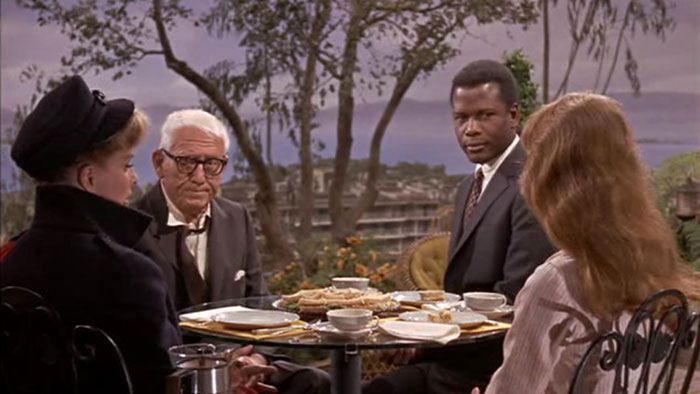
BATTLE LINES Stanley Kramer's seminal film on equality, Guess Who's Coming to Dinner?
BATTLE LINES Stanley Kramer’s seminal film on equality, Guess Who’s Coming to Dinner.

WE all know how to write, right? Well, perhaps not. I have been working on a play script for ten (yes, 10) long years and I still don’t have it down.

One of my writing heroes Helene Hanff once declared that after forty years she could write great characters and openings for plays, but she still couldn’t plot to save herself.

Well, having knocked-off about half that number of writing years, I decided to do a bit of research on story arcs, and apparently it doesn’t matter if you’re telling a joke or writing a blockbuster novel, a well told story needs to follow a basic formula.

I decided that the next movie or play I watched would be tested to see if it followed this ‘rule’, and as luck would have it, on television this afternoon the great Guess Who’s Coming to Dinner (1967) was screened, with no ads.

I sat down and put this plot (written by William Rose) through its paces. Here’s what I found… beware, there are spoilers.

Exposition – “You may in for the biggest shock of your young life”

The exposition must introduce us to the characters and show who is the protagonist (the hero) and the antagonist (the anti-hero, or ‘villain’); and the protagonist must be called to action, posing a question so interesting that we are gripped.

A young couple (Dr John Prentice and Joanna Drayton), canoodle their way through an airport. The world doesn’t seem to give a damn that he is African-American, and she is not, but without doing anything, the couple offends a cab driver; the Drayton’s African-American maid; Joanne’s mother Christine, and her father Matt. Joanne presents as the protagonist, with her blind intention to marry despite anyone’s objections. Her father Matt presents as the antagonist, and objects to the idea of the two marrying at all. The call to action occurs almost by accident, when the couple has no opportunity to tell Joanne’s parents about his racial identity before arriving at their home, posing the big question: Will they get the support of anyone in the world?

Rising Action – “All Hell Done Broke Loose”

The rising actions are those the antagonist uses to thwart the protagonist and show us who both of them really are.

Matt Drayton digs further into his objection, despite his wife’s support for the couple’s happiness; despite John’s declaration that if her parents will not support them, he will not marry Joanna; and despite their good friend Monsignor Ryan blessing the marriage. Joanna invites John’s parents to dinner, and Monsignor Ryan calls his old friend a phoney liberal coming face to face with his principles. Matt is outraged and decides to leave the house.

DYNAMIC DUO Hepburn and Tracy as the Draytons.

Climax – “We’re in Terrible Trouble”

The climax must be the start of a battle between the protagonist and the antagonist, and a turning point after which there is no going back for either.

Outside the comfort of their home, Joanna’s parents come face to face with how the world has changed around them. But a car accident with a young African-American man, and the news that Joanna is planning to leave with John that very night, sends Matt into a spin. He argues with Christine, who tells him she is not on his side in this debate about their daughter’s happiness. He argues with Monsignor Ryan, who tells Matt that he cannot destroy the couple’s happiness. Also out in the world, Joanna meets John’s parents, who show the kind of instant disapproval her father has been trying to warn her about.

Falling Action – “You Don’t Own Me”

The falling action must play out the battle between the protagonist and the antagonist, allowing one of them to win. The winner defines the piece as a comedy or a tragedy.

John’s parents arrive to a sumptuous dinner that nobody seems capable of enjoying, and the party quickly separates into rival loyalties – both mothers (who advocate for trusting the nature of love), and both fathers (who believe the relationship to be an aberration). Joanna announces she may well leave her family for good, and goes to pack, leaving the true protagonist, her fiancée John, to face his father. In the final defeat, John tells his father that he and his whole lousy generation must get off his back. Matt’s firm objections to the marriage are diminished by John’s mother, when she challenges him to accept that he has grown so old he has forgotten what true love is. Ruminating on this, he calls everyone back to the dinner.

Dénouement – “Screw Them All”

The dénouement (‘to untie’) must unravel all the conflict and bring everything to a sense of resolution. In a comedy, the protagonist is better off than when they started. In a tragedy, this is reversed. The big question posed in the exposition must be left answered.

Matt recaps the whole plot so far, reminding us of everyone’s ‘side’ in the debate. Crucially, he tells his daughter, the only one to interrupt him, to “shut-up”, and it becomes clear that he has been reminded, and is reminding them all, that they must put the way they feel above what they think. He compels the young couple to cling to one another against the objections the world will throw at them. Despite lingering unresolved feelings, the newly cemented family sit down to dinner.
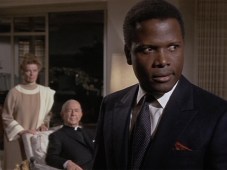
PROTAGONIST REVEALED Sydney Poitier as Dr John Prentice, the real protagonist of the movie.
PROTAGONIST REVEALED Sidney Poitier as Dr John Prentice, the real protagonist of the movie.

The Verdict

Of course all rules are meant to be broken, and Guess Who’s Coming to Dinner breaks them in some interesting ways. We are fooled into thinking that Joanna Drayton is the protagonist, while her fiancée John broods on the situation around him and seems so affable that he might just walk away from her in order to ‘save’ her. But he is and always was the protagonist, hidden because as the ‘coloured man’ he’s ostensibly the lowest status character in the story. Even the film’s title – which asks us to ‘guess who?’ – underlines the theme that this story is a search for which of the main characters is the hero.

WRITE REGARDLESSWhen John confronts his father, he assumes the hero position and shows us who he really is: a man struggling with too much history on his back. And the big question posed in the exposition, about whether the couple will get any acceptance, is well and truly answered.

© Michael Burge, all rights reserved.

An extract from Write, Regardless!

Helene Hanff – lady of letters

MISTRESS OF MISSIVES Helene Hanff (1916-1997) made a career of letter writing.

COULD there be a better proponent of written communication, a smarter wordsmith, a more ‘writerly’ writer than New York denizen, Queen of the day job, rejection letter collector, and one of the world’s biggest fans of English Literature – Helene Hanff (1916-1997), author of 84, Charing Cross Road?

Of all the writers I admire, I cannot think of one who deserved more to have lived long enough to write in the age of blogging.

It could be argued that Helene Hanff invented the style of writing now employed almost blindly by bloggers the world over – the confessional epistolary genre, studded with emotion, was embedded in her genes, and her unbeatable use of it was borne of her own life experience.

“I’m a great lover of i-was-there books,” she wrote in her most famous work.

“That her nature often resulted in alienation gives her story all the more pathos.”

Overwhelmed by a sense of failure and loneliness in her fifties, after the collapse of some long-held dreams about becoming a Broadway playwright (not to mention the four decades she spent trying), Hanff received news that one of her oldest friends had died.

This was bookstore manager Frank Doel of Marks & Co. at the address made famous by the title of her book, in the city of London, England.

The two had known one another since 1949. Hanff was devastated.

Forget that she had never been to London. Forget that they had never met face to face. Through their two decade correspondence, Doel and Hanff had developed a unique long distance friendship.

There was no overt romance, but there was a great and tender mutual love of English Literature – Hanff the reader, and Doel her literary scout, seeking-out affordable copies of the classics for a writer of limited means eking out an existence in New York City.

Compelled to document what may have felt like one of the more meaningful relationships in her life, Hanff embarked on what she thought would be a very small work.

MEETING OF MINDS First edition cover of Hanff's most famous book.
MEETING OF MINDS First edition cover of Hanff’s most famous book.

It’s hard to put a finger on why 84, Charing Cross Road resonates with readers. Beyond the letters between the main characters, Hanff (and Doel, in his replies) recorded the early post-WWII years on both sides of the Atlantic, through to the revolutionary late 1960s. On the journey, they held steadfastly to literature as the world changed around them.

I first encountered this story in its 1987 film adaptation, starring Anne Bancroft as Hanff and Anthony Hopkins as Doel.

What spoke to me was the idea that Hanff fed her soul without really leaving her living room, which some might consider limited, but which struck me as profoundly imaginative.

She really was an armchair traveller who reassured people the world over that where we were, right at that moment, was neither limited or mundane, if only we could read and access our imaginations.

I felt I was starting to understand Hanff better when I read one of her most revealing paragraphs in the sequel, The Duchess of Bloomsbury Street, when she described how she stumbled into what is known as the Actors’ Church in London’s Covent Garden, and promptly burst into tears at the sight of the small plaque in memory of Vivien Leigh.

It also says a lot that Hanff doesn’t explain why. Her sentiment was very personal, but it was also very private. She seemed to take plenty of secrets to her death in 1997, leaving behind much speculation about her life.

Although readers and fans got a rare glimpse into Helene Hanff’s life in a 2014 tribute written by her cousin, writer Jean Hanff Korelitz, who recorded her first meeting with her famous relative.

“Helene turned out to be a small woman with the wiry build of a preadolescent boy, and she dressed in a style that had seen her through decades of a writer’s life: wool trousers, cardigans, flat sneakers, everything well worn and often less than scrupulously clean,” Korelitz wrote.

“She had a barking voice, a wry perpetual smile, and a pageboy haircut that veered in colour towards a not entirely natural rust.”

These observations make Hanff sound like a short Katharine Hepburn, but it was Hanff’s response to her young cousin’s first published book that is the more revealing memory. According to Korelitz, when Hanff questioned, brusquely, why Korelitz wrote something “like that?”

“Five minutes later she called back, in tears. ‘I’m sorry,’ she wailed. I was stunned, and tried to persuade her that it was nothing, but she didn’t believe me, and she was right; when she died the following year there was still that skein of discomfort between us.”

These moments are reminiscent of similar turning points in 84, Charing Cross Road that do not appear in the correspondence, but rather provide the links between Doel and Hanff’s letters.

For example, when Hanff writes of sending a food package to the staff at the London bookshop in the middle of Britain’s postwar rationing, only to realise that the six-pound ham in it may have meant any kosher Jewish staff would miss out, she cares enough to write and make other arrangements.

In these anecdotes, Hanff reveals herself as an ‘act first, think second’ character, but one who was never afraid to try better next time.

Confronted with her younger cousin’s publication success, the woman who’d waited until she was almost fifty to make her own literary splash, and only did so by writing primarily about herself, Hanff’s response to Korelitz is understandable.

But it’s this combination of a strong individual who showed actions of great empathy that provides the dynamic attractive force in Helene Hanff, and, by extension, her work. That her nature often resulted in alienation gives her story all the more pathos.

A loyal respondent to the thousands of fan letters she received (and, according to her obituarist, kept in relative poverty for a few years from the postage costs), Hanff’s true life’s work was probably in these letters, surely scattered across the globe by now.

One day, Hanff’s replies to these fan letters may provide an even deeper account of this intensely private woman who preferred to put things in writing – after all, her breakthrough work (and certainly her most enduring), is ‘just’ an edited collection of letters.

If only the rest of her missives could be collected.

Her correspondence style was direct, humorous, polite, punctuated by outbursts in capitals and underlinings for emphasis (you can hear the clack of her typewriter in the execution), and you’ll never catch her abrevi8.

It’s tempting to imagine what Hanff would think of all the communication problems modern internet participants encounter in their use of written language. I’d like to think she’d write: “GET OVER IT and just READ, for God’s sake!” and: “TONE, you think I used a TONE with you? Of course I did …”

pluck-cover
BUY NOW

If she were alive today, Helene Hanff would preside over the world’s most followed literary blog, from which she’d broadcast her wry empathy to the world from her kitchen table. Would Twitter’s 140 characters have given her the space to say what she wanted? I am sure she’d have found a way; but emoticons? NEVER!

© Michael Burge, all rights reserved.

This article appears in Michael’s eBook Pluck: Exploits of the single-minded


Running with the rats of Soho

A Writer’s next day job.

WITHOUT a short-cut into the BBC or an entrée into a production company, it was almost impossible to get a job in film or television production in London, but pushing a foot through the door of a post production (editing) facility with a resume in your hand was a viable way to enter the industry.

And so, within 24 hours of pounding the narrow thoroughfares of Soho, between Shaftesbury Avenue and Oxford Street, I was offered two jobs.

Having just signed a lease with a group of friends on a cottage on the Isle of Dogs in east London, I had rent to pay, so I said yes to both.

As it happened, that weekend I went back to ARTTS International in Yorkshire to complete the final edit on a drama-documentary, and I was greeted like a conquering hero on the Saturday morning by a mob of students, hungry for a taste of the world beyond the pig farm, and then confronted by a Feedback Session.

Only ARTTS alumni around the world will know exactly what I mean by the latter. How do I describe it and not make it sound like ARTTS was, on occasion, a little like a correctional centre?

In any case all the accolades looked kindly beyond the fact that the best position of the two on offer was that of a lowly Post Production Runner.

A Soho Runner in those days was not an enviable position. If you were serious about your career, you’d want to stay in the job for no longer than six months.

So I took the offer than a Dean Street post production facility made to me, and started that very week. By the end of summer, I hoped, I’d be up the next rung of the ladder.

The other runners showed me to my first task – to clean-up the soft drink supply room below street level in a dank passageway that looked (and smelt) like I’d imagine the very same street did in Dickens’ time. Five years of tertiary education had prepared me to recognise dramatic tension, at least.

The rats gave ground by retreating around a bend in the subterranean storeroom, while I re-arranged the pallets of lolly water, trying to ensure they were not sitting in the inch of water that flowed across my shoes.

This post-production company liked to keep its clients happy, so there was no set lunch menu. Instead, the gourmet delights of central London were ordered and fetched on foot.

FABULOUS FOOD For fabulous people, Berwick Street Markets, Soho.

But we runners were also required to make a selection of sandwiches for clients who just couldn’t wait, created from the fresh produce of the fruit and veg markets on Berwick Street, with slabs of fresh bread and the finest cold meats from local delis. Luckily I’d had some sandwich-hand training while studying at NIDA, so I knew my way around a slice of focaccia.

There were some pretty speccy people making their way through these doors, but also plenty of clients who just believed they were on the A-List, and the only way they could gauge their level on the ladder was by shouting at the runners.

I never got shouted-at, but when a music-video maven came through to the kitchen in a tube dress right to her tennis-shoed ankles, calling for a “toasted ciabatta with marmite”, I made the mistake of answering that we were fresh out of ciabatta, but we had plenty of focaccia.

Her perplexed look quite naturally led me to believe that she simply didn’t know what focaccia was, so I began to explain. Before I got through the basics, she said: “I know exactly what it is!”, before insisting her first choice was fetched.

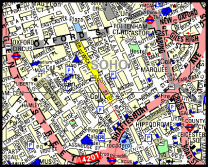
LONDON’S MAZE Soho is a small district jammed in between four major thoroughfares.

Now, most people couldn’t pick ciabatta from focaccia in a blind test, and since I was a Soho Runner of some weeks’ experience, I knew at that hour there wouldn’t be a fresh piece of either available anywhere. So I just sliced some bread quite thickly and smothered it with the maven’s favourite spread.

And so the cry of “I know exactly what it is” went on to be summer’s catchphrase at that end of Dean Street.

Each week I religiously wrote my first screenplay (an adaptation of E.M. Forster’s Other Kingdom), and duly typed it up for consideration. The potential to make movies flowed through my veins, even if I was really working in catering under a fancy name.

Running video tapes and reels between editing houses meant I soon got a great knowledge of Soho’s street network. Rarely did we have to travel beyond the zone bordered by Oxford Street, Charing Cross Road, Shaftesbury Avenue and Regent Street.

I also discovered the locations of all the production offices listed in the films I aspired to join-in-on – Merchant Ivory, Goldcrest, The Oil Factory – behind glossy doorways with polished buzzers at street level, with people rarely coming and going.

In this maze I realised that if you spend enough time in Soho, you’ll encounter famous people. I saw Sean Connery looking both ways as he turned into Dean Street in his rather boring looking car; Greta Scacchi looking like she’d locked herself out of her flat; and Germaine Greer leaning into the wind of a stormy night as she ambled next to me along Oxford Street.

Soho also brought me face-to-face with entertainment by a different name. One racy shopfront near the markets displayed hilarious posters of new porn films with names that referenced the mainstream movies of the day. There was A League of their Moans (a slightly different take on the all-girl baseball team flick), and Howard’s End (in which Howard’s end was about to be spanked by a rather domineering lady).

The really sad element to Soho was the homelessness. At the end of almost every day I packed-up the leftover sandwiches and took them to St Anne’s Court, where legions of homeless men spent their days in the sunlight. They accepted the fresh, nutritious food with a quiet gratitude … they knew exactly what it was, and they didn’t care if it was ciabatta or focaccia.

After a couple of months the boss found out and told me to stop, since the bags I carried the food in were the very same we used to run tapes and reels around Soho – a handy way of advertising, I guess – and he didn’t want our company associated with any feeding-of-the-poor.

But I didn’t stop. I didn’t even use different bags. I wasn’t going to leave perfectly edible food for the rats.

© Michael Burge, all rights reserved.