Tag Archives: Writing Process

The truth about writing advertorial

AD OR STORY? Actually, look closer, it's both.
AD OR STORY? Look closer, it’s actually both.

LUCKY is the writer who has never had to turn their hand to advertorial, that postmodern (possibly ‘Newspeak’) phenomenon which fills so much of our media.

Apparently around since the late 1940s, advertorial has a few tricky names: ‘commercial writing’ is the latest on the list, which includes ‘infomercial’ (usually on television) and ‘cash-for-comment’ (the bane of commercial radio).

Writers could, of course, make a purist stand and never engage in creating content off the back of advertising revenue, but you’d probably never make much money if you did, because all writing (yes, even literary fiction) needs to be commercial at some stage.

Here are my best tips for editors and writers on surviving this trickiest of writing practices, and interfacing with the sales team!

Advertorial can get you noticed

Right now, commercial writers are making decent money finding what is interesting about everything from water tanks to washing machines, and producing serious editorial articles for PR companies and big media advertisers. To achieve excellent results, and get your by-line into the publication, make your article about plumbing products so darned engaging that the editor will run it whole in that week’s paper, and make it look like serious journalism. Think laterally, find the story, interview people in the industry, shape it as you normally would a feature, take the money and submit your by-line at the top of the piece. They’ll snap it up, simply because they have one staff writer and they’re drowning just getting the news together.

Don’t mention the weather

Writing about destinations for travel companies, or regional events, means you’re going to have to find the way to say all the nice things and none of the nasty. Weather and climate are particularly off-limits, because advertisers don’t want readers to waver about heading to their locale. Keep the weather conditions a secret until the Bureau of Meteorology commits itself to a forecast, and remember how often they get it wrong! You’re a writer, right? Embellish, imagine and invent.

Journalist, edit thyself!

Your well-paid advertorial is unlikely to be completely read, edited or proofed by anyone, so spell and grammar check (the computer can do it for you, remember?), but don’t forget to read your own work a few times before sending it in. There are very, very few sub-editors left in the media who will commit to making your work better than it is, so get any notions out of your head about old-style newsrooms with teams of people with their heads down poring over your work. Journos used to have an old trick of making the last four to five paragraphs of a story work as possible endings, and this is great practice for commercial writers too, because it’s likely your work will be used as filler, and be cut down. If any of the last five pars works as an ending, you won’t look like an idiot, and if there is a sub in the process, they’ll remember your name, which means more work down the track.

AREN'T THEY GREAT? The sales team, everybody's BFF!
AREN’T THEY GREAT? The sales team, everybody’s BFF!

Sales reps invented advertorial

But they’ve forgotten they are one half of the job. Everyone knows people buy newspapers and magazines, and click-thru to online media sources, because they are desperate to read ads, right? Well, actually, they don’t, they want to be distracted and entertained by stories. It was ever thus, and nothing is changing in that regard, so don’t buy into the sales rep lies about how their sales are paying your wages so you’d better write what they want you to. Truth is, sales reps and their clients love it when you make the dross they produce look like a real article. Get it right for them, but don’t become a sales reps’ slave (see below).

A businesses’ opening hours is not news!

This is a mantra I have often used on sales reps who have sealed an advertising deal with a promise of award-winning journalism about the local chainsaw supplier, written by me. It’s ‘advertorial’, an amalgam of two jobs – theirs and yours – so feel sanctioned to send them packing with a mission to find the story for you: an award won by the business, some interesting staff member, a business milestone. Make the rep work for the favour you’re going to do them and flush it out, write it down, and email it to you. If you do this from day one, the sales reps will respect you, or leave in disgust to find other hapless writers they can drive crazy. Sales reps change jobs regularly. When they leave, it’s not going to be because of you, but they’ll try to make like it was.

Don’t give your phone number to advertisers

Unless you want them to call you all weekend. Sales reps love it when you agree to meet their clients, because it leaves you to do their job for them. Be nice, wave and smile, but let the sales rep do all the schmoozing. There is no law that says you must do lunch with an advertiser. Keep an air of unassailable mystery, or they will eat you for lunch, and add to your workload like crazy.

Q&A The friend of all commercial writers. Fast, fab, flattering, and fills a page.

Sales reps vs. account managers

I was once seated next to one of my magazine’s big advertisers at a political fundraiser, and once he’d gotten over the fear of me networking him for revenue, he told me something very interesting about advertising sales people: the good ones call themselves sales reps, and the crap ones call themselves Account Managers (their capitalisation, not mine).

The key words are ‘representative’ and ‘manager’: they must keep their energy on the job of selling from start to finish, but so often an account manager will drop their energy once the client has signed the contract. The only way to deal with this is to NEVER take the baton from them. Let it drop, they’ll soon pick it up to reach their sales target.

Be nice to sales reps

Because the publisher (your boss) won’t judge you by the quality of your writing (they don’t read it), they’ll judge you by how much the sales reps like you. Being ‘nice’ doesn’t mean being a pushover, it means being assertive without getting aggressive. Walk the line, forget being liked, go for respect.

Be nice to PR people

If you want to write commercially, public relations people are your friends. Don’t present with loads of writers’ angst, just deliver in a timely fashion. Knock-off your commercial pieces by 10am so you can get back to your novel. Tell them you’re writing a novel, because they might know someone in publishing …

WRITE REGARDLESSIf you can’t find anything nice to write

Make it up. You’re a writer.

© Michael Burge, all rights reserved.

An extract from Write, regardless!

Great stories come in threes

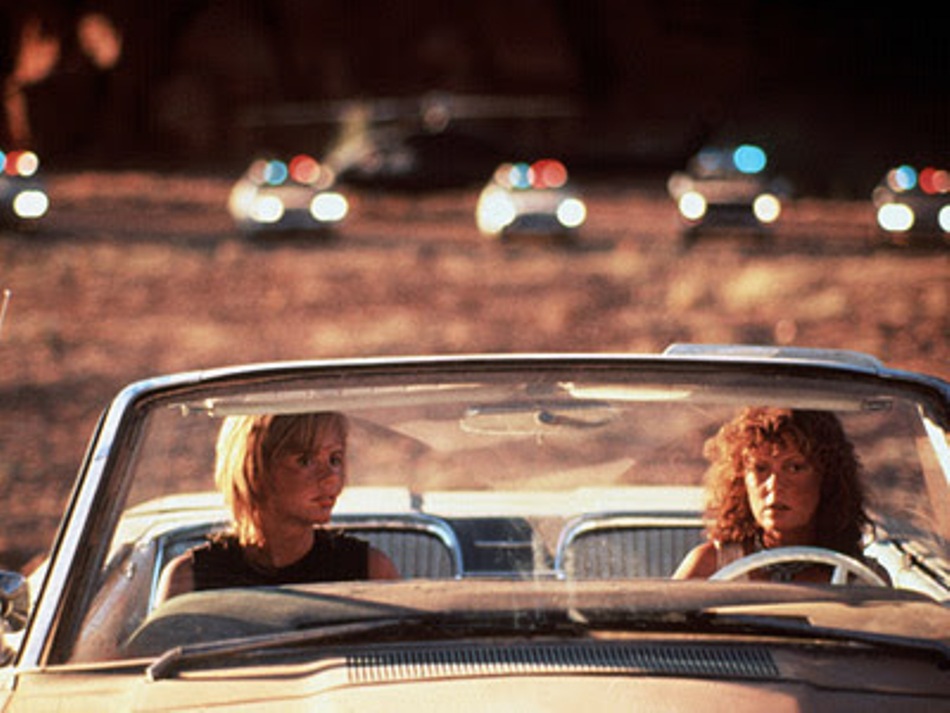
THREE'S A CROWD The climactic scene of Thelma & Louise (Production stills: Roland Neveu).
THREE’S A CROWD The climactic scene of Thelma & Louise (Production stills: Roland Neveu).

THE three-act structure is essential to the toolkit for that great misunderstood 20th century phenomenon: the Screenwriter.

Truncated to suit a 90- 120-minute session at a cineplex, the three-act storyline is undoubtedly the one most people are most accustomed to, so it’s probably in a writer’s interests to know how it works.

The good news is that it’s simpler in one way, because there is less to it. The bad news is that it’s reportedly much harder to get right, but we’ll look at why.

Act One

Broadly, this act must encompass an exposition (explaining who is who, particularly the relationship between the protagonist, or ‘hero’, and the antagonist, or ‘villain’), remembering that with screenwriting, dialogue must work effectively alongside onscreen action. Film is a visual and aural medium, so screenwriters must write what the viewer will see and hear.

This act generally also contains a point of no return, which propels the characters forward on their journey. Here’s where the 3-act structure differs from the five-act structure more commonly employed in novels, where the point of no return is generally in the second half of the story.

TURNING POINT Things escalate quickly in Thelma & Louise.

You can see where this difference arose – producers sitting in screening rooms, shouting: “Get to the point faster!”. Think Louise (played by Susan Sarandon) gunning down the rapist in the car park in Callie Kouri’s screenplay for Thelma and Louise, around 15 minutes into the movie.

Act Two

This act is the longest in the three-act structure, akin to the rising action of the five-act structure, where the protagonist struggles to rise above the point of no return, but often digs their way deeper into challenges set up by the antagonist.

Around the halfway point, or ‘midpoint’, something significant happens to the protagonist, which might be so sudden as to change the course of the story. In Thelma and Louise, this occurs with the appearance of Louise’s boyfriend, who might just convince her to give herself up, especially when he asks her to marry him. The protagonist’s response to the midpoint decides what happens for the rest of the story.

WHERE TO FROM HERE? One of the finest movie examples of a surprise ending.
WHERE TO FROM HERE? One of the finest screen examples of a surprise ending.

Act Three

Purportedly the hardest-fought scenes of every successful Hollywood screenplay, and the most difficult for writers to get right, this act contains the climax of the storyline, at a point significantly later than the five-act structure, where the tension comes to a head.

In Thelma and Louise, the climax is the most visually and emotionally dramatic scene of the movie, and the one where the protagonists commit their first willful crime – blowing up the truck driven by a hapless and offensive driver who has bothered them along their journey. Previously, they had committed crimes out of self defence or need. The climactic truck explosion signals their graduation into true outlaws.

No movie executive wants much time between the climax and the end of the film – everything has been said, seen and felt, and so the storyline must wrap up pronto. True criminals by then, Thelma and Louise drive to a speedy conclusion which could never be defined as a denouement, but rather a surprise ending.

The Verdict

Screenwriter Callie Khouri, who won an Oscar for her first screenplay, got it so right that the studio: “Didn’t come in and re-shoot four times” (Susan Sarandon, in a 1991 interview).

Khouri set this up with a coincidental moment, when Louise waits for Thelma to rob another gas station, and sees an old woman sitting at a window, a bundle of contained compromise and regret. In that fleeting moment, the writer foreshadows her ending without the need for a single word of dialogue. Another reading of the dramatic structure might place this moment as the climax.

Thelma and Louise works in three acts, and it works in five, depending on how deeply you want to analyse it. The three-act structure is, to me, just nifty shorthand for non-writers (e.g. producers) to define the ‘big moments’ they feel all scripts need.

WRITE REGARDLESSIf a writer can craft a five-act storyline, which hits these ‘big moments’ of the three-act structure, they’ll probably have an excellent script.

© Michael Burge, all rights reserved.

An extract from Write, Regardless!

The Writer of little things

GETTING GRITTY From small irritations, beauty is born.

Starting small.

I pride myself on being a wordsmith who could write on just about any subject, but such surety comes after over two decades’ experience. When I started out, I really had no idea what I was capable of.

So, a when a good friend got a job as a magazine editor, and called in a panic about not knowing what a “drop-cap”,  and other editing terms, referred to, I talked her away from the edge by looking everything up online with her on the other end of the phone. We both learned much from those sessions, without her boss having to know she (and me) were playing journo-school catch-up.

Eventually Eden asked more than unstinting support in a time of need, and commissioned me to write a feature about the history of beads. My late partner Jono had traded in semi-precious stones, and created jewellery out of them, so I knew my away around a bead shop, but a feature was a different matter. I just dived in, did my research, and came up with the goods, and they even used my headline! A new career was born in the process …

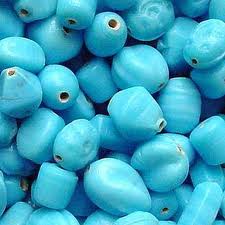
PORTABLE STYLE Beads have been strung, trades and prized for millennia.
PORTABLE STYLE Beads have been strung, traded and prized for millennia.

Little Treasures

A brief history of beading

In 21st century Australia we do not generally cook over fires with hand-crafted earthenware pots, read by the light of handmade candles, or make our own writing paper, but at the very centre of our culture is something as ancient as all these things: beads.

Most of us wear and use beads every day as functional items like buttons.

They are durable, attractive little examples of a living archaeology; museum pieces we wear, touch and treasure in our daily lives.

A brief look at the history of beads is not really history at all, because the manufacture of beads has not dramatically changed in thousands of years. It does not require very sophisticated technology to string small perforated objects onto a length of twine or wire. Five thousand years ago, artisans were capable of much the same techniques we use today in beading. Their work is often the only evidence of vast civilisations.

Probably the earliest gem like materials collected were those that were most apparent, such as amber and pearls.

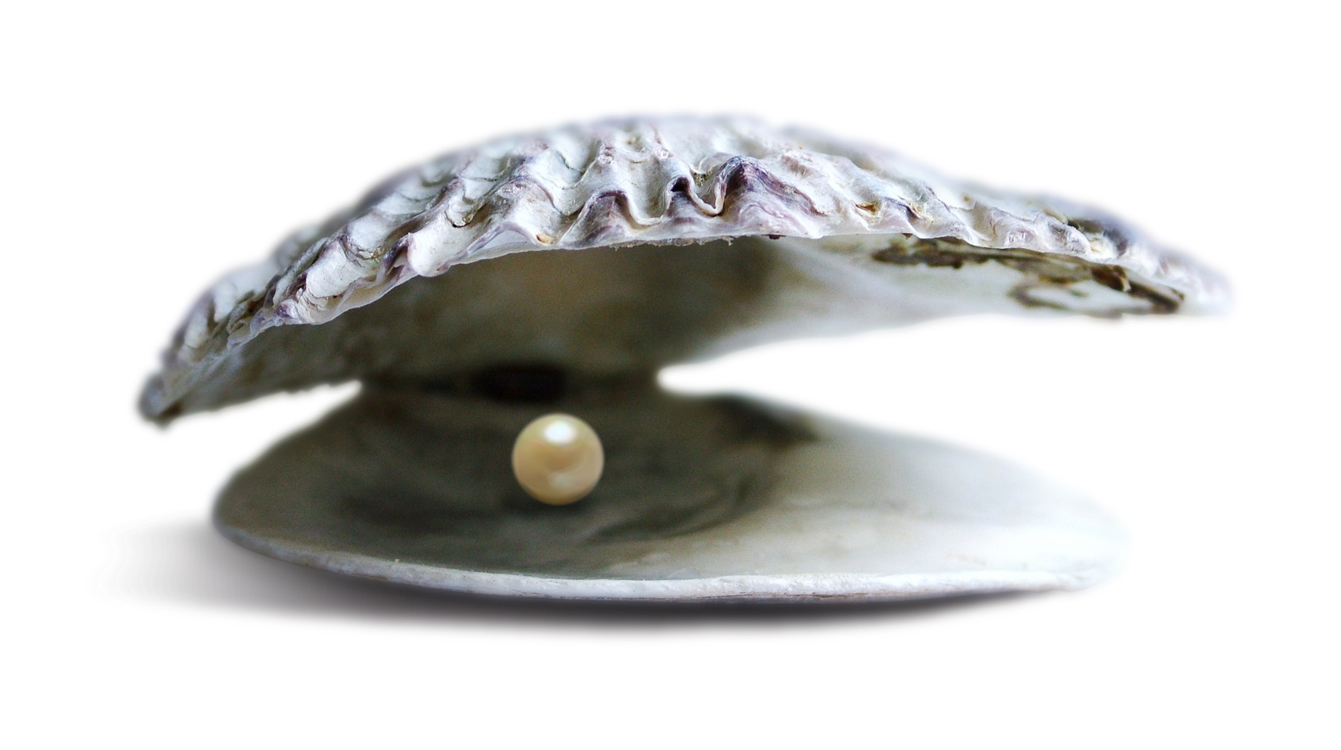
The amber pieces which regularly wash up on the Baltic shores and the east coast of Britain are an attractive and highly prized adornment traded for millennia. Likewise, the pearls of equatorial climates, gifted out of the mouths of oysters, have long been considered things of great mystery and beauty, worn and exchanged over great distances.

Shell, bone, wood and stone appear in all ancient civilisations as far back as 30,000 BC.

By around 2,500 BC, most continents saw complex religious and political cultures spring up in fertile river valleys, from Mesopotamia, Egypt and India, and beyond into Asia and Africa. These location yielded excellent agriculture, but also the raw materials for bead making, and the environment for excavating precious metals.

Beads are evidence of an international trade in these materials, created by the demands of royal and aristocratic lineage, and the artisans they patronised.

Egypt still remains one of the most influential beading cultures of all time. Within the borders of the Nile river valley were all the raw materials to produce beads from a time long before the pyramids were built until the era of Cleopatra, over two thousand years later.

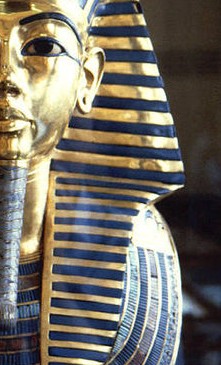
LAPIS OF THE GODS Tutankhamun's death mask is unarguably the prime example of Egyptian cultures love of lapis lazuli beads.
LAPIS OF THE GODS Tutankhamun’s death mask is unarguably the prime example of the Egyptian culture’s love of lapis lazuli beads.

Egyptian gold, turquoise and carnelian were crafted into the enduring Egyptian jewellery styles, most notably their iconic collars. The only material the Egyptians were forced to import was their beloved deep blue lapis lazuli, which was traded from ancient Afghanistan.

Perhaps Egypt’s greatest gift to the world of beads was their development of glassmaking techniques. The application of heat to sand and colouring agents created an early synthetic material called faience, which, over time, was improved to what we know as glass.

Because of its cheap production process, it was possible for most people in Egyptian society to buy and wear synthetic stone, or replicas of more precious materials.

Most of the known Western world was absorbed into the culture of the Roman Empire by the time of Julius Caesar in the first century BC. The Romans manufactured and traded glass on a grand scale, influencing beading from Britain to India.

CANDY CANE Glass bead being formed while viscous.

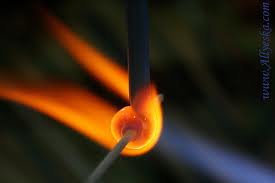
Glassmaking began much like the process of candy makers – long ‘canes’ of hot coloured resins were stretched and sliced, then cooled into various sized beads. Mixing colour into an array of patterns was a common practice, and the further each cane was stretched, with the same patterns and colours running though it, the more matching beads were able to be sliced from it. Each bead could be perforated with hot metal rods while the glass was still viscous, creating a hole for stringing.

During this time, the Anglo-Saxon language gave us the word “bede”, meaning “prayer”, showing that the religious association of beads was always strong. The major religions borne of this period – Christianity, Buddhism, and Hinduism – all adopted the use of prayer beads in rituals which are still practiced today.

Rome’s far reaching influence took European traders into Africa, and European beads appeared as far afield as South East Asia, impacting the beading styles of those regions, which held ancient beading traditions of their own.

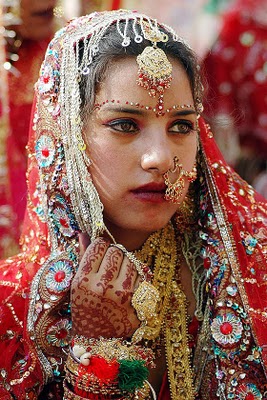
BEADED BRIDE Complex stone beading became a wedding tradition in India.

India had developed vast industries of stone beads, such as carnelian and agate, formed into detailed adornments such as the highly prized bridal collars. Thereafter, stone beads became a major Indian export.

African cultures had ancient jewellery traditions using organic materials such as seed, bone and tusk, and some of the richest sources of gold, which was exported back to Europe and beyond. The exaggerated animistic style of African beading impacted the later Roman and Byzantine decorative arts.

Glass remained the most widespread material for beading, and as the Roman Empire collapsed, the processes of glassmaking were kept alive by artisans in Phoenicia and the vast Islamic empires.

In the eastern regions of Arabia and Persia, the manufacture and trade of beads during the Middle Ages and early Renaissance saw new styles develop at a time when art and culture in western Europe diminished.

The Renaissance, from around 1400 AD, saw the rediscovery of ancient Greek and Roman cultures, including their beads. This was the era when Venetian glass influenced the decorative arts, and glass beads enjoyed a revival. The brightly coloured and textured Chevron bead was first created in Venice c.1500 AD and exported across the known world.

Exploration to the Americas took glass beads to the New World. It could be said that gifting large numbers of glass beads became something of an invasion technique, employed by explorers from Christopher Columbus to the conquistadors in South America.

The Native American and South American cultures had an impact in return. The Mayans and Aztecs prized Guatemalan jade over gold, and developed some of the most sophisticated techniques for drilling very long tubular beads. American Indians created detailed beading techniques to adorn everyday clothing.

Archaeology had a major impact on beading styles in the 20th century. The best example was the 1920s excavation of the tomb of Tutankhamun, the young Egyptian Pharaoh who was buried with unarguably the richest and most varied collection of decorative arts, which took modern minds back to the everyday items of New Kingdom Egypt.

Fashion in the 1920s, and certainly 20th century jewellery, were influenced by this major discovery. The highly intricate collars adorning Tutankhamun’s body were replicated by jewellers worldwide.

Beads often affected modern economies. For thousands of years it was impossible to produce spherical pearls, a process hidden inside the hard shell of oysters, but, in 1913, when businessman Mikimoto Kōkichi pioneered the mass production of perfectly spherical cultured pearls in Japan, the sudden influx of affordable yet perfect pearls sent jewellers worldwide into a spin.

Here in Australia we have Western beading styles in a setting which bridges South East Asia and the South Pacific, with the growing influence of Aboriginal Australian art, and it is not uncommon to see all these influences at work in contemporary Australian jewellery.

© Michael Burge, all rights reserved.