
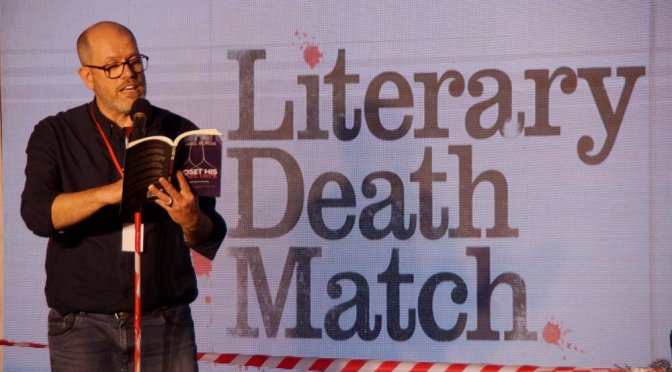
I WAS STILL packing for my long weekend away at the Bellingen Readers & Writers Festival, where I was to present my debut novel Tank Water (MidnightSun Publishing), when I got a slightly desperate call from one of the organisers, asking whether I had any short stories to my name.
I did, so the next question was whether I’d be up for a round of Literary Death Match. I’d never encountered this movement before, which has been entertaining readers and writing fans globally since 2006. A big-name author had to drop out for urgent dental work, meaning one place in the Bellingen LDM was available. So I said yes before I really understood what the whole thing was.
For an un-agented author who started out independently published and operates as my own publicist, even having a traditional book deal under my belt doesn’t stop me agreeing to everything a literary event asks of me. Such offers are so rare you’ve got to take what you get, and make the most of it.
I needed a short piece of fiction that I’d be prepared to read aloud in front of a crowd on Sunday evening. The right one popped into my mind immediately, so I grabbed my copy of my short story collection Closet His, Closet Hers and shoved it into my luggage.
Bellingen’s annual literary event is a gem of a way to spend the June long weekend. Situated in the coastal hinterland of the Mid North Coast, the community turns out in force for a huge number of visiting authors and wordsmiths.
Over the first two days of the festival, a few authors told me with great relief that they’d turned down the spare spot in the LDM on the final evening. I didn’t reveal I was the mug who’d said yes when everyone else was either too nervous or not prepared to stick around. Anyone who’d ever competed in a LDM, or who’d seen one take place, was effusive about it being “just a bit of fun”.
I sensed that was true, but my inner boy scout said: Be prepared!
So I honed the delivery of my short story ‘A Quick Fix’, which I wrote in the form of an email from a schoolgirl to her father, traversing some bitter family dynamics about an estranged gay uncle. Partly based on experience, I imbued this work with all the teenage brevity I recall from my own school years.
Bellingen’s glorious riverside parkland was the perfect place to sit in the winter sun and practice. Acting and broadcasting training goes a long way in such situations, and I needed to make a few cuts to deliver in the seven-minute time allocation, plus annotations to emphasise certain characteristics of this clarity-filled teen who delivers a dose of equality into a terrible situation.

When I met the competition – my fellow LDM authors Sophie Overett, Robbie Arnott and Alison Gibbs – in the green room, we were a herd of nervous deer about to meet a very large headlight.
I’d already been on a panel in the huge marquee we were suddenly being led to, lit up in the darkness with a capacity crowd expecting to have a blast, so I knew this was big.
Judges Sofie Laguna, Thomas Keneally and Costa Goergiadis walked up to the stage at the invitation of LDM host and creator Adrian Todd Zuniga, leaving we writers crouched down the back in the shadows. By the looks on our faces, we’d have preferred to stay there.

Yet we managed to go two rounds, reading to the crowd and getting bombed by literary questions. I barely remember any of it, just the glare of the spotlight and the silence as I started to read, my voice pitched slightly higher and rather quietly, to ensure I got their attention.
Paragraph by paragraph, every middle-aged one of my six feet very publicly embodied that teenage girl on the brink of discovering what equality means in this world.
And with my final line, I brought the house down, a tsunami of laughter and applause washing every bit of shame away about self publishing a collection of short fiction that no editor, agent or publisher in the country had ever thought enough of to get behind.
The judges awarded me a win in my round, but I was finally KO’d by the lovely Sophie Overett in a spelling bee finale.

In the aftermath, my copy of Closet His, Closet Hers was torn from my hand so that a reader could look up where to buy it. A big name author asked me in the green room who published it. I pointed to myself, which is what I did once at another event, when a bestselling author asked me who my publicist was.
Eyebrows go up in such moments, mine more than anyone’s, because for a short time it’s not about the luck, the opportunity, the contacts, the networking, the five-year plan or the affirmations… it’s simply about the writing.
That’s the beauty of Literary Death Match, writing really is the winner.
Here’s my top tips for anyone recruited into LDM:
– It is fun, and the rules are there to be massaged, purely for entertainment value. When Adrian called time on me, three times, I waved him off and kept reading
– Be bold and read with all the characterisation you can muster
– The crowd is pumped and on your side, they know writers are very often shy and retiring and LDM is a raucous big deal
– It’s fast, and will flash by in a heartbeat!
– You can read self-published, emerging work, so give the crowd an early literary experiment!


 Michael Burge Media