

A Writer’s first lesson in dramatic tension.
WHEN I was around six years old, mum bundled me and my siblings into the back of our station wagon and took us to the Inverell drive-in cinema. We were already asleep, so I don’t remember the start of the movie.
Much later I woke up, not because there was a particularly loud scene up on the big screen, but because it had gone uncharacteristically quiet. To a high-pitched, menacingly subtle soundtrack, figures, in the half-darkness, were focussed on some terrible task.
The movie was Sidney Lumet’s 1974 production of Agatha Christie’s iconic 1934 mystery novel Murder on the Orient Express. The onscreen figures were an array of 1970s movie stars. Silent. Deadly. Determined.
It was a powerful dose of dramatic tension for my young mind.
At the end of my final school exams, I picked up a Christie novel for the first time. It was By the Pricking of my Thumbs (1968). What attracted me was the cover illustration by Tom Adams – a cracked doll’s head with only one staring eye – an image dripping with the same dramatic tension.
Written very late in Christie’s career, this book is one of her ‘Tommy and Tuppence’ Beresford stories, the married amateur spies who aged with the author, and whom she used to give voice to much of the change her own generation faced across the 20th century.
They were never as famous as Hercule Poirot or Miss Marple, but the Beresfords took readers on adventures in the 1920s, through the espionage-rich 1940s, and featured in the last mystery story Christie ever penned – Postern of Fate (1973).
Heavy on atmosphere, By the Pricking of my Thumbs is a spooky page turner with plenty of sins of the past coming back to haunt the residents of a hidden-away village in England.
After months of research for exams, a murder mystery was exactly what I needed. It suited my propensity to dig up the past in my own home town, exploring the attics of old homes and the secrets they evoked.
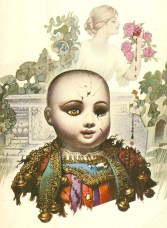
I began to spot Adams’ Magritte-like covers in the second-hand shops and book markets, and soon had quite a collection. There have been plenty of Christie cover artists, but I don’t think any have become quite so renowned for the job. Adams’ covers are masterpieces of illusion, with painterly, stylistic references running throughout.
Agatha Christie was a great exponent of plot, probably one of the greatest. Her use of the ‘slow reveal’, particularly in her most famous storylines (And Then There Were None in particular) became an intriguing hallmark in works that were never particularly long.
She undoubtedly suffered from over-exposure and publishing fatigue – for most of her career her work was sold annually as a ‘Christie for Christmas’. The sheer volume of her storytelling (well over 100 titles altogether) saw her create an oeuvre which has so far been unmatched in the crime genre.
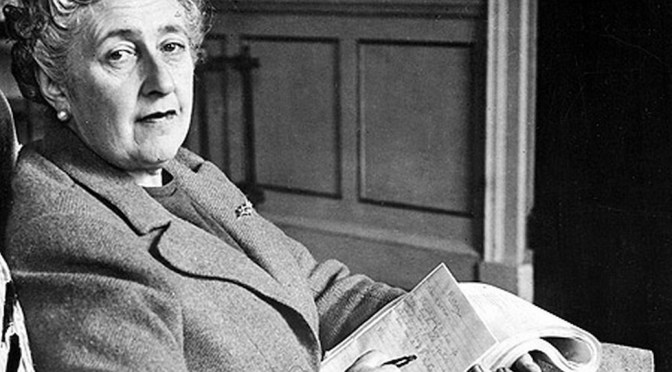
Christie’s own life held mysteries of its own. In December 1926 she disappeared, leaving clothing and her car at a lonely place near her home in Berkshire. A nearby lake was searched to find her body. The newspapers were all over the inexplicable story of the popular crime writer who seemed to be the victim of foul play.
Eleven days later she was discovered at Harrogate Spa in Yorkshire, a great distance for someone who’d left her transport and spare clothes. Whether the entire incident was a publicity stunt or the result of a nervous breakdown linked to her husband’s infidelity has never been fully explained. Christie herself never wrote about it.
“She’ll always be remembered for leaving us wanting more about those 11 mysterious days, where dramatic tension left the realm of fiction for a fortnight.”
Vanessa Redgrave played Agatha Christie in the movie Agatha (1979), based on this affair. Redgrave’s performance goes a long way to unravelling the truth of a woman faced with abandonment and loss, who just goes away for a while to sort her head out. Dustin Hoffman played the newspaper-man who helps her do so. It’s an artful script by screenwriters Kathleen Tynan and Arthur Hopcraft, assisted by the complete absence of Christie’s own account of the same events.
What I really admire about Christie’s work is how well her dramatic tension translates to the screen. In the right hands, the results are iconic – Murder on the Orient Express (screenwriter Paul Dehn) and Death on the Nile (screenwriter Anthony Shaffer) are perennially popular big screen productions, renowned for their ingenious plots and memorable characters played by screen giants. The original books have sustained more than one screen adaptation, none of which cancels-out the others.
But sometimes, the results are only passable. Stewart Harcourt’s adaptation of By the Pricking of my Thumbs became a kind of unintentional mash-up under the banner of the Marple ITV series in 2006, when Miss Marple was planted into the storyline to assist Tuppence Beresford unravel the mystery.
It was a great shame, not only because Tuppence was rendered a rather lacklustre detective’s assistant (despite the excellent casting of Greta Scacchi and the fact that Tommy and Tuppence had starred in their own ITV series in the past – Partners in Crime in 1983), but also because Christie’s storyline was unrecognisable in the second half.
The lesson is this: don’t muck around with plot when adapting for the screen. Nuances can be altered, of course, but the course of events? Never. Christie’s skills in atmosphere and dramatic tension rarely wavered, even in her less popular works. They are a gift to screenwriters.
And the ultimate lesson she left for posterity? Well, that’s easy – she’ll always be remembered for leaving us wanting more about those 11 mysterious days, where dramatic tension left the realm of fiction for a fortnight, and possibly transformed an emerging writer into a storytelling giant. Perhaps her publishers always suggested she stay silent on the subject?




 Michael Burge Media