All posts by Michael Burge

Journalist, author, artist

A painter’s perseverance

“I think I always was an artist, it just took a long time for ‘it’ to flourish.”

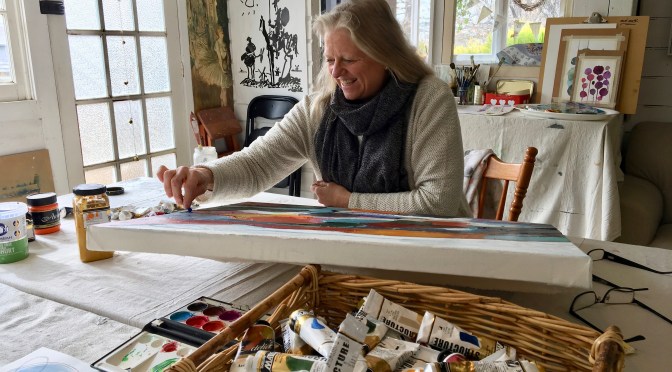
AFTER MORE THAN twenty years living and working in the New England region, Danish-born artist Marianne la Cour shared her sense of place in an exhibition of new work at Glen Innes throughout Spring.

“I finally feel a strong connection to this area,” she says. “As with most migrants, it takes a while to feel a part of a new place, to get a sense of belonging. It wasn’t really until I moved to the countryside that I found that connection”.

“I would find it hard to live anywhere else. I love this region, its seasons, its nature and its people. They have all been a part of changing me to whom I am today. I feel so lucky to have found this place.”

Having grown up with an appreciation of abstract art, design processes and handmade principles, Marianne says she is “deeply influenced” by her cultural heritage and many northern European painters.

“I am a great fan of Danish painters Per Kirkeby, Maja Lisa Engelhardt and Mogens Andersen, to name a few,” Marianne says. She also cites Australian painters Elizabeth Cummings, Ann Thompson, Sally Gabori, Angus Nivison and Ross Laurie as sources of inspiration.

MAKER’S MARK Marianne la Cour utilises acrylic paint and pastel.

Describing her creative journey as “long and winding”, Marianne was encouraged by her mother and grandmothers. “In my younger years I wanted to be a ceramicist and an author. Later, I wanted to be an architect, but none of that happened. In Denmark, as education was paid by the government, they would only let in a certain amount of students every year to the art school and the academy of architecture”.

“I tried several times, but never got in. Instead, I ended up in a bank, which was testing for my creative mind; but later in life it proved a very beneficial education to have when running a small business. When I moved to Australia in my thirties, I decided now was the time and I immersed myself in TAFE courses and workshops, and I have never looked back.”

According to Marianne, being a practising artist in the 21st century takes hard work, time and perseverance.

“It’s a lot easier now with the internet and social media, but when I started many years ago it was almost impossible for a country artist to get a foot in the door. Rocking up with your portfolio to art galleries was tough. Sometimes you got lucky but mostly it was just a disappointment.

“Today you cannot run an art business or a creative business without a presence on social media and websites. You are essentially doing all the work the gallery owners used to do for you. More than fifty percent of my time is dedicated to having a presence on the internet, and you still have to get out there and put your work in competitions and organise exhibitions. You also have to learn to write, take good photos and constantly keep up with the technology.”

When asked about what made her stick to her dream despite the obstacles, Marianne says: “I think I always was an artist, it just took a long time for ‘it’ to flourish. When I moved to Australia, becoming an artist was my ultimate goal, and I never lost sight of that. I did a lot of other things as well to keep bread on the table, but every opportunity I had to create, I took”.

“That’s what I mean about perseverance. I keep my hands busy and my mind open. I started out small and stayed small. That just fitted best into my lifestyle, which is very important to me.”

Marianne’s 2019 exhibition ‘Landliv’ (literally ‘rural life’ in Danish) ran at The Makers Shed, Glen Innes until the end of November.

“This body of work is executed with acrylic paint,” she says. “I have also used ink, charcoal and pastel and in some of the paintings I have used fabric and paper. I have always been drawn to mixed media and collage, and quite often it finds it way into my paintings.”

Through her online business Colours on Grey, Marianne promotes regular creative workshops at her inspiring rural-set studio just outside Glen Innes.

“I love to share my skills, my way of painting and I suppose my way of looking at art,” she says. “I want it to be easy and simple for participants. When I teach, I really try to simplify things and make sure they have something to be happy about by the end of the workshop. If they leave frustrated they are never going to give it a go at home, and I am a firm believer that we all need a little bit of creativity in our lives.”

This article first appeared in New England Living magazine.
Torrington’s timeless tipple

“Our mead takes around one year in the main vat and another year in the bottle, at least.”

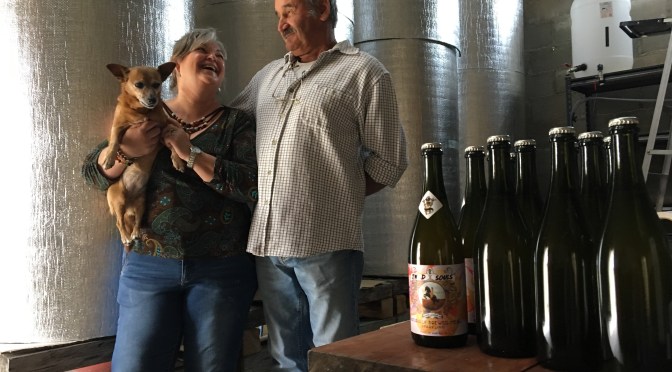
SITUATED ON A plateau between Glen Innes and Tenterfield, the village of Torrington was once a thriving hub of tin mining. Now its natural benefits have given rise to a tasty and very traditional tipple created by mead makers Pierre and Glenice Armand.

The couple created 2 Wild Souls Meadery after purchasing land at Torrington in 1979. “It was the beauty of the granite landscape,” Glenice recalls. “There was plenty of bushland without any cultivation of crops, and the benefit of four seasons. The mead making came about due to our property carrying timber species of interest to the local bee farmers. They’re always on the lookout for good bee sites, and our property had just that.”

“They paid for access to the sites by giving twenty-litre buckets of honey,” Pierre recalls. “This gave me the raw material to experiment with mead making.”

MEAD MAKER Pierre in the meadery.

A native of rural France, Pierre is the mead maker. “He grew up at the end of the subsistence farming era,” Glenice says. “The farmers produced everything for the table including wine in the south of France and cider in Brittany and Normandy. The production process was traditional and very simple. Quality was directly related to the quality of the grapes or apples and a rigorous hygiene in the making process. These are the principles applied in our mead making.”

Glenice’s qualifications and interest in alternative health underpin her passion for getting the 2 Wild Souls product out to appreciators of naturally-brewed, preservative-free beverages.

The mead making process comes from Pierre’s country of origin: “The méthode champenoise was devised by mistake when white wines of the Champagne region of France were sold to the court of England and they were bottled before the fermentation had run its full course, creating bubbles in the drink,” Glenice says.

“This process was perfected later to achieve a consistent product, and safe pressure levels in the bottles. The fermentation in the bottles produces a sediment which is called ‘lees’. In the méthode traditionelle the lees is disgorged, or removed, to enhance the presentation of the champagne to give a clear drink; whereas the méthode champenoise ancestrale that we use is a simpler more primitive process where disgorging is not carried out.”

The fermentation of honey in the mead making process is much slower than that of wine, due to the complexity of the sugars in the mix. “Our mead takes around one year in the main vat and another year in the bottle, at least, and a maturing process goes on from there,” Pierre explains. “Torrington is well suited for mead making due to its temperate climate and chemical-free environment. The cold of the winter requires heating of the shed but the summer heat is not excessive. The forest environment is there giving the raw product and the spring on our property gives us water of the best quality for mead making.”

WILD DROP 2 Wild Souls traditional mead.

Pierre and Glenice love offering mead tastings at regional festivals. “People want and expect more natural products,” she says. “We need to educate people about our mead because it is a completely new version of an ancient drink. Artisanal production like ours allows for small batches of high-quality mead to be produced without the back up of  preservatives or additives found in mass produced wines and beers.”

“We feel very proud and happy when we see the positive response from people liking our mead and giving compliments of the lovely blossom taste of our four varieties, especially when they experience the bubbles,” she says.

“Most times we hear ‘wow this is so different to what I have tasted in the past’, ‘can we drink this with different types of foods?’ and ‘when should we drink it, in the evening or only in winter?’ and our response is that people should chill the mead and enjoy it with all food day or night any time of the year.”

“Pierre and I met through our love of horses,” Glenice says. “All horses have a free spirit within them and nearly every young woman’s dream is to ride a free-spirited horse through meadows and woodlands, so our logo represents a beautiful powerful free-spirited horse with a free-spirited woman, which equals two wild souls.”

“Our dream is to see our mead being sold in the overseas market.”

This article first appeared in New England Living magazine.

The year of independent reading

Wonderful things happen when you open a bookshop. Ours started as a single set of shelves in one corner of the studio-gallery my husband and I created, The Makers Shed at Glen Innes in the NSW New England region. A year on, we’ve expanded, and we’re about to present our first literary award.

But it didn’t just happen by accident. Our resident High Country Book Club courageously joined us on a reading project with a purpose: to decide the best book in a year’s worth of independently-published reads.

When we started out, Richard and I found ourselves explaining a lot about indie books, but these days we barely mention that these titles have not been backed by a traditional publishing/marketing team. This is mainly because what readers want out of a book is the same thing no matter where it sprang from, and that’s a well-told story.

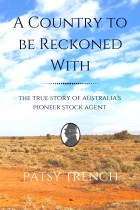
The club kicked off with a visit from London-based author Patsy Trench, who’d come to chat about her new non-fiction title A Country To Be Reckoned With.

This title is Patsy’s search for her great-great grandfather George Matcham Pitt, one of Australia’s earliest stock and station agents. The journey of discovery sheds an engaging new light on the European heritage of Australia.

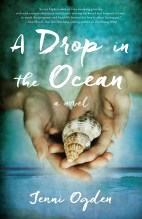
We moved onto fiction for our next read. New Zealander Jenni Ogden’s acclaimed debut novel A Drop in the Ocean is set predominantly on an island in Australia’s Great Barrier Reef. It’s the story of an high-achieving American academic who hits rock bottom and decides to relocate to the other side of the world to work at a remote turtle sanctuary. It took me by surprise with its memorable castaways working out their lives on the edge of an ocean wilderness.

The ocean was a major theme of our next title, Nothing But Blue, by American author Diane Meyer Lowman.

The true story of her adventure while working on a German container ship as it sailed from New York to Australia and New Zealand in the late Seventies, this book bravely recreated the perspective of a 19-year-old thrust into several alien environments.

Nothing But Blue and A Drop in the Ocean were published by She Writes Press, one of the world’s biggest joint-venture publishing outfits assisting women to get their manuscripts published.

Australian author Kim Kelly paid us a visit in March to chat about her novel Lady Bird & The Fox and explained how creating the Indigenous protagonist of her book – Annie Bird – also encouraged her to courageously self-publish. After having her first few works published traditionally, Kim sensed her Gold Rush heroine might have languished while waiting for a publisher with enough courage in this #OwnVoices world.

The true story of a beloved dog who endured a spinal stroke was our next read. Nobody Told Me My Legs Don’t Work is a memoir with a difference by American writer Travis C. Yates.

A short but emotional ride, this publication sparked plenty of debate about animal rights and the ethics of domestic animal ownership.

Infants of the Brush by A. M. Watson is an historical fiction that recreates a real-life Eighteenth Century legal case and the gritty, challenging world of the boy chimney sweeps of London.

Amy kindly made us a video outlining the broad research she conducted which underpins the historical accuracy in her novel.

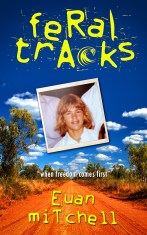
Euan Mitchell’s Feral Tracks brought us all back home with an Australian story about a teenager who leaves homes with a few dollars and some big issues to sort out on the road, as he hitchhikes across the country in search of purpose.

One of Australia’s most enduring self-published titles, this work was a confronting study of manhood in some tough Aussie environments.

English author William Blyghton provided plenty of contrast in his debut novel The House By The Marsh, which is also a study of manhood, but in a very different environment.

A story of grief late in life, this tale of human connection is set in several corners of evocative East Anglia, a county that we discovered was the birthplace of many novels, from works by Patricia Highsmith to Janet Frame.

We stayed in England for our read of Virginia Moffatt’s Echo Hall, a work of historical fiction set across multiple time periods in and around the same imposing home in another remote county of the United Kingdom.

With its ruminations on war and pacifism, Virginia’s intriguing, layered work explores the motivations of several families and their experiences of conflict, both domestic and between nations.

One of our country’s great marriage equality campaigners penned our next read, a very Australian read about human rights.

Shelley Argent’s memoir Just A Mum tells the story of her Brisbane upbringing and explores how this suburban wife and mother became an equality activist in the wake of one son’s coming out, and pushed this necessary social reform all the way to the gripping finale in Australia’s Parliament House.

We ended the year reading The Moor by English author Sam Haysom, a mystery story replete with characters facing enormous moral choices in and around a deceivingly simple wilderness walk.

Another intriguing debut novel, Sam’s book was created during 2015’s NaNoWriMo. (National Novel Writing Month), and published through Unbound. This crowdfunding publisher assists writers in bringing their ideas into life in book form, and is also the stable that Echo Hall sprang from.

All High Country Book Club titles are available for purchase from The Makers Shed, and can be posted to readers within Australia. Browse our online bookshop.

Congratulations to all the finalists in 2019… we’ve been thrilled, frightened, inspired, moved, angered, entertained and encouraged to keep reading by your engaging works of fiction and non-fiction.

Trophy handmade by Richard Moon.

The winner of the High Country Indie Book Award 2019 will be announced during the High Country Writers Festival on Saturday November 30, from 4 to 6pm at The Makers Shed, Glen Innes, NSW, Australia. All welcome!