All posts by Michael Burge

Journalist, author, artist

Homophobia for the holidays

Spending time with family over Christmas and New Year can be a challenge for anyone, but journalist and author Michael Burge explains how his first collection of short stories grew in the fertile ground of familial homophobia.

WHEN I began writing fiction, I didn’t understand at first that the theme I was really exploring was homophobia.

“I hope I have captured the blatancy of homophobia, but also its subtlety.”

After years of churning out scripts in the corporate world, which was not sustaining me in any kind of career, I decided to turn my hand to short stories. Over the course of about ten weeks in late 2009, I started writing fiction like a demon, and the stories took shape with a range of LGBTI (lesbian, gay, bisexual, transgender, intersex) protagonists, the likes of which I never imagined I could create.

As a reader, I had rarely encountered gay characters. I wanted to read a lot more of them, but part of me realised they weren’t really to be found widely in mainstream literature. I needed to create them myself.

About halfway through writing the cycle of stories I recently published as Closet His, Closet Hers I took a step back from the writing process to analyse the world of my characters. What startled me was seeing the range of Australian families I had created, and the LGBTI who inhabited them.

The title story is an account of a deeply-closeted gay man who marries a woman he went to school with, told from his perspective and from hers. To make that story credible, I needed to create two families with a past firmly rooted in the Australian suburbs, into which the main character’s homosexuality arrives out of nowhere.

While there’s not much overt homophobia in this story, the potential for it hangs on every plot point. It creates a pathway for the young man, who first realises his homosexuality at school Bible camp; but it also carves out the future of the young woman he marries, whose sexual world is no less restricted than his.

I’ve had my homophobia ‘radar’ set on high ever since I was almost completely disenfranchised after my partner died, and I believe it would surprise most people to see what a strong thread of prejudice runs through families, creating expectations for LGBTI and disappointments for their loved ones, who have not traditionally been prepared for homosexuality in their ranks.

But times are changing. In the 1990s, the media picked up on the ‘gay gene’ theory which was debunked by many as scientific fantasy and championed by others as proof that sexual orientation is not a choice. More than twenty years on, I have been part of many family discussions, particularly when multiple generations are gathered for Christmas, about how prevalent homosexuality is within the same family trees. Although the very idea of a gay gene offends people on both sides of the debate, these talks go a long way towards easing the feeling many parents have about what they fear was ‘bad parenting’ resulting in them ‘turning’ their children gay.

We’ve also seen great change in the Australian community, to the point that polling reveals a massive majority for marriage equality in this country.

I’d like to believe this means there is less homophobia within families, but I am not so sure. Homophobia takes many forms, not just overt violence against LGBTI. Much of it can remain hidden, taking the form of ridicule and exclusion. At its worst, ‘invisible’ homophobia leaves LGBTI out of processes that are routinely granted to our straight siblings and cousins.

I have a friend who recently came out to her family. She’s in a loving, committed relationship, but her partner is not welcome at the family Christmas event because her parents have a problem with her sexuality. LGBTI in this position are forced to choose between loved ones, meaning someone is always going to lose in the end. It’s this sense of isolation I have worked to express in Closet His, Closet Hers.

Many parents don’t really have a problem with their kids being LGBTI as such, but their homophobia appears when their sons and daughters manifest relationships.

9780645270525The stories in Closet His, Closet Hers illustrate this kind of prejudice. All the Worst Jobs is the story of a lesbian care worker, Jessie, who is outed by the older woman she showers every morning. The risk for Jessie immediately increases at this point, since she relies on the income yet walks the knife edge with her client, who seems to hold all the cards.

Multi-generational relationships are portrayed in They’re Curing All Sorts of Things Now, in which a grandmother’s advancing dementia is played out over the occasion her grandson comes out to her.

One of the most poignant stories, for me, is Dirty Nurse. Many years ago, I was told about an act of great heroism shown to the LGBTI community during the unfolding HIV-AIDS crisis in the 1980s, and I was keen to write about it, but I wanted to add to the tension by imagining how things would play out if this career nurse was gay herself.

Most of the stories in Closet His, Closet Hers are set slightly in the past, and while I acknowledge that things are very different for many LGBTI growing up now, I think it’s relevant to look back and record the emotional journeys taken by my generation.

Ours was the era during which homosexuality was decriminalised, and when HIV-AIDS ripped a hole through our communities and families. They were profoundly frightening times for young LGBTI and led to many of us, myself included, coming out rather late compared to young people today.

I hope readers can take a level of comfort from my stories, in knowing that times have changed, and that the work inspires them to make different choices when it comes to the LGBTI in their midst.

I don’t imagine many gay family members want special treatment at family gatherings such as Christmas lunch, but nor would we want to be made to feel somehow different, which occurs in a couple of the scenes I portray in Closet His, Closet Hers.

I hope I have captured the blatancy of homophobia, but also its subtlety. It can be a very discreet phenomenon.

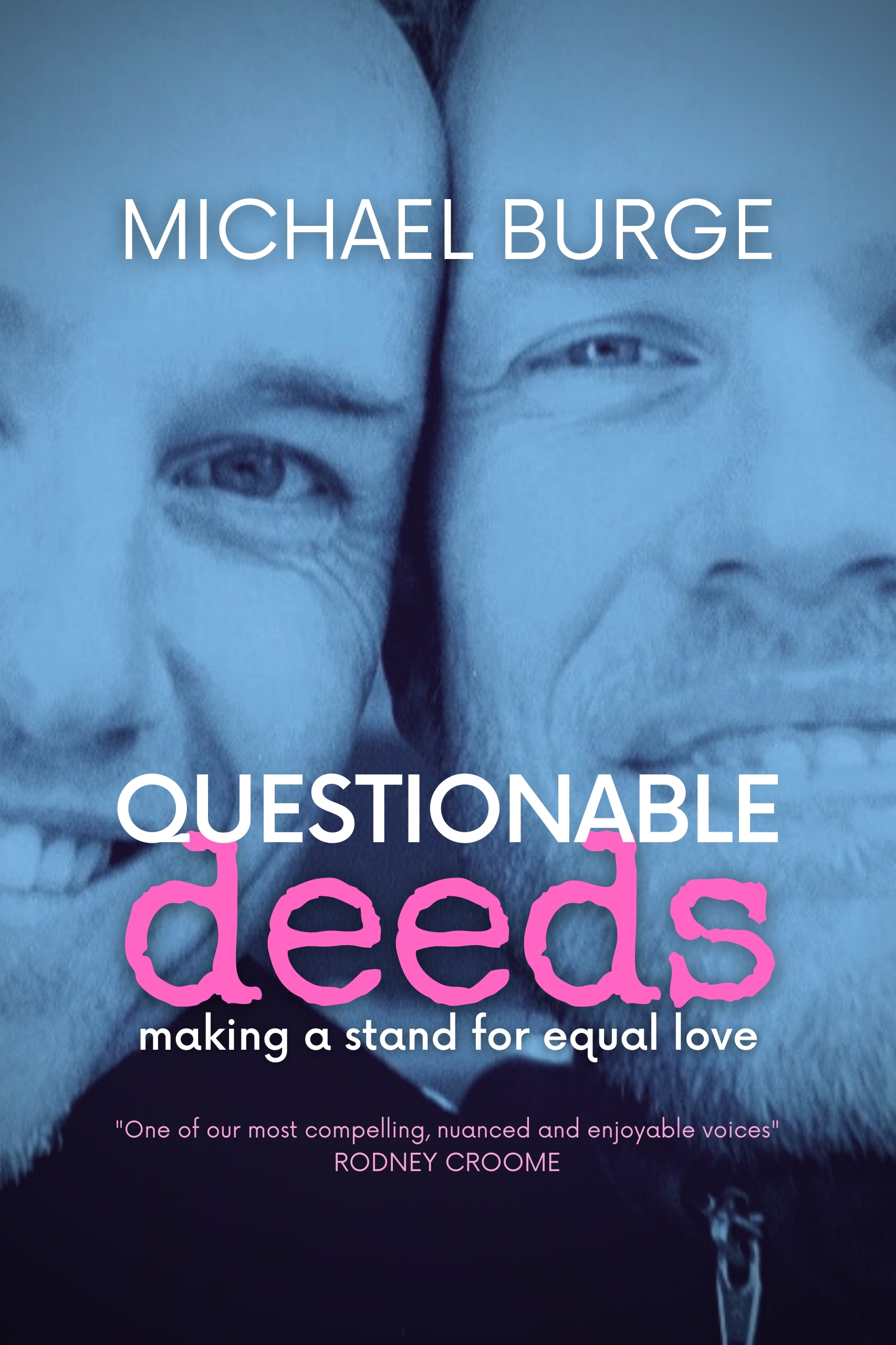
Michael’s debut memoir ‘Questionable Deeds: Making a stand for equal love’ became an Amazon bestseller. 

© Michael Burge, all rights reserved.

Writer, read your own work!

“The only way to achieve objectivity about a piece of work is to leave it alone for a while.”

A FEW years ago I asked my social media followers if anyone had complete or partial manuscripts sitting around, perhaps something potentially ’embarrassing’. This question yielded some interesting answers, and many fantastic potential books. One of the reasons I started Write, Regardless! was to assist stymied writers to dust these works off and breathe new life into them. The next step is one of the hardest for independent writers – successfully rewriting your first draft.

Don’t send in your first draft… just DON’T!

The best thing writers can do with our newly completed manuscripts is put them away. Ensure you have saved your work, backed it up to a memory stick, or at least printed it out, then bury it somewhere. Unfortunately, the negative reputation of the independent publishing industry is formed on the back of writers who complete a first draft of their books one day, then hit the publish button the next. Just because we can doesn’t mean we should. The only way to achieve objectivity about a piece of our work is to leave it alone for a while; I’d recommend a few months. Use that time to keep your social media platform buoyant… you’re going to need readers and followers, so start attracting them! Of course if you have a long-buried manuscript already, it’s time to rewrite it.

Do the work!

It sounds far too simple, but the best way to rewrite great second and subsequent drafts is to learn the discipline of reading our own writingThis is harder than it sounds, but it’s become an essential tool for all writers in an age when editing and proofreading have lost currency. Even if you are gifted with the perfect writer’s pathway – your manuscript gets picked-up by a mainstream publisher, and you are assigned an editor who lovingly massages your talent – you are going to be better prepared for this luxury if you know your own work better than anyone else. The only way to achieve that is to read your manuscript. Do the work.

“Publishers are not looking for problem writers.”

Manuscripts must be fit!

Even if you are planning to approach traditional publishers with your manuscript, you’ll need to complete several drafts of it before submitting. I cannot say it enough: publishers are not looking for problem writers. They don’t have the time, money, or inclination to find a ‘genius’ and shape their work. Sending a manuscript to a publisher or literary agent is just the same as job interviewing and auditioning – you and your work must be on top form from the very first moment you have the ear of industry professionals. Do the work.

Don’t overdo every rewrite

For me, rewriting is about seeking entertainment and distraction within my own work. I figure that if I cannot move myself through my writing, then I am not offering anything to a reader. When we embark on a first read, many hours of work on our manuscripts lie ahead of us, so it’s best to avoid getting stuck in too much detail. We need to see the big picture of our story arcs, not worry about spelling and grammar at this stage. Insert notes so you remember things that spring to mind, but move swiftly through your read, trusting that next time you’ll make it even better.

Be hard on your plot!

By now you should have a good grasp on what makes a good dramatic story arc. Detailed reads of our work are our chance to see where our plotting is weak. Revisit my article on plotting many times as you reshape yours. My advice would be to correct plot failings as soon as you discover them, because there is no use trying to gloss over a story with, say, no antagonist; or a novel in which there is no conflict; or a work of non-fiction that does not have an effective resolution. Be prepared to admit your first draft is not yet complete, and go back to the drawing board. That level of honesty with your writing will pay dividends down the track.

HARD READ The Reader by Ferdinand Hodler (Museo Thyssen-Bornemisza, Madrid)

Writer angst

I have written plenty in Write, Regardless! about practical approaches to writing. It’s time to focus a little on the emotion. If you find yourself distracted, head in the clouds, missing appointments or late for work, chances are most of your mind is happily engaged on your plot. Don’t panic! Your family and friends will notice a change, very often they’ll interpret your daydreaming as a form of selfishness. Confessing to being a writer can trigger familial panic (we’re loose cannons in all rigid economies, we creatives). Reading, rewriting and plotting takes time, quietude and headspace, and when we don’t get these things, if we are doing the work, our brain does something clever… it takes over and does it whenever it gets a chance, such as when we wake, or as we are drifting off to sleep, or doing the dishes, or driving. Surrender to this process. In order to achieve your writing, you’ll need to do plenty of artful dodging with loved ones. Expect the odd angry outburst to surface if you are a writer doing the work. What you’re probably having trouble expressing is your need for headspace.

Rewriting short stories

The art of writing entertaining short stories is something most writers attempt at some stage in our careers. It’s a unique form of expression that relies on being even more adept at plotting, not less. Don’t confuse ‘shorter’ with ‘easier’. Check out my notes on rewriting short stories.

Read the warning signs

The independent publishing marketplace is full of advice and tips on how to achieve success. I’ve been gleaning great ideas within it for years, but one thing I have learned to watch for are signs of back-pedalling. While the rush to the Publish Button has become a tempting shortcut, I have read plenty about self-published writers who design their book covers before embarking on the writing process; who set-up marketing campaigns before fleshing-out their novel’s plot; and quite high-profile self published authors pulling their books off the virtual shelves to rework them. They do everything, it seems, apart from sitting still and actually reading their own work.

Recap

write-regardless-cover
BUY NOW

There are many exclamation marks in this article! That means there is an important message you need to listen to: you are the first audience of your output. If you want to be an effective writer, you need to practice the art of reading your own work. All the secrets to improving your manuscript are on the page already, even by their absence. Read, read, and read your own manuscripts. Do the work.

An extract from Write, regardless!

© Michael Burge, all rights reserved.

Writer, don’t lose the plot!

“The essential foundation of all good storytelling.”

THE first six sessions of Write, Regardless! are about establishing an online social media platform, something all writers need to be doing for ourselves long before we start the process of publishing our books. Think of it this way… once you’ve got the regular selling process in place, it leaves you more time and energy to focus on regularly creating. To that end, we’ll start looking in more detail at the writing process, beginning with what I believe to be the essential foundation of all good storytelling: effective plotting.

Dig away at your plot

Every writer plots differently, but plotting a story is never executed just once or in isolation, it tends to evolve throughout the process of putting a title together. This article is something you’ll probably need to dip into across the writing of your work in order to stay on course with your plot.

Plotting a first draft

I am often asked if it’s possible to plot well in a first draft, and whether writers can keep track of where we are in our unfolding plots. The short answer is that I am a great advocate for belting out a first draft without focussing too much on plot. See where the inspiration takes you. There is a payoff for this rule-free ‘luxury’, however, which is that eventually we have to get tough on our plots in order to shape subsequent drafts. Having said that, the more we write, the more we become capable of shaping a plot in a first draft.

“This is your chance to make your work engaging and entertaining.”

Second draft and beyond

There’s no excuse for neglecting a tough plot analysis while executing your second and subsequent drafts. This is your chance to make your work engaging and entertaining. Don’t fall into the trap of believing that some literary fairy godmother is going to magically appear and make your first draft perfect. Submitting an incomplete, unworked manuscript is the height of writerly laziness and nobody in the publishing trade is paid to make your raw draft into a workable book. That’s your job. Luckily, there are tools to help.

Bite-sized plot structure

Depending on what genre and format you’re writing, there is more than one way to plot a story. The archetypal five-act plot is the classic structure for novels and can be applied to long-form non-fiction. The archetypal three-act plot is commonly applied to screenplays and plays, although it’s really a truncated form of the five-act plot. Remember, these are a plot’s starting points. The rules are not there to break (if you want to entertain readers/viewers) but rather to bend. Your ability to be flexible with the rules is what will make your writing original.

Perfect plot points

Drilling deeper into plot structure will expose more detail on precise moments that heighten the experience for readers/viewers, such as the narrative hook, the call to action, and the point of no return. Don’t complete a second or subsequent draft of your books/scripts without them.

Fighting the ‘formula’

I’ve had many animated discussions with writers who don’t believe in structured plots. I am not here to convince anyone of the need to plot their stories, but I do know that a joke has a formulaic structure (set-up, punchline) and a ghost story by a campfire has one too. Try telling such stories without sticking to tried and true plot structure will leave the teller looking as though they have no sense of humour. We all anticipate a punchline in a joke, and we know a ghost story has a chilling moment ahead, yet we submit to the formula without question. Plotting a novel or screenplay is no different, in fact these writing formats require more conscious plotting, since they are longer and fall further from the formula, especially if we seek to be original.

ALAS, POOR HAMLET Often used as an excuse for missing plots. Laurence Olivier as the Prince of Denmark in the 1948 film.

The Hamlet argument

Many plotting naysayers pull the Hamlet card, suggesting the Prince of Denmark’s “To be, or not to be” speech by William Shakespeare is literature’s greatest example of a character in some fascinating kind of stasis that gives all writers an excuse to avoid plotting better stories. While it’s true Hamlet works himself into a state of not knowing what to do, his famous monologue is actually almost halfway through Shakespeare’s plot. The play opens with the unlikeliest of events – the purported appearance of a ghost on the ramparts of Elsinore, and on the basis of what may be an hallucination, the hero drives the action through several major plot points before he pauses, thinks, and wonders if it might be better to die than go on. Sorry, plotting naysayers, Hamlet is not your trump card, nor is Waiting for Godot. Great stories have plots.

Create battles

When I get into a plot funk, I use a handy device to cut the crap and uncover what needs fixing by finding the ‘battle’ in my story. All journeys of protagonists (‘heroes’) and antagonists (‘villains’) involve conflict between the two. They get in each other’s way. I believe writers’ reticence to structure these conflicts is the greatest obstacle to good plotting. Name your hero and villain, and let them do battle. If you miss this fundamental core, you’ll have no plot.

When plotting and marketing combine

Rare is the writer who has not fantasised about our work in its finished form, imagining our books on shop shelves, complete with our ideas for titles and covers. This daydreaming can be an absolute writing killer, but there is a way to spin it into plotting gold… although my advice would be to try this process only when your first draft is done.

Try it on for size

If you can’t tell someone what your story is about, it’s probably not well plotted. When you have a first draft, try writing a blurb of your work. If this is hard work, it will show you where your plot is weak. If you don’t know who to focus the blurb on, it’s likely you don’t yet know who your protagonist is. Not being able to create an interesting blurb for a manuscript is a sure sign it is not well-plotted.

Synopsis vs blurb

When you’re approaching the point of submitting a manuscript to a publisher or a literary agent, or you’re preparing to independently publish your work, you will need to create either a synopsis or a blurb of your title. A common trap for writers at this stage is to conflate a synopsis (an abridged version of a title allowing a quick analysis of its entire contents, including all plot points) and a blurb (a promotional ‘taster’ of the work which holds plot points back to generate interest). Writers need to reveal all plot points in a synopsis sent to prospective publishers and agents – let them in on your story’s mysteries. Independent publishers need to entice readers by holding back some plot points (particularly our story’s outcomes) when creating blurbs.

Case studies

During my research on the plotting process, I put a few well-known plots through their paces. Because the stories were not mine, the once-removed quality of the analysis made it easier, and I advise all writers to analyse the plots of their favourite books and scripts. Here are my plot examinations of Guess Who’s Coming to Dinner and The Sum of Us, both works of fiction, and A Cry in Dark, a non-fiction screenplay. Try your own plot analysis as a way to grow familiar with the way stories are structured.

Recap

write-regardless-cover
BUY NOW

Structuring an engaging story by building a great plot is not something that magically happens in the editing process. It takes an understanding of storytelling that should be second nature to good writers. But have no fear, good plotting can be learned if you’re prepared to be tough on yourself.

An extract from Write, Regardless!

© Michael Burge, all rights reserved.