All posts by Michael Burge

Journalist, author, artist

Navigating prejudice – Matthew Flinders

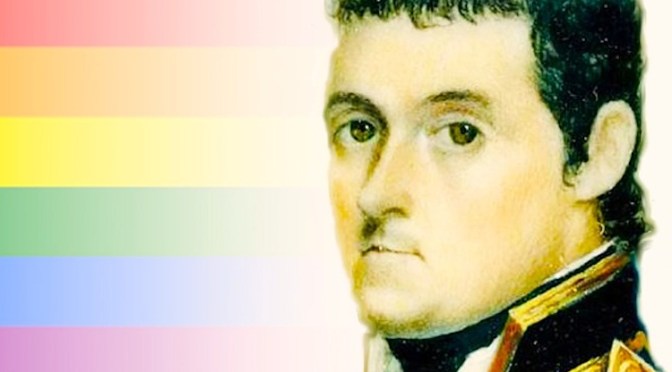
HELLO, SAILOR! Navigator Matthew Flinders (1774-1814)

SPECULATION about the sexual orientation of iconic English seaman Matthew Flinders rose like a colourful maritime flag over a decade ago when previously unknown letters surfaced, including emotionally charged passages written by Flinders to fellow explorer George Bass.

In his 2007 Meanjin article “Exploring love: did they or didn’t they?” historian Garry Wotherspoon asserted: “If the excerpts from Flinders’ letter to Bass had been written to a person of the opposite sex, we would be in little doubt as to what sort of relationship it was or what kinds of hope and expectation it had once contained”.

“It’s time to shift perspective and explore the homophobia Matthew Flinders encountered.”

“We would probably even confidently presume a sexual component in it, a basis in physical feelings if not actions. The possibility of a physical side to or a sexual element in Bass and Flinders’ relationship should therefore be acknowledged and considered.”

In the years since, little acknowledgement or consideration has been given to the sexuality of either man.

Historians are invariably baffled by Flinders in particular. Many of his extraordinary reactions lead them to describe such moments as out-of-character; but for anyone genuinely wanting to understand him, it’s time to shift perspective and explore the homophobia Matthew Flinders encountered.

Both Lincolnshire-born, Bass and Flinders met on a voyage to Australia in 1795 onboard the HMS Reliance. Once in the new colony, the two made a series of expeditions together. First it was short trips along waterways close to Port Jackson. Eventually, onboard the Norfolk, they circumnavigated Tasmania.

It’s tempting to paint all kinds of Brokeback Mountain-style possibilities for two unmarried men isolated on vessels in far-flung locations.

“There was a time, when I was so completely wrapped up in you, that no conversation but yours could give me any degree of pleasure …” Flinders wrote to Bass towards the end of this period, “And yet it is not clear to me that I love you entirely …”

Both men returned to England on separate ships in 1800 – the year of Flinders’ ‘love’ letter – and were married within six months of one another.

Bass soon left on a trading mission to the southern hemisphere in January 1801, leaving Flinders’ letter at home, where Mrs Bass – Elizabeth – had plenty of time to consider its contents and form the response she penned onto the letter itself.

“This, George, is written by a man who bears a bad character … no one has seen this letter but I could tell you many things that makes me dislike him,” she wrote.
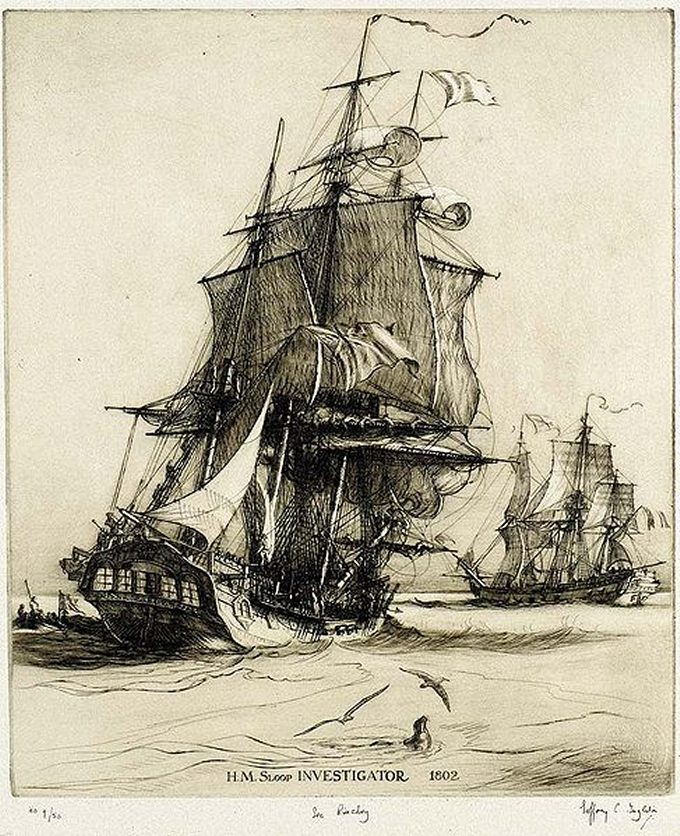
HMS sloop Investigator.
MARRIAGE VESSEL HMS sloop Investigator.

Her warning was given during a major turning point in Flinders’ life.

He shocked his friends and family by responding to a suggestion of marriage from a friend, Ann Chapelle, who he’d discouraged in previous letters.

Then he went so far as to invite her to return to Australia with him, keeping the reality of the Admiralty’s strict rules on wives from her until she was forced to get her things off the HMS Investigator and let him embark.

What the speed and the controversy of the marriage achieved was widespread gossip within the Admiralty and his circle that painted Flinders as a fervently married man.

Any Brokeback-style expeditions were off the cards in the following years for Bass and Flinders, whose paths did not cross again. Bass captained the Venus on trading jobs to New Zealand and Tahiti, while Flinders completed the first circumnavigation of Australia.

By the time the Investigator docked in Sydney in 1803, Bass had departed on the Venus bound for Tahiti and South America on a voyage for which there remains no known end – the ship and her crew all disappeared completely.

Flinders also had problems returning to his wife, when, in December 1803, he was arrested on the island of Mauritius, a French-held colony.

Much has been made of Flinders’ seven-year imprisonment at the order of Mauritian Governor Charles Decaen. The records revolve around spying accusations against Flinders and his incorrect passport, understandable concerns considering the English and the French were at war.

But what if homophobic whispers had pursued Flinders to the southern hemisphere? 
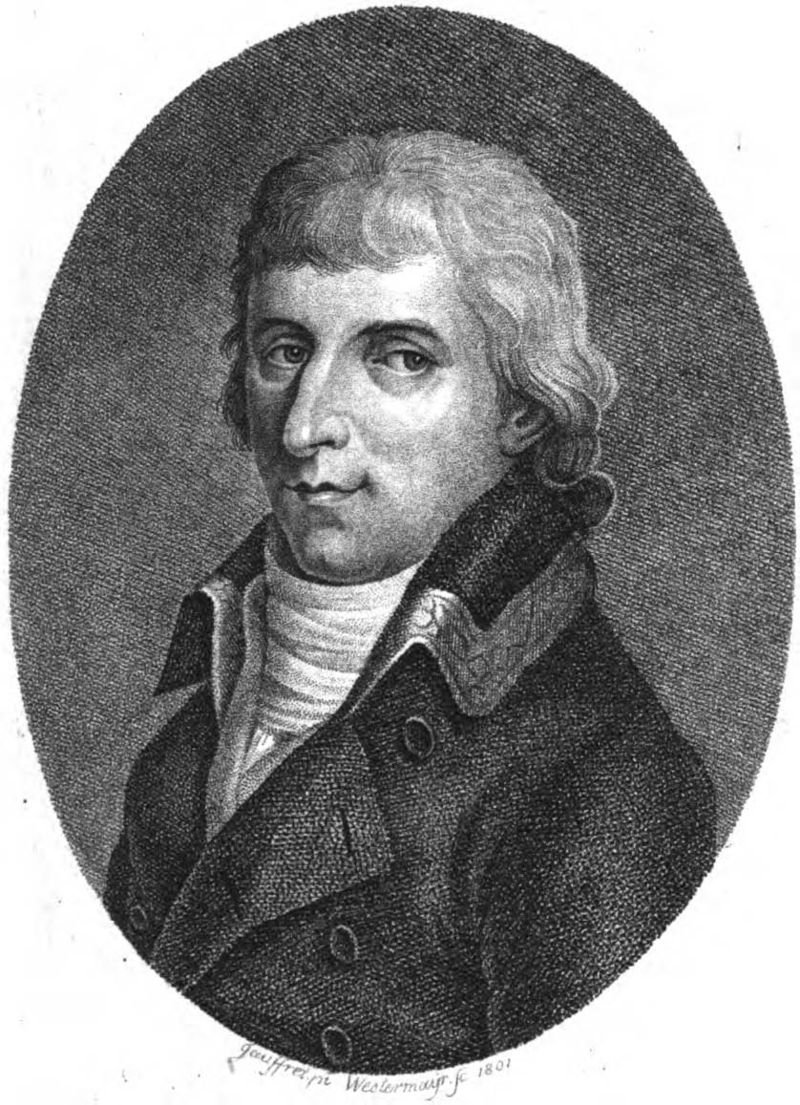
French Captain Nicolas Baudin.
CORDIAL CAPTAIN Nicolas Baudin in 1801. (Engraving from a portrait by Joseph Jauffret)

By the time Flinders limped into Mauritius in his damaged schooner the Cumberland, Decaen had heard of Monsieur “Flandaire”, probably from French captain Nicolas Baudin.

Baudin and Flinders had two previous encounters onboard Baudin’s ship, the Géographe, off the coast of southern Australia in early 1802.

After much flag-raising and shouting, when Flinders pulled the Investigator next to Baudin’s vessel and boarded, the men had the stilted, competitive discussion about charts and landmarks that has become folklore in the maritime history of both nations.

Researchers Jean Fornasiero and John West-Sooby had another look at the accounts of the Flinders-Baudin meetings in their 2005 essay A Cordial Encounter?

“Certain discrepancies between the accounts of the two captains are difficult to explain,” they wrote. “These have generally been attributed to communication difficulties between the French navigator and his English-speaking counterpart”.

“We do know Flinders ‘spat chips’ at Decaen for keeping him against his will.”

“This assumption, however, is far from self-evident. We have thus chosen to canvass the full range of possible explanations for the conflicting accounts of that meeting, including the hypothesis that Flinders, who is generally considered a reliable witness, may indeed have misrepresented his encounter with Baudin.”

But the one possibility they neglected was that Nicolas Baudin knew a homosexual when he saw one.

Eleven years prior to this encounter, the French Revolution recognised the existence of homosexuality when it left consensual, private sexual relations between two men out of the French Penal Code of 1791 (and again in 1810).

Before this, gay men could be burned at the stake if caught in sexual acts. As a consequence of the change, they were generally free to be themselves in public.

Compare that with Flinders’ place of birth, where, at the time of his meeting with Baudin, Henry VIII’s Buggery Act of 1533 still listed sodomy as a hanging crime. Consequently, writing love letters would only have been for the extremely courageous.

Baudin arrived in Mauritius, and died there of tuberculosis, just months before Flinders’ incarceration. Its doesn’t require a great leap to imagine him describing Flinders to Decaen as “pédéraste pétulant” instead of “un navigateur qualifiés”.

We do know Flinders ‘spat chips’ at Decaen for keeping him against his will, from letters the French Governor received from the explorer.

Decaen requested Flinders dine with he and his wife on the second day of Flinder’s detention. Flinders, who’d refused to remove his hat when he met the Governor, declined the olive branch and kept to his prison room dusting-off more missives.

His responses were so stinging that the Governor never repeated his invitation and kept this bird in a cage for a further seven years. 

The cage wasn’t entirely austere for Flinders – trips to the theatre and stays with local aristocrats, and parole for extended periods, took place in a civilised French colonial society which tolerated any gay rumours and allowed him to pass the time writing.

But Decaen maintained his personal control over Flinders’ detention, even contravening Napoleon’s 1806 directive to free the Englishman. The Governor’s excuse was the kind of blanket term used to beleaguer Oscar Wilde: Flinders was dangerous.

After his release and return to England in 1810, where he continued writing on his many groundbreaking explorations, Flinders’ ill health brought about his untimely death at the age of forty.
pluck-cover
BUY NOW

Yet his remarkable achievements resulted in inexplicable omission from the ranks of the Royal Society, the Admiralty’s old boys’ club that may, like Baudin, Decaen and Mrs Bass before them, have suspected the truth.

© Michael Burge, all rights reserved.

This article appears in Michael’s eBook Pluck: Exploits of the single-minded


‘It doesn’t have to be Shakespeare’

MERELY PLAYERS COVER PR (2)
Paperback | eBook | BUY NOW

WHEN a middle-aged boy player returns to London’s Globe playhouse during a terrible revival of Romeo and Juliet, she sets off a chain of events as great as any of Shakespeare’s entertainments, revealing a love story that lay hidden for decades, just beneath the lines of the script.

Centuries later, an out-of-work Sydney actor connects the dots of this drama and is inspired to write a play, bringing him face to face with big life lessons in the art and politics of storytelling.

The lives of these two unconventional players collide in a journey from Australia to England, from drama school to the professional stage, from male to female, from failure to success and back again, exploring the untold story of those who created the complete works of William Shakespeare.


An extract from Merely Players: Acting like Shakespeare really matters.

Masters, I have seen a man out of his clothes before, and not tried to make him mine.”

I go back to the place I have made for myself by the rack. Master Burbage sulks while the others begin to peel doublets over expanded bellies, revealing sweaty waists and backs. I notice Heminges undoing his hose on the other side of the rack, trying to conceal himself.

‘Masters, I have seen a man out of his clothes before, and not tried to make him mine, but if you’d be more comfortable hiding your glorious forms, I can wait upstairs,’ I say.

‘Nay, your place is down here with us. We’re not going to make a fuss about Master Tooley, now are we?’ Heminges asks.

Condell shakes his head.

‘Perchance you just sit by the steps and tell me if you can spot any printer’s boys in the crowd,’ Heminges adds.

‘You’re letting printers into the playhouse now?’ I ask, crossing to the stairs.

‘Much has changed since you were in the playhouse, Master Tooley. They’ll have real women playing soon enough,’ Condell says.

‘Don’t believe him, it will never happen,’ Master Burbage mutters into his lap.

‘And there’s never a rehearsal for the bit players, because there’s no lines apart from whatever you can drag up from within your receptacle,’ Condell adds, tapping the side of his head.

I search the ceiling by the stairs, where that larger crack allowed the light to fall onto my mirror when I arrived. Three steps up, the view of the stage reveals itself.

The sun has dipped below the highest gallery of the playhouse, where people sit talking and eating, some asleep against pillars or calling down to others in the pit.

I glance back into the darkness below, to see Condell rushing to get his wide arse back into a fresh pair of hose before I can see him.

‘It won’t be much of a play, without all the lines,’ I say, eyes back on the crowd.

‘We all know how the stories go, just follow the patterns,’ Condell says, ‘you enter, you wait and you listen, then you throw in a line or two which you think sounds right according to your part. Make it a rhyme, if you have the time. Keep it short, or have some sport … it doesn’t have to be Shakespeare.’

‘We don’t do too many old plays by Master Shakespeare,’ Heminges adds, emerging fully clothed from behind the rack, ‘not these days, because whenever we do, the printers send a pair of their pock-faced boys to sit up the back and scribble down our words as best they can. By the time they go to print with it, Will’s best poetry sounds like a madhouse ditty!’

Judging it safe to take my eyes from the stage, I say: ‘I might have been away from this playhouse for many years, Master Heminges, but I do recall you once had a grand plan to print all the plays of Master Shakespeare’s in the one book.’

“While you’re on the stage, duckie, perchance you work out what it is you did come back for.”

‘I did, but then one player of this playhouse took it upon himself to sell the contents of his receptacle to a printer, and when the little books of Master Shakespeare’s became so popular no printer was interested in paying for our plays anymore, they were only interested in stealing more of them. If I ever discover which player it was I’ll hang him by his balls from the top of this playhouse, but I could never catch him at it. I always thought it had to be a player who disappeared from our playhouse, and never dared show his face back here again,’ Heminges says.

I glance down at them, three pairs of eyes, looking into me.

Before I can say anything, a sudden round of trumpets announces the play. The crowd explodes into applause.

‘We’re off!’ Condell says.

‘No-one is listening to you prattle, Heminges, ready yourself,’ Burbage says.

‘I have, but where is my Lady Montague?’ Heminges asks, offering the hat and veil to me. I don them without thinking, and reach for the sliver of mirror in my basket, by the steps, the light from the stage falling across my aged face.

‘Oh dear … I am not ready for this,’ I say, pulling the veil tight and slipping it under my chin.

Heminges takes my arm in a strong grip. ‘You’ll soon be, duckie. A player who does not play has no place in a playhouse!’ he says, as we ascend into the light.


Performance rights for Merely Players are available via the ePlay rights page.

© Michael Burge, all rights reserved

A Myall in my shoes

A Writer on Australia’s Frontier Wars.

IT has taken me a lifetime to get back to Myall Creek, a typical watercourse that traverses a remote country road like thousands of others in NSW’s New England district.

Here, between the towns of Delungra and Bingara, a corrugated iron hall by a long-disused pair of tennis courts has been a place of dances, Christmas parties, cricket meets and a century of community gatherings.

As kids, me, my siblings and school friends played on iron swings that were already old by the time we clambered over them, while our parents enjoyed social tennis.

On the sidelines between one of those matches, my mother parked herself next to me on the swing in her tennis whites and told me a story. 

SWING
LIFE SWINGS The tennis courts at Myall Creek Hall (Photo: Michael Burge).

She gestured along the creek that snaked its way close to the shed, across a field dotted with pepper and willow trees, and whispered how, long ago, white settlers had driven Aboriginal people over the edge of the gully to their deaths.

The injustice in her tone got my attention, but also her reticence to tell me publicly. In all the years since, I have wondered if she’d been told about this crime, casually, over a lemon barley water on the other side of the court, when some long-term local updated this city girl on the region’s history.

Mum got essential details wrong at that first telling, but what she told me remains one of the most indelible events in Australia’s Frontier Wars – the Myall Creek Massacre.

Life took my family away from the New England region less than two years later. Over the decades, we drove across Myall Creek many times travelling to family events, never stopping.

“Now, the dead are ready to have us remember them.”

But the story of the massacre stayed with me, cropping up in school projects and writing efforts. Eventually, I did some research at Sydney’s Mitchell Library, and read for myself the newspaper accounts of the Myall Creek Massacre trials, replete with the often quoted, eye-popping racist responses from readers incensed at the white perpetrators being bought to justice.

The day I return with some of my family for the annual June Long Weekend Myall Creek Memorial, the paddocks around the hall are full of cars. 

I find my way back to the tennis courts, now covered by grass. The swings are still there. I spy the bridge over the creek, and the same gully my mother gestured to almost forty years ago.

By the time the crowd has moved up to the memorial site itself, it’s as though we cannot help but stand in racial groups. There is a hesitation about mingling. We don’t know anyone else. They don’t know us. We’ve all returned to Kamilaroi country because we remember.

Two Aboriginal men, helped by their kids, light a fire for a smoking ceremony. The sound of boomerangs being clapped together calls Aboriginal dancers into action. Smoke rises, wrapping around us, bringing us together.

SMOKE
WELCOME TO COUNTRY Smoking ceremony at the start of the Myall Creek Memorial (Photo: Michael Burge).

The air is heavy with a scent that wakes us into joining the respectful queue that forms at the head of the track leading into the memorial, and hands reach up to draw the white paint across our foreheads.

Now, the dead are ready to have us remember them.

The Myall Creek memorial is a short walk through scrubland typical of the region, with its basalt soils – chocolate-brown and ochre red – and the knee-deep sea of sandy coloured grass, lapping between stands of trees.

It’s also granite country. Small boulders lie everywhere, like markers, and as we walk, school students, some of them Aboriginal, read the plaques set into the stones while we progress.

Each tells part of the story of the killing of 28 unarmed Aboriginal women, children and old men in June, 1838. Most were felled by swords after being chained together, one chapter of the long conflict between European settlers and Aboriginal people.

The track leads us to the massacre site, a massive boulder set on the edge of a high place overlooking the remnant of the old Myall Creek Station.

In the distance, cattle feed and call. This was the land granted to squatter Henry Dangar, whose patch was eventually subdivided to create the nearby farm my parents worked in the late 1960s and 70s.

The familiarity of the farm noises comforts me, but when guest speaker Professor John Maynard speaks of the Aboriginal contribution to the wars Australia fought on foreign soil, his voice carries protest at the way Aboriginal history has been whitewashed. It’s a much-needed jolt of reality.

At the ceremony’s end, the next generation is encouraged never to forget the crime. Watching white and Aboriginal kids led by their elders, I am struck by what it must be like to not know about the Myall Creek Massacre.

Plenty of other massacres happened across Australia during the Frontier Wars – in other places, many more Aboriginal people were killed than at Myall Creek, in a variety of ways, from poisoning to shooting. Myall Creek stands out only because it was the first crime after which the bulk of the European killers were brought to justice.

Did the oral histories run deep amongst the white farmers because our ancestors were hanged for their crimes?

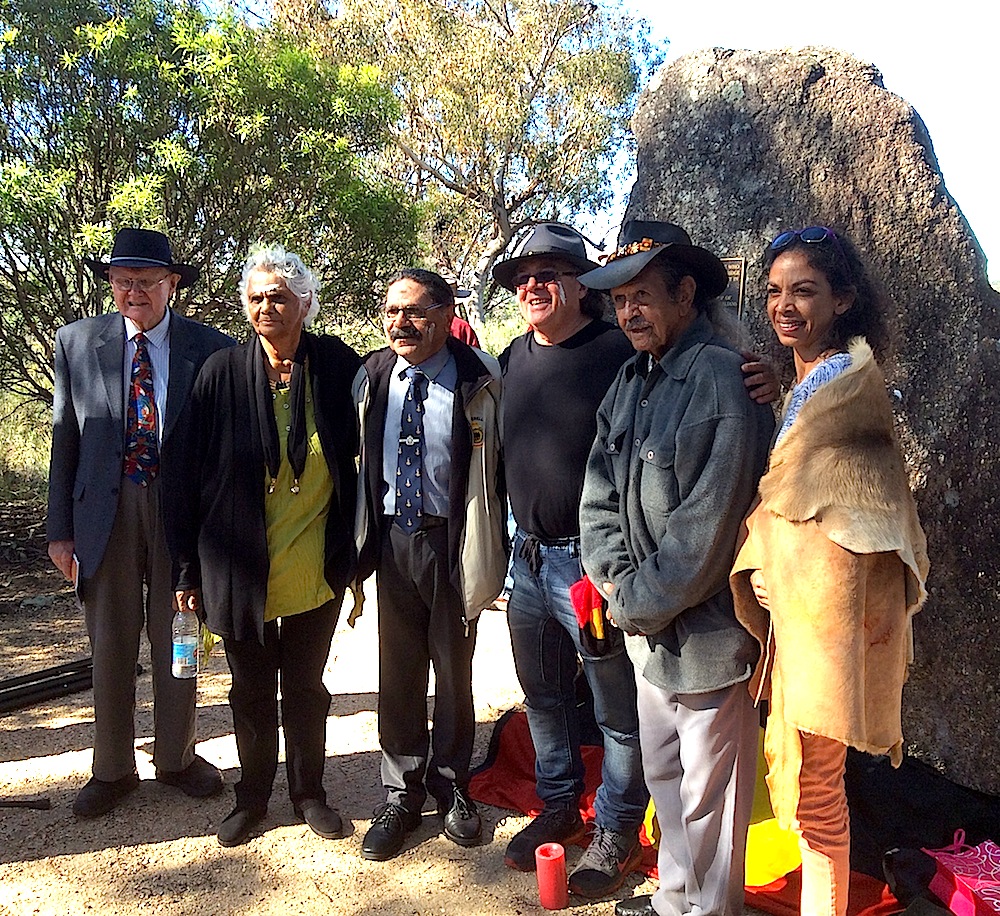
MYALL LEGENDS Elders and dignitaries at the memorial site (Photo: Michael Burge).

When American writer Bill Bryson came in search of the massacre site in the late 1990s, he found nothing.

By 2000, the place had been identified and marked. Occasional vandalism since has not dulled the growing spirit of reconciliation which will never be stymied by faceless racism. Now, a fundraising effort is behind a planned onsite education centre.

During the thoughtful walk back to the car, cautious divisions start falling away. We walk as one group. One people.

On the way to visit our old farm, we pause at a high point along the road where another farmhouse became derelict long ago. Very soon, other cars arrive, bearing various descendants of the other families who farmed down the same lane. They were all at the massacre memorial too.

Although we are all different ages, live across two states and our lives have followed varied pathways, one thing unites this group of relative strangers meeting on a tract of the Kamilaroi nation on this particular day – every one of us has always known about the Myall Creek Massacre.

This strong oral history has been handed down through generations and does not come with judgement, shame, or pity for white killers.

It comes with an unforgettable knowledge of what injustice really means in this country, and the desire to pass that message on.

© Michael Burge, all rights reserved.