
All posts by Michael Burge

Journalist, author, artist

France, a country driven by différence

A Writer’s dose of Francophilia.

IT’S safe to assume our Treasurer Joe Hockey would not have enjoyed a trip to France with Prime Minister Tony Abbott in 2014.

There’s just too many wind turbines across the French landscape. Hockey would have been offended every few kilometres.

“The locals are not afraid of heritage or design.”

I should know, I spent hours admiring the French commitment to clean wind-generated energy as endless, slender, spinning white needles slid past on my high-speed rail journey into the heartland of the country’s southwest. In the region known as the Lot (with its capital Cahors), massive forests reach wide green arms into built-up areas and quickly swallow visitors into an ancient rural landscape which still sustains its farming industries.

These abundant forests are not national parks, but a regularly harvested source of timber and firewood, large and well managed enough that supply is not threatened and wildlife has a permanent refuge alongside livestock.

MARKET FRESH White asparagus at Cahors farmers' market.
MARKET FRESH White asparagus at Cahors farmers’ market.

Supporting the regional agricultural economy, serious fresh food markets take place in most towns a few days every week, a vibrant and profitable exchange of local produce and other goods for the benefit of residents. Compare that to token farmers’ markets once a month, begrudgingly permitted by local chambers of commerce in Australia.

Every day, street sweepers (teams of people with brooms employed by the local council) clean the towns. Not just a cursory brush here and there, but every cigarette butt and scrap of paper.

Far from major cities, reliable service connects people to the internet without the same dropout I regularly encounter at home, a mere 35 kilometres from the central business district of Brisbane.

But the greatest surprise, for me, came with the palpable sensation of creativity happening all around me.

“They know that they’ve got, culturally and environmentally, and they are busy protecting it.”

Millennia-old heritage architecture abounds. Wherever recent building work has been undertaken, it complements townscapes instead of fighting against them. Modern repairs are completed with ancient building techniques. New properties are built in the same manner as homes that are hundreds of years old. Satellite dishes and solar panels are positioned to blend in. From their homes, to their public spaces and their everyday items, the locals are not afraid of heritage or design.

Local theatres, cinemas, galleries and ateliers (artist ‘workshops’) are in high saturation. Their output is not tourist fodder, but art for art’s sake.

In a region whose food export relies heavily on dubious animal welfare principles (foie gras, anyone?), and where hunting is commonplace, I spotted the word ‘vegetarian’ more often in advertising than I have ever encountered it in Queensland, where I’ve had a worse time as a veggo than a homosexual.

Travelling with my husband, we didn’t sense a hint of homophobia. Same-sex marriage has been legal in France for a year.

About now, you might be thinking: “If it’s so great, why don’t you move there?”, along the lines of the ‘Australia: love it or leave it’ principle.

Well, we did go into a real estate agent in the Medieval town of Gourdon, only to find that our dream home (a flat above a 15th century shop) was on the market for 55,000 euro (just under AU$80,000). Tempting enough to admit that I really don’t love Australia to the point that I would never leave it.

As we left the region, I got the sense that I was returning to a world that is busy destroying itself. There is no doubt in the Lot they know that they’ve got, culturally and environmentally, and they are busy protecting it.

I felt bereft as this special place disappeared in the wake of the high-speed rail journey back to Paris, where the sight of cars plugged into electrical recharging points, which have become part of the very infrastructure of the streets, was a sign that even French cities are connected to an alternative present, not just dreams of a different future.

FRENCH PRIDE The Louvre's French masterpieces are just the tip of the iceberg.
FRENCH PRIDE The Louvre’s French masterpieces are just the tip of the iceberg.

No one demographic dominates the Paris population. Mass immigration has resulted in the kind of melting pot of cultures which goes well beyond tolerance of unfamiliar cuisine. Both days we were in the city, loud, peaceful political protests for Sri Lankan and other refugees occurred. Australia’s base fears about racial and cultural differences, and our government’s cry that we are being overrun by asylum seekers, simply fade into the multicultural Parisienne haze.

At The Louvre, all the great Western masterpieces are on show, but included in this ‘greatness’ were acres of decorative arts from the Muslim world in the museum’s permanent collection.

Yes, I could be accused of seeing the grass as greener through my rose coloured glasses, but before leaving the Lot I asked a couple of local British expats about the region.

Wages are low. The economy is seasonal and almost shuts down over the deep winter. To counter this, most residents live well within their means. Perhaps that is what people did before economies relied so heavily on debt, deficit and the need for everyone to spend, spend, spend?

I don’t know why France and Australia are the way they are. Penal colonies, bloody revolutions and wars feature in the histories of both countries. Both have elected conservative governments for most of the years since the turn of the millennium. Something is at work in France which is beyond political ideology.

I left with far more questions than answers: What lies about the environment, immigration, culture, heritage and development have we believed, that such vast differences have become the reality in two Western economies?
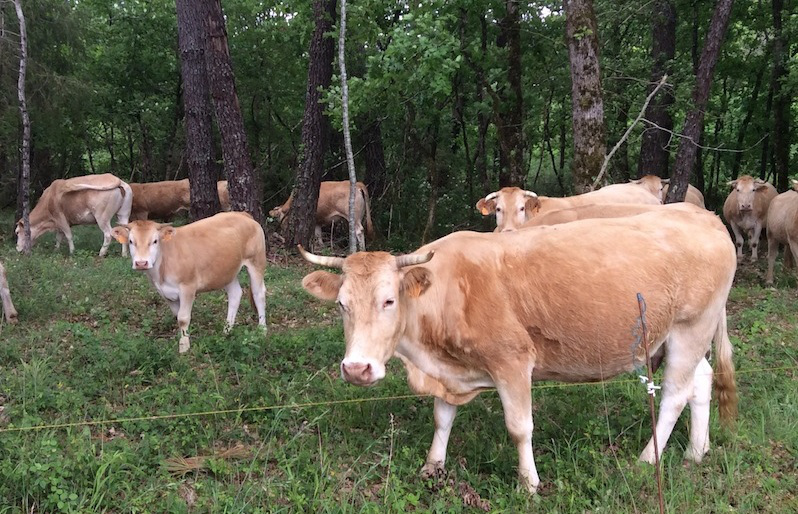
FREE RANGE Cattle in the woods near Prayssac.

What makes it possible for Australia’s Treasurer to be so vehemently offended by something which is already deeply embedded in France’s way of life? Are France’s wind turbines more or less offensive to Joe Hockey than Australia’s tradition of exporting uranium to France for their nuclear electricity generation program, which is Europe’s largest?

The French have a term for it – vive la différence (‘long live the difference’) – and perhaps they have learnt to say it about themselves more than others?

A much younger nation with an ancient first population, Australia doesn’t yet have words to express the same sentiment, and that is a telling difference indeed.

© Michael Burge, all rights reserved.

The new age of Iron

A Writer on the dawn of Lithgow’s Ironfest .

THIS year marks the sixteenth anniversary of a unique festival in the Central Western NSW town of Lithgow – Ironfest – the brainchild of a couple who escaped the city of Sydney for life on the other side of the Blue Mountains.

Their story was published in the April-May 2010 edition of Blue Mountains Life magazine (Vintage Press).

LIFE OF IRON Ali and Macgregor Ross, co-founders of Ironfest.
LIFE OF IRON Alison Lynes and Macgregor Ross, co-founders of Ironfest.

Iron Founders

Macgregor Ross and Alison Lynes’ life of Ironfest

Macgregor Ross and Alison Lynes nearly cancelled the first Ironfest in 2000.

“I’m not a fatalist,” Mac asserts, “but there was something about it which was meant to be”.

“I’d spent a few years gathering a database of metal artists I’d met on the festival circuit, we’d named the date and Ali designed our logo, but exhibitors were very reluctant to come over the Mountains. One by one they all cancelled.

“Then a local said: ‘You’ve been talking about this for years, why don’t you just do it?’ I don’t know if it was synchronicity, but the next day people started agreeing to come along and join in.”

Ali shows me what that first event entailed, in a converted shop-cum-home on the main street of Lithgow, where she, Mac and their daughters live and work.

“We created a gallery circuit,” she explains, “with two shops, the walkways down the sides and both back gardens full of art,” she adds.

“On a truck in the back lane there was a band called The Mull Pigs, with the audience sitting of roofs in all directions. There was one fire twirler, and a local blacksmith.”

Even before Ironfest, metal played a part in Mac’s life. While working for the federal police, he took a bullet on the job.

“I was looking for a way out of that career anyway, but the injury created an eight-year hole in my life.”

“One of the best things about Ironfest is there’s no crappy food and no rides, but the kids still love it.”

His path to recovery took his thoughts back to a 1982 trip to Mexico, where he was first inspired by the art of metal. By the time he’d met Ali and had some direction in his life, it was the precious metal gold which became his pass to the Central Western town of Lithgow.

“With what I had left from the compensation payout for my injury, I purchased one gold bar,” Mac says. “The bank manager was not that keen on our idea of buying an old shop to live and work in,” he remembers. “We had limited assets, and Ali’s business books from her shop in Newtown, but I had the gold bar in a paper bag and just pulled it out…”

Bank loan approved, the chance to head west allowed this couple to reinvent themselves. Like many artists, Ali (who works in glass and draws), and Mac (a metal artist) struggle with deriving an income from their creative work. Ironfest was a way to turn that around, for themselves and others.

From an initial attendance of around 400 people ten years ago, numbers at the 2009 Ironfest soared to an estimated 10,000. This expansion is the result of constant vigilance about the couple’s creative vision and their ownership of the Ironfest brand (the event is run under the auspices of Ironfest Inc – a registered, incorporated not-for-profit association). Such growth also created a few waves in the Lithgow scene.

Lithgow has a long history in the metal industries, something which inspired Mac when he found out, almost by accident, that this town at the western foot of the Blue Mountains was the birthplace of the steel industry in Australia.

KNIGHT SCHOOL The Ironfest crowds thrill to the sound of mock fighting.

The centenary of Lithgow’s metal roots happened to be around April 24, 2000. In the same way Federation in 1901 gave Australia a symbolic separation from its British roots, the ability to produce its own steel for the production of high-grade weapons gave the new nation a form of industrial independence. Finding the historical reference was “like finding a gold nugget,” Mac says.

Key to the first year’s success was the pitching of the story of Lithgow’s metal heritage to ABC radio, which provided great coverage.

“Now we have news clips about the festival sent to us from Al-Jazeera television,” Ali laughs. “We can’t understand a word they say, except ‘Ironfest’.”

Ironfest was always going to attract those interested in weaponry, and over the years it’s become a celebration of the art of combat, from the Australian Napoleonic Association to the jousting tournaments brought to the festival by Rod and Michelle Walker.

From one blacksmith in 2000, they’re now expecting seventeen exhibitors of this ancient art.

Mac and Ali have faced many challenges to the longevity of Ironfest, including perceptions about town that they are millionaires. Ali clarifies their position on this: “Artists are very often expected to create their work for free,” she says, “but we set up Ironfest so that artists could generate income. We offer a chance for people to contribute something creative which they’re good at, even if they make fifty bucks”.

“It’s a portable event,” Mac adds, explaining how Ironfest has relocated to other venues and now has a home at Lithgow Showground, and may well go further afield in the future.

The two are quick to explain how executive and production committees of supportive locals were borne of the willing voluntary crews the event attracted right from the start.

“You cannot rely on the goodwill of volunteers forever,” Mac adds. “We rely on people investing their time and energy, and we try to match that with a way to earn money from Ironfest too.”

When asked how co-producing a major event impacts on their relationship, Ali says: “Usually at Ironfest time we’re like ships passing in the night”. With two girls, there is a family unit to keep running, and both Rosa and Maya are proud of the family festival.

Rosa likes to relate that ‘Ironfest’ was the first word she ever spoke, and Maya has often used Ironfest updates as her class news at school.

“One of the best things about Ironfest is there’s no crappy food and no rides, but the kids still love it,” Ali says.

Some of the old-fashioned thrills the event provides for the young and the young-at-heart include beheading re-enactments and ‘Knight School’ for would-be pages who get to mock fight with foam weapons.

A graduate of the UK’s Winchester School of Art, Ali also runs a popular local boutique called Rock Star, in addition to her glass art and attending art lessons.

Mac’s not afraid of admitting that his creative practice has suffered a bit due to Ironfest, but it’s been a great way to exhibit and sell metal art he’s had sitting around in their iron-dotted town garden.

Between the shop and home, and the steel shipping container which is the Ironfest office, there’s a collection of Mac’s art, which seamlessly melds into the garden itself, from beautifully wrought garden chairs to delicate iron and plant fusions.

“I do as much of my art as I can, but I think I have found my life’s work in Ironfest,” he reflects.

© Michael Burge, all rights reserved.


Let Tamar Iveri have her opera straight

IVERI HOMOPHOBIC Georgian soprano Tamar Iveri.

A Writer (sort of) defends a diva.

AMID the flurry over Georgian opera singer Tamar Iveri and the comments she made in the social media about a protest march in Georgia on International Day Against Homophobia (IDAHO) in May, 2013, there was an assumption the soprano was just one homophobic voice in an accepting international opera industry, an aberration who must be silenced.

In an open letter to her country’s president, the singer compared gay people to “fecal masses”, a description picked-up by the social media ahead of Ivari’s scheduled performances for Opera Australia last year.

“Homophobia needs to be exposed, and that’s best done in the limelight where it has maximum impact.”

While I believe it was hypocritical of her to court Western dollars for her performances while condemning Western values which have attained mainstream followings, like LGBTQI equality, I’d like to place Iveri’s conservatism in context, particularly in the Australian performing arts scene.

Australian showbiz has long had an unspoken ‘don’t ask, don’t tell’ policy about its same-sex attracted performing artists. From our televisions screens to our stages, generations of us have grown up with gay, lesbian, bisexual and transgender entertainers and personalities, it’s just that we never knew them that way.

Almost forty years since Australia’s decriminalisation of homosexuality started in South Australia, you’d be forgiven for thinking the only ‘queer’ in prime-time, mainstream Aussie showbiz was Peter Allen, followed swiftly by Carlotta, Todd McKenney and opera singer Deborah Cheetham.

Statistics and common sense tell us that the numbers are much higher than that. Kindness and respect tells me that it would be simply unfair to extrapolate the rumours about which of our stars were (and are) simply ‘not the marrying kind’.

Does it really matter? Well, perhaps it does, when we are baying for blood over the homophobia expressed by a diva from the other side of the world, and the performing arts industry she has been a guest of puts on a very straight front.

NO PROBLEM Iran’s President Ahmadinajad speaking at Columbia University in 2007.

The Tamar Iveri homophobia story reminds me of Iranian President Mahmoud Ahmadinejad’s reception at Columbia University in 2007, when he guilelessly professed that they do not have the gay ‘phenomenon’ in Iran.

A ripple of snorts, which became a wave of laughter, washed across the audience and left Ahmadinejad blinking.

After expressing their deeply held convictions about the level of homosexuality in their countries (Iveri cites a statistic with no evidence: “3 in 50″ are “born gay”, and the rest are “following the trend”), both commentators had their foundations rocked.

I see this as consciousness being raised, and I can only applaud it, because homophobia needs to be exposed, and that’s best done in the limelight where it has maximum impact and ongoing ramifications. So what is going on in 21st century opera for gays?

“Fabio is now the benchmark for the male opera star, not Pavarotti.”

When I typed “out gay opera singer” into a search engine I was met with extremes. The first news stories covered out gay opera singer, American counter-tenor David Daniels, who spoke with pride about his sexuality; and Swedish tenor Rickard Soderberg, who survived a random (possibly homophobic) attack.

At “33 Opera Hunks Who Need To Serenade You Right Now”, the parade of muscle men (one of whom, England’s Ed Lyon, identifies as #teamgay) reminded me of beefcakes gracing the romantic fiction section of bookstores.

Fabio is now the benchmark for the male opera star, not Pavarotti. Gone are the days when divas built like Brunhilde could pull off the role of starving slave girl.

Despite the sexy new out gay veritas in the opera industry, like closeted movie stars, gay opera performers might feel that being out while suspending disbelief as a straight hero or heroine is a bridge too far.

Meanwhile, amongst the ranks of design and directing staff in particular, same-sex attracted opera makers have maintained a public silence about homophobia. The secrets of the most ill-mannered and worst-behaved divas have always been kindly kept behind the scenes, the stuff of myth.

Pauline Pantsdown is one of only a few voices of protest from Australia’s showbiz industry about the Iveri issue. Opera Australia issued a statement announcing Tamar Iveri’s explanation of the circumstances behind her comments. Less than a week later, they released her from her contract.

While I applaud their decision, when I think about all the marriages of convenience and closeting in Opera Australia’s not too distant past, the company’s decision to part ways with her at this late stage, over homophobia expressed more than twelve months ago, contains a level of hypocrisy.

That they fêted her so long, and seemingly so unaware, smacks of blindness.

I would have liked to see Iveri perform in our country, just to see if the fuss caused any kind of protest. Surely at least one of the same-sex attracted opera staff might have sprung something on her, like not turning-up for her quick change, or not combing her wigs. A conductor could have downed a baton for Iveri’s big numbers, or one of the stage crew left her waiting.

Had she stayed, she couldn’t possibly have gotten through her Australian seasons without a hint of doubt about the ranks of same-sex attracted men and women working alongside her in the Australian opera industry, and a large percentage of the paying audience.

It’s laughable to inhabit the opera industry and commentate negatively on homosexuality. Take the gay out of opera and what are we left with? One homophobic diva who thought all those designers, costumiers, wigmakers, make-up artists and hairdressers were just a little light on their feet?

The work of composers Tchaikovsky, Britten and Schubert may one day land on Iveri’s music stand. Will she refuse to place their notes and lyrics in her mouth and have them flowing across her vocal chords because these men, being same-sex attracted, were akin to fecal matter? Or will she swallow that gay shit and project it to the back row?

creating-waves-cover
BUY NOW

Hopefully, the whole incident will have a lasting positive impact on same-sex attracted performing artists in this country. If so, it’s about time.

This article first appeared on No Fibs.

© Michael Burge, all rights reserved. 

This article appears in Michael’s eBook Creating Waves: Critical takes on culture and politics.