All posts by Michael Burge

Journalist, author, artist

Labor, heal your hate

A Writer’s appeal to progressives.

I WAS reminded recently about the depth of hatred that courses through the Australian Labor Party, by a friend who admitted she is a ‘hater’ in the Paul Keating tradition. Her special kind of venom is reserved for Kevin Rudd.

She’s not a lonely hater, far from it. Plenty of others rail on Facebook about Bill Shorten’s shortcomings as an opposition leader, with a vitriol bordering on hatred.

Still another camp exists – the Julia Gillard haters – especially those in the Deep North who won’t ever forget what she did to their Kevin.

“Imagine what you’ll do when Julia Gillard and Kevin Rudd eventually bury the hatchet.”

In an arc from Whitlam’s sacking, to Keating’s toppling of Hawke and Gillard’s of Rudd, a ripple of Labor-red retribution runs through the left-leaning party and its followers so pervasively I wonder why anyone ever agrees to lead the rabble.

Whenever a Rudd or Gillard hater comes out of the woodwork, a rarely expressed question forms for me: If you hated (insert whichever Labor leader you like) so much, why did you vote for them?

Because that’s the thing, isn’t it? Did all the Rudd haters vote for John Howard in 2007? Did all the Gillard haters vote for Tony Abbott in 2010? Does the hate exist before these people lead the country, or does it develop later?

Maybe with all my questions I’m missing the hate’s purpose. Is Labor’s pulsating hating principle some kind of energy source to help progressives ‘take it up’ to conservatives?
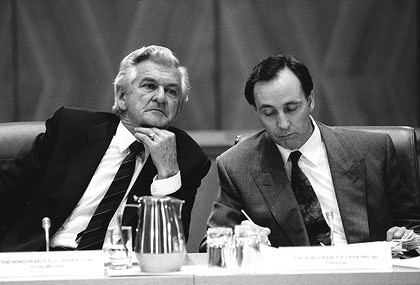
LABORING THE FRIENDSHIP Bob Hawke and Paul Keating, 1991 (Photo: Peter Morris).

If so, it’s not working. Since Paul Keating was popularly elected in his own right, all hate seems to have done for the party is truncate ALP leadership regimes. After acrimony borne of fundamental internal divisions, they collapse after about three years in power.

At its best, Labor’s ability to hate moves mountains. It toppled Work Choices, John Howard’s attempt to obliterate the workplace standards delivered to this country by the Trade Union movement.

Labor’s hatred of Malcolm Fraser’s meddling in Medibank ushered-in Medicare, one of the defining ALP social reforms.

And then there is just about everything Gough Whitlam did with his single-handed hatred of conservatism, from fault-free divorce to laws allowing home brewing.

All these were fine, upstanding examples of collective hatred directed at Labor’s common enemies.

Thanks to many in the Australian media we get regular encouragement for our Labor hate. For every David Marr and his revelations about ‘Rudd rage’ there is a Michelle Grattan calling for Julia Gillard to quit.

Some make no secret of their contempt. Chris Uhlmann springs to mind, whose Rudd hatred became patently obvious at the press conference the day KRudd became Prime Minister for the second time.

Someone – perhaps Kevin – had asked the ABC to televise each journalist as they asked their questions, an interesting angle which seemed to keep the media nice.

“Did a whole stack of ALP Rudd haters actually vote for Abbott at the 2013 federal election?”

When it came to Uhlmann, he turned Rudd’s embryonic policy on asylum seekers into war with Indonesia in a heartbeat, long before the Coalition’s Operation Sovereign Borders ever hit the airwaves.

An attempt to shape the news, make the news, or just throw Rudd off? Whatever it was, the Rudd haters must have loved it, but it took a non-hater to see it.

I’ve had my own hate happening, I admit. The night of the 2007 election my husband and I watched the ABC, and once it became clear Howard was out, I said to Richard: “Why can’t we have her as Prime Minister?”

“Who, Julia Gillard?” he said.

“She’s very well spoken, she’s well turned-out and I like what she says; and she’s not religious.”

We shrugged and went to bed, happy the conservatives were defeated.

Apologies to the Stolen Generations, the signing of the Kyoto Protocol and an approaching price on carbon necessarily preceded the wave of legislative changes that impacted very positively on our household, when Kevin Rudd kept his election promise and changed over 100 laws that discriminated against same-sex-attracted de-facto couples in Australia.

Nevertheless, I celebrated on the day Gillard became Prime Minister, not because I hated Rudd, but because I felt Australia had grown up a little. Naively I thought others would see things the same way, but when I saw people upset at the news, genuinely confused and angry, I thought shit, this isn’t good.

So I turned my thoughts to the possibility this new atheist leader in a de-facto relationship would usher in marriage equality, since she seemed to understand the need for choice when it came to relationships, right?

Wrong.

Because she never explained her anti-marriage stance on an issue of equality, I hated Julia Gillard, for a while.

But I still voted for her. I would have voted for her again in 2013. Instead I voted for Rudd, even though it was boring as heck that he got back in, and it did no one any good, but I wasn’t ever going to vote for the alternative.

Which makes me wonder: Did a whole stack of ALP Rudd haters actually vote for Abbott at the 2013 federal election?

To keep your ideology away from power to spite them … now that is hatred.

IT'S TIME to busy the hatchet, but not in one another's back ...
IT’S TIME to bury the hatchet, but not in one another’s back.

I say it’s time to heal your hate, Labor supporters. That means marrying Kevin Rudd and Julia Gillard into one awkward, stumbling, problematic but progressive six-year relationship which saw great social advancements – from the National Disability Insurance Scheme to record numbers of women in cabinet – all of which is being swiftly undone while we keep hating one or the other of the leaders who brought it all into being.

To encourage you in your hate healing, imagine what you’ll do when Julia Gillard and Kevin Rudd eventually bury the hatchet. If Gough Whitlam and Malcolm Fraser could find common ground after all that went down between them, it’s entirely possible for Gillard and Rudd to come to terms with the position each put the other in.

creating-waves-cover
BUY NOW

And remember, both of them gave you something, and that is not reason to hate, it’s great cause for hope.

© Michael Burge, all rights reserved.

This article appears in Michael’s eBook Creating Waves: Critical takes on culture and politics.

‘New-fangled mob’ Down Under

THOROUGHLY MODERN The interrelated Modern Family of ABC's comedy series.
THOROUGHLY MODERN The interrelated Modern Family of ABC’s comedy series.

A Writer looks at modern families.

IT was charming and kind of awkward when Australians welcomed the cast of America’s ABC comedy Modern Family (what Aussies might prefer to call a ‘new-fangled mob’) to our shores earlier this year, for the production of a special Australian ‘destination’ episode.

The series has consistently rated highly with Australian viewers and the locally filmed episode was always going to please and offend us.

Did they hit the mark and show us something about ourselves that’s not already apparent from any number of fantastic Australian television families, from The Sullivans to The Moodys?

The answer might lie in comparing the fiction with the data.

“There is simply no mainstream equivalent on Australian television.”

The first major difference is in Modern Family’s portrayal of three family units with kids – it’s simply not representative (what Aussies might prefer to call ‘average’)  of this country.

A trio of multi-generational groupings, including biological, adopted, and step-children, is not the Australian way, according to the Australian Institute of Family Studies.

Two out of three Australian families had children in the 2011 census, in fact, couples without children made up the dominant chunk of the pie chart, at 37.8 per cent of family units.

A beloved and core element to Modern Family’s make-up is the male same-sex couple (Mitch and Cam). Despite pushing boundaries in the United States for its honest (and to many, not honest enough) portrayal of the realities of same-sex families with children, this is not Australia’s reality.

The Australian Bureau of Statistics reveals that Australian same-sex couples with children are overwhelmingly female (a whopping 89 per cent).

Australia is undoubtedly ready for Mitch and Cam adopting children on our television screens, but our communities are a long way behind.

The first legal adoption by a same-sex couple in Australia took place in 2007, in Western Australia, where adoption had been legal for same-sex couples for five years prior. Currently, four Australian states and territories allow same-sex couples zero adoption rights.

Racial and cultural diversity is a core principle of Modern Family’s casting. Out of a total of twelve main characters, 33 per cent of the show’s key cast could be defined as racially diverse, including Latin-American and Asian-American representation.

There is simply no mainstream commercial equivalent on Australian television, an issue which continues to plague the industry, while a racially diverse audience of just under one-quarter of all Australians remains barely represented on our small screen.

Modern Family’s Australian episode did not hit the mark with everyone on home soil – The Guardian Australia’s review carried the headline: ‘Modern Family’s Australian episode was a cliched travelogue’.

WE'RE WAITING
WE’RE WAITING Jessie Tyler Ferguson and Eric Stonestreet (Mitch and Cam) in their Australian Marriage Equality video.

But there was one sign that the show’s content could drag Australian television content, and our nation, into the 21st century.

Jesse Tyler Ferguson and Eric Stonestreet (who play  Mitch and Cam) released a video produced by Australian Marriage Equality, comically expressing (what Aussies call ‘taking the piss’) their astonishment that same-sex marriage is not yet legal in Australia.

So, not until a racially diverse, childless lesbian couple inhabits our television comedies, will Australians become a truly ‘modern family’.

Until then we’ll need fictional outsiders to show us what we could be if we tried.

© Michael Burge, all rights reserved.

The publish button killed the media

THE cancellation of the funding behind Australia’s flagship online news source The Global Mail sent shock waves through the local media, because many journalists were watching to see if the rise of the independent online media hub was a viable career lifeboat.

The demeanour of journalist Mike Seccombe said it all, when he fronted-up for an interview on Friday’s ABC Breakfast News.

Virginia Trioli asked him whether there were other ways of funding The Global Mail. He exhaled, shrugged and replied that he is a journalist, not a money man.

I felt for him, because if 20,000 subscribers, a stable of top-notch journos, and private backing are not good enough to make The Global Mail work, what the hell is?

Before things got too depressing, technical problems meant the interview had to be wrapped-up fast, and the inexpressible did not get articulated.

The inexpressible being, of course, that the media as we know it is in its death throes. It’s on the mat. The death rattle has begun. Wake up peeps, it’s happening, it’s really happening.

WHERE IT'S AT The Publish Button, we've all got one now!
WHERE IT’S AT The Publish Button, we’ve all got one now!

I could rail at the media moguls who have sold us out, but I’m calling The Publish Button the main culprit, that powerful little hyperlink which emerged on online blogging platforms a decade ago.

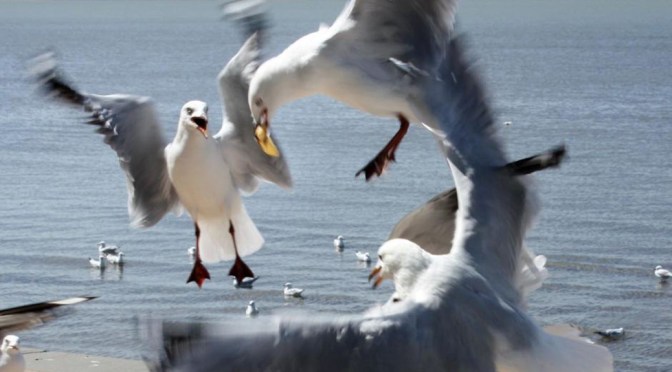
We flocked to it like gulls at a rubbish bin, and since digital technology was able to count the uptake, advertisers followed in an equally frenzied manner, until there were simply more pecks on The Publish Button than there were on all the print floors combined.

Twitter, Facebook and various forms of blogging now fulfill the very strong desire to be ‘published’ and ‘posted’, ‘liked’ and have our status ‘updated’ and ‘shared’.

Now, I’m not saying what we blog/post/tweet about is necessarily rubbish, but the bin is where it’s at peeps, the gulls are just not flocking to the mainstream media, which has been stripped, flogged and hung out to dry, journalistic job security with it.

The companies who made The Publish Button have become the new media moguls. They have no need to invest in ink, paper, print floors, newsagents, transport, and the tens of thousands of people who once staffed the media.

And without us even noticing, they have managed extremely well without journalists. A media which has no need to pay for content is every CEO’s dream.

Content flows freely to them, because The Publish Button is such effective bait.

Its lightning fast distribution is a stimulant like no other to wordsmiths. No barrier to participation, no editors to chase us, no pesky sub-editors to keep us nice, no delay in reaching our audience, and the ability to correct errors instantaneously… if we care about any of that, and there’s no requirement to.

If I StumbleUpon it I can Storify it, and I can say I’ve Reddit. I can Press my Words, I can show my Pinterest, I can Inst a Gram, I can meme like a Tumblr.

It’s all so liberating and wonderful… “Content is King!”, they say, to exhort us into creating great content, but it’s also free, and it’s left journalism with virtually no currency.

The social media’s advertising and subscription revenue, which is placing the corporations behind The Publish Button in stockmarket positions that have Rupert Murdoch worried, is not shared with the content creators of this new world media.

To complain any further about the mainstream media is just like a new government blaming the old: after a while, it just doesn’t hold true anymore.

So, where does journalism stand now the media is flatlining?

ARRESTING JOURNO Margo Kingston under arrest at the Leard Blockade. (Photo: Georgina Woods).

In February, 2014, No Fibs citizen journalist Margo Kingston showed by example what journalists can do with The Publish Button, by relocating to north-west NSW and reporting on the #leardblockade, where a group of activists held back the progress of the Maules Creek Mine.

Margo self-funded her Storify reports, put together by Tony ‘The Geek’ Yegles, which were uploaded onto No Fibs with a regularity that a mainstream news site would be envious of.

Twitter was utilised to distribute these short interviews, news items and reports to a growing audience.

What made it relevant was the depth of engagement, participation, and the provision of opportunities for the subject to contribute to the report.

This is possibly the true meaning of ‘social’ in social media, and it’s possibly what makes very tasty bits for the gulls to peck at.

If The Global Mail had attracted a few gulls to the edge of the bin they might not have reached this point. Their low-level social media engagement may well have been their Achilles heel, or was it their propensity to pay their journalists a decent salary?

I’m not in a position to answer that. What’s clear to me now is that the social media is the only media.

There, I’ve said it. As a journalist, all I have to do is find a way to come to terms with it.

An extract from Write, Regardless!

© Michael Burge, all rights reserved.