All posts by Michael Burge

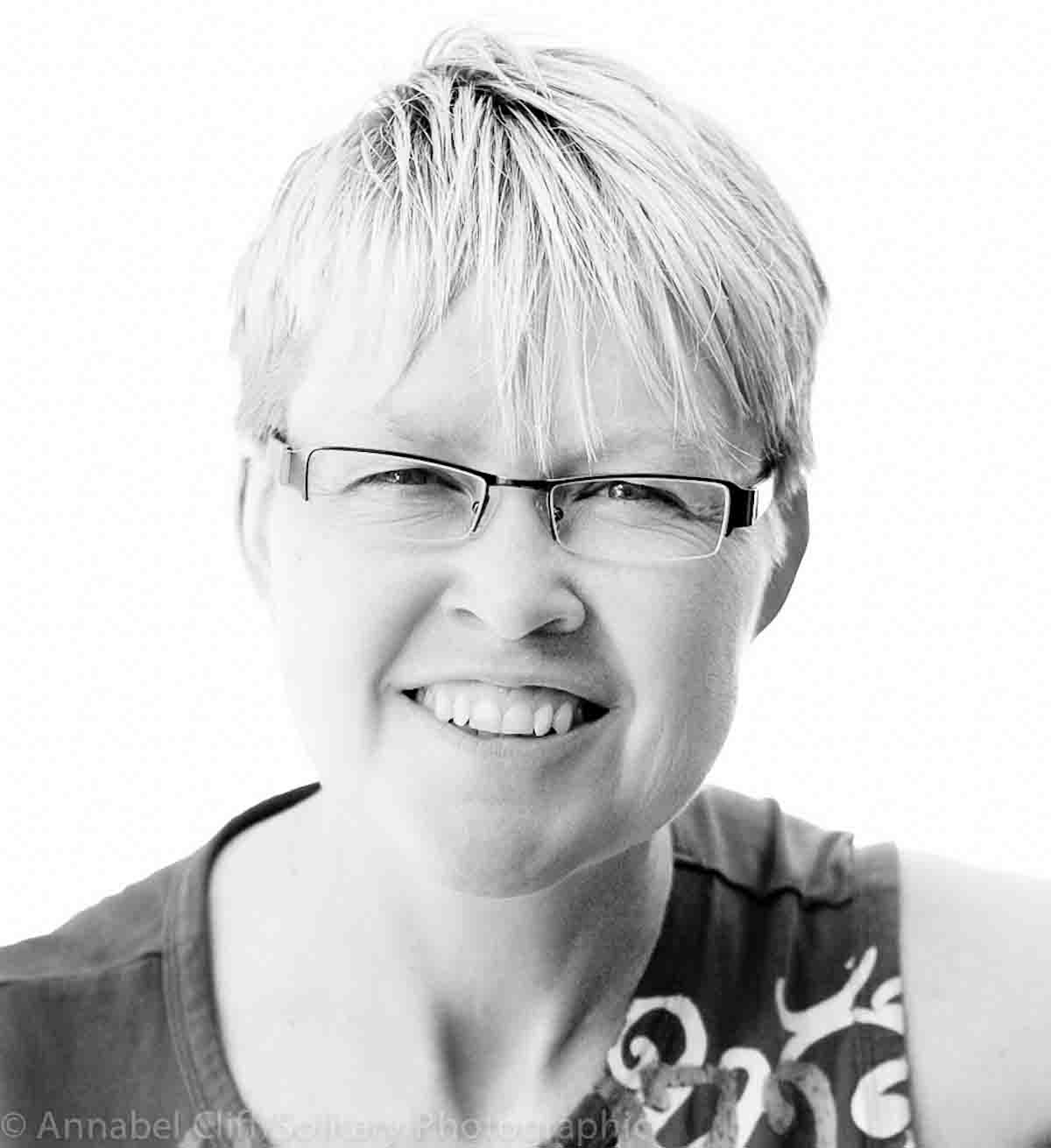
Journalist, author, artist

The truth about writing advertorial

AD OR STORY? Actually, look closer, it's both.
AD OR STORY? Look closer, it’s actually both.

LUCKY is the writer who has never had to turn their hand to advertorial, that postmodern (possibly ‘Newspeak’) phenomenon which fills so much of our media.

Apparently around since the late 1940s, advertorial has a few tricky names: ‘commercial writing’ is the latest on the list, which includes ‘infomercial’ (usually on television) and ‘cash-for-comment’ (the bane of commercial radio).

Writers could, of course, make a purist stand and never engage in creating content off the back of advertising revenue, but you’d probably never make much money if you did, because all writing (yes, even literary fiction) needs to be commercial at some stage.

Here are my best tips for editors and writers on surviving this trickiest of writing practices, and interfacing with the sales team!

Advertorial can get you noticed

Right now, commercial writers are making decent money finding what is interesting about everything from water tanks to washing machines, and producing serious editorial articles for PR companies and big media advertisers. To achieve excellent results, and get your by-line into the publication, make your article about plumbing products so darned engaging that the editor will run it whole in that week’s paper, and make it look like serious journalism. Think laterally, find the story, interview people in the industry, shape it as you normally would a feature, take the money and submit your by-line at the top of the piece. They’ll snap it up, simply because they have one staff writer and they’re drowning just getting the news together.

Don’t mention the weather

Writing about destinations for travel companies, or regional events, means you’re going to have to find the way to say all the nice things and none of the nasty. Weather and climate are particularly off-limits, because advertisers don’t want readers to waver about heading to their locale. Keep the weather conditions a secret until the Bureau of Meteorology commits itself to a forecast, and remember how often they get it wrong! You’re a writer, right? Embellish, imagine and invent.

Journalist, edit thyself!

Your well-paid advertorial is unlikely to be completely read, edited or proofed by anyone, so spell and grammar check (the computer can do it for you, remember?), but don’t forget to read your own work a few times before sending it in. There are very, very few sub-editors left in the media who will commit to making your work better than it is, so get any notions out of your head about old-style newsrooms with teams of people with their heads down poring over your work. Journos used to have an old trick of making the last four to five paragraphs of a story work as possible endings, and this is great practice for commercial writers too, because it’s likely your work will be used as filler, and be cut down. If any of the last five pars works as an ending, you won’t look like an idiot, and if there is a sub in the process, they’ll remember your name, which means more work down the track.

AREN'T THEY GREAT? The sales team, everybody's BFF!
AREN’T THEY GREAT? The sales team, everybody’s BFF!

Sales reps invented advertorial

But they’ve forgotten they are one half of the job. Everyone knows people buy newspapers and magazines, and click-thru to online media sources, because they are desperate to read ads, right? Well, actually, they don’t, they want to be distracted and entertained by stories. It was ever thus, and nothing is changing in that regard, so don’t buy into the sales rep lies about how their sales are paying your wages so you’d better write what they want you to. Truth is, sales reps and their clients love it when you make the dross they produce look like a real article. Get it right for them, but don’t become a sales reps’ slave (see below).

A businesses’ opening hours is not news!

This is a mantra I have often used on sales reps who have sealed an advertising deal with a promise of award-winning journalism about the local chainsaw supplier, written by me. It’s ‘advertorial’, an amalgam of two jobs – theirs and yours – so feel sanctioned to send them packing with a mission to find the story for you: an award won by the business, some interesting staff member, a business milestone. Make the rep work for the favour you’re going to do them and flush it out, write it down, and email it to you. If you do this from day one, the sales reps will respect you, or leave in disgust to find other hapless writers they can drive crazy. Sales reps change jobs regularly. When they leave, it’s not going to be because of you, but they’ll try to make like it was.

Don’t give your phone number to advertisers

Unless you want them to call you all weekend. Sales reps love it when you agree to meet their clients, because it leaves you to do their job for them. Be nice, wave and smile, but let the sales rep do all the schmoozing. There is no law that says you must do lunch with an advertiser. Keep an air of unassailable mystery, or they will eat you for lunch, and add to your workload like crazy.

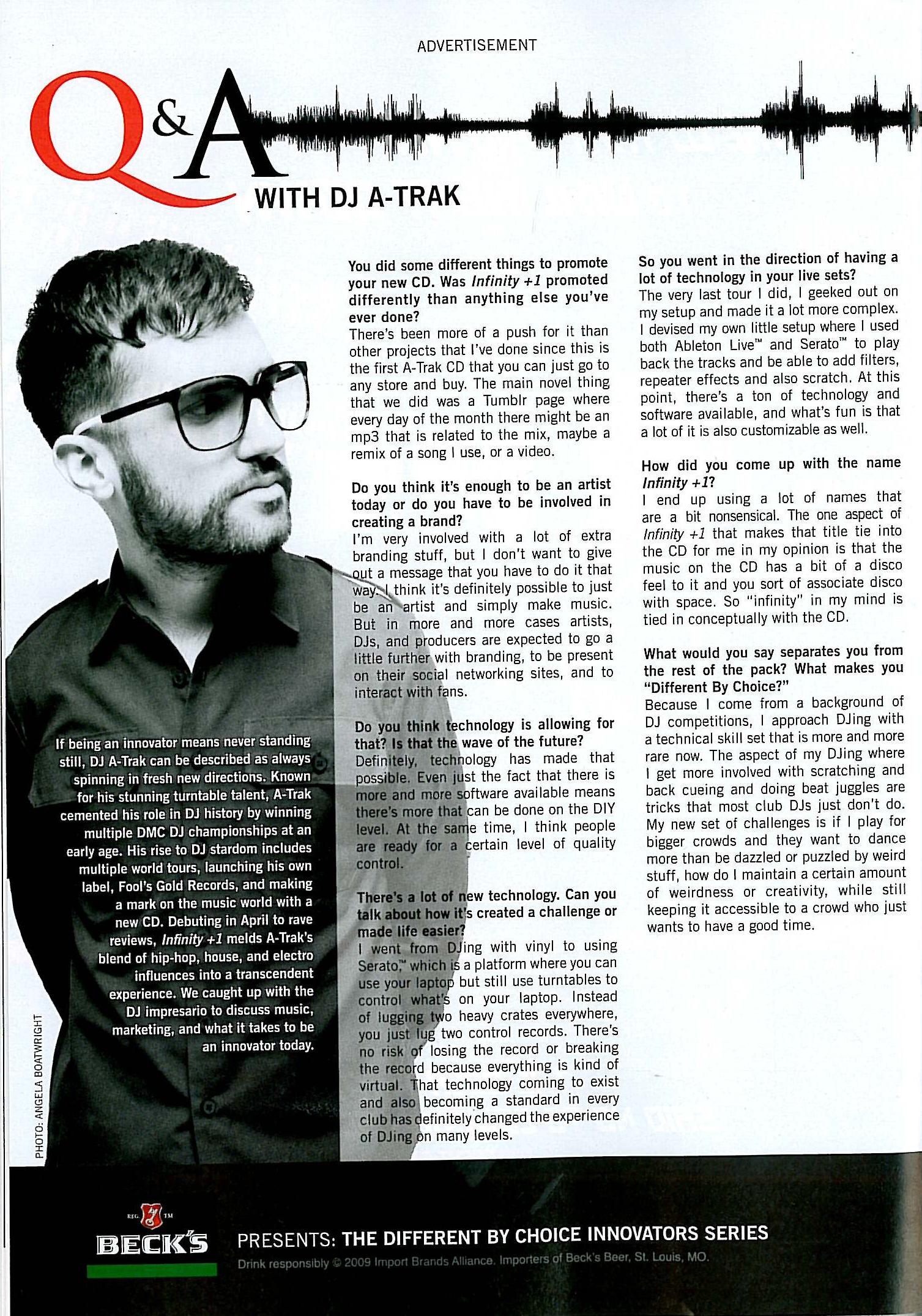
Q&A The friend of all commercial writers. Fast, fab, flattering, and fills a page.

Sales reps vs. account managers

I was once seated next to one of my magazine’s big advertisers at a political fundraiser, and once he’d gotten over the fear of me networking him for revenue, he told me something very interesting about advertising sales people: the good ones call themselves sales reps, and the crap ones call themselves Account Managers (their capitalisation, not mine).

The key words are ‘representative’ and ‘manager’: they must keep their energy on the job of selling from start to finish, but so often an account manager will drop their energy once the client has signed the contract. The only way to deal with this is to NEVER take the baton from them. Let it drop, they’ll soon pick it up to reach their sales target.

Be nice to sales reps

Because the publisher (your boss) won’t judge you by the quality of your writing (they don’t read it), they’ll judge you by how much the sales reps like you. Being ‘nice’ doesn’t mean being a pushover, it means being assertive without getting aggressive. Walk the line, forget being liked, go for respect.

Be nice to PR people

If you want to write commercially, public relations people are your friends. Don’t present with loads of writers’ angst, just deliver in a timely fashion. Knock-off your commercial pieces by 10am so you can get back to your novel. Tell them you’re writing a novel, because they might know someone in publishing …

WRITE REGARDLESSIf you can’t find anything nice to write

Make it up. You’re a writer.

© Michael Burge, all rights reserved.

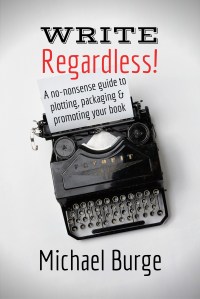
An extract from Write, regardless!

Janet Mays – forging Independence

INDEPENDENT THINKER Former Blue Mountains City Councillor, Janet Mays.

A Writer’s encounter with politics.

THE first political piece I ever wrote was also the first scoop I ever got.

I was a resident of the Blue Mountains for thirty years, give or take my years at university and a six-year stint in the United Kingdom.

By the time Blue Mountains City Councillor Janet Mays stood for the NSW State elections in 2011, I was on the bandwagon of change for an area I loved deeply.

It was time for us to cease being a political football, an electorate that churned-out state and federal backbenchers who shored-up the numbers in parliament but stood for very little locally.

Janet burst onto the region’s political scene with a compassionate assertiveness that started to wake people up, the same way voters seem to have become aware of the two-party power shenanigans in the Victorian federal division of Indi, where Independent Cathy McGowan toppled the sitting member for the LNP, Sophie Mirabella, at the federal election in 2013.

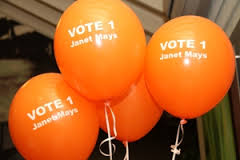
She took a fifth of the primary vote from the major parties, and lost the seat in a State intent on nothing but ridding itself of the ALP, but Janet Mays used orange for her Independent campaign colours when Voice for Indi was just a whisper of frustration. It’s a fitting symbol of her link to the groundswell of Independent thinking rising across Australian electorates.

This feature was published in the October-November 2010 edition of Blue Mountains Life.

ORANGE MOUNTAINS For one Summer, the Blue Mountains toyed with changing colour.

The Long Walk to Independence

From cafés and cars to the footwork of politics, meet Janet Mays.  

Janet Mays knows her way across the Blue Mountains better than most. In November 2009, she led the Health, Equity & Access Lobby (‘HEAL’) on a walk covering the fifty kilometres between Katoomba and Nepean Hospitals. The ‘It’s a Bl**dy Long Way to Nepean Hospital’ walk was designed to throw light on declining hospital services at Katoomba, and HEAL ignited a movement which is taking more than footsteps in the region.

“We were frustrated at the way nothing was shifting. We’d gathered a lot of support around bringing primary health services back to Katoomba, but there was very little action,” Janet says. “No one is demanding the government provide open heart surgery at Katoomba, but it’s not too much to expect basic surgery at your local hospital, like an appendectomy.”

In 2007, Janet experienced first hand a hospital system which was simply not functioning. “As someone who’d lived in the Mountains for a few years, I just assumed I could have my appendix removed locally,” she says. “At Nepean I had to wait twenty-seven hours for primary care on two occasions before they diagnosed the problem was simply appendicitis. It was so traumatising at some level, having to come home and then go back again, like Groundhog Day”.

“I knew intuitively that the removal of my appendix could have been done locally, if the will was there.”

Janet’s search for that will saw her take out a full-page letter in the local newspaper, gathering support from a number of groups and individuals concerned about similar issues. From this, HEAL was born.

“I also spent two years visiting council meetings. I listened to the debates and gained an understanding of how it all worked. This cemented a desire to eventually get onto the Blue Mountains City Council, in order to understand and represent the views of the community.”

In 2008, Janet was elected as an Independent Blue Mountains City Councillor. When asked about her first time in the chamber, she recalls: “It was like being let off a leash as a resident, but also very daunting. I knew I had it in me. I’d been involved in plenty of drama and music as I grew up. Part of being a politician is articulating a message in the same manner as a performer does”.

“It is hard as an independent to get support. You have to be very eloquent in prosecuting your case to the other councillors. When I am going to debate, I research the facts so that I gain an understanding of both sides of an issue.

MOUNTAIN VIEWS Janet Mays awoke an Independent movement in the Blue Mountains.

“Ward One might be my patch,” Janet says, “but I am required to vote on issues across our entire region, so I need to get out there and familiarise myself with the issues. As a true independent I don’t believe I have any choice. I don’t have the luxury of party colleagues informing me of anything, so I need to listen to people up and down the Mountains”.

“I sometimes change my mind on issues when I do the research or consult an expert. Being an independent can get lonely sometimes, but it’s also very exciting.”

Born in Melbourne, Janet was raised and schooled in Canberra.

“It does heighten your political interest,” she says, “at least it did then. My Dad was in the public service, and so were friends’ parents. Politics were discussed around the dinner table every night. That was part of the Canberra culture.”

After running her own café for many years, Janet, “stumbled into a career in and around the automotive industry, spanning twenty-four years.”

Like many other Mountain residents, she and partner Jocelyn Street purchased a Mountains weekender which soon became their permanent home in 2003.

“After a very short time we both realised that Sydney is not that far away, so we said ‘bugger the commute’ and settled here. Commuting is tiring,” Janet adds. “We do it for economic reasons, but it can separate you from your community. I work four days a week in the city and I travel up and down every day, which allows me time for my council work.”

The death of her father a short time before the move seems to have been more of a defining moment than Janet is prepared to reveal. “It left me unsettled as a person,” she says of a period when she and Jocelyn also committed to their de-facto relationship. “We have very similar family backgrounds, with many siblings,” Janet outlines. “We’re both from stable homes, with parents who worked hard”.

“I came out in my late thirties,” Janet adds. “I’d been through a marriage, and I suppose the world had shifted since my strong Catholic upbringing. My parents’ reaction to my sexuality was to say ‘as long as you’re happy’.

“With the support of my partner, I have really come into my own as a human being, and I’ve been able to achieve a lot in many different ways.”

As a Blue Mountains City Councillor, Janet has championed Indigenous access by helping set up the First People’s Advisory Committee. “I am particularly proud of that,” she says. “Council now has a way to be advised by Indigenous people on matters directly relating to them.”

Janet’s support of the creation of an Economic Development Working Party aims to broaden the employment base in the Blue Mountains Government Area. “Fifty-eight percent of working adults are forced to commute,” Janet outlines. “This working party aims to create new industries here, and broaden existing ones.”

And the local health system remains high on Janet’s agenda.

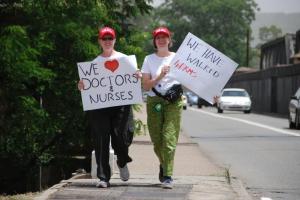
LONG WALK Clr Janet Mays and HEAL Vice President Claire Cook cross the Nepean River at Penrith (Photo: Jocelyn Street).

“Day one was a very hot day,” she recalls of the Bl**dy Long Way to Nepean walk. “We were very blessed with a large gathering of people at the start, and more joined us along the way for one or two legs. We ended the day at the Ori in Springwood … it was the best tasting beer,” she smiles.

“On day two the seven core walkers sped up considerably,” Jocelyn (walk support team leader) remembers. “There was an incredible energy on the day, not just from the walkers, but also passing motorists, who seemed to really love the fact that people were getting out there and doing something for the community.”

“Once we crossed the Nepean River our signs really told our story. There was a recognition from Penrith residents that Nepean is their hospital, and they were saying ‘good on you’ because our aim is to take the pressure off Nepean,” Janet says.

“We know HEAL raised an important issue that day,” Janet underlines, “because we brought Phil Koperberg (ALP State Member for Macquarie at the time) and Jillian Skinner (Opposition Health Spokeswoman) together at one moment to demand a shared response on Katoomba Hospital. It’s the first time that has ever happened. The more we do, even though it annoys the Sydney Western Area Health Service, we are representing community views”.

“It’s an ongoing process to bring further change,” Janet says. “Katoomba is blessed with a dedicated hospital staff, operating at their best in a system which does not value them. They are not permitted to deliver services as they are trained to, yet they remain dedicated. Our hospital staff deserve greater support from all levels of government”.

“The Blue Mountains have not been well served in recent years,” Janet adds, before revealing her intention to run as an independent candidate for the Blue Mountains at the March 2011 state election. “The Blue Mountains is a unique area with its own identity and a fragile environment under pressure from all sides,” Janet says. “How do we ensure our voice is heard?” she asks. “It is time for this community to have a member absolutely focussed on local interests, and not party interests”.

pluck-cover
BUY NOW

“It takes courage,” Janet adds. “Independents are not in opposition. Our role is to work collaboratively with the government of the day, to beat the drum and bang the table for our communities. That is the essence of what it is to be independent.”

© Michael Burge, all rights reserved.

This article appears in Michael’s ebook Pluck: Exploits of the single-minded.

I fought the law

BOB'S WAY Attorney General of NSW until 2007, the Hon. Bob Debus.
BOB’S WAY Attorney-General of NSW until 2007, the Hon. Bob Debus.

A Writer takes on an Attorney-General.

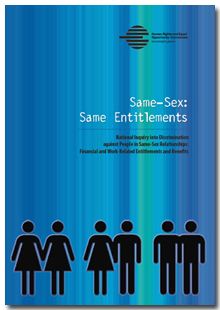
NINETEEN months after the death of my long-term partner Jonathan Rosten, I received an email out of the blue via the Sydney Star Observer, one of Australia’s gay and lesbian news sources.

Weeks before I’d shared my story in an interview with a journalist from that paper, detailing the precarious legal and financial deadlock I had been subjected to by Jono’s family, their denial of our relationship, and their illegal actions which prevented me from accessing his death certificate.

I’d spoken about my experience to warn other gay couples in Australia, particularly in the city I lived in (‘gay friendly’ Sydney), that it was still a political act for two people of the same gender to live together, because they were not afforded the full protection of the law.

The email was from a man whose name I will not write here – we’ll call him Wayne – because what he told me could have gotten him sacked.

He worked within the Registry of Births, Deaths and Marriages, presided over by State Attorney-General, The Hon. Bob Debus.

Wayne’s email was friendly, letting me know he’d read about my experience in the SSO, and wasn’t it great that the laws had recently been relaxed, meaning I could now get a copy of Jono’s death certificate with my name on it?

This was news to me.

I contacted the SSO and got Wayne’s number. He confirmed for me that, yes, working within the Registry, he’d witnessed directives that same-sex spouses were now to be granted access to their deceased partner’s death certificates. He wanted to remain anonymous because there were homophobes in very high positions within the department he worked in.

I rang the Registry, fobbing off the typical bureaucratic nonsense the telephonists engaged in. I already knew nobody but a top shit-kicker could help me, got put through, stated my case, and booked an appointment the next day.

The first thing that shocked me about the NSW Registry of Births, Deaths and Marriages was the level of security. Bouncers, thick glass screens, metal detecting barriers, and an air of protection pervaded the place.

That’s when I realised why I’d had such a tough time with these bastards: they control access to some of the most important life decisions we enter into as citizens, so they expect problems, and they’re in a permanent state of lock-down.

Upstairs, the chief shit-kicker invited me to show him the documentation in my possession: statutory declarations, bank accounts, rental contracts, personal items, Jono’s journal; in all some sixty documents which proved various parts of our relationship.

His eyes widened, and he went to stand, saying he just needed to photocopy the first three. But I didn’t, couldn’t, let him go.

I got extremely angry and emotional at having to wait for this moment much longer than a straight spouse in my position would have had to. In the nineteen months prior I’d been brought to my knees emotionally, financially, and spiritually. I’d survived suicidal thoughts, processed deep shame, lost friends, and had to move far too often because I’d been forced to become a ball of unmanageable humanity by the shortcomings of one family and the internal regulations of this man’s department.

FINDING A PULSE in a homophobe can take some work.

He was not getting away with just copying a few documents, this guy. I already sensed he was trapped between his feelings of homophobia and the new regulations which now required him to treat me equally, a full seven years after the NSW laws had changed.

He managed to squeeze out that he reckoned I had a very good case, and that if a new certificate were to be issued, all the old copies would be recalled for destruction.

Did he need the details of exactly where those fraudulent copies were now?

Yes, he mumbled, shame-faced.

I handed over the names and addresses for him to request the return of the death certificate which had been created for me, long withheld by the funeral director I’d contracted and held in their safe behind a wall of defensiveness and avoidance; and the other at Jono’s family’s disposal, already widely distributed to claim that I, Jono’s surviving spouse, did not exist.

At that, the shit-kicker looked as though he’d shit his pants.

Ironically, it was just a week later, after attending Sydney’s first screening of Brokeback Mountain (the story of two men who could barely come out to one another, let alone live as a couple, the way Jono and I had), that I arrived home to a letter inviting me to collect Jono’s death certificate from the Registry, whenever I was ready.

I could have gotten it from the front desk, but I booked an appointment with the shit-kicker and I made him give it to me, right into my hand.

IN HIS OWN HANDS My friend Prue took this shot of me, Jono's death certificate hot off the press.
IN HIS OWN HANDS My friend Prue took this shot of me, with Jono’s death certificate hot off the press.

There, on the same page, was Jono’s name, and mine, a record of the exact number of years we had been together, and the address we shared on the day he died: the truth which had frightened the homophobes in our lives, finally laid bare in paper form more indelible than any gravestone.

I cried a little, and then I went downstairs to apply for another original of the certificate by filling a form and passing it across the desk with the thick glass screen.

The young woman took the form and immediately shook her head, tapped her finger on my name and Jono’s, and said: “You can’t get this, not when you’re the same gender.”

I was not surprised. I said to her, calmly so as not to set off any security screens or draw the attention of the bouncers, that she was incorrect and needed to ask her manager for some training on this issue. The jaw, that had been munching so enthusiastically on chewing gum, went motionless.

I went upstairs and saw the shit-kicker’s distorted face through the glass as I made the same demand of the managers. Not one of them would come out of their office to meet me.

So I went to the top. I wrote to the NSW Attorney-General, and made a formal request for him to ensure all staff in his department were now made aware, ideally through some kind of training, that same-sex couples were able to apply for their deceased spouses’ death certificates without recourse to anyone.

Perhaps, I suggested, some media releases to the same effect would be an idea?

When his reply was tardy, I went to NSW’s best shit-kicker, Independent MP Clover Moore, who hurried the Honorable Mr. Debus along a little.

We never received more than a staffer’s reply. I guess Attorney-Generals hate to be reminded they need to catch up with the law.

© Michael Burge, all rights reserved.
Michael’s story is published as Questionable Deeds.