


A Writer’s day job leads to an encounter with a legend.
IN late 2008 when I trained as a guide at Jenolan Caves, probably Australia’s best-known cave system, I embarked on a fascinating journey.
Jenolan is a world of its own, with its own folklore, and within the network of caverns resides a collection of intriguing stories.
“I was enveloped in a dreadful skirt that made me look like some disreputable old charwoman.”
For a theatre worker, the task of taking tickets at the door, leading guests on adventures in the dark, retelling stories, playing with light and sound to enhance the experience, in underground chambers of acoustic perfection, often followed by a round of applause, felt like a return to the magic backstage world of a real theatre.
Jenolan guides, when I trained, were given little written material on the history of the place. We needed to glean the legends of the caves from our more experienced peers. I realised very quickly that the men and women who hold Jenolan’s stories were taught the same cycles by their peers, and that I was being given access to a unique oral history with a very immediate link to the past.
The story which intrigued me the most was that of Katie Webb, and her cave exploring sisters, long ago dubbed ‘The Cave Girls’.
This article was published in Blue Mountains Life (Vintage Press) in October-November 2010.

What Katie Did
The Legend of Katie Webb & Jenolan’s female explorers.
Of his visit to Katie’s Bower in Jenolan’s Left Imperial Cave during the 1880s, Samuel Cook wrote: “Descending 14 steps into the Bower there is a fountain full of lime-water, and a plate suitably inscribed conveys the information that Katie’s Bower was discovered on the 7th February, 1881, by Jeremiah Wilson (guide), C. Webb, H. Fulton, C. West, J. Bright, E. Webb, E. T. Webb, J. Thompson, W. H. Webb, E. Bowman, W. Thompson, J. M’Phillamy, R. Thompson, J. Webb, and S. Webb. The before-mentioned gentlemen were the first to enter the Bower after its discovery”.
Despite the placement given to Jeremiah Wilson, persistent legends credit the second name on the list – ‘C.Webb’ – with the discovery of the chamber.
This person was not a ‘before-mentioned gentleman’, but Catherine, or ‘Katie’ Webb.
For the 170 years that Jenolan has attracted tourists, there has been a hunger for guides to interpret their mysteries, and cave discovery tales rank amongst the most retold.
Years of tradition have made Jenolan’s guiding staff into the keepers of the Caves’ stories.
Rebecca Lewis has been a Jenolan guide since 2006, and has collected information about the first woman credited with the discovery of a Jenolan cave.
“This story is all oral history, and it varies depending on who you talk to,” Beck says.
“I believe Katie and her family were visiting the Left Imperial Cave (the original name of the Chifley) with Jeremiah Wilson, who had discovered the cave the year before. The group was admiring the beauty of the Lucinda Cave, named after Jeremiah’s wife. Jeremiah was about to lead the group out, but Katie, about 19 at the time, decreed that she did not wish to return the way they entered. Instead, she wished to continue down a large and steeply sloping passage that none had yet been down. Jeremiah, who was a curious man himself, decided to lower her down the passageway with a rope tied around her waist. With only a candle to light her way as she slid down the passage into the unknown, she found the largest chamber yet to be discovered in that area.”
Katie Webb was not the first female explorer at Jenolan. Thirty years before, legend tells of the caving exploits of Jane Falls.
“Everything we know about her is basically guesswork from piecing together the signatures she left behind in the caves,” Rebecca explains. “It was common practice for the visitors of her time to sign their names on the cave walls to prove they had been there, like leaving our names in a visitors’ book today”.
“The most talked-about signature of Jane is at a place called ‘Signature Rock’ in the Elder Cave (also referred to as ‘The Plughole’).
“The signature reads ‘J Falls 27th December 1854’,” Beck outlines.
“The interesting fact about this particular signature is that she did not sign her name ‘Jane’. She probably did this because she knew it might not remain on the rock if passing visitors realised it was a woman who wrote it. Writing ‘J. Falls’ leaves the assumption that the writer was a male. We know it is Jane’s signature because we have found her name in other caves and we can match dates and handwriting.”
One appearance of a ‘J. Falls’ signature has challenged the discovery of Jenolan’s popular Lucas Cave.
“A signature of hers remains in the original entrance of the Lucas Cave, known as the ‘Sole of the Boot’. It’s been sighted many times over the years, however, every time we mount an expedition to photograph it we cannot relocate it to do so!” Rebecca says.
According to some guides, the signature is dated 1858, predating the established discovery of the Lucas Cave by Nicholas Irwin and George Whiting by two years.
While researching for newspaper reports of the Lucas Cave’s discovery (which might clear up the mystery), Jenolan guide and historical researcher, David Hay, found that the originals in Sydney’s Mitchell Library have disappeared. “It’s almost as though someone pinched them,” he laughs.
Tantalising myths and very little evidence leaves us to explore the possibilities.
“‘The Cave Girls’ is a name that was given to a group of women in an old photo and the name just kind of stuck!” Rebecca explains.
“The thing that we all find interesting is that they are all wearing men’s clothing! We don’t know for certain who any of the women are, but we believe Katie and her sister Selena are amongst them.
“They must have been fairly influential women for their time not only to be wearing men’s clothing in the first place, but to also have a photo taken wearing them.”
Comparison with later photographs suggests Katie and Selena (known as Nellie) are the central figures seated on rocks, with their mother (also Selena) standing at the left.
Katie Webb’s father Edmund Webb accompanied his family to Jenolan on the day of Katie’s discovery – his name and those of Katie’s siblings Selena and Edmund Thomas Webb appeared on the plaque seen by Cook.
Webb was a prominent Bathurst businessman and politician, whose empire included the supply of clothing, footwear and millinery to the Central West. The uniform clothing of the three women at the top of the ‘The Cave Girls’ image might indicate they were supplied by Webb specifically for the purposes of cave exploration.
In her often humorous Letters from Samoa (1891-1895) Margaret Stevenson (mother of writer Robert Louis Stevenson) sheds light on how visiting female tourists were attired at Jenolan.
“We had to take off our good dresses and get the loan of dirty old clothes; Miss B- wore a pyjama suit, and made a very nice boy, but I absolutely declined to go to that length of juvenility. In consequence I was enveloped in a dreadful skirt that made me look like some disreputable old charwoman.”
Described as a “dedicated Wesleyan Methodist”, if Edmund Webb was anything like American Wesleyans, the rights of women would have been firmly entrenched in his family principles, enough for his daughter’s name to be forever linked with her discovery in the way Jane Falls’ may not have been.
The plaque observed by Cook in the 1880s is long gone, but a signature which may be Katie’s remains by the steep entranceway to her bower, reading ‘C. J. Webb’.
In what is now known as ‘Upper Katie’s Bower’, someone wrote ‘Katie’s Bower’ and the date matching the plaque. The original floor level below the writing was lowered in the 1920s to allow for a new exit from the cave. Allowing for this alteration, the writing would originally have been about the right height for a young woman to record her own name and the date of her discovery.
Jenolan guides’ oral histories vary on the approach Katie took from Lucinda’s Cave into the bower which still bears her name, with two possible routes.
One is the steep slope with a very deep chasm at the bottom (now followed by the stairs). The other is a hole below what is known as Lucinda’s Column, which requires a significant abseil.
The two dates recorded allow for the possibility that Katie’s discovery over more than one day’s exploration, and that both passageways were attempted.
And what did Katie do next?
Another name on the original plaque was ‘E’ or Ernest Bowman, the man Katie married just over a year after her discovery of Katie’s Bower. The two lived their married life in the Central West, and as Catherine Bowman, Katie was awarded an MBE in 1924 for “her many years of devoted service to the community”. In 1925 she and her daughter were presented to King George V at Buckingham Palace.
The next time a woman was credited with the discovery of a cave at Jenolan was almost 130 years after Katie.
“Deborah Johnson, a member of the Sydney University Speleological Society, discovered a cave in Jenolan’s Southern Limestone in January 2009,” Rebecca explains.
Within Jenolan’s Guides Office an honour board lists long serving guides back to Jeremiah Wilson. Both men and women are identified only by their first initial (the same as most signatures on cave walls), making it hard to identify the first female guides employed in the 1980s.

“It wasn’t until 2005 that the number of female and male employees reached equilibrium, with female staff undertaking all the same regular duties as male staff,” recalls Domino Houlbrook-Cove, who started as a guide in 1989 and is now manager of corporate, functions and events.
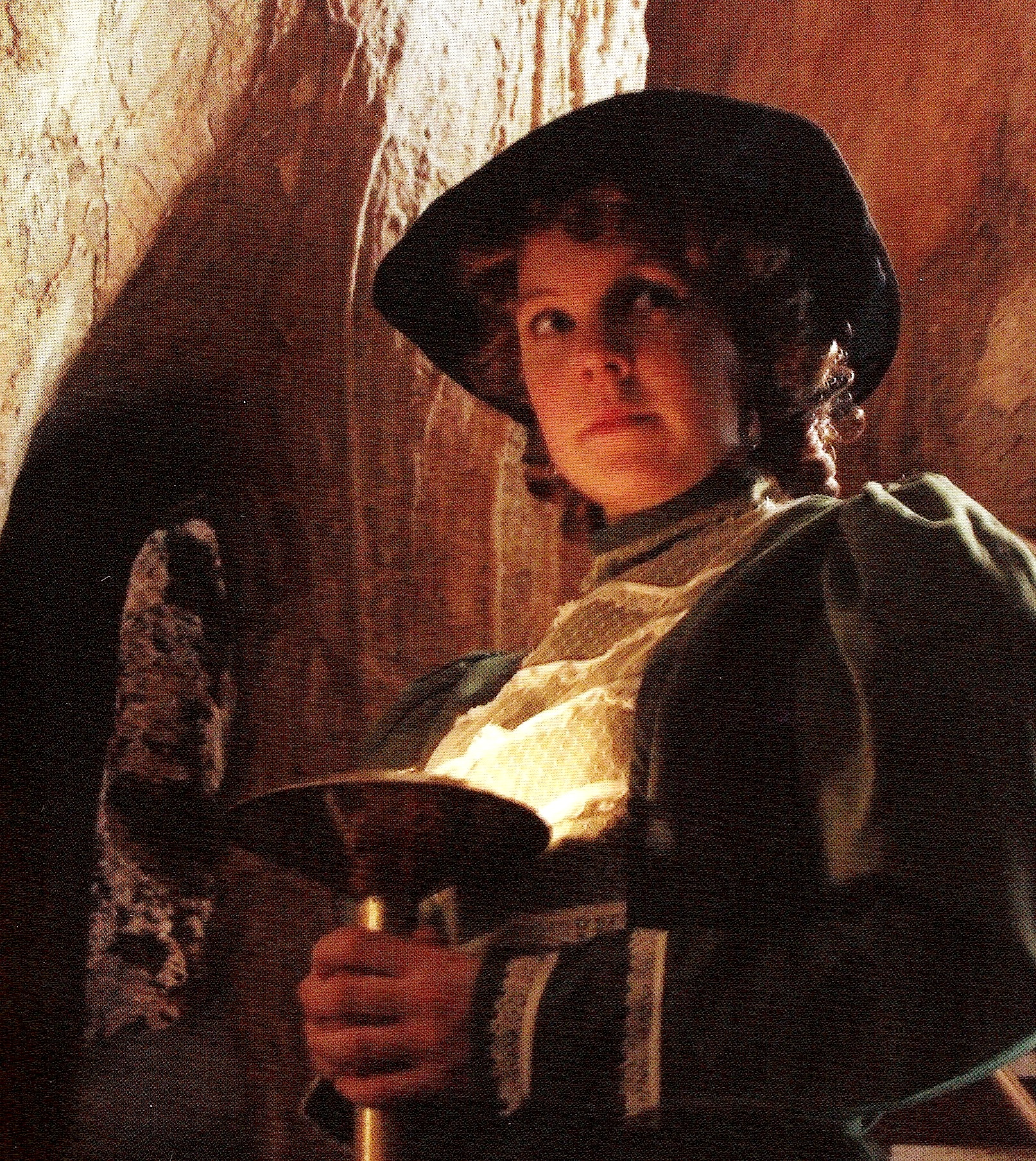
On occasion, visitors to Jenolan can still experience the courage of Katie Webb, played by Rebecca Lewis on a history tour.
“It’s so much fun! I get a great response from people who even today are amazed at what Katie did, especially for her time,” Beck enthuses. “People love stepping back in time to do a tour with someone from that era. I find I get asked more questions about the women cavers when I’m dressed as Katie than what I do when I’m guiding normally”.
“Jenolan has been a great place to work for a number of reasons. Mainly, though, it keeps you on your toes. It’s never like giving a speech where the words are there in front of you, you have to always be ready to answer any question that comes your way. It means you have to hold a huge store of information ranging from geology to history to everyday guiding and maintenance activities. You’re always learning and updating your information as a guide, not to mention ~the physical side of things.
“Of course the Cave Girls, whoever they were, would have all been great cavers, there is no doubt about that! Women make great cavers, and we have proof of that today.”
Thanks to Jenolan guides David Hay (cultural initiatives) and Keith Painter for historical information. Details about Catherine Bowman from ‘Written in Gold: The Story of Gulgong’ by Eileen Maxwell (1978).
© Michael Burge, all rights reserved.
This article appears in Michael’s eBook Pluck: Exploits of the single-minded.




 Michael Burge Media