All posts by Michael Burge

Journalist, author, artist

Jonathan Rosten – spirited dancer

DANCER Jonathan Rosten rehearsing for Song and Dance (Photo: Branco Gaica).
LANGUAGE OF DANCE Jonathan Rosten rehearsing for Song and Dance (Photo: Branco Gaica).

Jonathan Rosten (1960-2004).

JONATHAN Rosten knew how to dance – it was the language he expressed himself best in. His dance career included some magnificent highlights – solo parts for The Australian Ballet Company, and roles in Andrew Lloyd Webber’s Song and Dance (Cameron Mackintosh) and An Evening (Sydney Dance Company).

Jono also made his mark in commercial dance, from variety television appearances, to iconic dance-based commercials, and his various spots in the opening of the NSW Royal Bicentennial Concert.

After 20 years as a dancer, Jono began a new career path when he found himself writing, directing and choreographing his first show – A Really Off Off Broadway Show. Jono’s program notes for this end-of-year student performance at Jester’s Acting School in 1986 describe himself as, “One who has been thrust into directing and is better equipped to handle toasted cheese sandwiches”.

Just why he made this move seemed to be a combination of things – too many hours spent bitching about the quality of productions on offer at the time; a desire to turn his burgeoning ideas into reality; and seeing a now renowned production of an entire musical in a garage in North Sydney, which inspired Jono with it’s ‘Let’s Just Do It’ approach to entertainment.

Once this door was open, Jono spent the next ten years in a showbiz no-man’s-land, taking dance work where it paid well in order to finance his writing. Moving from mainstream to independent theatre also saw him work with and be inspired by some early mavericks, including choreographer John O’Connell on Mr. Cha Cha Says Dance.

An early unproduced work he created was And Then God Created Showbiz!, beginning a tradition of exclamation marks in his show titles. This was a comic exploration of the history of showbiz in a biblical and new age context. Ideas for numbers included The Ten Commandments in the style of The Ziegfeld Follies; a Fonteyn and Nureyev duet with a wheelchair-bound Fonteyn; and a climactic Xanadu-inspired number with Jesus on roller-skates.

Suffice to say the humour was subversive. The vaudevillian line-up of showgirls, drag-queens, biblical characters and historical showbiz luminaries would have made this show highly expensive and a copyright nightmare.

For Jono, it was a fantastic experiment he worked on for a decade, a place where all that seemed ‘unacceptable’ in his world (homosexuality, cross-dressing and new age spirituality) could be placed centre-stage. These were recurring themes in all his work, taken from his own life journey and stories he’d encountered along the way.

It took another ten years before Jono found someone out there like him. At the end of a trip across America, in which he took-in the heights of Broadway, Jono happened upon a small theatre company in Los Angeles holding a retrospective of the collected works of Justin Tanner, a self-made theatre man who created shows like Zombies Attack and Pot Mom. He went to see a new work every night of his stay in LA, and the impression it left on him lasted for the rest of his life.

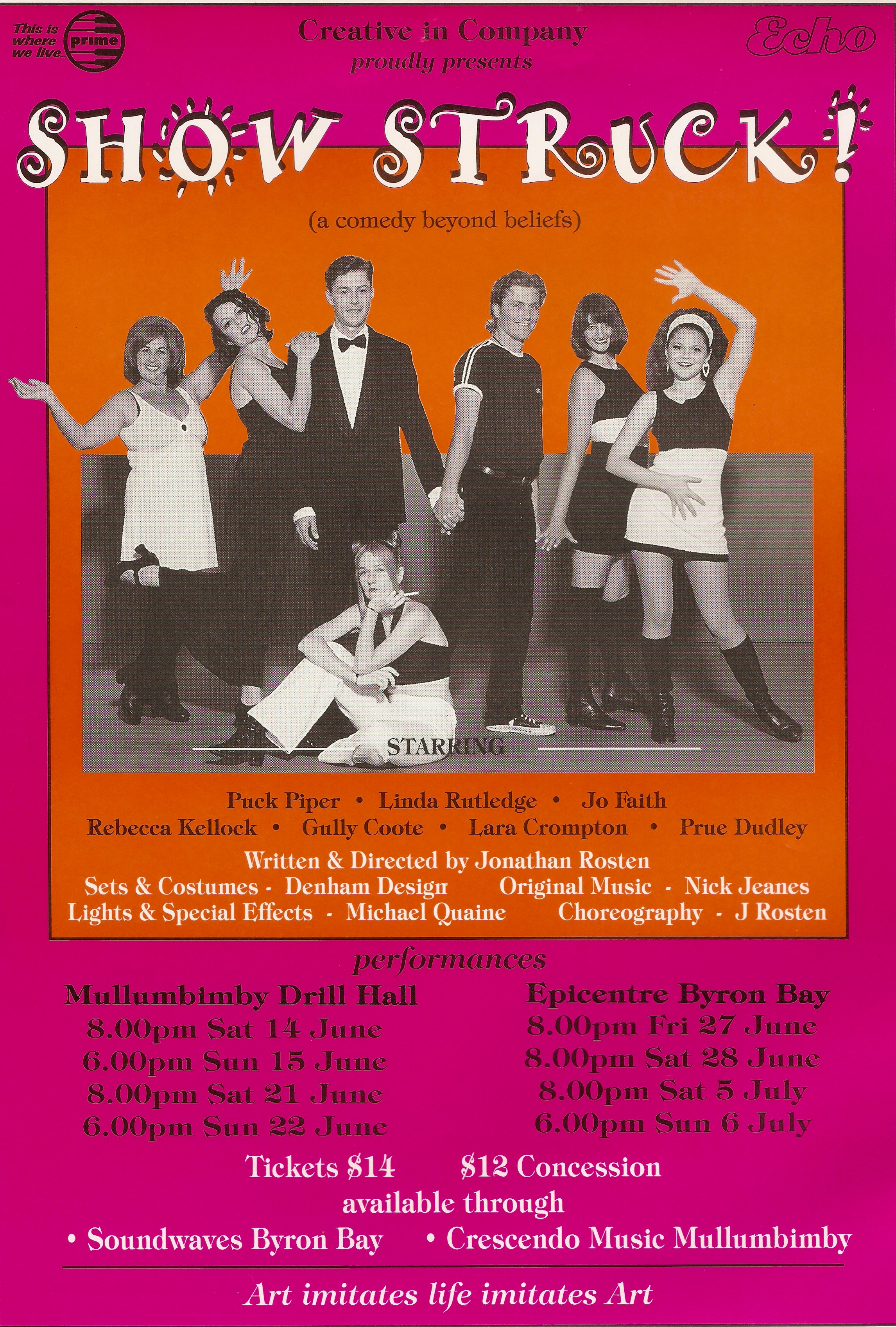
SHOWSTRUCK

He knew he had no time to waste. He knew he could be to Australia what Tanner was for Tinseltown, and shelved a host of stymied and incomplete works, including And Then God Created Showbiz! to embark on an entirely new piece called Show Struck!

Produced in the Northern Rivers area by Jono’s fledging theatre company Creative in Company, this new show was popular with audiences and was well-reviewed.

Jono created a show where the vaudevillian and alternative concepts were well within the context of a strong plot – one man’s journey through contemporary Australian show business, his desire to integrate spiritually in a spiritual vacuum, and to express his sexuality as a gay man. He wrote the show’s lyrics and produced, directed, choreographed and also acted in the show when one of the cast was injured.

Tired of endless touring to regional RSL’s, Daniel, the hero of Show Struck! is in creative limbo with his friend, mentor and bete-noire, Sherri, a showbiz survivor who has nurtured Daniel creatively and spiritually but will not let him flourish in the face of her own failures.

His journey takes him from also feeling like a failure in life, career and love to a state of limitless potential, having exorcised his demons – Sherri, his agent, and creative and sexual guilt within himself. Comically and beautifully, this journey is made in the form of an original show within a show.

One of Jono’s favourite real-life showbiz characters was Ed Wood of Plan 9 From Outer Space and Glen or Glenda fame. In the same spirit of this Hollywood maverick, Jono had big dreams to realise.

LOST SOULS The Lost Brother, Bondi Ballet, 2002.
LOST SOULS The Lost Brother, choreographed by Jonathan Rosten for Bondi Ballet, 2002.

He left Byron Bay for the Blue Mountains in 1999 and found himself in a new creative community where he quickly made his presence felt.

He began working with other maverick producers, like Out of the Blue, a community theatre group who through sheer hard work and self-belief staged the electrifying Australian Premiere of The Who’s Rock Opera Tommy at Parramatta Riverside Theatres in 2003, choreographed by Jono. Bondi Ballet gave Jono the chance to write and choreograph Lost Brother in 2002, a highly personal dance-multimedia work about the drowning death of his older brother Peter.

His dream now was to live close to the city and take original shows into Sydney after out-of-town tryouts in Katoomba. The Clarendon Dinner Theatre was the perfect venue for this plan, having birthed many successful productions over the years, and Jono approached the venue with a new show She Males from Outer Space!

Like all Jono’s shows She Males was purposely derivative. He dubbed it ‘Scooby Doo meets Plan Nine from Outer Space’. A gang of kids lost in the Australian bush encounter two strangely attired women who look like they’re from a science fiction movie, but claim to be collecting minerals at midnight. Before the kids know it they’re trapped in an intergalactic breeding program when one of them – Anne, a devout Brethren girl – is kidnapped. The gang must get her back and face their own shortcomings and lack-of-acceptance in the process.

SHE MALES

This show made it to Sydney in February 2004 as part of the Mardi Gras Cultural Festival, and had a 4-week season at The Edge Theatre in Newtown.

Jono injected this classic story of opposites with some of his best choreography. There were cheerleading sequences, mesmerising alien dance-moves and a continual comic through-line involving movement and lines inspired by old movies and television.

Deep in the plot was another of Jono’s appeals for acceptance when the hermaphrodite alien she-males explain to the younger gang that they are “Perfectly balanced in our male and female parts”, a beautiful piece of writing which challenges the gang (and us) to accept themselves, each other, and ultimately Anne’s alien she-male baby who was born during the curtain call.

Jono had succeeded in a long-held ambition to carry a weighty political message with a light comic touch, and reviewers and audiences responded. He had also discovered where his greatest talent lay – in storytelling using movement, dance and comic juxtaposition.

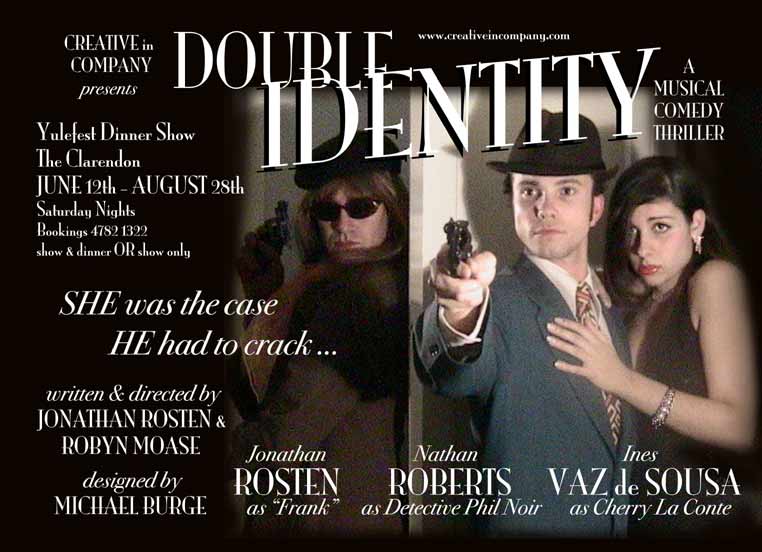
The Clarendon immediately asked for another show and Jono responded with his last unproduced show Double Identity (strangely there was no exclamation mark in this one). This show was again highly derivative, taking the film noir world and turning it on its head.

Inspired by audience reactions to the comic dance and movement styles in She Males, Jono created a series of dance/movement numbers and then built a plot around these. He also planned to return to the stage in a number of small crazy parts, including Frank the club owner who cross-dresses.

To date this show has had one performance only, two days before Jono died suddenly in rehearsal. Harking back to the garage-show in the 1980s, this performance was in the studio at the back of our home. I was the only member of the audience and the young leads – Nathan Roberts and Ines Vas De Sousa, were obviously going to be fantastic in the run. Jono was in there too – I had rarely seen him perform, and he sparkled with a glint in his eye, even when things went wrong and they had to do numbers from the top.

The man who started out as Buckingham in The Australian Ballet’s Three Musketeers, who danced for the Prince and Princess of Wales at Australia’s Bicentenary, who was The Milka Boy in the Swiss Alps with purple cows, was now integrating again in his newest incarnation as a singer-dancer-actor-writer-choreographer-director-producer.

Little did he or we know that the integration was so complete that only 48 hours later he would make the ultimate transition into death.

POSTER_email

Double Identity did not have its 3-month season at The Clarendon.

I can imagine Jono changing the name of this production to The Show Must Not Go On! (and scoring an exclamation!) because showbiz seems all too superficial without him.

Reality of his absence has kicked-in and Creative in Company has dissipated with the understandable shock.

The irony is that while his company was called ‘Creative in Company’ it really was just Jono instigating the work and driving it forwards, like Daniel in Show Struck!, helped and supported by a lot of talented people, but it was always Jono driving the bus.

“Don’t worry about being famous,” was one of the last things he ever said to me, in a way which told me he had once cared about fame, but had certainly let go of it and become much happier as a result.

I knew then why I loved him so much, and will never forget my years in the presence of this cheeky showbiz original who achieved his life’s ambition to understand himself, well out of the spotlight.

For this I am sure he would be happy to be remembered in the AussieTheatre.com Hall of Fame.

Published by AussieTheatre.com in 2004.

How to write excellent articles

TypeKeysFilledTHERE has never been a time when writers have more opportunity to put work in front of an audience hungry for information and entertainment. Publishing has become a simple matter of processing words and clicking a button. Nevertheless, I am passionate about keeping writing standards high.

Here’s some of what I have learnt about writing and editing features for the past ten years, some of them even published on paper!

Get to the point

Readers are fast and fickle. Good articles pose a question very quickly and get straight to the job of answering it. Even an essay on a complex subject matter will benefit from getting to the point nice and early. Readers can click away as fast as they found you. Engage from word one.

Add to the public record

One of the hallmarks of good journalism used to be standing on the shoulders of the giants who came before us. While the giants may now be in short supply, there’s no excuse for rehashing existing media. It’s a form of plagiarism, really. Reference what has come before, sure, but adding to the story will impress readers who know more about your subject than you do.

Let the reader connect  

Readers love to feel smarter than writers. While you may be able to construe every well-honed argument on your subject, your reader may feel bludgeoned by your intelligence unless you give them something to use their brains on. TV quiz shows always give viewers more time to answer the questions than the contestants. It makes the audience feel smart, and keeps them tuning in. Leave a few loose threads for your readers to connect.

Watch out for your writing patterns

While they usually serve us well, often our unique writing patterns suppress great subject matter with an overbearing style. Throw yourself off sometimes. Make your third paragraph your first, and see what happens.

Keep it simple

Feature writing is not fiction. Keep the adjectives at bay and don’t set the scene too much. You’ll generally be writing about someone else’s truth, not your own, so keep the language less flowery and more factual.

Stick to the facts

In Australia, the Media Entertainment and Arts Alliance (MEAA) has a handy code of ethics some journos have been following as long as others have been ignoring it. It’s just about establishing the truth, truthfully. If your work ever gets picked up by media outlets, and you haven’t fact-checked it already, it, and you, are likely to get dropped like a hot potato. Commenters will rip you apart.

There’s always an angle you just cannot take

Almost every story I have covered has revealed a really interesting angle, what I’d call the ‘real story’, but, for various reasons (usually linked to advertising) cannot be published for fear of offending someone. People are fascinating, we have endless layers of secrets and lies, but if you’re only there to do a write up on their garden (because the sales reps owe them a favour, and you got the unenviable task), you’re hardly going to reveal the reason the garden is so amazing is because it was built on abundant political kick-backs. Stick to the tulips, take the money, and save your award-winning efforts for another time.

Don’t surprise your interviewees

Send them a transcript of what they said, if not a late edit of the whole piece, before publishing and/or submitting, with an invitation for them to amend anything inaccurate but nothing stylistic by a certain deadline. If they don’t get back to you, no problem, you have a paper trail showing they had their chance. Keep all your notes and recordings long after publication. Even the threat of litigation can be hurtful, worrying and expensive for writers.

FAITHFULL INTERVIEW Marianne Faithful playes second fiddle to journalist Lynn Barber in an interview (Photo: Reuters)
FAITHFULL INTERVIEW Marianne Faithful played second fiddle to journalist Lynn Barber in an interview (Photo: Reuters)

Should I be in the story?

The first piece I read in which the journo was the star was Lynn Barber’s profile on singer Marianne Faithfull. Faithfull behaved so badly in Barber’s eyes that the journalist made the first half of the profile about being kept waiting, and filled the second half with catty observations about failed celebrity. Yes, we now live in a world where so much of the media is ‘all about me’, but I believe it’s wise to walk the fine line between these two extremes, and think of the reader first. Unless we’re integral to the story, it’s probable the reader will be more interested in the subject than us. Barber won a British Press Award for that interview, but she has since received death threats, embargoes by other celebrities, and the publisher of one of her later interviews lost a 65,000-pound libel case for malicious falsehood. Putting yourself in an article has consequences, but Barber has often cited her Faithfull interview as a career highlight, so some outcomes can be career-building for journalists. Perhaps wait until you, and you employer, can afford a lawyer.

Stick to the word length

Even if you’re not writing for an editor, have a look at how many words constitutes a good article: they’re rarely over 800 words, and that’s diminishing each year. If an editor requests 800-1000 words, don’t submit 1250, saying, “I didn’t know where to cut”, because it’s annoying, lazy, and likely to see you overlooked for future work.

Read your own work

WRITE REGARDLESSMaybe you’re publishing on your own site. Maybe you’re writing for an editor. Whatever the case, read, read, and read your work. Chances are you’re the only editor your article will ever have. Make it accurate, grammatically correct, and spell-check. Think of your predecessors who never had the benefits of dynamic spelling!

© Michael Burge, all rights reserved.

An extract from Write, Regardless!

Margaret Betts – tree planter

SHE-OAK Hawkesbury cattle farmer Margaret Betts (Photo
SHE-OAK Hawkesbury cattle farmer Margaret Betts (Hawkesbury Gazette).

A Writer’s encounter with a rural rebel

MY two decades of research on the descendants of Mary Pitt eventually led me to the Hawkesbury Valley, where many of Australia’s first settlers were granted land for the purposes of contributing to the survival of the fledgling colony by farming.

With their indelible link to their benefactor Lord Nelson, the two Pitt family farms were named, at different times, ‘Nelson’ and ‘Trafalgar’, in the wake of Nelson’s great 1805 maritime victory at the Battle of Trafalgar.

Finding these original land grants took time.

Nelson Farm had gone by another name for many years, but, as I was to discover, it was still under the stewardship of an indefatigable woman. This feature was published in Blue Mountains Life in June-July 2010.

Out on a Limb

How Margaret Betts reforested an original Hawkesbury farm

On Nelson Farm near Agnes Banks stands a house known as Bronte, with uninterrupted views of the Blue Mountains.

Even before this region became the cradle of modern Australian agriculture, the fertile river flats yielded food for generations of Aboriginal people.

The house is positioned on an 1802 hundred-acre grant of land to Thomas Pitt. Originally called Nelson Farm, the property was amalgamated with adjacent land granted to Thomas’ mother Mary Pitt and renamed Bronte.

This name remembers British naval hero (and Mary’s benefactor) Lord Horatio Nelson, first Duke of Bronte.

022-cropped1
HAWKESBURY HOUSE Bronte on Nelson Farm (Photo: Mary Matcham Pitt family history website).

Mary Pitt’s land grant was eventually sold off, although Bronte remained in the family until 1919.

The impressive mid-Victorian building is not the original, but from Castlereagh Road, the giveaway stands of hoop pine (Araucaria cunninghamii) and bunya trees (Araucaria bidwillii) reveal traces of the original settlers’ use of the land.

Many Hawkesbury heritage properties are open to the public or have become public places, but Bronte on Nelson Farm has always been in private hands, and a working farm since 1802.

The current owner, Margaret Betts, has lived there since 1998, and her parents William and Mary farmed the land since 1955.

“Dad did the hard work and Mum did the reading,” Margaret says, recalling her parents’ years as dairy farmers at Bronte. “They were both from logging country, so they were both what you’d call ‘old school’ farmers,” Margaret relates. “Trees, to them, were just something that sapped-up the goodness out of the soil.”

Mary Betts’ wariness about trees on dairy country became particularly pertinent in 1998, when an enormous oak tree came down in the westerly wind the night after she died, an event which made the local news.

Margaret recalls many such nights taking their toll on the few trees left on the property, and she realised “that if we didn’t do something about it, there’d be nothing left.”

Margaret knew the farm’s history, including the years when her father leased acreage to vegetable farmers with a strict stipulation to leave the stands of Casuarina running down the spine of the property towards the river. “They killed the lot,” Margaret remembers, “and they were original trees on the property.”

For someone who spent her career teaching music and in school administration, continuing her parents’ work at Bronte seems like a totally new angle for Margaret, but I get the feeling she sees farming as something in her genes, and that common sense counts for more than experience.

Margaret had a plan to develop beef production at Bronte, with very different needs to dairy farming, and certainly requiring a lot more shade than vegetable fields provided.

“I could have counted the remaining trees on one hand,” she recalls, “and I needed to do my research,” Margaret stresses.

“This region is part of the Cumberland Plain, in terms of its vegetation. If I was going to plant a large amount of trees I needed to know they were going to be viable.

BUNYA PINE Araucaria bidwillii (Photo: Bidgee)

“We’ve had hoop pine and bunya growing here for well over a hundred years. The settlers planted those, and even though they’re not native to this region, they’ve done well.

“At one stage the bunyas at Bronte were described as the largest stand in the western suburbs, but they’ve very much diminished in recent decades.

“I propagated seedlings from ours and they came up no problem.

“Hoop pines need shelter to get established, but the bunya trees just take off. There were also a few Kurrajong trees (Brachychiton populneus), and quite a few local gum trees which I assumed would do well.”

“But I also remembered the Casuarinas, which are local,” Margaret says. “In my research I found they were one of the only trees which soak up pesticides.”

With high use of pesticides on all sides of her property, Margaret had stumbled on a natural solution to an age-old problem.

The planting of trees did nothing for relations with her neighbours, particularly the vegetable farmers. “They thought I was destroying good farming land,” Margaret says, “so I got a lot of abuse. I still do, only last week one of them was shouting at me over the fence. I just wave back,” she laughs.

“I taught many of them, so they know what I’m like,” she hastens to add, illustrating how her resolve to reforest Bronte has never wavered.

After failed attempts to establish Landcare groups in the area, Margaret realised that if she was going to succeed then she needed to take action on her own. She also discovered that the tree problem was not just apparent above ground – the local water table was severely degraded.

After generations of development, the original reservoirs and lagoons of the Agnes Banks region had become choked with weeds (including water hyacinth and alligator weed), and polluted with litter and sewerage.

Insufficient drainage and water retention from nearby farms meant the water supply for Bronte was contaminated, and that affected Margaret’s cattle with outbreaks of salmonella.

The water problem only seemed to sharpen Margaret’s resolve. “At one stage I was planting around thirty trees a day, I must’ve planted thousands of them over twelve years,” she recalls.

“If you looked out here in 1998,” she says, throwing an arm out to the vista above the nearby Hawkesbury River and distant Yarramundi Lane, which is her western border, “there were only these trees close to the house and little else.”

Now, in a great green belt below Bronte is a reforested barrier of green, mainly Casuarina (river she oak, and swamp she oak), looking more like the glimpses of natural bush at the foot of the Mountains across the river. Twelve years seems like barely enough time for this result.

“The cows love the shade, they’re up here under the trees by seven o’clock on a hot day. The trees have also brought the birds back,” Margaret adds, which surely must annoy the vegetable farmers, I suggest.

“Birds are a natural pesticide,” Margaret replies.

“The water table has been improved so much with those trees,” she indicates, and indeed there are shallow lakes at intervals along the lowest points of the property.

“It’s made me more conscious of water,” Margaret says, “but we need clean water,” she adds, explaining that drainage problems caused by the use of poultry litter as fertiliser on higher-set nearby farms, combined with ineffective Council drainage along the road, contributes to the continual pollution of Bronte’s water table.

The solution was to drill a bore. “Dad was an excellent water diviner,” Margaret recalls. “He found the old wells on the property that way,” illustrating how Bronte’s past has once again become a part of its future.

The Department of Environment and Climate Change Cumberland Plain Recovery Plan draft document of November 2009 suggests private land holders like Margaret are on the right track: “Conservation of the rich biodiversity of the Cumberland Plain in western Sydney is one of the most challenging issues facing natural resources management in New South Wales,” the introduction states.

“Extensive loss and fragmentation of vegetation has occurred, land values are high, and competing land uses are placing extraordinary pressures on the remaining areas of bushland in the region.”

“You’ve really got to take care of your patch, and keep at it,” Margaret says. “I won’t see most of what I’ve planted come to anything, but others will,” she adds, indicating the hoop pine saplings she propagated and planted, trees which will stand long after their parents have fallen.

© Michael Burge, all rights reserved.

This article appears in Michael’s eBook Pluck: Exploits of the single-minded