JOURNALIST James Brandt lives in a brittle truce with his partner Dylan and his family, never talking about the homophobic attacks he exposed in his rural hometown, including the brutal death of a beloved cousin twenty years ago.
But this illusion of peace is ripped apart by the start of the state’s historical gay-hate crime inquiry, and the reappearance of the Joneses, who waltz back into Kippen professing to be queer allies. Yet when one of that notorious dynasty is found dead at a local water tower, it is James who stands accused.
With an under-resourced sergeant and a tech-savvy podcaster on his heels, James refuses to trust in a police force that has proven its inadequacy with gay-hate crime. In order to clear his name and flush out which member of this remote community took justice into their own hands, he will need to expose every secret, including his own.
The gripping and heartbreaking sequel from the author of Tank Water.
Daniel knew his own name but not much else. Somehow, he’d ended up leaning against the top gate, out of the heat with the butcher birds. Their chatter in the trees above his head made the view of the old homestead down the hill seem much less lonely.
That must be home. While he waited until he was sure, Daniel pulled out a hanky and dabbed the sore spot on his forehead where he must have hit the ground after he blacked out, but there wasn’t much blood on the white cloth with the soil and bits of wheat stubble.
‘You’re a duffer,’ he muttered, Father’s turn of phrase coming back to him.
He didn’t know what day it was yet, but Daniel had walked this stretch between Bill’s place and home a thousand times. His brother’s property was called Deloraine, and home, down the hill, was The Mulgas. A bit closer to the head of Brandt Lane was Glen Alpine, where Father and Mother lived. As little boys, the Brandt brothers had been drilled on the location of the three homesteads down the one lane, just in case they ever got lost.
But what was Bill doing leaving the wheat stubble when it should be burned off?
Something red was catching the sunlight from one of the furrows. Rubbish blowing in from Bill’s shed, no doubt, so Daniel followed his own bootprints back into the heat to fetch it. Through the dusty haze, the sight of his brother’s place worried him. The cars between the house and the sheds were all wrong. Where was Bill’s old Ford? And whose was that expensive looking petrol guzzler parked by Deloraine’s home yard gate?
Daniel nearly stumbled again when it all came back.
He was old. Older than Father ever got to; and Bill was long gone.
Shit. It was Christmas, and his brother’s widow Doris had spent the whole of lunch suffering in silence because she’d been turfed out to live in the manager’s cottage while her daughter Yvonne did all the cooking. Brandt family get togethers weren’t like the old days when all the kids were happy. Yvonne and her husband Pete were pushing fifty and Daniel’s middle boy Jamie was even older, sitting there with his husband, mouths full of vegetarian muck while Jamie carried on about that dead poofter inquiry coming up in Sydney, trying to get someone to watch it with him on the internet.
The only young ones were Yvonne’s two girls, dragged home for the holidays so everyone could pester them about what they were up to in the big city. They’d gawped at their phones while their mother and grandmother gave the men the silent treatment, not one of them prepared to talk about Tony, their dead son, brother and uncle. So Jamie had offered to drive Daniel home in that fancy European car still taking up space on Deloraine’s driveway, but he’d had enough of his middle boy’s drama for one day.
The red rubbish in the wheat stubble was his bag of gifts, and now he remembered slipping a beer into it before heading home. He just needed a bit of fizz under all the gravy and pudding in his guts, then he’d come good.
But the bottle was empty, as though someone had pilfered his presents while Daniel had lain there, out cold. He glanced up and down the parched field, trying to spot whoever it was in the scrub while he patted his pockets looking for his old police notebook. When he came up with nothing, he panicked, tipped the whole lot out and saw the dark little book drop onto the black soil with the new socks and hankies.
Relieved, Daniel shoved everything back in. ‘There’s no one watching, you old fool,’ he muttered, scanning the shadows stretching across the wheat stubble, half expecting Father had walked down from Glen Alpine to criticise all these crooked furrows.
Yvonne’s husband was too cowardly to torch the straw like everyone used to, but Pete wasn’t a Brandt, he’d only married one and been handed Deloraine’s five thousand acres on a plate. What the place needed was Tony. The Brandt farms had a future when Daniel’s fine young nephew had walked the best cleared black soil for a hundred miles, pulling in the cheekiest crops in the district and marrying the prettiest bird, all right here down Brandt Lane. But Tony had been put in the family plot years before his father and anyway there was no point wishing.
By the time he was back at his top gate, Daniel could see traces of cloud drawing in from the south. That could mean a storm, so he stumbled down the driveway to get ready.
The big iron tank that once stood against the homestead was always cool to the touch when there was water inside, but this modern plastic replacement needed drumming to tell how much was left. Habit made Daniel slap a hand on the side, one ear against it to hear the hollow boom. If the top inlet was blocked by even the slightest bit of muck the rain would just bounce out, so he threw the bag of pointless presents into the long grass, ignored the pain in his belly as he hoisted up a ladder and took to the rungs.
The view from the top made him pause. Always the golden fucking light on granite-covered slopes, beautiful until a long wait for rain made it a harsh, dry joke. Daniel turned away and flopped his trunk onto the faded plastic top of the tank, scattering the butcher birds up the driveway. A few of them swooped overhead, took to the peak of the roof, then turn their heads to stare as he stretched one hand towards the tank hole.
The end of his fingers brushed something, so he shoved his body forwards, frustrated at the weakness of his arms after twenty years’ retirement. This bloody inquiry wasn’t helping. The best police work was always achieved on the quiet, and the last thing Daniel needed was the whole country seeing his mistakes in Tony’s case. Once they got out, Jamie, the one journalist in a family of farmers, would lead the charge against his own father all over again.
‘The trouble with you journos is you just don’t trust experienced investigators,’ Daniel said, aiming his lecture at the closest bird as though it were his son.
Just like Jamie, it fluffed its feathers and croaked out some back chat.
‘Smart arse,’ Daniel said, even though Jamie had been proven right about the police turning a blind eye to Kippen’s dead gays. Daniel had witnessed all three broken bodies in his time on the force, and he’d never get over his nephew Tony being one of them.
He groaned and stretched one hand into the tank hole, getting wrist-deep in muck. But Daniel’s secret weapon was the old tin dirt trap he’d pulled out of the family rubbish dump in the gully down the hill. Round and deep like Mother’s trifle dish, its rim sat proud of the surface and dipped down to a thousand nail holes that worked better than any modern sieve. Daniel’s fingernails found them now, remembering how Father had made him punch out every one with an iron tack, back when sons stuck around. Not like Daniel’s three, one long dead, one lost to the city and Jamie living up the road with Dylan, making house at Father and Mother’s old place.
A dead something came out with the first scrape, drowned bird or crispy frog. He threw it upwards and it spattered across the roof irons before the birds dived for it.
Daniel sat up and saw Tony down below, leaning against a verandah post. He laughed when he realised it wasn’t his dead nephew, just some other hairy head in the golden fucking light. ‘Thought you were someone else,’ he said, turning his back.
But he spun too fast. Grabbing for the ladder, the muck on his hand made it slip and hit the top of the tank, the rumble spooking the birds.
‘Hold this thing for me, mate?’ Daniel added over his shoulder.
The unexpected visitor lifted one boot onto the bottom rung and looked up.
Daniel couldn’t believe his eyes, because this was the bloke he’d been searching for.
‘Didn’t think I’d see you so soon,’ he said, chuckling because his knack of flushing out murder suspects was still spot on, even after those twenty years off the force. ‘I’ll get us a beer, then you can tell me why you hung up on me last week.’
But the boot swung, and a heavy jolt sent the ladder out from underneath him.
A cry burst out of Daniel’s gob. His arms flapped but he dropped too fast to do anything about going off headfirst. The crunch of landing winded him, like falling under the scrum in footy, then all he saw were birds squawking off into the golden fucking light.
The second stop in a series of literary excursions examines how one of the world oldest cave systems inspired a crime novel…
THE WAY TO Jenolan Caves within the Blue Mountains National Park of New South Wales has always been long and winding. The Burra Burra clan group of the Gundungurra nation, the region’s Indigenous custodians, tell a Dreamtime story of ancient spirits journeying there via the waterways and valleys. European settlers descended the steep ridges on foot and horseback from the 1830s, and visitors have traversed a variety of precarious access roads ever since.
The approach gives you plenty of time to cast off the everyday world. As a casual tour guide between 2008 and 2012, I used the inspiring commute to ponder the extensive stories of the place.
Like many trainees before me, I’d gleaned the local tales from my more experienced peers. It didn’t take long to realise that the job had granted me rare access to a unique oral history, although my journalistic experience told me it was a paradoxically flawed mish-mash based on limited primary evidence.
Almost instantly I felt there was a novel in this massive well of storytelling, and to find it I eventually decided to cut through Jenolan’s tourist tales to recreate a time when the caves sat on the edge of the colonial frontier. A place that settlers viewed with suspicion, not wonder, very often through a lens of faith.
What drove me were the stories few wanted to talk about, particularly First Nations peoples’ connection to the region; the cattle farmers who gradually occupied the same countryside; the Wesleyan Methodist community of the nearby region once known as Fish River Creek, now Oberon, and the role of women in early cave exploration.
Crime was never far from the colonial experience. The massacres and random killings of Aboriginal people and reprisals against settlers are now referred to as the Frontier Wars. The occupation of the land was not possible without the importation of convicts to build roads and towns, a mounted police force to impose British law, and Christian missionaries to uphold ethical standards.
Long before I embarked on a first draft, I interviewed Gundungurra elder Aunty Sharyn Halls at Echo Point in Katoomba, listening to her share knowledge about the pathways and waterways used by her ancestors between the Oberon region and the Southern Highlands. It helped me to understand how different the approaches to the caves were in the 19th century, and that new perspective encouraged me to question everything we think we know about Jenolan.
Errors and Conundrums
Jenolan’s oral tradition tells stories of two early female explorers. The more recent was Catherine (‘Katie’) Webb (1861-1941), daughter of a local businessman and visitor to Jenolan in its Victorian heyday.
Women visiting Jenolan in the 1800s.
Katie’s 1881 discovery of the chamber that bears her name in the Chifley Cave took place at a time when women were regularly photographed in caving attire. But another woman whose exploration pre-dated Katie’s by two decades hangs barely visible in the Stygian gloom.
I first heard about Jane Falls while on a training tour of the Lucas Cave. She sometimes rates a mention when Jenolan guides interpret the soaring Cathedral Chamber into which the first European explorers stumbled in January 1860. Some will tell you she assisted in that expedition, while others credit her with the discovery at an earlier date.
A person known as ‘J. Falls’ was mentioned in the letter written by George Whiting to the Bathurst Free Press and Mining Journal about that expedition. This could be Irish emigrant and Oberon resident Jane Falls (1829-1911), or her mother Jane Falls née Nelson (1802-1893). It could also be Jane’s brother James Falls (1834-1911) or his twin George Falls (1834-1867) recorded with the wrong initial, because when it comes to giving credit for cave discoveries, Jenolan is full of errors and conundrums.
The use of initials instead of full names was common on hand-engraved memorials and in newspaper typesetting. Catherine ‘Katie’ Webb’s 1881 discovery resulted in her name being inscribed on an early plaque (now long gone) as ‘C. Webb’ in a list of ‘before-mentioned gentlemen’, her sister sister Selena among them, recorded as ‘S. Webb.’
But in 1995, according to what became known as the Historical Inscriptions Project (kept by Jenolan Caves Historical And Preservation Society), a full hand-written signature of Jane Falls was discovered in Jenolan’s Elder Cave, dated February 27, 1854. It’s a long way from the Cathedral Chamber in the Lucas Cave, but it’s one of the earliest names inscribed in the entire Jenolan system.
The obvious way to clear up the matter is to fact-check George Whiting’s claim that he and fellow explorer Nicholas Irwin were the first to enter the Lucas Cave. That’s problematic, because when an official plaque about cave discoverers was dedicated in the Grand Arch in the 1920s, neither man got a mention.
Photographs of this event reveal a well-attended ceremony on February 23, 1929. A clock on the rock wall pinpoints the solemn moment, just after three in the afternoon, when first in the line of dignitaries gazing up at the plaque was eminent explorer and geologist Sir Edgeworth David.
TROUBLING MEMORIAL Unveiling of a plaque by Sir Edgeworth David, to commemorate the discoveries of various caves, February 23, 1929 (Photographer: Sam Hood)
The plaque credits N. Wilson, G. Whalan and G. Falls with the co-discovery of the Lucas Cave in 1858, and is still pondered over by cave visitors today. But its veracity was challenged in the NSW papers for a few years after its dedication, and six decades later someone who knew Jenolan better than most made a judgment about it.
In his paper and subsequent book The Men of Jenolan Caves 1838-1964 (1987) speleologist and former Jenolan guide Basil Ralston was quick to reject the plaque in favour of George Whiting’s 1860 letter to the editor.
Whiting’s letter is nothing if not detailed. It reads like he was discrediting another claim when he described he and Nicholas Irwin finding the way in a “… pristine state, unbroken and undilapidated; not the slightest trace or vestige of human being ever having set foot there.”
But that was never the only doorway into the mountain.
Suspended between contradictory oral histories, citizen journalism and widespread speculation, the story of exactly who discovered Jenolan’s Lucas Cave sometime in the late 1850s remains an open case. Jane Falls’ role most certainly cannot be ruled out, but if she was involved, many more questions hang in the air.
Small Obfuscations
Further research on Whiting and Irwin only makes things murkier.
The George Whiting who wrote to the papers about his 1860 exploration party is extremely elusive in the records. Some of what we think we know about him comes from a letter that historian Ward Llewellyn Havard wrote to the The Sydney Morning Herald in 1934, with an aside describing Whiting as “tutor to Charles Whalan’s children”.
Early Oberon settlers Charles Whalan (1811-1885) and his brother James (1806–1854) happened across the caves in the 1830s. Elizabeth Whalan (1810-1899), married to Charles in 1836, was said to be the first white woman in the region.
The couple’s homestead Glyndwr became a popular base for expeditions to visit the underworld. They had many children and there are a few colonial-era George Whitings who could have educated them.
The closest candidate is George Robert Whiting (1834-1922), whose obituary locates the Oxford-born settler on the Turon River during the Gold Rush of the 1850s, not far from the Whalan family at Oberon. His later role as a teacher at Sydney’s ‘ragged school’ for destitute children suggests he had tutoring experience.
Explorer Nicholas Irwin is even sketchier because his name began to get mis-spelled at an indeterminate time, possibly in George Whiting’s 1860 letter that describes “Irwin” as “an old experienced guide”. Yet Charles Whalan’s son Alfred wrote to the Lithgow Mercury in 1899 describing the same man as “Urwin” and calling him Whalan’s “servant” who accompanied his master to the caves on an exploration in the early 1840s.
Report on the trial of Nicholas Urwin (British Library)
Nicholas Urwin (1808-1899) was in fact a former convict sentenced to hard labour in the burgeoning colony, but he was no petty thief. He was a lifer, transported to NSW after avoiding the noose. His crime: the rape of Mary Dodds, aged 77, in Country Durham in 1835.
Little wonder that his name never ended up on any plaque at Jenolan.
Yet after being granted a ticket of leave in 1845 and a conditional pardon in 1853, Urwin could be said to have attained something of an unconditional pardon in 1870 when Annie Mary Wild agreed to marry him. They produced twelve children prior to his death at Peelwood, aged over 90.
There can be no doubt the Whalans knew of Urwin’s crime. A convict’s record stayed with them through each transition towards their freedom. We know more about convicts than we ever could about many free settlers, simply because a description of their appearance may have been required had they escaped or reoffended, something it appears Nicholas Urwin never did.
George Whiting might have altered the spelling of Urwin’s name to Irwin as a means of disguising a known sex offender in much the same way as a convict could be construed as a “servant”; or a female explorer concealed by recording her initial only. Once again, small obfuscations resulted in huge ramifications for Jenolan’s view of itself and its history.
Female Gaze
Jane Falls’s story probably got a bit lost in Jenolan’s oral tradition for the most obvious of reasons: According to obituaries, she lived in the Oberon district from the 1850s until her death in 1911, but for the bulk of that time she went by her married name Jane Eaton.
After her husband William’s death in 1874, she emerged in reports about her wool and hops growing operations, and while her mother Jane was eulogised as fervently devout in 1893, Jane Eaton was remembered in 1911 as ‘well respected’ without any religious fanfare. Her grave remains unmarked in Oberon’s Old Methodist Cemetery and her progeny occupied the region for another century.
Unlike the stories of Katie Webb there is little detail, however mythical, about the cave explorations of Jane Falls. Faced with recreating what she might have achieved, I was left to imagination.
A dose of allegory allowed my early drafts to take shape. I was inspired by the classical Greek legend of Eros and Psyche. E. M. Forster’s A Passage to India was another influence, and I took a leaf out of a powerful modern Australian myth: Joan Lindsay’s 1967 novel Picnic at Hanging Rock.
Psyche in the Underworld, 1865, by Eugène-Ernest Hillemacher(NGV)
Psyche is sent to the Underworld; Lindsay’s schoolgirls disappear into a monolith, and Forster’s Adela Quested confronts her hypocrisy in a cave. But just as interesting is what happens above ground, when half-truths take flight.
While mentions in a few newspaper reports and signatures on cave walls give scant evidence for a larger tale about Jane Falls, accepting the limitations freed me to explore what it would take for an unmarried, female, Irish émigré living in a devout Methodist community to participate in the discovery of an Australian cave in the mid-Victorian period; and why she would leave so few traces of her achievements.
If the rather abstract figures of George Whiting and Nicholas Irwin warrant a place in the interpretation of Jenolan Caves, then so too do Jane Falls, Katie Webb, and the generations of women who hosted its visitors, from Elizabeth Whalan and Lucinda Wilson to Barbara Chisholm of Caves House. Writers such as Margaret Isabella Stevenson and Agatha Christie also recorded their cave tours in detail and give a female gaze to Jenolan that is often lacking.
Border land of Error
The Methodism running through Jenolan’s settler history led me to research the teachings and principals of cleric John Wesley (1703-1791).
James Colwell’s Illustrated History of Methodism in Australia (1904) outlines the mission to assist the Aboriginal population of Bathurst, which was declining in the wake of the Bathurst War fought in 1824 between the Indigenous Wiradjuri nation and the British militia. It also paints a troubled picture of the Bathurst and Fish River Methodist circuits between 1849 and 1852.
The Reverend John Pemell reported, “the Circuit was low in piety, for there had been a fourth year’s appointment against which the people protested. Great discord existed,” and detailed the abandonment of congregations as a result of the NSW Gold Rush.
Methodist support for Aboriginal people eventually became less of a priority than the survival of diminishing congregations. Many historians describe the broader Methodist mission to support Indigenous people as a failure.
Yet early European settlers thrived on it, and Philippa Gemmell-Smith in her 2004 Thematic History of Oberon Shire directed me to Pemell’s mention about the construction of a sod-walled chapel at Jenolan Caves in 1851.
Illustration from The Circuit Rider.
This apparently pre-dates other buildings at the caves. If it had been raised in the Jenolan valley this soil-constructed chapel was likely washed away by floods years ago. Its disappearance speaks to the broader vanishment of 19th century circuit riders who engaged in “field preaching” and tent revivals, which seemed more of a tradition on the American frontier.
But not so. Up at old Oberon when it was known as Fish River Creek, the Wesleyan circuit saw revivals, conversions and chapel-raising. According to a preacher who knew him, Charles Whalan experienced a conversion to the Methodist faith on the banks of the Saltwater Creek near Glyndwr on his return from a revival at Bathurst in around 1842.
“He was something of a mystic, too. The look into eternity made spiritual things real to him. He had those revelations of the unseen, which only come to those who live in close touch with God. He had dreams and visions, and suggestions which he had no doubt came from God for his guidance; and sometimes perhaps the workings of an active imagination influenced by strong feeling or unconscious bias may have been mistaken for the Divine Voice. There is a border land of error that lies close to the truth, and the step over is taken easily enough and without conscious default.”
This portrait of Charles Whalan by Reverend Matthew Maddern appeared in a comprehensive biography of Whalan in The Methodist in July, 1911, foregrounding Whalan’s work for the Wesleyan faith and leaving his connection to Jenolan as an afterthought.
William ‘California’ Taylor.
Tent revivals were common in frontier communities throughout the 19th century, and visiting American preachers were not uncommon during the Gold Rush. Evangelical missionary William ‘California’ Taylor (1821-1902) hosted revivals throughout regional Australia in the 1860s.
Many Irish Methodists practiced being “slain in the spirit” or falling prostrate in ecstasy during preaching. Wesley himself encountered this form of rapture in his travels, as stated in his journal entry of July 14, 1759:
“In the afternoon, Mr B was constrained, by the multitude of people, to come out of the church, and preach in his own close. Some of those who were here pricked to the heart, were affected in an astonishing manner… One woman tore up the ground with her hands, filling them with dust and with the hard trodden grass, on which I saw her lie, with her hands clinched, as one dead, when the multitude dispersed. Another roared and screamed in a more dreadful agony than ever I heard before… I saw one who lay two or three hours in the open air, and being then carried into the house, continued insensible another hour, as if actually dead. The first sign of life she showed was a rapture of praise intermixed with a small joyous laughter.”
If it seems outlandish to equate such phenomena with Jenolan, consider that Havard also wrote about a young stockman, Luke White, who claimed to have seen the Devil parking his horse-driven coach inside a cavern at Jenolan Caves in the 1830s.
White was a convict transported to NSW for seven years before his release in 1834, after which he took up work with various cattle farmers in the Oberon region, including a stint as an employee of Charles Whalan’s. By 1840, he was before the courts again, charged with cattle theft.
Whalan appeared as a witness, although his association with White dealt him a counter accusation of cattle thievery too, for which he was committed and bailed at the time of giving evidence at White’s trial.
White was found guilty and transported to Norfolk Island, but Whalan found god. His biographer Maddern described this as “the great change” of Whalan’s life, after being “more than careless about the concerns of his soul.”
Maddern was very understanding about his old friend Whalan when he eloquently skated around the man’s mystical beliefs, outlining how his “active imagination” traversed a “border land of error”.
There are perhaps no better terms to define Jenolan Caves as a tourism experience and a subject to research and write about.
Look no deeper than the enduring reminder of White’s hellish vision, remembered to the present day in the name of Jenolan’s enormous daylight cavern: The Devil’s Coach House.
Connecting Dots
My literary journey to Jenolan was enriched by listening to Aunty Sharyn, who gave new perspective to my many years of research about the history of Aboriginal life in the region.
As the manuscript came together, Gundungurra traditional owner Kazan Brown assisted me in depicting Burra Burra history, place and cultural practice. I also relied on aspects of Burra Burra culture at Jenolan Caves that have been shared by the Gundungurra Tribal Council.
My experience of guiding groups along thousands of steps inside the caves was a constant inspiration, considering how the winding caverns bind everyone who enters into a common experience, often filled with wonder yet tinged with anxiety.
The underground settings in my book are based on real caverns, although I have engaged a bit of dramatic license in depicting some of the chambers, and how far the characters reach into the mountain and by which means, considering the novel is set in the early 1850s.
But what can we ever really know with absolute accuracy in Jenolan’s “border land of error” when so many tales have been told and tracks covered?
To connect the dots left by history, I re-imagined a fiction of all these lives.
Readers sleuthing after facts will hopefully set themselves free to enjoy my speculation about Jenolan’s discordant year of 1852, and the way the place baffled European settlers who stumbled into the dark, heads full of powerful scripture.
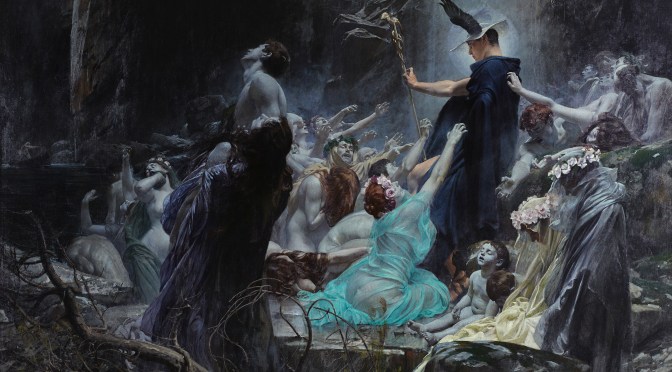
Main image: Souls on the Banks of the Acheron, Adolf Hirémy-Hirschl, 1898 (The Belvedere)
IN A REMOTE Methodist community of New South Wales in 1852, aspiring lay preacher Charles Muncey is tasked with recording the sins of every soul who signs up for a week-long revival.
He has plenty to work with. Pardoned convict Thomas Gunson knows the way through the wilderness and agrees to guide the faithful on a circuit of their struggling chapels, though he fears the company of people now that he’s out of his shackles. Irish emigre Oona Farry, recruited as a candlemaker, resents the devotion of the women during their ecstatic praising, convinced that God has abandoned her for her lustful secrets. Even righteous hosts Jacob and Anne Temple harbour transgressions they dare not voice.
But when Californian preacher Charisma Groom stirs up unbridled repentance during a watchnight on the edge of wild country, illicit sex and sudden death come to light. The congregation is ordered to hunt the devil through the ancient Fish River Caves, a dangerous underworld where raptures more powerful than faith are awakened.
With nothing but his fledgling moral compass, Muncey must see through blind faith to uncover which member of the flock is a callous killer.
This is a bold reimagining of the untold story of the Methodist settlers who colonised Australia’s renowned Jenolan Caves during the Frontier Wars.
The prologue of The Watchnight
Gunson thought about firing a potshot over the head of the kid who was dragging a pony up the spine of the treeless hogback, but there was no time to fish out his pistol. Besides, the white smears of the beast’s eyes told a story of near death. The lad must have forced his ride through the flooded gully below, and the way he aimed his own pale peepers right at the hut meant there was no hiding.
‘Creek up?’ Gunson shouted like a smartass.
The kid nodded between tight shoulders. ‘If you’re Thomas Gunson, I’m to go straight back to Mr. Temple with your answer,’ he said, holding out a damp envelope.
Judging by the dark sheen of his duds, the lad had worse weather at his heels. The last thing Gunson needed was someone stopping the night, but he lashed Lizzie’s reins to the post on the sheltered side of the hut, cranky that his mare would have to share the cramped space with a half-dead pony and shoved the door open.
‘Clothes over the chair,’ he said, throwing the lad a blanket and rattling up the fire inside the granite chimney.
Words on a page still dazzled him, so he poked the envelope onto a nail above the mantle, lit a candle in the iron cage hanging from the rafters, and threw bits and brats into the stew pot. By the time Gunson sat on the cot and peeled the letter open to see what his old master wanted of him, the kid had dozed off.
I hope this letter finds you home, friend, and not tempted to go digging for gold. We lost more souls to its baneful influence this spring, including a Reverend who preached his treachery to several stockmen and their women. All walked away from their places in our chapel, faces bereft of-
Jacob Temple had taught Gunson to read, and the memory of his old master’s turn of phrase usually helped unravel the scrawl that came off the ends of his preachy fingers, but the next word – a nest of curls and loops – stumped the pupil.
‘Speak this for me,’ Gunson said, loud enough to rouse the boy.
The lad squinted while sounding it out with chirps and hisses. ‘Ek-stay-see,’ he said.
‘Ecstasy!’ Gunson said, whipping the page back. ‘What does it mean?’
Faces bereft of ecstasy yet full of shameful greed.
‘Go back to sleep,’ Gunson said, recalling the mask of joy that Temple and his faithful wore. If yet another preacher had the sense to run off to the goldfields, good luck to him.
Our Savior replaced them with a young tutor from Cambridge, whose soul I saved on the banks of the Turon. He will make an excellent lay preacher, and is bringing his intended bride from Sydney this week. In addition, a devout widow straight off the boat from Ireland with a marriageable daughter and a lad fit for mustering.
More Irish living on Temple’s overpriced land because they’d fled the famine. Gunson felt for them, because soon enough they’d be indebted beyond their wildest dreams.
We want you back to guide the faithful of Fish River on a Circuit of our chapels. The Reverend Charisma Groom of California has disembarked in Sydney and is mak- ing his way here to lead our Revival. We would count your attendance on the first Friday of summer as a contribution to your capital for the land, and put you well ahead on your loan.
Gunson reached for the tin under the cot, knocked the lid off and sifted through the tobacco left from this month’s supply, adding up the days on dusty fingers. With a groan he calculated that he was expected in under a week.
Temple prided himself about walking his country, which was all very well along the well-trodden trail from Templevale to Cave Hill, but the way on to the chapel at Hampton was along steep-sided waterways that the men of the Burra Burra mob had shown Gunson years ago. Although he would never say it, Temple feared that route because it was not part of his kingdom.
Gunson had no grounds for refusal, not if he wanted peace in his new place.
It wasn’t the idea of guiding a party that left him feeling dead in his own skin, it was bitter experience that told him whenever the Bible thumpers from Fish River ventured beyond Cave Hill, at least one would lose their way in the dark. Temple’s new tutor, fresh Irish, and an American preacher sounded just like the type to tumble down a very deep hole.
Gunson held the letter up to the light for another look at the name of this Reverend.
Charisma.
He tried speaking it out but gave up after hearing the noises coming off his tongue. The lad had pulled his feet under the blanket and the fire was begging for a log. Hooves scraped under the belting gusts outside. Lizzie would have her head down against the door and be mostly out of the rain, the pony trying to keep behind her.
It was still early. Hours of night lay ahead. He’d eat, wake the lad and make him shove down a mouthful to warm his guts, then push him into the cot.
After struggling to rest while the candle burned, Gunson woke with a jolt, dazzlers at the edges of his sight, wondering where the fuck he was. Gaol? Ship? Cave? Harriet Dacre had been in his trance again, yammering about what he’d done to her. If it weren’t for the lad calling out to calm his shouting at the old bird, Gunson might have clawed through the rock wall for a glimpse of light.
Then he remembered: Temple wanted him back to lead lost souls through the wild country. It would be Gunson’s first time in a company of people since he’d become a free man. The rain had let up, but the gale seemed to bounce off his skull. Splinters slid under his nails as he grappled with the arms of the chair, trying to shake the dread.





 Michael Burge Media