Category Archives: LGBTIQ Equality

Jonathan Rosten – spirited dancer

DANCER Jonathan Rosten rehearsing for Song and Dance (Photo: Branco Gaica).
LANGUAGE OF DANCE Jonathan Rosten (Photo: Branco Gaica).

Jonathan Rosten (1960-2004).

JONATHAN Rosten knew how to dance – it was the language he expressed himself best in. His dance career included some magnificent highlights – solo parts for The Australian Ballet Company, and roles in Andrew Lloyd Webber’s Song and Dance (Cameron Mackintosh) and An Evening (Sydney Dance Company).

Jono also made his mark in commercial dance, from variety television appearances, to iconic dance-based commercials, and his various spots in the opening of the NSW Royal Bicentennial Concert.

After 20 years as a dancer, Jono began a new career path when he found himself writing, directing and choreographing his first show – A Really Off Off Broadway Show. Jono’s program notes for this end-of-year student performance at Jester’s Acting School in 1986 describe himself as, “One who has been thrust into directing and is better equipped to handle toasted cheese sandwiches.”

Just why he made this move seemed to be a combination of things – too many hours spent bitching about the quality of productions on offer at the time; a desire to turn his burgeoning ideas into reality, and seeing a now renowned production of an entire musical in a garage in North Sydney, which inspired Jono with it’s ‘Let’s Just Do It’ approach to entertainment.

Once this door was open, Jono spent the next ten years in a showbiz no-man’s-land, taking dance work where it paid well in order to finance his writing. Moving from mainstream to independent theatre also saw him work with and be inspired by some early mavericks, including choreographer John O’Connell on Mr Cha Cha Says Dance.

An early unproduced work he created was And Then God Created Showbiz! beginning a tradition of exclamation marks in his show titles. This was a comic exploration of the history of showbiz in a biblical and new age context. Ideas for numbers included The Ten Commandments in the style of The Ziegfeld Follies; a Fonteyn and Nureyev duet with a wheelchair-bound Fonteyn, and a climactic Xanadu-inspired number with Jesus on roller-skates.

Suffice to say the humour was subversive. The vaudevillian line-up of showgirls, drag-queens, biblical characters and historical showbiz luminaries would have made this show highly expensive and a copyright nightmare.

For Jono, it was a fantastic experiment he worked on for a decade, a place where all that seemed ‘unacceptable’ in his world (homosexuality, cross-dressing and new-age spirituality) could be placed centre-stage. These were recurring themes in all his work, taken from his own life journey and stories he’d encountered along the way.

It took another ten years before Jono found someone out there like him. At the end of a trip across America, in which he took-in the heights of Broadway, Jono happened upon a small theatre company in Los Angeles holding a retrospective of the collected works of Justin Tanner, a self-made theatre man who created shows like Zombies Attack and Pot Mom. He went to see a new work every night of his stay in LA, and the impression it left on him lasted for the rest of his life.
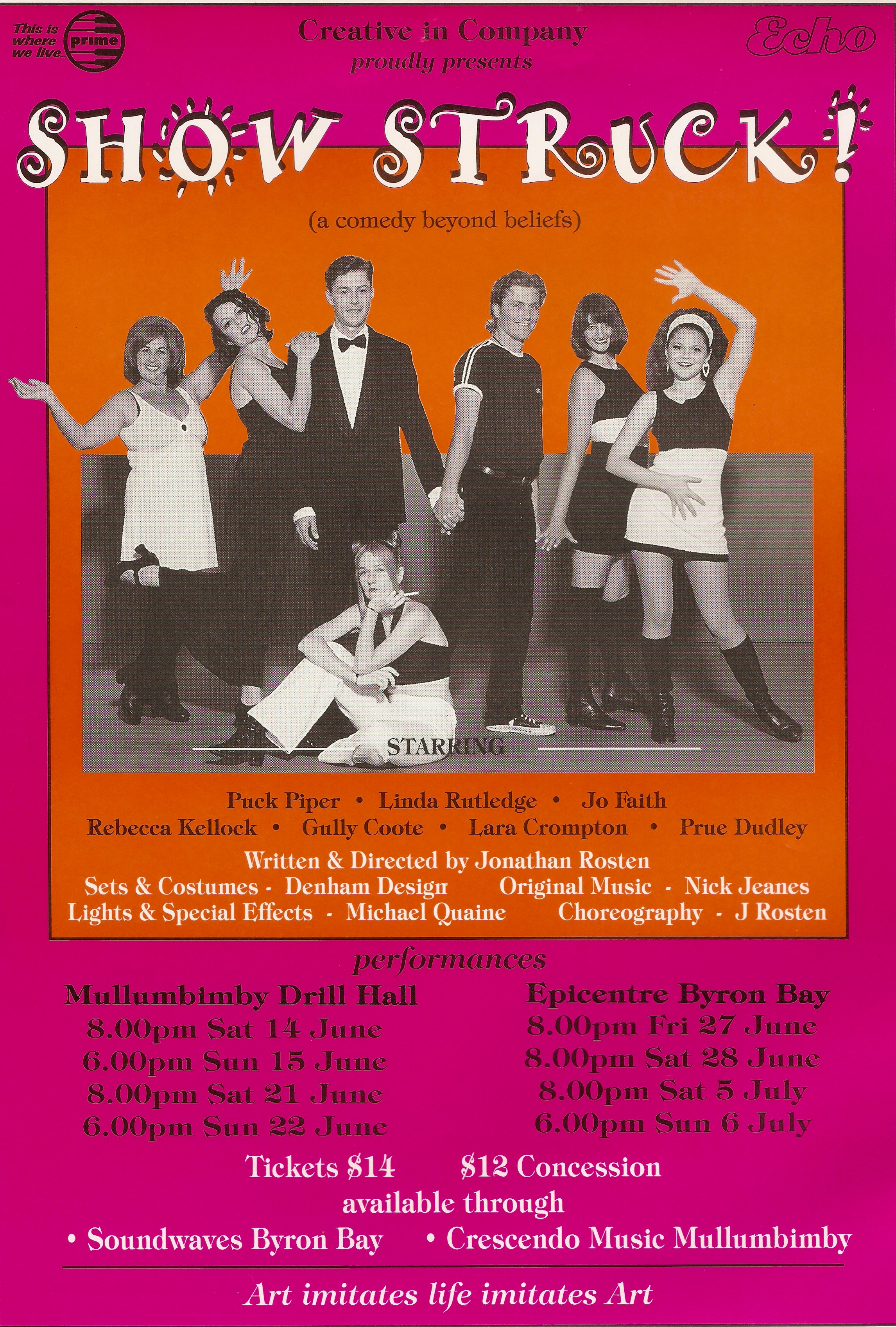
SHOWSTRUCK

He knew he had no time to waste. He knew he could be to Australia what Tanner was for Tinseltown, and shelved a host of stymied and incomplete works, including And Then God Created Showbiz! to embark on an entirely new piece called Show Struck!

Produced in the Northern Rivers area by Jono’s fledging theatre company Creative in Company, this new show was popular with audiences and was well-reviewed.

Jono created a show where the vaudevillian and alternative concepts were well within the context of a strong plot – one man’s journey through contemporary Australian show business, his desire to integrate spiritually in a spiritual vacuum, and to express his sexuality as a gay man. He wrote the show’s lyrics and produced, directed, choreographed and also acted in the show when one of the cast was injured.

Tired of endless touring to regional RSL’s, Daniel, the hero of Show Struck! is in creative limbo with his friend, mentor and bete-noire, Sherri, a showbiz survivor who has nurtured Daniel creatively and spiritually but will not let him flourish in the face of her own failures.

His journey takes him from also feeling like a failure in life, career and love to a state of limitless potential, having exorcised his demons – Sherri, his agent, and creative and sexual guilt within himself. Comically and beautifully, this journey is made in the form of an original show within a show.

One of Jono’s favourite real-life showbiz characters was Ed Wood of Plan 9 From Outer Space and Glen or Glenda fame. In the same spirit of this Hollywood maverick, Jono had big dreams to realise.

LOST SOULS The Lost Brother, Bondi Ballet, 2002.

He left Byron Bay for the Blue Mountains in 1999 and found himself in a new creative community where he quickly made his presence felt.

He began working with other maverick producers, like Out of the Blue, a community theatre group who through sheer hard work and self-belief staged the electrifying Australian Premiere of The Who’s Rock Opera Tommy at Parramatta Riverside Theatres in 2003, choreographed by Jono. Bondi Ballet gave Jono the chance to write and choreograph Lost Brother in 2002, a highly personal dance-multimedia work about the drowning death of his older brother Peter.

His dream now was to live close to the city and take original shows into Sydney after out-of-town tryouts in Katoomba. The Clarendon Dinner Theatre was the perfect venue for this plan, having birthed many successful productions over the years, and Jono approached the venue with a new show She Males from Outer Space!

Like all Jono’s shows, She Males was purposely derivative. He dubbed it ‘Scooby Doo meets Plan Nine from Outer Space’. A gang of kids lost in the Australian bush encounter two strangely attired women who look like they’re from a science fiction movie, but claim to be collecting minerals at midnight. Before the kids know it they’re trapped in an intergalactic breeding program when one of them – Anne, a devout Brethren girl – is kidnapped. The gang must get her back and face their own shortcomings and lack of acceptance in the process.

SHE MALES

This show made it to Sydney in February 2004 as part of the Mardi Gras Cultural Festival, and had a four-week season at The Edge Theatre in Newtown.

Jono injected this classic story of opposites with some of his best choreography. There were cheerleading sequences, mesmerising alien dance-moves and a continual comic through-line involving movement and lines inspired by old movies and television.

Deep in the plot was another of Jono’s appeals for acceptance when the hermaphrodite alien she-males explain to the younger gang that they are, “Perfectly balanced in our male and female parts,” a beautiful piece of writing which challenges the gang (and us) to accept themselves, each other, and ultimately Anne’s alien she-male baby who was born during the curtain call.

Jono had succeeded in a long-held ambition to carry a weighty political message with a light comic touch, and reviewers and audiences responded. He had also discovered where his greatest talent lay – in storytelling using movement, dance and comic juxtaposition.

The Clarendon immediately asked for another show and Jono responded with his last unproduced show Double Identity (strangely there was no exclamation mark in this one). This show was again highly derivative, taking the film noir world and turning it on its head.

Inspired by audience reactions to the comic dance and movement styles in She Males, Jono created a series of dance/movement numbers and then built a plot around these. He also planned to return to the stage in a number of small crazy parts, including Frank the club owner who cross-dresses.

To date this show has had one performance only, two days before Jono died suddenly in rehearsal. Harking back to the garage-show in the 1980s, this performance was in the studio at the back of our home. I was the only member of the audience and the young leads – Nathan Roberts and Ines Vas De Sousa, were obviously going to be fantastic in the run. Jono was in there too – I had rarely seen him perform, and he sparkled with a glint in his eye, even when things went wrong and they had to do numbers from the top.

The man who started out as Buckingham in The Australian Ballet’s Three Musketeers, who danced for the Prince and Princess of Wales at Australia’s Bicentenary, who was The Milka Boy in the Swiss Alps with purple cows, was now integrating again in his newest incarnation as a singer-dancer-actor-writer-choreographer-director-producer.

Little did he or we know that the integration was so complete that only 48 hours later he would make the ultimate transition into death.
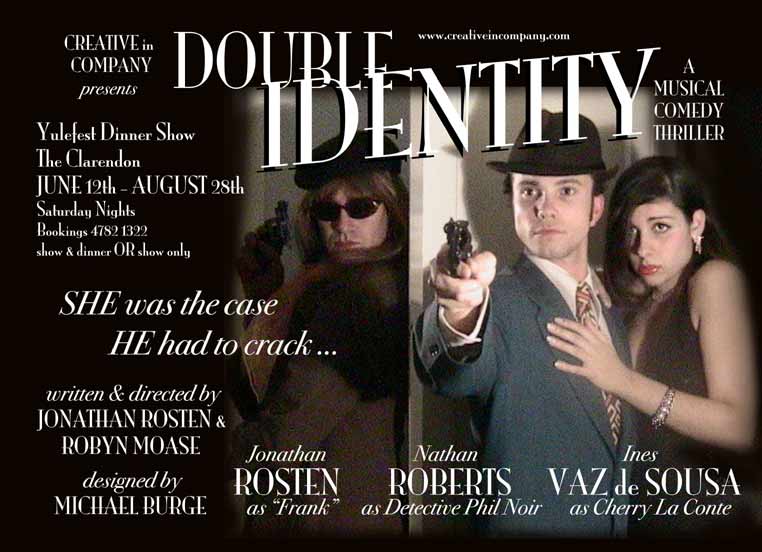
POSTER_email

Double Identity did not have its three-month season at The Clarendon.

I can imagine Jono changing the name of this production to The Show Must Not Go On! (and scoring an exclamation!) because showbiz seems all too superficial without him.

Reality of his absence has kicked-in and Creative in Company has dissipated with the understandable shock.

The irony is that while his company was called ‘Creative in Company’ it really was just Jono instigating the work and driving it forwards, like Daniel in Show Struck!, helped and supported by a lot of talented people, but it was always Jono driving the bus.

“Don’t worry about being famous,” was one of the last things he ever said to me, in a way which told me he had once cared about fame, but had certainly let go of it and become much happier as a result.

I knew then why I loved him so much, and will never forget my years in the presence of this cheeky showbiz original who achieved his life’s ambition to understand himself, well out of the spotlight.

For this I am sure he would be happy to be remembered in the AussieTheatre.com Hall of Fame.

Published by AussieTheatre.com in 2004.

Writing my way out of the closet

GAY MESSIAH Graham Chapman in Monty Python's The Life of Brian.
GAY MESSIAH Graham Chapman

A Writer finally comes out.

THE late, great Monty Python comedian Graham Chapman was the inspiration for my coming out.

In the year that homosexuality was decriminalised in the UK, he famously hosted a party for all his friends, introduced them to his male partner, then got on with his life.

The news didn’t reach our small town until long after my homophobic brother and his poofter-hating mates had come to revere Chapman and his cohorts as the best thing on their TV screens, but it was a great affirmation for me to discover that the Python’s camp humour had its roots in a living, breathing homosexual.

I wanted to find a similar way to tell everyone myself and thought seriously about hosting a coming out party at my very first house in the town of Katoomba in the Blue Mountains. But it became apparent very quickly that there was no way I’d get everyone I knew and loved in the same place at the same time – they had far too many ‘issues’.

A few very close friends, and my sister Jen, already knew. I’d told them in person after going through much angst.

I have always been much better at expressing myself in writing than any other form of communication anyway, so I embarked on writing to everyone in my life. Not just a few people, but everyone – I drew no line in the sand for my sake, or theirs.

The first step was to find a beautiful book of postcards, and I was attracted to a lovely set by Asian master print-makers. I took my time and wrote that I had come to terms with my sexuality, sharing the good news that this had given me a much-needed dose of personal happiness.

When the writing task was complete, I determined that I’d walk to the local post office, buy enough stamps for well over 100 postcards, and simply post my future out to the world.

It proved to be one of the longest walks in my life.

Katoomba is a very small community, and as luck would have it I met many people I knew along the way, some of them what I’ll call ‘Difficult Cases’ – people for whom my postcard news was going to come as something of a challenge.

I endured their meaningless chit-chat, and just internalised my resolve to keep going to the post box, through which I was convinced freedom from the closet was only days away.

The first phone call came from my cousin, whose instant, unquestioning support spoke volumes of acceptance. Great start.

Two family friends turned up. Over cups of tea this support lessened a little when the inevitable “I already knew” crept into the conversation.

If they already knew, why hadn’t they had enough courage to be inclusive when they’d asked, quite regularly, did I “have a girlfriend?” by adding just three words to that question, “or a boyfriend?”

REACHING OUT Coming to terms with sexuality is an internal journey.
REACHING OUT Coming to terms with sexuality is a journey out of oneself

Stony silence stretched out in many cases to more than a week, followed by stilted phone conversations in which people forced themselves to utter what they thought they should say.

Some Difficult Cases needed a little encouragement, so I went to see them. One crossed the street when he saw me. One broached the subject with a weird question: “Why do all lesbians hate men?” as though I’d know the answer even if such an ignorant assertion were remotely true. One looked startled when I passed her at the supermarket, her face not altering as I smiled, made eye contact, said “hello,” and kept going, since obviously she had a problem.

One assumed my postcard was a suicide letter. Another misread the words “I am gay,” thinking I’d written “I am angry”. What can you do?

“I am gay too,” was an interesting response, from the married father of two. That was out of the blue!

But it wasn’t all bad or weird: “Got your lovely postcard,” said dear Sal, mentor, friend, superwoman and strong out lesbian who’d long inspired me.

And the phone call from my grandmother, who said that she would help me find a cure, because: “They can fix all kinds of things these days, you know”.

“But I’m not sick grandma, I don’t need a cure,” I replied.

“Oh thank goodness,” she said, quick as a flash, her total belief in the way I felt about myself eclipsed generations of people in her wake.

At her 90th birthday a few months later, she raised her arms in delight when I arrived, enfolded me in a hug as the shouted: “You are so special!” so loudly that it echoed off the ranks of Difficult Cases in the family, standing in maudlin, silent rows. Priceless, unconditional acceptance.

With all the consummate skill of a country woman Grandma had hand-made clothes for my dolls when I was a toddler. She never questioned my behavior, or shamed me, she just joined in the fun and made a safe place for a young gay boy to play.

The overwhelming majority of my postcard’s recipients I never heard from again – close family friends, people I grew up with, people who were welcome in our home and accepted by our family in the face of their own ‘scandals’, people who had cried on my shoulder when I shared the intimate details about our mother, their friend, as she died. People who should have known a lot better by the accepting example that she set.

Some Difficult Cases hung in there for a while, but fell away in the wake of me manifesting my first gay relationship. For many people it’s okay if you’re gay and single (and lonely!) but bringing a partner into their home creates a challenge of “What do we tell the neighbours?” proportions, poor things.

For someone who was sent-off from his community with a mass of support, I certainly came home to a resounding rejection.

But growing up in that community had taught me to help others, so it was with a great sense of validation that I later heard about another coming out.

“I’ve done a Mike,” one young gay family friend said to his loved ones as he got real a few years after I did, at a much earlier stage in his life.

That was all I needed to hear that I’d done exactly the right thing, the Difficult Cases be damned.

To anyone who is closeted, my best advice is to love whoever you want. If anyone has the guts to ask you what your sexual orientation is, reward their courage by telling them your truth. Forget coming-out – it’s just society’s outmoded and unnecessarily pressure-filled way of working out who is ‘normal’ and who is (to quote The Life of Brian) a “very naughty boy”.

© Michael Burge, all rights reserved.

The thing about Britain

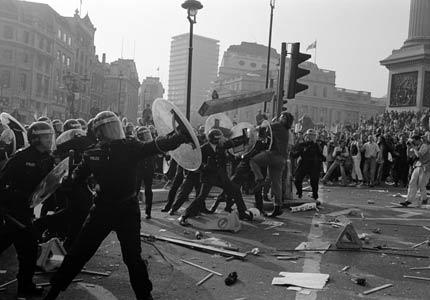
BRITAIN AT WAR The 1990 poll tax riots in Trafalgar Square.
BRITAIN AT WAR The 1990 poll tax riots in London’s Trafalgar Square.

TOWARDS the end of my second year working for United News and Media, the staff received news that our company was in the final stages of broad economic reforms that would cut right through the Farming Press office at Ipswich.

Signs of this began when an all-staff memorandum indicated that only one bottle of wine was permitted at business lunches, a message met with glee from people like us who worked at the fringes of this multinational company and had no idea we could even put wine on the company tab!

Perhaps it was our new-found business-lunch rights that finally tipped the company into financial free-fall? I doubt it, because it turned out the mechanics of change were underway years before my position was ever advertised.

By the end of 1997 the writing was on the wall. With no new employees since I’d started, I was faced with being ‘last on, first off’. So I took stock, decided it was time, for many reasons, to return to Australia, and accepted an offer of voluntary redundancy.

Having lived in a permanent state of debt for five years, my payout would be enough to buy a one-way ticket home and pay off my credit card. It was an easy decision to make.

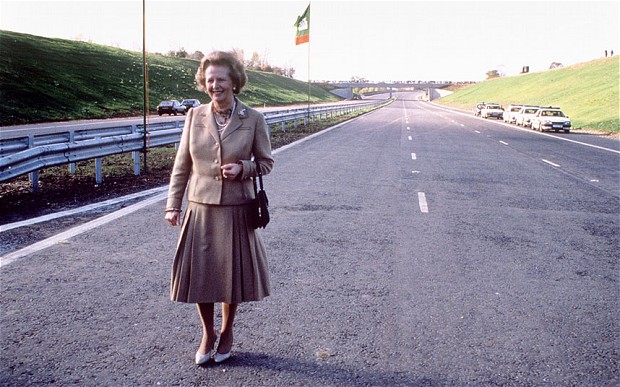
NO SOCIETY LADY Baroness Thatcher on the newly opened M25 Motorway in 1986.

Being part of a folding company was the last in a long list of eye-opening experiences of living in Great Britain’s economy.

The late Baroness Thatcher made no secret of not believing in society, which seemed to stand in the way of her penchant for the free market.

Having landed first in Yorkshire and then South London, I experienced life first-hand in territories where Thatcherism had left its mark on formerly cohesive and supportive communities.

I would later say, with regularity, that everything I learnt about economics and politics I learnt from living in Britain, simply because I joined the ranks of everyday people trying to earn a living in the immediate post-Thatcher years.

Here are some other observations about Britain in the 1990s:-

No-one could afford a day out at the beach. In Australia we call this a human right, but in England day-trippers were faced with whopping public transport costs. Few people I knew could afford cars, but a one-way train ticket for the short trip to London from Ipswich was well over twenty pounds for one person. This was solely due to the privatisation of every possible segment of the railways – one company owned the carriage, another the rails, another the station, and they all wanted to profit from ticket sales. A similar journey in Australia still costs far less than half that, twenty years later.

When buying an electrical appliance, the cable cost extra. What better way to gouge a bit of extra profit than to make the mains cable of most electrical appliances a separate item the customer must buy to use the equipment?

The country was full of criminals. Speaking as a citizen of the nation invaded to set up the penal colony of New South Wales, I have to say the common sight of colleagues being marched out of the office by a pair of police officers says a lot about the British criminal disposition as opposed to the Australian. These were never ‘bad’ people, they were just trying to keep their family afloat in the economy. Every single company I worked for contained employees who were on the take, and I don’t just mean the toilet paper.

Many people were closeted. Perhaps it’s a case of like attracting like, but most men I became friends with in England turned out to be gay. From the married father of two to the tough-as-nails London busker, they all came tumbling out of the closet in the wake of my own coming out. It was an eye opener about the choices faced by the British male under the infamous Section 28 of Britain’s Local Government Act, which embedded disapproval of gay lifestyle and relationships into the country’s law. For a nation which had decriminalised homosexuality in 1967, this was a mean-spirited regulation which was seen by many as a knee-jerk reaction to the HIV/AIDS epidemic of the 1980s and 1990s.

British food was crap. When you think about the proximity of Britain to the fresh produce of continental Europe, the lack of affordable nutritious food was a terrible side effect of euro-phobia and economic rationalism, and an indictment on the ‘Grocer’s Daughter’ who had contributed to the scarcity. The only ‘fresh’ fruit and veg I saw in my first month were lumpy potatoes, mouldy onions, and bunches of silverbeet, withered and pricey. Most people I knew ate everything out of tins, and ‘boil in the bag’ meals were the norm.

You could still sense the war. People would still queue uncomplainingly for things that were freely available in other western nations. Avoidable diseases were still common in England’s north, and childhood mortality was higher-than-average.

The tenant paid the council rates, not the landlord. Thatcher’s infamous poll tax (or ‘council tax’) was well and truly in place when I became a renter in London, and my Yorkshire flatmates showed me the clever ways their parents taught them to avoid the payment as long as was possible. Often, it was the catalyst for moving house.

No-one answered their front door. Due to avoiding paying the poll tax (see above) and the TV licensing charges (see below), I was always under strict instructions from every flatmate I ever had to never open the door to a knocking visitor in case it was someone coming to collect taxes. I was once fooled by the TV license man when he pretended he was delivering a parcel to the first floor flat I shared in Lewisham. He launched himself through the front door into the foyer, and I had to pretend I was a visiting friend who had no idea if the flat had a television or not. Luckily I had some acting training under my belt.

MEN IN SUITS The notorious TV License man and his Doctor Who-like scanner.
MEN IN SUITS The notorious TV License man and his Doctor Who-like ‘scanner’.

It cost a lot to watch the tele. A hefty annual television license fee comes with the pleasure of tuning in to the BBC, oh, and all the other channels who would appear to be doing quite well already with all the advertising revenue they’re getting from the endless commercials, of course. The jury is still out on whether the mysterious vans driving around Britain’s streets are capable of telling who is receiving a TV signal are real, or some kind of psychological warfare. It’s all very Doctor Who. Another reason to avoid answering the front door (see above).

This list is cursory and might seem glib. But it’s also true. I will always remember many colleagues in Britain who worked long hours for the same very low rate of pay I was on, only they had mouths to feed and backs to clothe. I don’t know how they did it, but most worked with a ready smile and by doing without luxuries that most people in Australia take completely for granted.

But I also recall how few of them thought it was worth getting off their backsides on election day and voting.

By May Day 1997 Tony Blair seemed determined to sweep away two decades of Thatcherism, convincing the nation of the merits of ‘New Labor’. I can remember where I was when I heard the news – working on location in the Yorkshire Dales. Never had I experienced such a sense of palpable hope and imminent change amongst the British as I did across that summer. Princess Diana’s death knocked most of that energy out of the British only a few short months later, but I witnessed the brief smile on the nation’s face.

Ever since I returned home I have been vocal about the P-word. Privatisation has not spread its destructive fingers into every Australian industry, yet. I know what an impact it will have on that day trip to the beach if public transport is ever extensively privatised in a nation where long distances are the norm.

I will be eternally grateful for the support I received to travel overseas in the first place, but ‘travel’ is a great distraction. Living and working in another country, for more than a stint fruit picking, is what I call an education.

© Michael Burge, all rights reserved.