Category Archives: My Story

A Myall in my shoes

A Writer on Australia’s Frontier Wars.

IT has taken me a lifetime to get back to Myall Creek, a typical watercourse that traverses a remote country road like thousands of others in NSW’s New England district.

Here, between the towns of Delungra and Bingara, a corrugated iron hall by a long-disused pair of tennis courts has been a place of dances, Christmas parties, cricket meets and a century of community gatherings.

As kids, me, my siblings and school friends played on iron swings that were already old by the time we clambered over them, while our parents enjoyed social tennis.

On the sidelines between one of those matches, my mother parked herself next to me on the swing in her tennis whites and told me a story. 

SWING
LIFE SWINGS The tennis courts at Myall Creek Hall (Photo: Michael Burge).

She gestured along the creek that snaked its way close to the shed, across a field dotted with pepper and willow trees, and whispered how, long ago, white settlers had driven Aboriginal people over the edge of the gully to their deaths.

The injustice in her tone got my attention, but also her reticence to tell me publicly. In all the years since, I have wondered if she’d been told about this crime, casually, over a lemon barley water on the other side of the court, when some long-term local updated this city girl on the region’s history.

Mum got essential details wrong at that first telling, but what she told me remains one of the most indelible events in Australia’s Frontier Wars – the Myall Creek Massacre.

Life took my family away from the New England region less than two years later. Over the decades, we drove across Myall Creek many times travelling to family events, never stopping.

“Now, the dead are ready to have us remember them.”

But the story of the massacre stayed with me, cropping up in school projects and writing efforts. Eventually, I did some research at Sydney’s Mitchell Library, and read for myself the newspaper accounts of the Myall Creek Massacre trials, replete with the often quoted, eye-popping racist responses from readers incensed at the white perpetrators being bought to justice.

The day I return with some of my family for the annual June Long Weekend Myall Creek Memorial, the paddocks around the hall are full of cars. 

I find my way back to the tennis courts, now covered by grass. The swings are still there. I spy the bridge over the creek, and the same gully my mother gestured to almost forty years ago.

By the time the crowd has moved up to the memorial site itself, it’s as though we cannot help but stand in racial groups. There is a hesitation about mingling. We don’t know anyone else. They don’t know us. We’ve all returned to Kamilaroi country because we remember.

Two Aboriginal men, helped by their kids, light a fire for a smoking ceremony. The sound of boomerangs being clapped together calls Aboriginal dancers into action. Smoke rises, wrapping around us, bringing us together.

SMOKE
WELCOME TO COUNTRY Smoking ceremony at the start of the Myall Creek Memorial (Photo: Michael Burge).

The air is heavy with a scent that wakes us into joining the respectful queue that forms at the head of the track leading into the memorial, and hands reach up to draw the white paint across our foreheads.

Now, the dead are ready to have us remember them.

The Myall Creek memorial is a short walk through scrubland typical of the region, with its basalt soils – chocolate-brown and ochre red – and the knee-deep sea of sandy coloured grass, lapping between stands of trees.

It’s also granite country. Small boulders lie everywhere, like markers, and as we walk, school students, some of them Aboriginal, read the plaques set into the stones while we progress.

Each tells part of the story of the killing of 28 unarmed Aboriginal women, children and old men in June, 1838. Most were felled by swords after being chained together, one chapter of the long conflict between European settlers and Aboriginal people.

The track leads us to the massacre site, a massive boulder set on the edge of a high place overlooking the remnant of the old Myall Creek Station.

In the distance, cattle feed and call. This was the land granted to squatter Henry Dangar, whose patch was eventually subdivided to create the nearby farm my parents worked in the late 1960s and 70s.

The familiarity of the farm noises comforts me, but when guest speaker Professor John Maynard speaks of the Aboriginal contribution to the wars Australia fought on foreign soil, his voice carries protest at the way Aboriginal history has been whitewashed. It’s a much-needed jolt of reality.

At the ceremony’s end, the next generation is encouraged never to forget the crime. Watching white and Aboriginal kids led by their elders, I am struck by what it must be like to not know about the Myall Creek Massacre.

Plenty of other massacres happened across Australia during the Frontier Wars – in other places, many more Aboriginal people were killed than at Myall Creek, in a variety of ways, from poisoning to shooting. Myall Creek stands out only because it was the first crime after which the bulk of the European killers were brought to justice.

Did the oral histories run deep amongst the white farmers because our ancestors were hanged for their crimes?

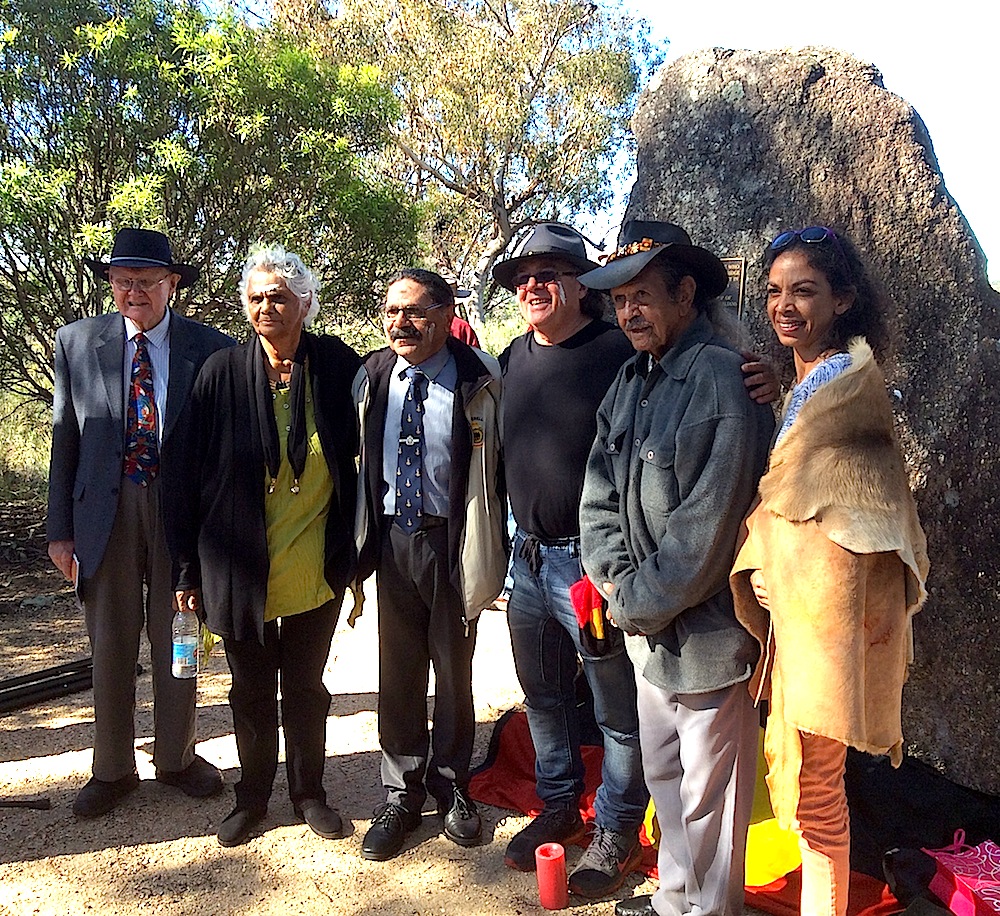
MYALL LEGENDS Elders and dignitaries at the memorial site (Photo: Michael Burge).

When American writer Bill Bryson came in search of the massacre site in the late 1990s, he found nothing.

By 2000, the place had been identified and marked. Occasional vandalism since has not dulled the growing spirit of reconciliation which will never be stymied by faceless racism. Now, a fundraising effort is behind a planned onsite education centre.

During the thoughtful walk back to the car, cautious divisions start falling away. We walk as one group. One people.

On the way to visit our old farm, we pause at a high point along the road where another farmhouse became derelict long ago. Very soon, other cars arrive, bearing various descendants of the other families who farmed down the same lane. They were all at the massacre memorial too.

Although we are all different ages, live across two states and our lives have followed varied pathways, one thing unites this group of relative strangers meeting on a tract of the Kamilaroi nation on this particular day – every one of us has always known about the Myall Creek Massacre.

This strong oral history has been handed down through generations and does not come with judgement, shame, or pity for white killers.

It comes with an unforgettable knowledge of what injustice really means in this country, and the desire to pass that message on.

© Michael Burge, all rights reserved.

The making of a marriage equality advocate

IRELAND’S yes vote for marriage equality kicked a rainbow-coloured goal for LGBTI people around the globe, and while the major Australian political parties fight for ownership of the ball, this extract from an upcoming podcast and book Questionable Deeds is a reminder of how far we’ve come. 

IN the lead up to the 2004 federal election the issue of same-sex marriage hit the media.

The year prior, various provinces followed Ontario’s lead in Canada and allowed same-sex marriages to take place. Many Australians availed themselves of this legislation since it did not require the couples to be residents, but as soon as the newlyweds stepped back onto Australian soil, the marriages had no legal standing whatsoever.

Two couples decided to test Australia’s Marriage Act (1961), and their application landed on the desk of federal Attorney-General Phillip Ruddock, sending him into a spin.

“Marriage, like a seed, was planted within me.”

It turned out there was no specific mention of gender in the Act. As far as the law was concerned, any two people, same-sex or otherwise, could apply to be married in this country. Back in the early 1960s when the legislation was created, nobody even dreamed of same-sex marriage.

The conservative Liberal government, led by John Howard, went into overdrive to see this loophole changed, and they got plenty of support from both sides of parliament, election year or not.

By August of the year my partner Jono died, same-sex marriage had been made a legal impossibility in this country. I barely recall the announcement. It would have passed through my consciousness in my deepest grief and registered only as another reason to feel dreadfully unsafe about being same-sex attracted in my own country.

The looming election, of course, required me to turn up at the ballot box, since all Australians must have our names ticked off the voting register on the day, whether we use our vote or not.

The voting queue at the local primary school, the same one I had attended over twenty years’ prior, was long. It gave me plenty of time to think over the issues, and, more importantly, to observe people and the colour of the how-to-vote cards in their hands.

Prime Minister John Howard was showing great leadership for the majority of Australians – sixty per cent – who objected to same-sex marriage, and, by the amount of blue of the cards I saw all around me, things were not about to change.

They didn’t. The diminutive target John Howard saw off the Labor party’s brutish Mark Latham, no problem.

But marriage, like a seed, was planted within me as a concept. Alone, processing the loss of my partner, I pondered what difference marriage would have made to my situation.

First and most obvious was the certification. The warranting of a relationship’s existence is so easy with that ‘one piece of paper’ which straight couples had access to for years prior, eschewed by many as either too binding or not needed.

I realised how much simpler it would have been for me, one certificate, and how much harder – impossible, really – it would have been for Jono’s mother and brother to erase the visible signs of his relationship with me.

I thought of the traditional marriage vows, and the words ‘forsaking all others’.

I processed its meaning, looked deeper than any sublimation of women and property rights, to find how the line was actually a warning to all those present at a marriage ceremony that they are the forsaken ones. Their son or daughter is placing them on solemn notice with that line, warranting that they are no longer the next of kin to their loved one.

Their spouse replaces family, from that moment, and a new family unit is created.

My parents’ marriage had ended in acrimonious divorce, to the point where my mother was wary of any signs of my father in me and my brother, and our father allowed his new wife to demonise our mother as she saw fit.

I was glad they did not stay together, and Prime Minister Gough Whitlam’s leadership on fault-free divorce through the creation of the Family Law Act (1975) had built the firm foundation that allowed many families to undo what needed to be undone, with access to legal aid and counselling.

Almost instantly I shed my wariness of marriage. I saw exactly how it could work for same-sex couples needing that line in the sand around our relationships, whether the marriage lasted forever or not.

Marriage did not have to follow the archetypal plan. Its history is littered with anomalies, of couples stretching its boundaries, simply because they were quite safe to do so by law. In recent times, any victim of marriage also had recourse to become un-married.

I recalled the night Jono and I took one another to our favourite pizzeria on Katoomba Street, on the brink of relocating to Sydney and starting a new phase of our lives. Jono was pensive until he revealed what was on his mind: he was worried that he did not have enough to offer me as a partner, being ten years my senior. He wondered if I wanted to explore other relationships.

I looked him in the eye, and held his hands between mine, and said: “No, Jono, that is not what I want. I want to be with you.”

He bent his head in his humble, accepting way, flicked the corners of his mouth up, and we kissed.

From that moment, we were married. The only things missing, apart from the support of any law, were two witnesses and a state-sanctioned celebrant.

9780645270532
 

Widowed and alone in that voting queue, barely two years later, I became a marriage equality advocate.

An extract from Questionable Deeds: Making a stand for equal love.

© Michael Burge, all rights reserved.

Making way for the marriage of true minds

AUSSIE AUSSIE AUSSIE Unequal, unequal, unequal.

A Writer is helped to understand his subject.

I WASN’T going to write anything more on the lack of marriage equality in Australia. Frustrated and saddened by the wait, I decided to stop trying.  But this week I had one of my most profound experiences around the debate, one which needs sharing.

A week ago I received an unprompted apology from someone I went to school with. He sought me out on Facebook and made amends for his homophobic bullying more than twenty-seven years ago.

I was initially cynical – after all, this particular cruelty was usually an invitation into a fake conversation followed by a bullying sting.

So I publicly asked him to take some action – to write to his federal member in support of marriage equality – just to see if his apology was something more than words.

“The self-determined gay couple, if ever aware enough to lobby for the full backing of the law, would force societies to evolve.”

Then I waited. My husband witnessed me waver as the days passed – “I’ll never hear from this guy” I muttered, realising that I’d asked him to come out as a supporter of same-sex marriage.

I already knew from bitter experience how hard coming out can be. Declaring anything unexpected within your community can be a deal-breaker for all our relationships.

While I hoped for a reply and yearned for it to be a positive one, I revisited my own journey to marriage equality.

It began 10 years ago while I was standing in the voting queue at the 2004 federal election.

My life had taken its harshest turn for the worse earlier that year. My long-term partner Jono died suddenly, and in the midst of my grief his family denied the existence of our relationship and caused a legal battle over Jono’s debt-ridden estate.

Homophobia mixed with grief mixed with denial mixed with money … a devastating cocktail I tried my best to assuage, and failed.

I sorely missed a powerful record of our relationship to use against that force, but that year federal Attorney-General Phillip Ruddock and Prime Minister John Howard trounced any chance  same-sex-attracted people had of accessing the federal Marriage Act to create legally recognised relationships.

NEVER GONNA HAPPEN Mark Latham roughing-up John Howard in 2004.

By the looks of the colour of the how-to-vote cards in that long voting queue, Labor’s Mark Latham was not going to see-off Liberal Prime Minister John Howard, and, with community support for same-sex marriage languishing at just over 35 per cent, marriage equality seemed forever away.

Jono and I were oblivious to the precarious legal situation our relationship was in. We’d been happy to live very much to the tune of Joni Mitchell’s ‘My Old Man’: “We don’t need a piece of paper from the City Hall, keepin’ us tied and true”.

Not an uncommon stance in our generation but one which can leave either party in legal limbo after the death or incapacitation of the other.

As I waited to vote, I realised there was a tool to keep an indelible legal line in the sand when one in a couple dies – a marriage certificate – that elusive piece of paper.

I suddenly felt duped by the society in which I paid taxes. It had never given me and Jono the chance to feel secure, and all the while we’d fooled ourselves that we had forever, and that nothing could touch our evolving togetherness.

That was the scary part for many people – the self-determined gay couple, if ever aware enough to lobby for the full backing of the law, would force societies to evolve. No wonder our collective relationships were such a political football.

A decade on, the only thing that’s changed is the percentage. Now, 72pc of Australians support marriage equality – surely a free kick for whichever Prime Minister has the guts to kick that ball over the line.

Like many LGBTIQ commentators, I find the lack of parliamentary leadership on this issue deeply unsettling, and in what I thought was my marriage-equality-writing-swan song, I extrapolated all the issues as I saw them.

But in trying to express my pain and angst in words, it turns out I was wrong about all of it.

Here’s why.

Earlier this week I woke for a very early start at work. Bleary-eyed at the computer I noticed I’d been sent a friend request on Facebook – from the man who, as a teenager, bullied me at school.

The sending of that request, the most common, throwaway click of a virtual button, and my equally everyday acceptance of it, revealed a far more powerful acceptance.

“He is not a bully, he is a hero.”

On his Facebook wall I saw he’d graciously acquiesced to my challenge.

Here is his letter in full:-


Dear (name deleted)

I am writing to urge you to support a free vote on marriage equality.

I went through school with a gay student and recently reconnected with him. He was gracious enough to share with me the way that society’s treatment of gay people has impacted his life. As a young student he was bullied at school, and as a gay man he has been subjected to ridicule, discrimination and disenfranchisement for no other reason than because of who he loves. The reason I am giving you this context is because I am ashamed to say that at school, I was one of his bullies.

This person sharing his experience of how my actions at school impacted him, provided me with an opportunity to put myself in his shoes, to empathise with how it must have felt to be a victim of discrimination. Looking back I am appalled at my thoughtless disregard for the rights of another person. Today, all these years later, I am equally appalled that this person is still having  his rights disregarded, only this time it is via Government-sanctioned  draconian legislation, rather than by a high school bully.

As a parent, all I can think of is how I would feel if one of my children was forced to face the same struggles for acceptance, and forced to fight for what you and I, as heterosexual males, take for granted — the right to marry the person you love.

Could I ask you to place yourself in the shoes of someone facing this discrimination? Imagine if it was your own son who was in this position, if your beloved child was unable to marry the person he loved.  Or perhaps think how it would feel if one of your daughters was not legally allowed to marry the person she had fallen in love with. If one of your own children was denied the same rights as the rest of society based purely on their genetic sexual orientation, wouldn’t you do everything in your power to fix this injustice?  Wouldn’t you fight against the ignorance of others to ensure the freedom and chance of happiness for one of your own?

Research has shown that the majority of Australians believe it’s time marriage equality became a reality. I would hope that as a father, a husband, and a citizen of Australia in 2014, you agree that now is the time for this change. Now is the time for you to join 72% of the Australian population who are saying that all Australians are entitled to marriage equality.

I strongly urge you, as my representative with the power your position bestows upon you on my behalf, to take the necessary steps to ensure marriage equality becomes a reality. Please support a free vote on marriage equality. Do this on behalf of every parent, for the sake of every child who deserves the same rights as you and me.


This man and I must always have had more in common than we realised. He is not a bully, he is a hero, and on reading this for the first time, I was released from cynicism into fierce protection.

Same-sex marriages and civil unions have been granted and overturned at state level; the community support in all known polling regardless of age, region, religion and ethnicity is in the seventieth percentile, and plenty of same-sex-attracted couples want one.

Clearly, the culture war has long been won.

All that’s standing in the way are the real bullies – the politicians and community leaders who never really grew up and continue to cajole, avoid, ignore and deny the rights of same-sex attracted people, and our friends.

It took a reformed bully, and a reformed victim, to see it.

© Michael Burge, all rights reserved.