Category Archives: My Story

The Writer of little things

GETTING GRITTY From small irritations, beauty is born.

Starting small.

I pride myself on being a wordsmith who could write on just about any subject, but such surety comes after over two decades’ experience. When I started out, I really had no idea what I was capable of.

So, a when a good friend got a job as a magazine editor, and called in a panic about not knowing what a “drop-cap”,  and other editing terms, referred to, I talked her away from the edge by looking everything up online with her on the other end of the phone. We both learned much from those sessions, without her boss having to know she (and me) were playing journo-school catch-up.

Eventually Eden asked more than unstinting support in a time of need, and commissioned me to write a feature about the history of beads. My late partner Jono had traded in semi-precious stones, and created jewellery out of them, so I knew my away around a bead shop, but a feature was a different matter. I just dived in, did my research, and came up with the goods, and they even used my headline! A new career was born in the process …

PORTABLE STYLE Beads have been strung, trades and prized for millennia.
PORTABLE STYLE Beads have been strung, traded and prized for millennia.

Little Treasures

A brief history of beading

In 21st century Australia we do not generally cook over fires with hand-crafted earthenware pots, read by the light of handmade candles, or make our own writing paper, but at the very centre of our culture is something as ancient as all these things: beads.

Most of us wear and use beads every day as functional items like buttons.

They are durable, attractive little examples of a living archaeology; museum pieces we wear, touch and treasure in our daily lives.

A brief look at the history of beads is not really history at all, because the manufacture of beads has not dramatically changed in thousands of years. It does not require very sophisticated technology to string small perforated objects onto a length of twine or wire. Five thousand years ago, artisans were capable of much the same techniques we use today in beading. Their work is often the only evidence of vast civilisations.

Probably the earliest gem like materials collected were those that were most apparent, such as amber and pearls.

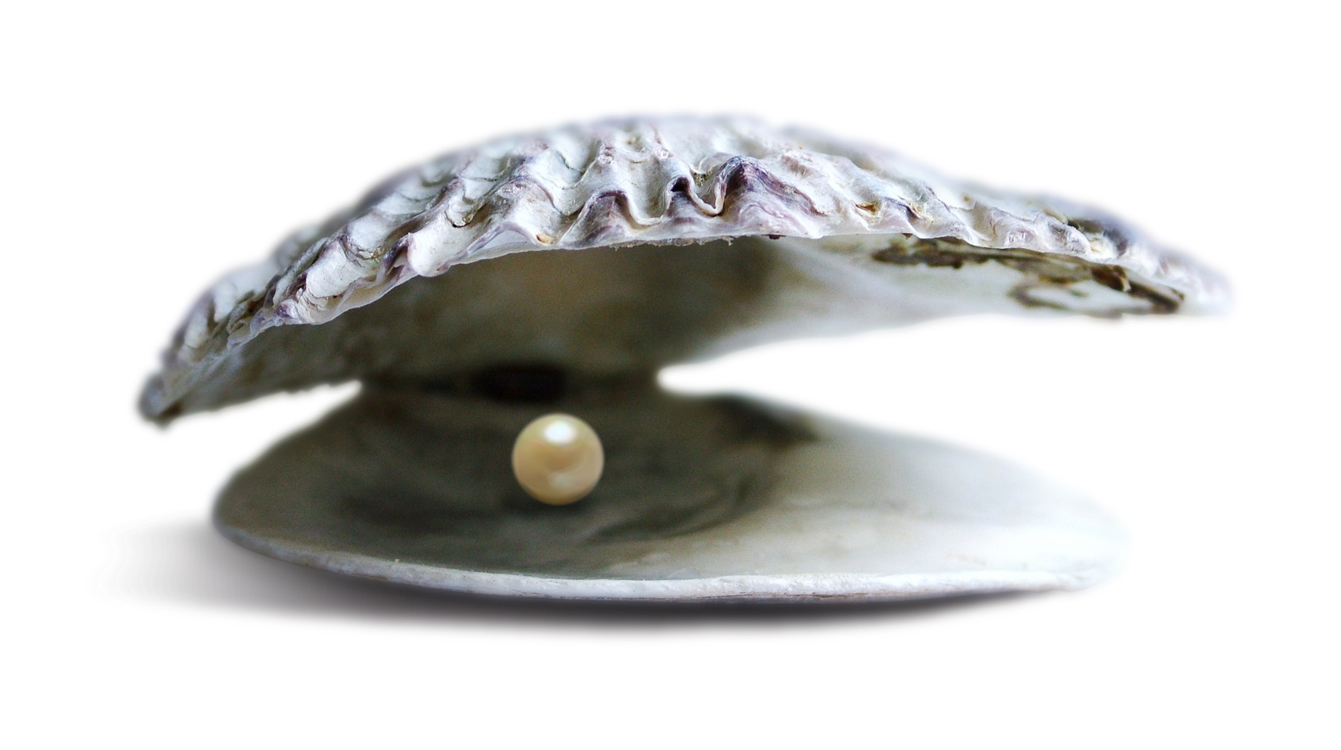
The amber pieces which regularly wash up on the Baltic shores and the east coast of Britain are an attractive and highly prized adornment traded for millennia. Likewise, the pearls of equatorial climates, gifted out of the mouths of oysters, have long been considered things of great mystery and beauty, worn and exchanged over great distances.

Shell, bone, wood and stone appear in all ancient civilisations as far back as 30,000 BC.

By around 2,500 BC, most continents saw complex religious and political cultures spring up in fertile river valleys, from Mesopotamia, Egypt and India, and beyond into Asia and Africa. These location yielded excellent agriculture, but also the raw materials for bead making, and the environment for excavating precious metals.

Beads are evidence of an international trade in these materials, created by the demands of royal and aristocratic lineage, and the artisans they patronised.

Egypt still remains one of the most influential beading cultures of all time. Within the borders of the Nile river valley were all the raw materials to produce beads from a time long before the pyramids were built until the era of Cleopatra, over two thousand years later.
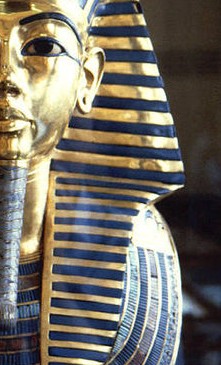
LAPIS OF THE GODS Tutankhamun's death mask is unarguably the prime example of Egyptian cultures love of lapis lazuli beads.
LAPIS OF THE GODS Tutankhamun’s death mask is unarguably the prime example of the Egyptian culture’s love of lapis lazuli beads.

Egyptian gold, turquoise and carnelian were crafted into the enduring Egyptian jewellery styles, most notably their iconic collars. The only material the Egyptians were forced to import was their beloved deep blue lapis lazuli, which was traded from ancient Afghanistan.

Perhaps Egypt’s greatest gift to the world of beads was their development of glassmaking techniques. The application of heat to sand and colouring agents created an early synthetic material called faience, which, over time, was improved to what we know as glass.

Because of its cheap production process, it was possible for most people in Egyptian society to buy and wear synthetic stone, or replicas of more precious materials.

Most of the known Western world was absorbed into the culture of the Roman Empire by the time of Julius Caesar in the first century BC. The Romans manufactured and traded glass on a grand scale, influencing beading from Britain to India.

CANDY CANE Glass bead being formed while viscous.

Glassmaking began much like the process of candy makers – long ‘canes’ of hot coloured resins were stretched and sliced, then cooled into various sized beads. Mixing colour into an array of patterns was a common practice, and the further each cane was stretched, with the same patterns and colours running though it, the more matching beads were able to be sliced from it. Each bead could be perforated with hot metal rods while the glass was still viscous, creating a hole for stringing.

During this time, the Anglo-Saxon language gave us the word “bede”, meaning “prayer”, showing that the religious association of beads was always strong. The major religions borne of this period – Christianity, Buddhism, and Hinduism – all adopted the use of prayer beads in rituals which are still practiced today.

Rome’s far reaching influence took European traders into Africa, and European beads appeared as far afield as South East Asia, impacting the beading styles of those regions, which held ancient beading traditions of their own.
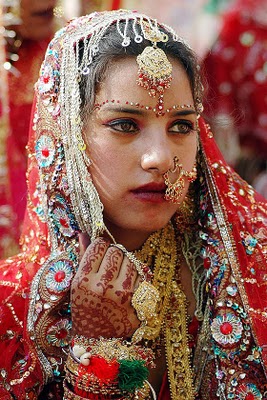
BEADED BRIDE Complex stone beading became a wedding tradition in India.

India had developed vast industries of stone beads, such as carnelian and agate, formed into detailed adornments such as the highly prized bridal collars. Thereafter, stone beads became a major Indian export.

African cultures had ancient jewellery traditions using organic materials such as seed, bone and tusk, and some of the richest sources of gold, which was exported back to Europe and beyond. The exaggerated animistic style of African beading impacted the later Roman and Byzantine decorative arts.

Glass remained the most widespread material for beading, and as the Roman Empire collapsed, the processes of glassmaking were kept alive by artisans in Phoenicia and the vast Islamic empires.

In the eastern regions of Arabia and Persia, the manufacture and trade of beads during the Middle Ages and early Renaissance saw new styles develop at a time when art and culture in western Europe diminished.

The Renaissance, from around 1400 AD, saw the rediscovery of ancient Greek and Roman cultures, including their beads. This was the era when Venetian glass influenced the decorative arts, and glass beads enjoyed a revival. The brightly coloured and textured Chevron bead was first created in Venice c.1500 AD and exported across the known world.

Exploration to the Americas took glass beads to the New World. It could be said that gifting large numbers of glass beads became something of an invasion technique, employed by explorers from Christopher Columbus to the conquistadors in South America.

The Native American and South American cultures had an impact in return. The Mayans and Aztecs prized Guatemalan jade over gold, and developed some of the most sophisticated techniques for drilling very long tubular beads. American Indians created detailed beading techniques to adorn everyday clothing.

Archaeology had a major impact on beading styles in the 20th century. The best example was the 1920s excavation of the tomb of Tutankhamun, the young Egyptian Pharaoh who was buried with unarguably the richest and most varied collection of decorative arts, which took modern minds back to the everyday items of New Kingdom Egypt.

Fashion in the 1920s, and certainly 20th century jewellery, were influenced by this major discovery. The highly intricate collars adorning Tutankhamun’s body were replicated by jewellers worldwide.

Beads often affected modern economies. For thousands of years it was impossible to produce spherical pearls, a process hidden inside the hard shell of oysters, but, in 1913, when businessman Mikimoto Kōkichi pioneered the mass production of perfectly spherical cultured pearls in Japan, the sudden influx of affordable yet perfect pearls sent jewellers worldwide into a spin.

Here in Australia we have Western beading styles in a setting which bridges South East Asia and the South Pacific, with the growing influence of Aboriginal Australian art, and it is not uncommon to see all these influences at work in contemporary Australian jewellery.

© Michael Burge, all rights reserved.
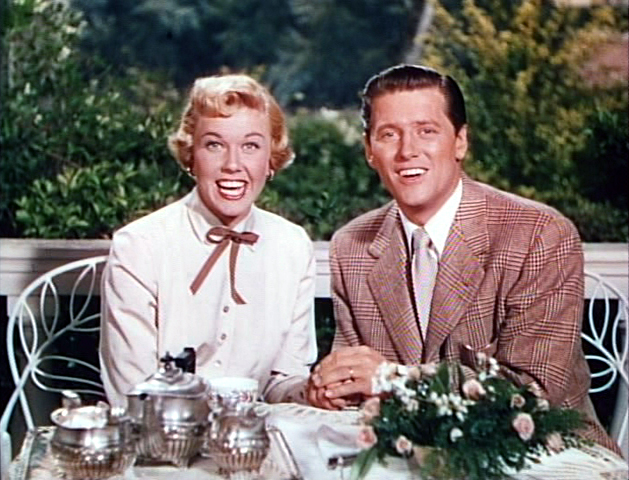
Tea for three, with viagra

TEA FOR TWO Doris Day and Gordon MacRea in the 1950 film.

A Writer’s saviours.

IT TAKES a very bleak outlook for me to feel like giving up writing, but once I very nearly did.

Living by myself in a friend’s granny flat, my partner having died, my best friend having dropped me, my car having burst an engine gasket and been sold at bottom dollar for scrap, I was at a low ebb.

The idea of writing anything was the last thing on my mind.

Enter two dear friends – Yvonne and D’arcy – with a plan. Yvonne is a writer, having taken it up relatively late in life, and D’arcy knows the English language backwards, a natural editor like no other.

They wanted to enter a national TV screenwriting competition with an adaptation of one of Yvonne’s short stories. They knew I had experience in screenwriting. They were also wise enough to realise I needed something to keep my mind off the dreadful turn of events my life had produced.

I was a little dubious about how effective I’d be collaborating on a storyline, but after reading Yvonne’s story, Tea for Two, I could see immediately how this tale of revenge and bad behaviour amongst older people could be made into a riveting 30-minute drama.

So I said I was interested, as long as Yvonne and D’arcy agreed to tell me honestly if they thought it was no good. We’d only enter the competition, as a team, if we were all happy with the result.

Over cake and tea, we shook hands on it.

The competition had strict production criteria that submitted scripts needed to adhere to or get knocked out – limited numbers of characters, no scenes set at night (meaning no expensive night shoots), and a strong dramatic twist in the plot.

Yvonne’s story needed some adjustments to make it work as a screenplay – one location, and stronger character motivations to allow the story to take place in the 30-minute format – but it was fundamentally a brilliant tale about passion, poison, and older people, with a great ring of truth, because both Yvonne and D’arcy were well into their seventies when they wrote it.

I came up with a first draft in a few days and sent it off to them. This began a series of phone conversations and notes sessions, the likes of which I had not before (and have never since) been part of even with the most experienced collaborators.

All delivered, I hasten to add, with the kind of honesty, good manners and intelligence that all writers crave.

But these two went the extra mile. During one phone call, Yvonne’s voice sounded a little odd, like she’d been out jogging. When I suggested she sit down and let me call her back, she explained that she and D’arcy were entangled on their sofa reenacting the dramatic cliffhanging denouement of our script, with her dangling by a thread over the edge of the furniture, and D’arcy holding her.

CLIFFHANGER Alfred Hitchcock's Vertigo.
CLIFFHANGER Alfred Hitchcock’s Vertigo.

“It won’t work, luvvie,” Yvonne said, sure and to-the-point. “We’ve tried it and there’s no way that character could see anyone up above the cliff while they’re holding on by their fingertips. Can we change it?”

There was no refusing such commitment . I duly rewrote with her notes in mind.

The poisoning element of Yvonne’s storyline was pivotal, and I was keen on having an overdose of viagra as the means by which the murder was executed, something I assumed would be in good supply in an independent living nursing home, where we’d set our screenplay.

But I needed some facts on it, and thought to ask Yvonne.

“We don’t know luvvie, D’arcy doesn’t need it,” she said, completely without guile. “I could ask down at the Chemist’s, shall I do that?”

Priceless, unquestioning support.

Within a fortnight we’d researched all the facts we needed and collaborated on a series of drafts, and after a month had our script on the page in a state we were all very happy with.

Tea for Two was a very Australian, very timely exploration of older characters who were three-dimensional and hungry for their last-ditch, last-chance grabs at life.

We were extremely proud when we got through the first round, mainly because we knew we’d artfully worked within the production parameters requested; but ultimately our collaboration got rejected. The TV series was made that year, replete with stories focussed on younger people dealing with perhaps less realistic issues.

I’d dared D’arcy to place one single hair inside the 3rd page of the screenplay – an old writers’ technique for finding out if your screenplay had even been read before rejection. When it came back to us, yes, the strand of hair was still there.

But Tea for Two made one bereaved writer and two older collaborators feel very relevant for one Autumn. We still laugh about it. I will never forget Yvonne and D’arcy for the gift of their collaboration, and because they kept me writing despite the odds.

© Michael Burge, all rights reserved.

Care, incorporated

Waiting for a real helping hand (Photo: Chalmers Butterfield).
WAITING & WATCHING for a real helping hand (Photo: Chalmers Butterfield).

A Writer’s next day job.

BY the time I felt ready to work again after the death of my partner, I was drawn to an industry which seemed at first glance to be all about offering an old-fashioned helping hand. While I took time away from writing, acting and designing, I accepted a job as a carer for older people living in their homes.

Across four years, what I discovered was life enlarging and shocking, and, of course, I eventually wrote about it. This article was published by Australian Ageing Agenda (Intermedia) In their March-April 2010 edition.

Reflections of a carer

Former carer, Michael Burge, highlights the unintended consequences of government-funded community aged care.

Dan* lives alone in a cottage with a stunning garden. To his neighbours he’s like thousands of elderly men, gardening and feeding the birds. But Dan lives with a secret – he’s in the advanced stages of Alzheimer’s disease. That kind young man who used to call in and see him once a day was not his son, but me, when I worked for a church-owned community aged care organisation.

It took a few days to realise Dan has dementia but I guessed after we had the same conversation three times in a row. When I visited Dan, I would make his lunch and prompt him to dress. Apart from weekend visits from his retired daughter, who’d ask me for care tips, Dan was on his own.

I also cleaned for Ken and Betty, a war veteran and his wife. Ken had problems walking and was permanently catheterised, not that you would have known. As Betty was worried about losing him to a nursing home, she tried to hide all outward signs of his conditions from me.

Cameron lived with his son. Fond of telling me how many properties he owned, he bragged about securing maximum care at budget prices, since his son worked in the health system. Despite family support and excellent health, Cameron felt totally entitled.

Beryl had a degenerative joint condition, yet she handled the stairs on our weekly shopping trips with a mountain climber’s courage. I got used to the frowns from passers-by who saw a carer forcing her, rather than a woman choosing to participate in her own rehabilitation.

Klaus lived in squalor on booze and chocolate while his meals-on-wheels dinners went off in the hallway. He refused to get out of bed when I said I wasn’t permitted to take him to the bottle shop. This got him off out books and back into ‘no man’s land’.

WAITING AND WATCHING (Photo: Ahmet Demirel).
WAITING & WATCHING for solutions to home care (Photo: Ahmet Demirel).

Exposing the gaps

Carers are not there to judge, we’re there to do what our clients cannot. Trained in the practice of ‘person centred care’, we won’t do up a client’s buttons if they can still do it for themselves. Interfering might lead to ‘learned helplessness’.

Filled with such euphemisms for an old-fashioned helping hand, home care is touted as the ideal in aged care. Millions of taxpayer and private sector dollars are pumped into this growth industry every year, and the demand is only growing.

Expectations of home care are very high. It looks good on paper – after all, it’s about nurturing people facing one of life’s most challenging periods. But after working in home care for four years, I came to realise it’s just a safety net, and it’s full of holes.

So many older people are estranged from their families, or have outlived them and most of their friends. If you believed everything older Australians say about their baby-boomer children, you’d end up confused over which generation was the more demanding, but it’s clear someone is capitalising on this lack of intergenerational care within families.

Carers are deemed competent in infection control, manual handling and occupational health and safety. After warnings about old vacuum cleaners and hand washing, they do a couple of buddy shifts with experienced carers, then work relatively unsupervised in the field. Nurses are dubious of carer’s skills, yet they are turning away from aged care citing low pay and demanding conditions.

Department of Veteran’s Affairs (DVA) clients get the most support, but they’re coded according to where they (or their spouses) served, in addition to having their needs assessed. This sometimes leaves the impression that some DVA clients are not getting enough care, whereas others seem to receive more than they need.

Experiencing the consequences

There can be few things more important than the care of people, but governments have a habit of throwing money at home care and regulating the system from a distance.

Operating from a charitable, benevolent or customer service standpoint, home care organisations fill the gap by providing broad safety nets in highly populated areas. These nets are stretched between middle and senior management, padded with charitable status tax-breaks and strung out by government funding.

Clients are netted at very vulnerable times. After a traumatic experience, such as a hospital stay because of a broken limb, they are contracted into the system. Many home care organisations eventually stream clients into their own residential care facilities.

I was recruited into a home care organisation at a vulnerable time in my life after the sudden death of my partner. Return-to-work mums were my most common colleagues. We were often full of doubt about our abilities and found it hard to get the promised hours out of our supervisors. They usually gave us just enough to keep us off the unemployment statistics but not enough to pay all our expenses.

After a promotion into the training department, I could see how the supervisor’s hands were tied by a system with a high number of needy, casual staff delivering minimal care hours to the maximum number of clients. It was also obvious that satisfying government regulation drew heavily on available funds.

Carers were commonly sent to new clients without knowing they had dementia and without the appropriate training to provide effective care. Clients were routinely kept in the dark about which day and time their carers were coming, unable to contact their service coordinator. The time supervisors spent with clients was regularly reduced by management, allowing important care needs to be overlooked.

Whatever reasons management had for this, the result always pushed the clients further from the centre of the care process, and contributed to an extremely high staff turnover. The hypocrisy of my employer not sharing its broad tax relief with employees was startling and I too eventually resigned.

NOT WAITING
NOT WAITING “Old age ain’t no place for sissies” said Bette Davis (1908-1989) (Photo: Alan Light).

An alternative approach

If the choice was up to me, I’d provide incentives for families to care for their own relatives, and pay Dan’s daughter for the one hour a day he needs. I’d cease planning which care facility I wanted to stream Ken into and I’d support Betty to care for him. I’d means test the system to filter out Cameron. I’d allow Klaus’s carer to take him to the bottle shop. I’d clarify the system which seems to define care needs based on service history for DVA clients. I’d aim for changes to free up resources for people who have limited funds and no family, like Beryl. I’d also make caring a real career option for employees.

Despite the fact that I am a fully trained and there are a plethora of aged care positions in the paper, I’ve chosen to work in a different industry since I left my previous employer. Aged care doesn’t offer an unconditional helping hand anymore. If it could, then the safety net might truly catch people.

*All names have been changed.

© Michael Burge, all rights reserved.

This article appears in Michael’s eBook Creating Waves: Critical takes on culture and politics.