We arrived on time, were seated amongst an array of other school groups, and waited for the performance to begin.
Eventually, a lone figure – one of the actors – walked sheepishly onstage to deliver an apology.
One of the school groups (a busload of students from the Central West, apparently) was late, and the stage management had decided to wait for their imminent arrival. It seemed a little inappropriate that one of the actors was selected to give us the news.
Whether he was playing Vladimir or Estragon was not clear – he wore the Chaplin-like baggy pants and bowler hat of Beckett’s main characters, and he sat on a chair, like the rest of us, and waited.
And waited … and waited … and waited.
As teenagers, we all did what teenagers do while they’re waiting. We got impatient. We gossiped. We heckled one another. We heckled the actor. We did everything we’d predictably do. I recall going inside myself, my outer shell not showing impatience, but I was seething inside, thinking: “Typical country school, couldn’t leave home on time … now we won’t have any shopping time before we have to go home on the train.”
Eventually, it seemed even the actor had waited enough. He sat upright and addressed us, but not to make a further announcement. The lights went down suddenly, leaving only a spotlight on his face, and, using Beckett’s words, he berated us all for being so foolish as to believe his cunning little trick of making us understand, whether we liked it or not, what this classic piece of Absurdist Theatre is really about.
And that wasn’t all. There were no other actors to this production. Usually, Waiting for Godot has a cast of five. Very quickly it became apparent that we were going to be roped-into this production, quite literally.
And there was no such thing as personal space. The actor proceeded to push his way along certain rows, unravelling a rope as he went, thick rope that weighed into our laps. No amount of complaining got through to him, as he sectioned-off an entire block of the audience to evoke the roped-by-the-neck character Lucky, by whipping the rope with each hand. Many of the lines were delivered directly to people in the front row. “Poor them,” I thought, “lucky we weren’t seated down there.”
The effect got right under my teenager’s shell, cut through all my boundaries, and made me respond against my will.
ABSURD THEATRE Sydney Theatre Company, housed in a wharf on Sydney Harbour.
I don’t think the actor took a curtain call. We poured out into the foyer, and I quickly disappeared on foot. I couldn’t wait for the bus – I just walked.
I strode through the city, walking over two kilometres, trying to rid myself of the feelings. Muttering how ‘bad’ the show was. Questioning why they couldn’t have done ‘Godot’ traditionally, whatever that meant.
I eschewed the shops, too unsettled to think about more than these feelings, got on an early train by myself, and settled into my seat feeling like a bit of an idiot.
The rhythmical rocking of the train unravelled me bit by bit, until I could reflect, at a distance, on what a brilliant production I had experienced.
It lead to me following a career in the performing arts, hoping to be a part of an industry which could affect people that way.
In two decades, I have never been quite so literally ‘moved’ by a piece of theatre.
WAR OF WORDS Writing about Australia’s history can lead to conflict
A Writer’s first lesson in the politics of publishing.
WRITING about the past is dangerous. In Australia, we’ve become so outraged by historical exploration of our nation’s journey that there is now a term for the debate – The History Wars.
Although I wasn’t writing about anything particularly controversial, I came to understand how contested history writing can be throughout my second foray into getting published.
In 1989. I embarked on co-authoring a simple local history book, written to mark the centenary of Coorah, a Victorian-era house in my home town Wentworth Falls, right at the heart of the high school I’d attended: Blue Mountains Grammar.
I was full of a heady naiveté, thinking it would be a cinch; but nothing prepared me for the fuss this seemingly innocent publication would cause.
Equipped with some experience in academic detachment, I set off to follow a few leads. Various people living in my town had worked at this home before the Second World War. Surely they’d be happy to speak about their time in this century-old home?
Yet while recording a series of interviews, the great material I anticipated was not forthcoming. Some of the subjects raised an eyebrow at why anyone was remotely interested in their lives. Trying to explain how first-hand accounts are invaluable in fleshing out history, I glossed over the grumbles and complaints and put it all down to old age.
Then came the primary evidence. In those pre-internet days, research for this kind of material was laborious, based on luck and generous contacts. Nevertheless, I spent many happy hours in the State Library making brilliant discoveries using processes of deduction, and when I found material related to others’ research, I duly passed it on.
Since the old house had been an Anglican hostel for children, church records were also of interest. An administrator from Sydney’s Anglican records office found plenty of references to the lives of the kids who’d lived in the home in the 1940s and quickly sent them for use in the book. Perhaps a little too quickly…
Eventually there was enough original material to start writing the book, but then the trouble really began.
The descendants of the family who’d built the house were contacted. Their awkward reactions to my queries left me with the distinct feeling I was treading on the toes of the ‘official family historian’, who was planning to write her own book.
I put this aside because word had gotten around about our project, and we were getting offers of assistance, extra historical material, and photographs.
Sometimes these came with a great spirit of generosity – after all, we weren’t about to make a fortune for voluntarily writing this book.
More often, the ‘gatekeepers’ for much of the material were difficult characters, heavy with their reminders that they were ‘experts’ in various fields, that we were somehow lacking in experience and the same commitment to the past as they. Plenty of head-nodding and patience were required to extract necessary archives from the hands of collectors.
Foremost in our minds was the earliest known image of the home, boasted-about by the school executive who’d been given it after news about our book got out, and now stored in his office. Of course we were very keen to include it in the publication.
Yet no amount of queries, by letter or by phone, could get that image into the light of day. We never received an outright ‘no’, but the delay caused by his dissembling was putting pressure on our deadline. The home’s centenary was fast approaching, and we’d planned, understandably, to have our book available for sale on the very day.
CAPTIVE PHOTOGRAPH The earliest known image of Coorah, in Wentworth Falls.
So the manuscript – an attempt to tell Coorah’s story from all that dissembling, denial and jealousy – was duly presented.
Our deadline came and went. The centenary was celebrated, but with no book. Printed six weeks later, without any opportunity given for proof-reading, the brand new title languished in boxes, its target audience long gone.
More than a little disappointed, I got back to my drama school coursework and waitering job, and tried to make history of what had turned out to be a deflating experience.
Six years later, a meeting with a woman who’d been housed at Coorah while it was a church hostel revived the home’s story. Her account shed new light on the experiences recorded in the church records. Far from the ‘happy times’ which Anglican subscribers were fed in the 1940s, this place had actually been a source of fear to many of the resident children. At this time, generations of stolen, abused and neglected children in Australia were just starting to surface and tell their stories.
The house itself had been given a timely facelift, and the force behind the transformation proved to be the very same guardian of the earliest photograph of the building. Unfortunately, he never got around to reading our book, or even having a copy of it on display. Misinformation about the building was rife – basic facts, like dates, which the book had recorded from primary sources, were not being communicated.
The cause of that was a little harder to discover, but it also revealed itself, in time.
The photograph-concealer headed-up a push to adapt the old house into a public space, very far removed from the building’s core purpose. Our research showed that half a century before, the man who built Coorah – Robert Pitt (1849-1935) – had willed it for charitable purposes, stipulating that the property be entrusted for the use of children.
Childrens’ homes and a school were undoubtedly fitting uses under that extremely generous gift, but what about a use which had less to do with the needs of children and more to do with the vested interests of adults? With this yawning gap between the original owner’s intentions, and the home’s new life, it was little wonder there were no copies of our book hanging around as pesky reminders of the truth.
Over two decades have passed since the home’s centenary. There is now a new generation of family historians amongst the descendants of the man who built it, and they hosted their first family reunion there a few years ago. I attended and was taken by surprise when one of them held out a copy of our little book on the house, asking me for my signature in it.
Around that time I started writing again.
The avoidance of history has now become far more fascinating to me than history itself, and has become integral to my work. Yet I know that when I write something about the past, based on events which actually happened, it’s going to get me in trouble, somewhere, sometime…
And what of that elusive photograph? Well, thanks to the internet, I publish it here with this post, just because I can.
And what of my first full-length publication? Well, after two decades, all those once-languishing copies have become as rare as hen’s teeth, and our research has contributed to the record.
And what of the house? Well, after two decades masquerading as something it was never intended to be, the adults have been evicted and Coorah has returned to a use that benefits children.
History has a strange way of coming back to bite, after all.
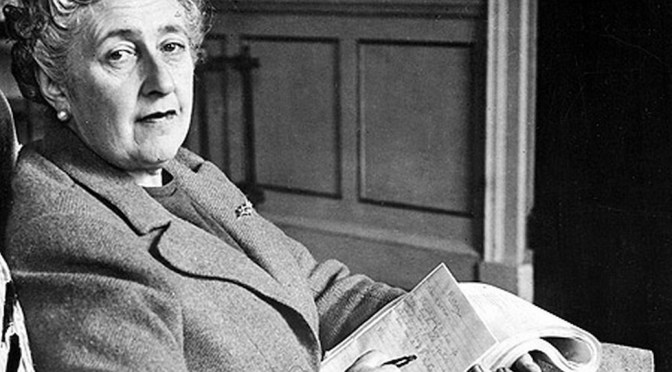
KEPT THEM GUESSING Dame Agatha Christie (1890-1976), author of over 100 crime titles.
A Writer’s first lesson in dramatic tension.
WHEN I was around six years old, mum bundled me and my siblings into the back of our station wagon and took us to the Inverell drive-in cinema. We were already asleep, so I don’t remember the start of the movie.
Much later I woke up, not because there was a particularly loud scene up on the big screen, but because it had gone uncharacteristically quiet. To a high-pitched, menacingly subtle soundtrack, figures, in the half-darkness, were focussed on some terrible task.
The movie was Sidney Lumet’s 1974 production of Agatha Christie’s iconic 1934 mystery novel Murder on the Orient Express. The onscreen figures were an array of 1970s movie stars. Silent. Deadly. Determined.
It was a powerful dose of dramatic tension for my young mind.
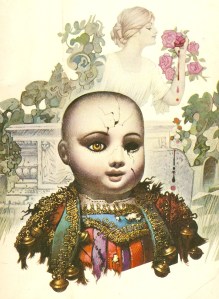
At the end of my final school exams, I picked up a Christie novel for the first time. It was By the Pricking of my Thumbs (1968). What attracted me was the cover illustration by Tom Adams – a cracked doll’s head with only one staring eye – an image dripping with the same dramatic tension.
Written very late in Christie’s career, this book is one of her ‘Tommy and Tuppence’ Beresford stories, the married amateur spies who aged with the author, and whom she used to give voice to much of the change her own generation faced across the 20th century.
They were never as famous as Hercule Poirot or Miss Marple, but the Beresfords took readers on adventures in the 1920s, through the espionage-rich 1940s, and featured in the last mystery story Christie ever penned – Postern of Fate(1973).
Heavy on atmosphere, By the Pricking of my Thumbs is a spooky page turner with plenty of sins of the past coming back to haunt the residents of a hidden-away village in England.
After months of research for exams, a murder mystery was exactly what I needed. It suited my propensity to dig up the past in my own home town, exploring the attics of old homes and the secrets they evoked.
COVER STORY Tom Adams’ cover illustration for Agatha Christie’s 1968 mystery By the Pricking of my Thumbs.
I began to spot Adams’ Magritte-like covers in the second-hand shops and book markets, and soon had quite a collection. There have been plenty of Christie cover artists, but I don’t think any have become quite so renowned for the job. Adams’ covers are masterpieces of illusion, with painterly, stylistic references running throughout.
Agatha Christie was a great exponent of plot, probably one of the greatest. Her use of the ‘slow reveal’, particularly in her most famous storylines (And Then There Were None in particular) became an intriguing hallmark in works that were never particularly long.
She undoubtedly suffered from over-exposure and publishing fatigue – for most of her career her work was sold annually as a ‘Christie for Christmas’. The sheer volume of her storytelling (well over 100 titles altogether) saw her create an oeuvre which has so far been unmatched in the crime genre.
Christie’s own life held mysteries of its own. In December 1926 she disappeared, leaving clothing and her car at a lonely place near her home in Berkshire. A nearby lake was searched to find her body. The newspapers were all over the inexplicable story of the popular crime writer who seemed to be the victim of foul play.
Eleven days later she was discovered at Harrogate Spa in Yorkshire, a great distance for someone who’d left her transport and spare clothes. Whether the entire incident was a publicity stunt or the result of a nervous breakdown linked to her husband’s infidelity has never been fully explained. Christie herself never wrote about it.
“She’ll always be remembered for leaving us wanting more about those 11 mysterious days, where dramatic tension left the realm of fiction for a fortnight.”
Vanessa Redgrave played Agatha Christie in the movie Agatha (1979), based on this affair. Redgrave’s performance goes a long way to unravelling the truth of a woman faced with abandonment and loss, who just goes away for a while to sort her head out. Dustin Hoffman played the newspaper-man who helps her do so. It’s an artful script by screenwriters Kathleen Tynan and Arthur Hopcraft, assisted by the complete absence of Christie’s own account of the same events.
What I really admire about Christie’s work is how well her dramatic tension translates to the screen. In the right hands, the results are iconic – Murder on the Orient Express (screenwriter Paul Dehn) and Death on the Nile (screenwriter Anthony Shaffer) are perennially popular big screen productions, renowned for their ingenious plots and memorable characters played by screen giants. The original books have sustained more than one screen adaptation, none of which cancels-out the others.
But sometimes, the results are only passable. Stewart Harcourt’s adaptation of By the Pricking of my Thumbs became a kind of unintentional mash-up under the banner of the MarpleITV series in 2006, when Miss Marple was planted into the storyline to assist Tuppence Beresford unravel the mystery.
It was a great shame, not only because Tuppence was rendered a rather lacklustre detective’s assistant (despite the excellent casting of Greta Scacchi and the fact that Tommy and Tuppence had starred in their own ITV series in the past – Partners in Crime in 1983), but also because Christie’s storyline was unrecognisable in the second half.
The lesson is this: don’t muck around with plot when adapting for the screen. Nuances can be altered, of course, but the course of events? Never. Christie’s skills in atmosphere and dramatic tension rarely wavered, even in her less popular works. They are a gift to screenwriters.
And the ultimate lesson she left for posterity? Well, that’s easy – she’ll always be remembered for leaving us wanting more about those 11 mysterious days, where dramatic tension left the realm of fiction for a fortnight, and possibly transformed an emerging writer into a storytelling giant. Perhaps her publishers always suggested she stay silent on the subject?




 Michael Burge Media