Category Archives: Rebels

Navigating prejudice – Matthew Flinders

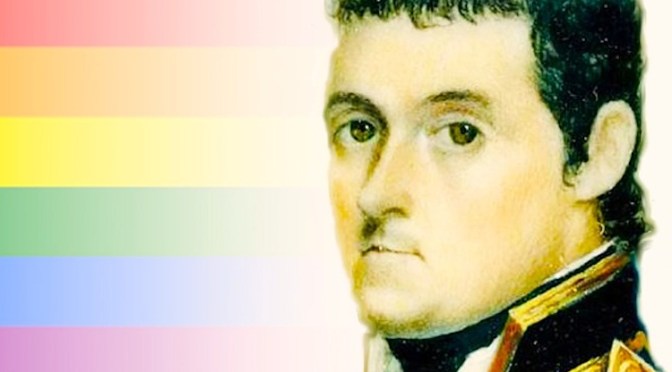
HELLO, SAILOR! Navigator Matthew Flinders (1774-1814)

SPECULATION about the sexual orientation of iconic English seaman Matthew Flinders rose like a colourful maritime flag over a decade ago when previously unknown letters surfaced, including emotionally charged passages written by Flinders to fellow explorer George Bass.

In his 2007 Meanjin article “Exploring love: did they or didn’t they?” historian Garry Wotherspoon asserted: “If the excerpts from Flinders’ letter to Bass had been written to a person of the opposite sex, we would be in little doubt as to what sort of relationship it was or what kinds of hope and expectation it had once contained”.

“It’s time to shift perspective and explore the homophobia Matthew Flinders encountered.”

“We would probably even confidently presume a sexual component in it, a basis in physical feelings if not actions. The possibility of a physical side to or a sexual element in Bass and Flinders’ relationship should therefore be acknowledged and considered.”

In the years since, little acknowledgement or consideration has been given to the sexuality of either man.

Historians are invariably baffled by Flinders in particular. Many of his extraordinary reactions lead them to describe such moments as out-of-character; but for anyone genuinely wanting to understand him, it’s time to shift perspective and explore the homophobia Matthew Flinders encountered.

Both Lincolnshire-born, Bass and Flinders met on a voyage to Australia in 1795 onboard the HMS Reliance. Once in the new colony, the two made a series of expeditions together. First it was short trips along waterways close to Port Jackson. Eventually, onboard the Norfolk, they circumnavigated Tasmania.

It’s tempting to paint all kinds of Brokeback Mountain-style possibilities for two unmarried men isolated on vessels in far-flung locations.

“There was a time, when I was so completely wrapped up in you, that no conversation but yours could give me any degree of pleasure …” Flinders wrote to Bass towards the end of this period, “And yet it is not clear to me that I love you entirely …”

Both men returned to England on separate ships in 1800 – the year of Flinders’ ‘love’ letter – and were married within six months of one another.

Bass soon left on a trading mission to the southern hemisphere in January 1801, leaving Flinders’ letter at home, where Mrs Bass – Elizabeth – had plenty of time to consider its contents and form the response she penned onto the letter itself.

“This, George, is written by a man who bears a bad character … no one has seen this letter but I could tell you many things that makes me dislike him,” she wrote.
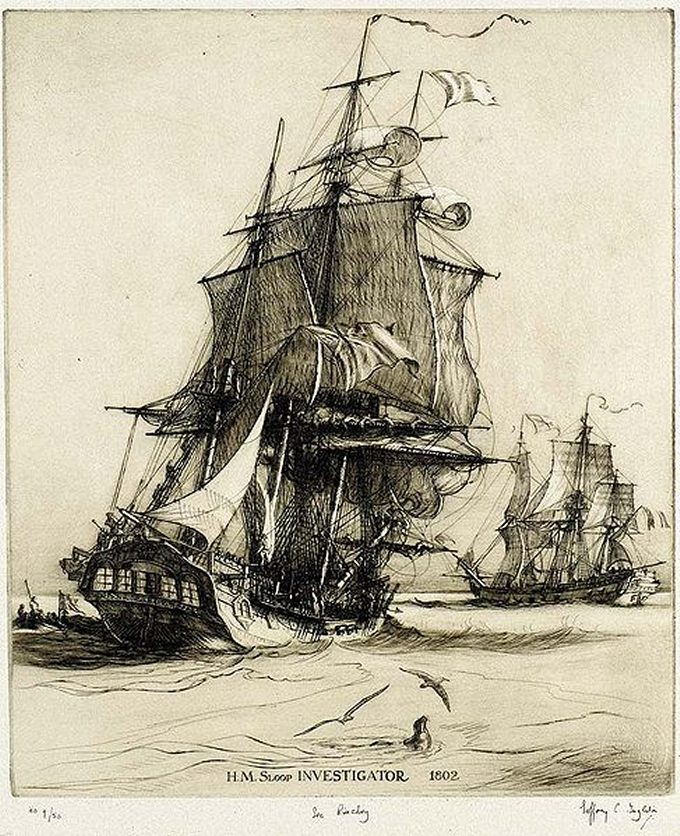
HMS sloop Investigator.
MARRIAGE VESSEL HMS sloop Investigator.

Her warning was given during a major turning point in Flinders’ life.

He shocked his friends and family by responding to a suggestion of marriage from a friend, Ann Chapelle, who he’d discouraged in previous letters.

Then he went so far as to invite her to return to Australia with him, keeping the reality of the Admiralty’s strict rules on wives from her until she was forced to get her things off the HMS Investigator and let him embark.

What the speed and the controversy of the marriage achieved was widespread gossip within the Admiralty and his circle that painted Flinders as a fervently married man.

Any Brokeback-style expeditions were off the cards in the following years for Bass and Flinders, whose paths did not cross again. Bass captained the Venus on trading jobs to New Zealand and Tahiti, while Flinders completed the first circumnavigation of Australia.

By the time the Investigator docked in Sydney in 1803, Bass had departed on the Venus bound for Tahiti and South America on a voyage for which there remains no known end – the ship and her crew all disappeared completely.

Flinders also had problems returning to his wife, when, in December 1803, he was arrested on the island of Mauritius, a French-held colony.

Much has been made of Flinders’ seven-year imprisonment at the order of Mauritian Governor Charles Decaen. The records revolve around spying accusations against Flinders and his incorrect passport, understandable concerns considering the English and the French were at war.

But what if homophobic whispers had pursued Flinders to the southern hemisphere? 
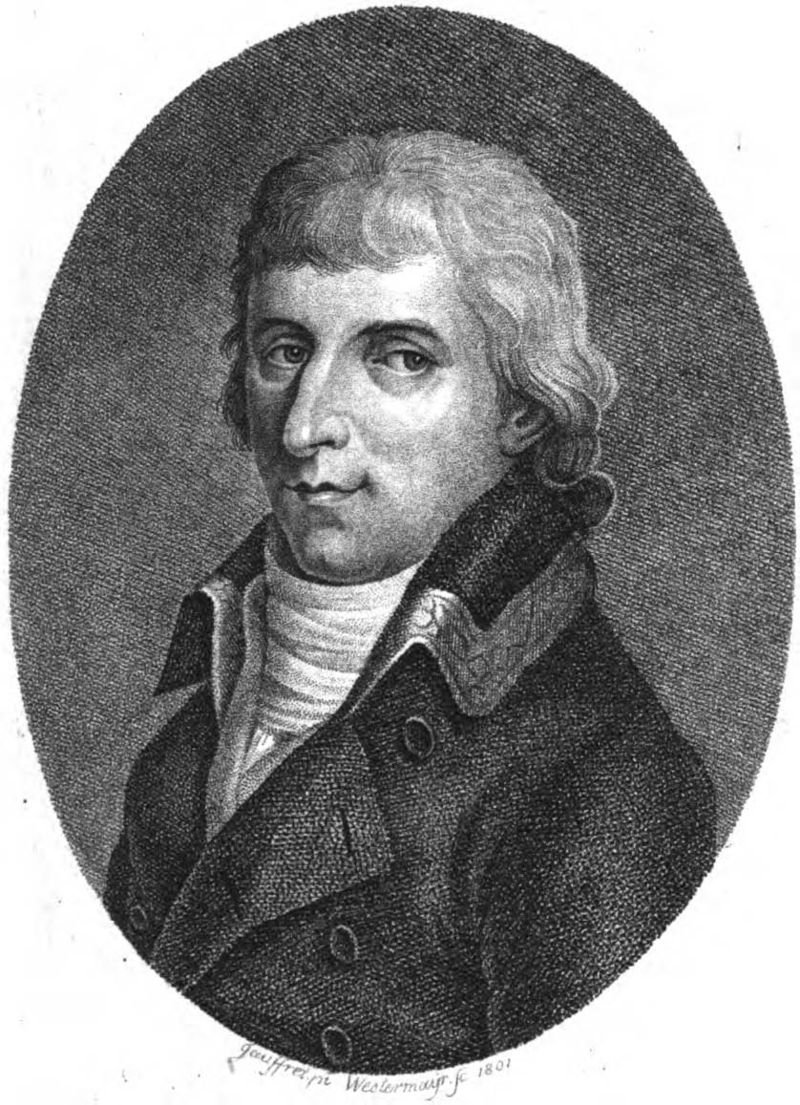
French Captain Nicolas Baudin.
CORDIAL CAPTAIN Nicolas Baudin in 1801. (Engraving from a portrait by Joseph Jauffret)

By the time Flinders limped into Mauritius in his damaged schooner the Cumberland, Decaen had heard of Monsieur “Flandaire”, probably from French captain Nicolas Baudin.

Baudin and Flinders had two previous encounters onboard Baudin’s ship, the Géographe, off the coast of southern Australia in early 1802.

After much flag-raising and shouting, when Flinders pulled the Investigator next to Baudin’s vessel and boarded, the men had the stilted, competitive discussion about charts and landmarks that has become folklore in the maritime history of both nations.

Researchers Jean Fornasiero and John West-Sooby had another look at the accounts of the Flinders-Baudin meetings in their 2005 essay A Cordial Encounter?

“Certain discrepancies between the accounts of the two captains are difficult to explain,” they wrote. “These have generally been attributed to communication difficulties between the French navigator and his English-speaking counterpart”.

“We do know Flinders ‘spat chips’ at Decaen for keeping him against his will.”

“This assumption, however, is far from self-evident. We have thus chosen to canvass the full range of possible explanations for the conflicting accounts of that meeting, including the hypothesis that Flinders, who is generally considered a reliable witness, may indeed have misrepresented his encounter with Baudin.”

But the one possibility they neglected was that Nicolas Baudin knew a homosexual when he saw one.

Eleven years prior to this encounter, the French Revolution recognised the existence of homosexuality when it left consensual, private sexual relations between two men out of the French Penal Code of 1791 (and again in 1810).

Before this, gay men could be burned at the stake if caught in sexual acts. As a consequence of the change, they were generally free to be themselves in public.

Compare that with Flinders’ place of birth, where, at the time of his meeting with Baudin, Henry VIII’s Buggery Act of 1533 still listed sodomy as a hanging crime. Consequently, writing love letters would only have been for the extremely courageous.

Baudin arrived in Mauritius, and died there of tuberculosis, just months before Flinders’ incarceration. Its doesn’t require a great leap to imagine him describing Flinders to Decaen as “pédéraste pétulant” instead of “un navigateur qualifiés”.

We do know Flinders ‘spat chips’ at Decaen for keeping him against his will, from letters the French Governor received from the explorer.

Decaen requested Flinders dine with he and his wife on the second day of Flinder’s detention. Flinders, who’d refused to remove his hat when he met the Governor, declined the olive branch and kept to his prison room dusting-off more missives.

His responses were so stinging that the Governor never repeated his invitation and kept this bird in a cage for a further seven years. 

The cage wasn’t entirely austere for Flinders – trips to the theatre and stays with local aristocrats, and parole for extended periods, took place in a civilised French colonial society which tolerated any gay rumours and allowed him to pass the time writing.

But Decaen maintained his personal control over Flinders’ detention, even contravening Napoleon’s 1806 directive to free the Englishman. The Governor’s excuse was the kind of blanket term used to beleaguer Oscar Wilde: Flinders was dangerous.

After his release and return to England in 1810, where he continued writing on his many groundbreaking explorations, Flinders’ ill health brought about his untimely death at the age of forty.

pluck-cover
BUY NOW

Yet his remarkable achievements resulted in inexplicable omission from the ranks of the Royal Society, the Admiralty’s old boys’ club that may, like Baudin, Decaen and Mrs Bass before them, have suspected the truth.

© Michael Burge, all rights reserved.

This article appears in Michael’s eBook Pluck: Exploits of the single-minded


Lest we object

co-postcardHow a century of war gave rise to conscientious objection.

BURIED not far beneath the commemoration of the Anzac Day centenary is a silence into which few voices will respectfully speak.

I join those few not to disrespect the First World War fallen and those who remember them – the slaughter and waste of war is too indelible to play word games with – but to fill a few silences alongside an international movement on a trajectory to one day rival Anzac.

My journey of discovery started where the Anzac legend was handed over by the last servicemen who carried the baton – with Britain and Australia’s oldest living First World War diggers.

“This Anzac centenary, it’s probable we will not hear the words ‘conscientious objector’.”

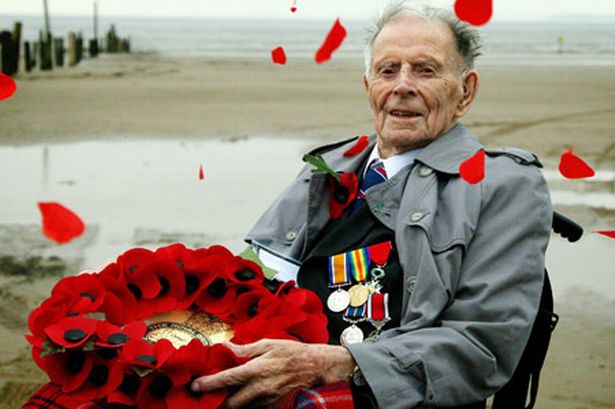
Both Claude Choules, and Harry Patch lived to within a few years of the Gallipoli centenary, long enough to share potent memories and deeply felt convictions about something which barely rates a mention on the day we have loaded with a century of war – they came to make no secret of their pacifism.

For half the time Australians have been rising early on Anzac Day for dawn services, followed by marches, church services and games of two-up at the pub, Claude ‘Chuckles’ Choules refused to join the remembrance.

If anyone had a right to march, it was Claude. After lying about his age to get into the armed forces, he served in Britain’s Royal Navy in the wake of two brothers’ service at, and survival of, Gallipoli.

He subsequently served with the Royal Australian Navy during the Second World War, settled here, and, after fifty years of service, took up fishing and ballroom dancing.

It was left to his children to articulate his feelings about armed conflict, not long before his death in 2011.

“He used to say that while he was serving in the war he was trained to hate the enemy, but later he really grew to understand that they were just young blokes who were the same as him,” Claude’s son, Adrian Choules, said.

“He said wars were planned by old men and fought by young men and that they were a stupid waste of time and energy.”

Harry Patch used much stronger language. “War is organised murder, and nothing else” this British tommy (or ‘digger’) asserted to former British prime minister Tony Blair in a BBC television documentary.

FIGHTING PACIFIST Lance Corporal Harry Patch.

In the thick of the Western Front for months, Lance Corporal Patch saw his comrades torn apart, times he waited almost a century to recount when working on his book The Last Fighting Tommy, published shortly before his death in 2009.

Both Patch and Choules broke ranks publicly about the realities of combat only when enough time had passed that they must have wondered what the point of their service had been in a world still intent on waging war.

But there were many others who did not stay silent so long.

This Anzac centenary, it’s probable we will not hear the words ‘conscientious objector’ uttered much in the mainstream coverage.

Those who declared their disagreement with government war policy – often known as ‘C.Os’ or ‘conchies’ – faced imprisonment, torture, hard labour, capital punishment, and widespread public shaming throughout the wars of the twentieth century.

Often refusing active service on religious grounds, conchie stories are often limited to shadowy characters in war dramas, opening anonymous envelopes to white feathers, labelling the recipient a coward.

BEARING WITHOUT HARM Stretcher bearers on the Western Front, 1917.

The mythmaking masked a variety of reasons men would not willingly succumb to war recruitment. Many went to war but bore stretchers instead of arms, or worked in field hospitals, where it was not always possible to escape the labels.

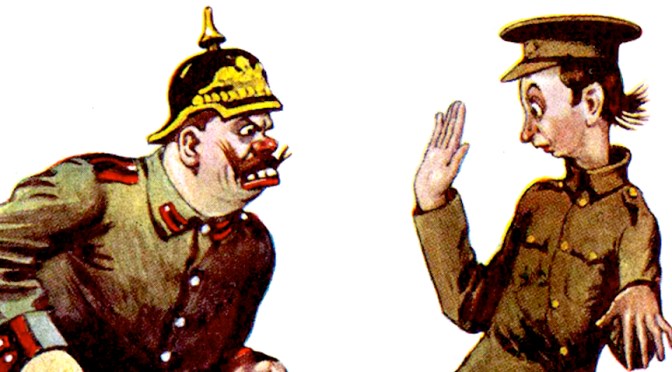
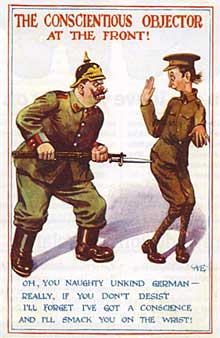
Governments with conscription legislation during the First World War, such as Britain and New Zealand, pilloried conchies with a level of desperation. The limp-wristed charicatures in the propaganda made little secret of the homosexual aspersions cast on men who refused to fight.

This, despite the many gay men who willingly served in theatres of war.

For those who agreed to fight but eventually abandoned their posts, the death penalty was a stronger disincentive, although Australia’s anti-conscription stance (despite two closely fought referenda under Prime Minister Billy Hughes) meant Australia’s voluntary forces were not subject to being shot for desertion, like hundreds of British and five New Zealanders.

Instead, Australian deserters’ names were published in the newspapers.

Despite the efforts to stamp out the conscientious objection movement, it became so potent after another war that the world slowly started to wake up to the concept of pacifism as a choice.

It took the definition of what constituted a war crime. At the Nuremberg Trials of 1945-6, carried out by the International Law Commission of the United Nations, a much firmer legal entity was defined for the refusal to participate in conscripted killing.

By the Vietnam War, conchies began a serious coming out process. The most famous of this era was Muhammad Ali, who said of his resistance to being drafted: “I ain’t got no quarrel with them Viet Cong, no Viet Cong ever called me Nigger.”

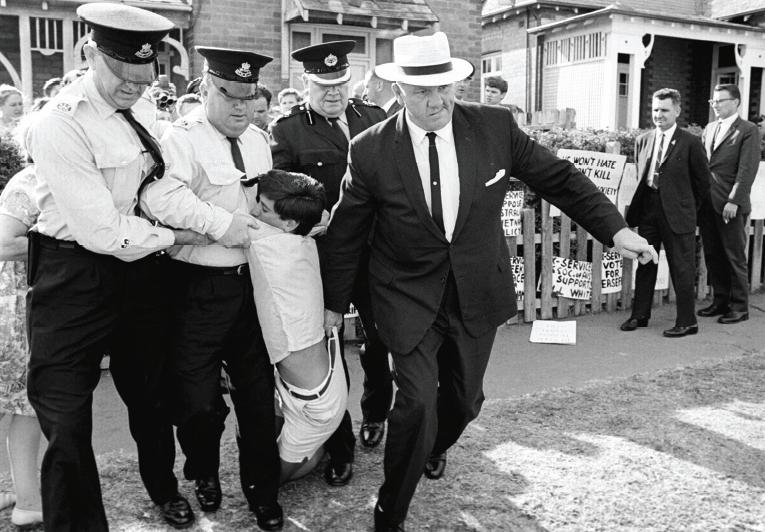
Australian teacher and conscientious objector William White made a stand in Sydney in 1966 when he refused to report for military service under Australian conscription laws.

OBJECTION OVERRULED William White's arrest in Sydney, 1966.
OBJECTION OVERRULED William White’s arrest in Sydney, 1966. (Photo: John Fairfax)

“I am opposed to a state’s right to conscript a person,” White said. “I believe very strongly in democracy and democratic ideals, and I believe that it is in the area of the state’s right over the life of the individual that the difference lies between totalitarian and democratic government.

“My opposition to conscription, of course, is intensified greatly when the conscription is for military purposes. In fact the National Service Act is the embodiment of what I consider to be morally wrong and, no matter what the consequences, I will never fulfill the terms of the act.”

White’s voice added fuel to the Moratorium Protests that swept across Australia in May 1970, when an estimated 200,000 people marched to end the Vietnam War.

His image, being dragged by a pack of police from his home, caused embarrassment to authorities but embedded a greater sense of resistance in ‘the conchie’ than the cartoons disseminated fifty years prior.

Thirty years after White’s imprisonment, conscientious objection was ratified in a United Nations Commission on Human Rights resolution, which was subsequently extended to include those already serving in military forces who “may develop conscientious objections.”

On May 15, the annual commemoration of the world’s conscientious objectors will take place. It’s an international grassroots movement allied to other twentieth century groundswells in racial, gender and gay rights.

Many Australians have a conchie in the family, and it is fitting we remember them too.

But it’s Anzac Day first, a day on which it’s only fair to leave the last word to someone who was able to join the dots between fighting and objecting – Harry Patch.

creating-waves-cover
BUY NOW

“Politicians who took us to war should have been given the guns and told to settle their differences themselves.”

© Michael Burge, all rights reserved.

This article appears in Michael’s eBook Creating Waves: Critical takes on culture and politics.

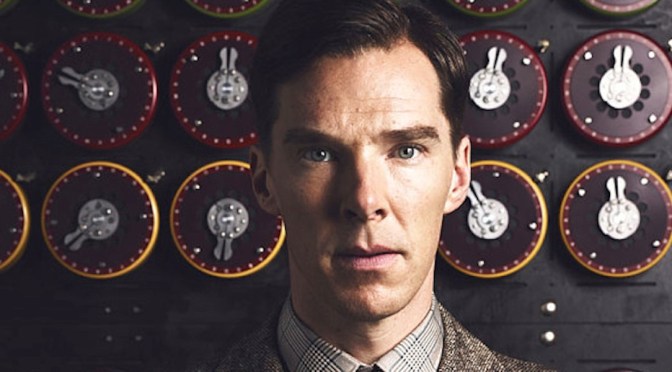
Heartbreaking enigma of The Imitation Game

CODEBREAKING ENIGMA Alan Turing (1912-1954).

THE first time I tried to see The Imitation Game with my husband, the session was solidly booked out.

On the surface I was annoyed, but deep down I was incredibly pleased, knowing that a full house of holidaying Australians was being exposed to the story of Alan Turing, code-breaker, computer innovator and gay man now transfigured by time into an unassailable hero.

At our second attempt, we booked but ended up in seats down the front. Craning my neck up at the enormous screen, I realised something in me still could not quite come to terms with how this film’s gay protagonist garners such excellent box office.

I’ve known Turing’s story for many years – I feel his tragedy keenly as one of the first generation that missed out on electro aversion therapy and chemical castration by a fraction of time.

“When you have to wait more than 20 years between screen heroes, you realise how straight audiences take theirs for granted.”

Seeing the way he trounced the entrenched straight male fraternity at Bletchley Park, as his keen mind turned the tide of a terrible war, all the while knowing how betrayed he would be by those he saved… well, it was heartbreaking.

His legacy was all the fuel I would have ever needed to overcome fear and just be myself as a teenager, standing on Turing’s shoulders.

Yet the very nature of his achievement – hidden and classified – took him from my generation until it was too late. So many of us slipped easily and quietly into our own closets and codes, fashioned in the shadows of sodomy laws and HIV/AIDS.

We silently air-punched for our beloved Alan Turing from our ridiculous seats. We lionised him, raised him up without hesitation, even though we knew we weren’t seeing the whole truth in Graham Moore’s excellent debut screenplay.

Plenty has already been written about the inaccuracies of The Imitation Game – you’ve got the usual casting concerns, like Keira Knightley not being a plain enough Joan Clarke; the wrong name for Turing’s Enigma-breaking machine; spurious spies and an exaggerated antagonist in Commander Alastair Denniston.

But to focus on all that is just so much dissembling avoidance.

Not since Tom Hanks’ performance in Philadelphia (1993) have screen audiences been exposed to a three-dimensional gay protagonist in a mainstream drama. I don’t count Brokeback Mountain – those cowboys were not even out to themselves.

Why is this so important? Well, because when you have to wait more than 20 years between screen heroes, you realise how straight audiences take theirs for granted.

It wouldn’t matter how much they altered the margins of Alan Turing’s life story, or shuffled facts to make a workable three-act plot structure, the fundamentals are not up for debate and need little embellishment. The Imitation Game is true to the man’s core experience. His tale follows the very equation of heroism.

Yet the film has its detractors. Films with gay heroes will inspire unsettled, contrary resentment until all the fairytales behind the great archetypal stories and their happy ever afters get rewritten and rediscovered, until they allow for all human experiences.

BROTHERLY LOVE Tom Hanks in Philadelphia.

Also preying on peoples’ enjoyment levels is the fact that The Imitation Game is a tragedy. Like Philadelphia, there is no other possible outcome for the protagonist than one in which Turing is worse off than where his story started.

But this is not Hollywood killing off the queer to make a point: it’s the truth. The untimely death of anyone, even gay geniuses and HIV/AIDS sufferers, hurts like hell, and most of us are only just letting such feelings in.

To fully understand it, this film is best compared with Fred Schepisi’s A Cry in the Dark – the story of Lindy and Michael Chamberlain, accused of killing their baby daughter Azaria at Uluru in 1980. Another relentless real life miscarriage of justice that made audiences finally look at the awful truth via nothing more complex than a recreation of the salient facts.

These stories cannot be assimilated in a two-hour cinema experience. They are in our minds before we buy our tickets and they linger long after our popcorn is finished. They are bigger than whether we like the movie or not.

The cause for hope is that the Chamberlain’s complete exoneration was due, in part, to writers and artists adapting their story and exploring it in multiple forms, just as Alan Turing’s WWII service was rediscovered by writers and artists long before the British establishment posthumously overturned his gross indecency conviction.

creating-waves-cover
BUY NOW

And now the push has begun in Britain for the pardoning of the tens of thousands of similarly convicted gay men.

© Michael Burge, all rights reserved.

This article appears in Michael’s eBook Creating Waves: Critical takes on culture and politics.