Category Archives: Rebels

John Tebbutt – southern stargazer

images
NOTING TEBBUTT John Tebbutt (1834-1916) on Australia’s first one-hundred-dollar note.

A Writer’s encounter with a scientist’s story

I’D already seen the mysterious Tebbutt’s Observatory from a horse-drawn carriage tour of Windsor, in NSW’s Hawkesbury region. The combination of the rhythm of my ride, and the mist rising off local fields on a warm spring morning, gave this encounter a magical feel, as the low-set, Grecian-style string of buildings that comprise Tebbutt’s workplace appeared, dominating the Colonial landscape of this part of the Hawkesbury without needing to try at all.

As soon as I had the opportunity, I went to have a look for myself, and encountered the descendants of astronomer John Tebbutt (1834-1916) in their ongoing custodianship of his life’s work. This article was published in Blue Mountains Life (Aug-Sept 2010).

TEBBUTT'S TELESCOPE John Tebbutt (1834-1916) and the telescope which he used to chart the return of Halley's Comet in 1986.
TEBBUTT’S TELESCOPE John Tebbutt (1834-1916) and the telescope used to chart the return of Halley’s Comet in 1986.

Southern stargazer

Inside the Hawkesbury observatory of John Tebbutt

As a Windsor school boy who showed a flair for astronomy, John Tebbutt also had the good fortune to grow up in a home with excellent views of the southern sky at night – Peninsula House.

Completed c.1845 and set on a low hill overlooking the major bend in the Hawkesbury, to the present day the property (and the three observatories Tebbutt designed and built) have commanding views towards all points of the compass.

For the lad who went on to discover two comets and create a critical mass of astronomy in the southern hemisphere, early stargazing took place on the verandah of Peninsula House, which is still in the Tebbutt family today.

“It’s well known my great-grandfather set up his first marine telescope on the verandah of the main house,” current owner John Tebbutt outlines, “but the only remaining verandah faces due north, whereas the southern sky was his domain. When you come to think of it, he must have set-up on the southern side of the house which has long since changed.”

Peninsula House and the two remaining observatories emerge from the mist of a typical Hawkesbury winter morning, as John Tebbutt and daughter Angela lead the way into the workplace in which their ancestor spent thousands of hours making accurate celestial observations and recordings.

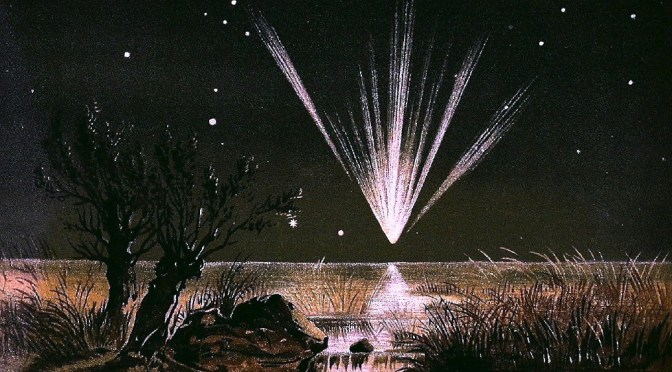
COMET COMING The Great Comet of 1861, on Tebbutt's radar in Windsor.
COMET COMING The ‘Great Comet’ of 1861, on Tebbutt’s radar in Windsor.

Tebbutt’s achievements in astronomy are well-documented.

Just shy of his twenty-seventh birthday, before acquiring complex telescopic equipment or building a designated observatory, Tebbutt discovered the ‘Great Comet’ of 1861 and accurately predicted that the Earth would pass through the visible tail, news which created a wave of mild hysteria in June of the same year.

The discovery led to the building of his first weatherboard observatory in 1864 (demolished in the 1930s), and, by 1879, the beautiful brick observatory which still stands.

Although Tebbutt never left Australia, “he would have read about designs from overseas,” the current John Tebbutt outlines as we stand before the two neo-classical porticos of his grandfather’s 1879 observatory.

Reminiscent of the Royal Observatory in London (hotbed of all things astronomical and timekeeper of the western world), Tebbutt’s Observatory served a similar purpose.

“For many years he provided a time service for Windsor,” John says, “and many believe he wanted to create the equivalent of Greenwich for the southern hemisphere.”

That’s easy to believe looking through the beautifully designed brick buildings, appearing like Greek temples in the distance as you approach the property.

“There were many more statues,” Angela Tebbutt explains, “but this one of Atlas is the last one we have.”

Accessed through two heavy iron doors is Tebbutt’s library.

“We found the doors below inches of dirt in a shed,” John explains, “and for a while we weren’t sure what they were, then we realised they fit these door frames exactly. They were for security, because he housed quite a collection of books and instruments here, spending hours making his observations, and would often have to leave the instruments for a period of time. For the accuracy of recordings, things needed some protection.”

“He also had seven children,” Angela laughs, “and we think he liked to keep things safe from them.”

Heavy iron doors seem like overkill when protecting recordings from little fingers, and when I inquire as to whether any significant event might have made Tebbutt wary, both John and Angela immediately talk of the fire which destroyed the property’s granary, thought to have started in an outdoor oven. The full-brick walls and iron doors of Tebbutt’s library speak of someone who knew the consequences of losing irreplaceable work.
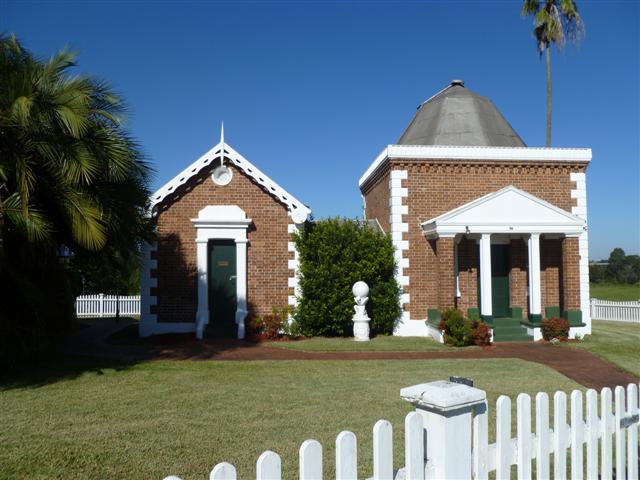
GRECIAN-STYLE Tebbutt's Osvervatory (Photo: http://convictstock.wordpress.com/
GRECIAN-STYLE Neo-classical facades of Tebbutt’s Observatory (Photo: convictstock).

Between the two main structures of the 1879 observatory is Tebbutt’s transit room, aligned like everything else on a true north-south axis.

This leads through to a room in which a large pier is the central feature.

“We rebuilt that,” John remembers, “because it had been removed for the tenants. It sits below where the large telescope was on the top floor, but it’s not particularly weight-bearing. It’s more for preventing too much vibration in the building when taking readings through the telescope.”

The current John Tebbutt inherited the property from an uncle in the 1960s, and set about restoring the observatories during the astronomical renaissance prior to the return of Halley’s Comet.

“He came out of retirement for Halley’s in 1910” John explains, “and worked on predicting the path for its return in 1986. By then he’d appeared on Australia’s first one hundred dollar note, and there was interest from the local council in restoring his place in our history before the Bicentenary.”

John regales the story of finding his grandfather’s Irish ‘Grubb’ equatorial telescope, which was sold after Tebbutt’s death in 1916 and ended up at an observatory in New Zealand.

“Councillor Rex Stubbs had a lot to do with getting it back here,” John remembers, “they organised to have it flown back by the RAAF in a training exercise, then trucked from Richmond Air Base out here. Exactly a century since my grandfather set the telescope up here in Windsor, it was returned.”

Tebbutt’s 8-inch equatorial refractor is now housed in his third observatory, a more primitive structure now half hidden by greenery, speaking less of Greenwich-like aspirations and more about the sheer hard work observing and recording Tebbutt completed once he was able to see further into the universe (in all directions) than he had before.

“I think we came pretty close,” John says when I ask if he achieved what he set out to do with restoring the setting of his great grandfather’s life’s work.

“People who used to live here have come back for weddings or other events, and they can’t believe what it now looks like,” Angela adds.

© Michael Burge, all rights reserved.

Katie Webb and the cave girls

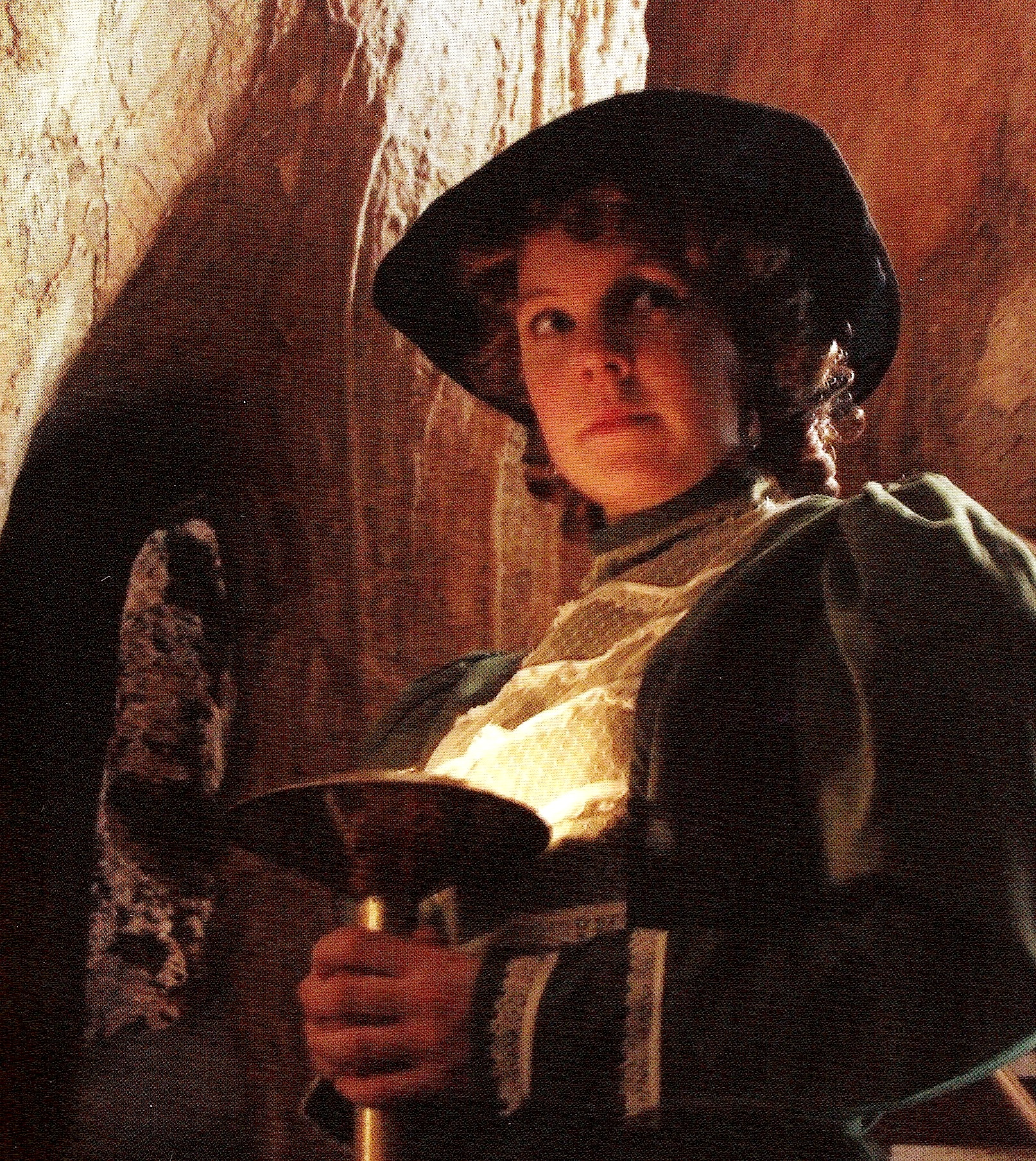
THE CAVE GIRLS An image which may include Katie Webb, her sister and mother.

A Writer’s day job leads to an encounter with a legend.

IN late 2008 when I trained as a guide at Jenolan Caves, probably Australia’s best-known cave system, I embarked on a fascinating journey.

Jenolan is a world of its own, with its own folklore, and within the network of caverns resides a collection of intriguing stories.

“I was enveloped in a dreadful skirt that made me look like some disreputable old charwoman.”

For a theatre worker, the task of taking tickets at the door, leading guests on adventures in the dark, retelling stories, playing with light and sound to enhance the experience, in underground chambers of acoustic perfection, often followed by a round of applause, felt like a return to the magic backstage world of a real theatre.

Jenolan guides, when I trained, were given little written material on the history of the place. We needed to glean the legends of the caves from our more experienced peers. I realised very quickly that the men and women who hold Jenolan’s stories were taught the same cycles by their peers, and that I was being given access to a unique oral history with a very immediate link to the past.

The story which intrigued me the most was that of Katie Webb, and her cave exploring sisters, long ago dubbed ‘The Cave Girls’.

This article was published in Blue Mountains Life (Vintage Press) in October-November 2010.

CAVE ART Possibly the earliest surviving image of the Grand Arch of Jenolan Caves, known in 1861 as Fish River Caves.

What Katie Did

The Legend of Katie Webb & Jenolan’s female explorers.

Of his visit to Katie’s Bower in Jenolan’s Left Imperial Cave during the 1880s, Samuel Cook wrote: “Descending 14 steps into the Bower there is a fountain full of lime-water, and a plate suitably inscribed conveys the information that Katie’s Bower was discovered on the 7th February, 1881, by Jeremiah Wilson (guide), C. Webb, H. Fulton, C. West, J. Bright, E. Webb, E. T. Webb, J. Thompson, W. H. Webb, E. Bowman, W. Thompson, J. M’Phillamy, R. Thompson, J. Webb, and S. Webb. The before-mentioned gentlemen were the first to enter the Bower after its discovery”.

Despite the placement given to Jeremiah Wilson, persistent legends credit the second name on the list – ‘C.Webb’ – with the discovery of the chamber.

This person was not a ‘before-mentioned gentleman’, but Catherine, or ‘Katie’ Webb.

For the 170 years that Jenolan has attracted tourists, there has been a hunger for guides to interpret their mysteries, and cave discovery tales rank amongst the most retold.

Years of tradition have made Jenolan’s guiding staff into the keepers of the Caves’ stories.

Rebecca Lewis has been a Jenolan guide since 2006, and has collected information about the first woman credited with the discovery of a Jenolan cave.

“This story is all oral history, and it varies depending on who you talk to,” Beck says.

“I believe Katie and her family were visiting the Left Imperial Cave (the original name of the Chifley) with Jeremiah Wilson, who had discovered the cave the year before. The group was admiring the beauty of the Lucinda Cave, named after Jeremiah’s wife. Jeremiah was about to lead the group out, but Katie, about 19 at the time, decreed that she did not wish to return the way they entered. Instead, she wished to continue down a large and steeply sloping passage that none had yet been down. Jeremiah, who was a curious man himself, decided to lower her down the passageway with a rope tied around her waist. With only a candle to light her way as she slid down the passage into the unknown, she found the largest chamber yet to be discovered in that area.”

Katie Webb was not the first female explorer at Jenolan. Thirty years before, legend tells of the caving exploits of Jane Falls.

“Everything we know about her is basically guesswork from piecing together the signatures she left behind in the caves,” Rebecca explains. “It was common practice for the visitors of her time to sign their names on the cave walls to prove they had been there, like leaving our names in a visitors’ book today”.

“The most talked-about signature of Jane is at a place called ‘Signature Rock’ in the Elder Cave (also referred to as ‘The Plughole’).

“The signature reads ‘J Falls 27th December 1854’,” Beck outlines.

“The interesting fact about this particular signature is that she did not sign her name ‘Jane’. She probably did this because she knew it might not remain on the rock if passing visitors realised it was a woman who wrote it. Writing ‘J. Falls’ leaves the assumption that the writer was a male. We know it is Jane’s signature because we have found her name in other caves and we can match dates and handwriting.”

One appearance of a ‘J. Falls’ signature has challenged the discovery of Jenolan’s popular Lucas Cave.

“A signature of hers remains in the original entrance of the Lucas Cave, known as the ‘Sole of the Boot’. It’s been sighted many times over the years, however, every time we mount an expedition to photograph it we cannot relocate it to do so!” Rebecca says.

According to some guides, the signature is dated 1858, predating the established discovery of the Lucas Cave by Nicholas Irwin and George Whiting by two years.

While researching for newspaper reports of the Lucas Cave’s discovery (which might clear up the mystery), Jenolan guide and historical researcher, David Hay, found that the originals in Sydney’s Mitchell Library have disappeared. “It’s almost as though someone pinched them,” he laughs.

Tantalising myths and very little evidence leaves us to explore the possibilities.

CAVE DISCOVERER Catherine 'Katie' Webb, the woman who discovered Jenolan's Chifley Cave in the 1880s.
CAVE DISCOVERER Rebecca Lewis as Catherine ‘Katie’ Webb, the woman who discovered Jenolan’s Chifley Cave in the 1880s.

“‘The Cave Girls’ is a name that was given to a group of women in an old photo and the name just kind of stuck!” Rebecca explains.

“The thing that we all find interesting is that they are all wearing men’s clothing! We don’t know for certain who any of the women are, but we believe Katie and her sister Selena are amongst them.

They must have been fairly influential women for their time not only to be wearing men’s clothing in the first place, but to also have a photo taken wearing them.”

Comparison with later photographs suggests Katie and Selena (known as Nellie) are the central figures seated on rocks, with their mother (also Selena) standing at the left.

Katie Webb’s father Edmund Webb accompanied his family to Jenolan on the day of Katie’s discovery – his name and those of Katie’s siblings Selena and Edmund Thomas Webb appeared on the plaque seen by Cook.

Webb was a prominent Bathurst businessman and politician, whose empire included the supply of clothing, footwear and millinery to the Central West. The uniform clothing of the three women at the top of the ‘The Cave Girls’ image might indicate they were supplied by Webb specifically for the purposes of cave exploration.

In her often humorous Letters from Samoa (1891-1895) Margaret Stevenson (mother of writer Robert Louis Stevenson) sheds light on how visiting female tourists were attired at Jenolan.

“We had to take off our good dresses and get the loan of dirty old clothes; Miss B- wore a pyjama suit, and made a very nice boy, but I absolutely declined to go to that length of juvenility. In consequence I was enveloped in a dreadful skirt that made me look like some disreputable old charwoman.”

Described as a “dedicated Wesleyan Methodist”, if Edmund Webb was anything like American Wesleyans, the rights of women would have been firmly entrenched in his family principles, enough for his daughter’s name to be forever linked with her discovery in the way Jane Falls’ may not have been.

The plaque observed by Cook in the 1880s is long gone, but a signature which may be Katie’s remains by the steep entranceway to her bower, reading ‘C. J. Webb’.

In what is now known as ‘Upper Katie’s Bower’, someone wrote ‘Katie’s Bower’ and the date matching the plaque. The original floor level below the writing was lowered in the 1920s to allow for a new exit from the cave. Allowing for this alteration, the writing would originally have been about the right height for a young woman to record her own name and the date of her discovery.

Jenolan guides’ oral histories vary on the approach Katie took from Lucinda’s Cave into the bower which still bears her name, with two possible routes.

One is the steep slope with a very deep chasm at the bottom (now followed by the stairs). The other is a hole below what is known as Lucinda’s Column, which requires a significant abseil.

The two dates recorded allow for the possibility that Katie’s discovery over more than one day’s exploration, and that both passageways were attempted.

And what did Katie do next?

Another name on the original plaque was ‘E’ or Ernest Bowman, the man Katie married just over a year after her discovery of Katie’s Bower. The two lived their married life in the Central West, and as Catherine Bowman, Katie was awarded an MBE in 1924 for “her many years of devoted service to the community”. In 1925 she and her daughter were presented to King George V at Buckingham Palace.

The next time a woman was credited with the discovery of a cave at Jenolan was almost 130 years after Katie.

“Deborah Johnson, a member of the Sydney University Speleological Society, discovered a cave in Jenolan’s Southern Limestone in January 2009,” Rebecca explains.

Within Jenolan’s Guides Office an honour board lists long serving guides back to Jeremiah Wilson. Both men and women are identified only by their first initial (the same as most signatures on cave walls), making it hard to identify the first female guides employed in the 1980s.

CAVE GIRLS 2
CAVE GUIDES Rebecca Lewis (top, middle) and a group of long-term female cave guides.

“It wasn’t until 2005 that the number of female and male employees reached equilibrium, with female staff undertaking all the same regular duties as male staff,” recalls Domino Houlbrook-Cove, who started as a guide in 1989 and is now manager of corporate, functions and events.

On occasion, visitors to Jenolan can still experience the courage of Katie Webb, played by Rebecca Lewis on a history tour.

“It’s so much fun! I get a great response from people who even today are amazed at what Katie did, especially for her time,” Beck enthuses. “People love stepping back in time to do a tour with someone from that era. I find I get asked more questions about the women cavers when I’m dressed as Katie than what I do when I’m guiding normally”.

“Jenolan has been a great place to work for a number of reasons. Mainly, though, it keeps you on your toes. It’s never like giving a speech where the words are there in front of you, you have to always be ready to answer any question that comes your way. It means you have to hold a huge store of information ranging from geology to history to everyday guiding and maintenance activities. You’re always learning and updating your information as a guide, not to mention ~the physical side of things.

“Of course the Cave Girls, whoever they were, would have all been great cavers, there is no doubt about that! Women make great cavers, and we have proof of that today.”

pluck-cover
BUY NOW

Thanks to Jenolan guides David Hay (cultural initiatives) and Keith Painter for historical information. Details about Catherine Bowman from ‘Written in Gold: The Story of Gulgong’ by Eileen Maxwell (1978).

© Michael Burge, all rights reserved.

This article appears in Michael’s eBook Pluck: Exploits of the single-minded


Janet Mays – forging Independence

INDEPENDENT THINKER Former Blue Mountains City Councillor, Janet Mays.

A Writer’s encounter with politics.

THE first political piece I ever wrote was also the first scoop I ever got.

I was a resident of the Blue Mountains for thirty years, give or take my years at university and a six-year stint in the United Kingdom.

By the time Blue Mountains City Councillor Janet Mays stood for the NSW State elections in 2011, I was on the bandwagon of change for an area I loved deeply.

It was time for us to cease being a political football, an electorate that churned-out state and federal backbenchers who shored-up the numbers in parliament but stood for very little locally.

Janet burst onto the region’s political scene with a compassionate assertiveness that started to wake people up, the same way voters seem to have become aware of the two-party power shenanigans in the Victorian federal division of Indi, where Independent Cathy McGowan toppled the sitting member for the LNP, Sophie Mirabella, at the federal election in 2013.

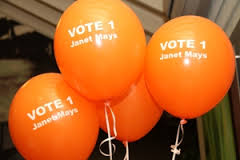
She took a fifth of the primary vote from the major parties, and lost the seat in a State intent on nothing but ridding itself of the ALP, but Janet Mays used orange for her Independent campaign colours when Voice for Indi was just a whisper of frustration. It’s a fitting symbol of her link to the groundswell of Independent thinking rising across Australian electorates.

This feature was published in the October-November 2010 edition of Blue Mountains Life.

ORANGE MOUNTAINS For one Summer, the Blue Mountains toyed with changing colour.

The Long Walk to Independence

From cafés and cars to the footwork of politics, meet Janet Mays.  

Janet Mays knows her way across the Blue Mountains better than most. In November 2009, she led the Health, Equity & Access Lobby (‘HEAL’) on a walk covering the fifty kilometres between Katoomba and Nepean Hospitals. The ‘It’s a Bl**dy Long Way to Nepean Hospital’ walk was designed to throw light on declining hospital services at Katoomba, and HEAL ignited a movement which is taking more than footsteps in the region.

“We were frustrated at the way nothing was shifting. We’d gathered a lot of support around bringing primary health services back to Katoomba, but there was very little action,” Janet says. “No one is demanding the government provide open heart surgery at Katoomba, but it’s not too much to expect basic surgery at your local hospital, like an appendectomy.”

In 2007, Janet experienced first hand a hospital system which was simply not functioning. “As someone who’d lived in the Mountains for a few years, I just assumed I could have my appendix removed locally,” she says. “At Nepean I had to wait twenty-seven hours for primary care on two occasions before they diagnosed the problem was simply appendicitis. It was so traumatising at some level, having to come home and then go back again, like Groundhog Day”.

“I knew intuitively that the removal of my appendix could have been done locally, if the will was there.”

Janet’s search for that will saw her take out a full-page letter in the local newspaper, gathering support from a number of groups and individuals concerned about similar issues. From this, HEAL was born.

“I also spent two years visiting council meetings. I listened to the debates and gained an understanding of how it all worked. This cemented a desire to eventually get onto the Blue Mountains City Council, in order to understand and represent the views of the community.”

In 2008, Janet was elected as an Independent Blue Mountains City Councillor. When asked about her first time in the chamber, she recalls: “It was like being let off a leash as a resident, but also very daunting. I knew I had it in me. I’d been involved in plenty of drama and music as I grew up. Part of being a politician is articulating a message in the same manner as a performer does”.

“It is hard as an independent to get support. You have to be very eloquent in prosecuting your case to the other councillors. When I am going to debate, I research the facts so that I gain an understanding of both sides of an issue.

MOUNTAIN VIEWS Janet Mays awoke an Independent movement in the Blue Mountains.

“Ward One might be my patch,” Janet says, “but I am required to vote on issues across our entire region, so I need to get out there and familiarise myself with the issues. As a true independent I don’t believe I have any choice. I don’t have the luxury of party colleagues informing me of anything, so I need to listen to people up and down the Mountains”.

“I sometimes change my mind on issues when I do the research or consult an expert. Being an independent can get lonely sometimes, but it’s also very exciting.”

Born in Melbourne, Janet was raised and schooled in Canberra.

“It does heighten your political interest,” she says, “at least it did then. My Dad was in the public service, and so were friends’ parents. Politics were discussed around the dinner table every night. That was part of the Canberra culture.”

After running her own café for many years, Janet, “stumbled into a career in and around the automotive industry, spanning twenty-four years.”

Like many other Mountain residents, she and partner Jocelyn Street purchased a Mountains weekender which soon became their permanent home in 2003.

“After a very short time we both realised that Sydney is not that far away, so we said ‘bugger the commute’ and settled here. Commuting is tiring,” Janet adds. “We do it for economic reasons, but it can separate you from your community. I work four days a week in the city and I travel up and down every day, which allows me time for my council work.”

The death of her father a short time before the move seems to have been more of a defining moment than Janet is prepared to reveal. “It left me unsettled as a person,” she says of a period when she and Jocelyn also committed to their de-facto relationship. “We have very similar family backgrounds, with many siblings,” Janet outlines. “We’re both from stable homes, with parents who worked hard”.

“I came out in my late thirties,” Janet adds. “I’d been through a marriage, and I suppose the world had shifted since my strong Catholic upbringing. My parents’ reaction to my sexuality was to say ‘as long as you’re happy’.

“With the support of my partner, I have really come into my own as a human being, and I’ve been able to achieve a lot in many different ways.”

As a Blue Mountains City Councillor, Janet has championed Indigenous access by helping set up the First People’s Advisory Committee. “I am particularly proud of that,” she says. “Council now has a way to be advised by Indigenous people on matters directly relating to them.”

Janet’s support of the creation of an Economic Development Working Party aims to broaden the employment base in the Blue Mountains Government Area. “Fifty-eight percent of working adults are forced to commute,” Janet outlines. “This working party aims to create new industries here, and broaden existing ones.”

And the local health system remains high on Janet’s agenda.

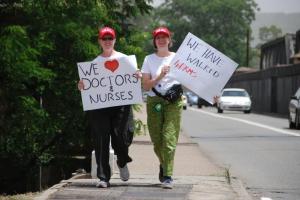
LONG WALK Clr Janet Mays and HEAL Vice President Claire Cook cross the Nepean River at Penrith (Photo: Jocelyn Street).

“Day one was a very hot day,” she recalls of the Bl**dy Long Way to Nepean walk. “We were very blessed with a large gathering of people at the start, and more joined us along the way for one or two legs. We ended the day at the Ori in Springwood … it was the best tasting beer,” she smiles.

“On day two the seven core walkers sped up considerably,” Jocelyn (walk support team leader) remembers. “There was an incredible energy on the day, not just from the walkers, but also passing motorists, who seemed to really love the fact that people were getting out there and doing something for the community.”

“Once we crossed the Nepean River our signs really told our story. There was a recognition from Penrith residents that Nepean is their hospital, and they were saying ‘good on you’ because our aim is to take the pressure off Nepean,” Janet says.

“We know HEAL raised an important issue that day,” Janet underlines, “because we brought Phil Koperberg (ALP State Member for Macquarie at the time) and Jillian Skinner (Opposition Health Spokeswoman) together at one moment to demand a shared response on Katoomba Hospital. It’s the first time that has ever happened. The more we do, even though it annoys the Sydney Western Area Health Service, we are representing community views”.

“It’s an ongoing process to bring further change,” Janet says. “Katoomba is blessed with a dedicated hospital staff, operating at their best in a system which does not value them. They are not permitted to deliver services as they are trained to, yet they remain dedicated. Our hospital staff deserve greater support from all levels of government”.

“The Blue Mountains have not been well served in recent years,” Janet adds, before revealing her intention to run as an independent candidate for the Blue Mountains at the March 2011 state election. “The Blue Mountains is a unique area with its own identity and a fragile environment under pressure from all sides,” Janet says. “How do we ensure our voice is heard?” she asks. “It is time for this community to have a member absolutely focussed on local interests, and not party interests”.

pluck-cover
BUY NOW

“It takes courage,” Janet adds. “Independents are not in opposition. Our role is to work collaboratively with the government of the day, to beat the drum and bang the table for our communities. That is the essence of what it is to be independent.”

© Michael Burge, all rights reserved.

This article appears in Michael’s ebook Pluck: Exploits of the single-minded.