Category Archives: Reviews

A place for truth in Titanic’s lifeboat

A Writer’s review of David Dyer’s The Midnight Watch

“This novel grows organically into the rarest of literary adventures: a journey into the very heart of writing and all its private motivations.”

IN the scratchy, indefinite pulses of Marconi transmissions – the standard wireless communication in the era of the great transatlantic ocean liners – first-time Australian author David Dyer rediscovers a story at once indelible and elusive, of human frailty that turned the world order on its head.

This shorthand of ship radio operators, whose brief and highly coded messaging system kept ships in communication and carried telegraphic messages to shore for passengers, crew and commercial interests, was past its infancy when RMS Titanic embarked on its maiden voyage, but it was certainly not a definitive means of delivering clarity under pressure.

Yet the lives of more than 1500 people came to rest upon it.

the_midnight_watch_0

The Midnight Watch holds human communication at its core.

Protagonist John Steadman is a journalist, a newshound the likes of which has all but disappeared in the twenty-first century. He has a keen sense of injustice, having endured grief and loss as a young man, scars that have made him into the industry’s ‘body man’, reporting on untimely, unjust deaths.

By the time of the sinking of the Titanic, this fictional character is so skilled he’s able to navigate his way into what he sees as the real story: the factual mystery of the ‘other’ ship – the Californian – which sat in sight of the Titanic as the latter foundered, firing eight distress rockets, each of which the crew of the Californian witnessed, and did nothing about.

It’s the supreme postmodern maritime mystery, as replete with conspiracy theories as the Shakespeare authorship question, and Dyer tackles it through recreating the players and the dramatic tension that existed before the world knew about the Californian’s failure, taking readers on a compelling journey.

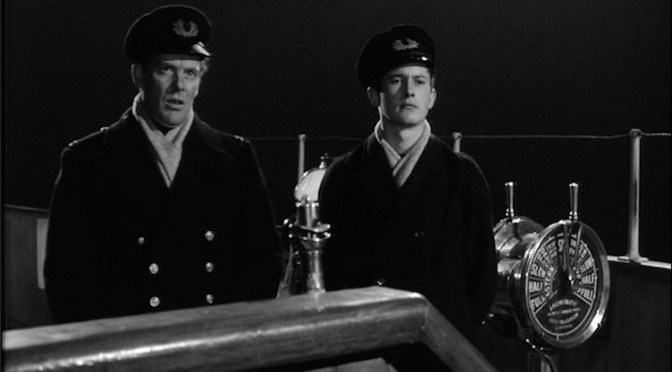
The tale pivots around the inaction of two men: Captain Stanley Lord, who remained in his bed during the two-and-a-half hours the Titanic sank, and his second officer Herbert Stone, who reported what he saw to the captain via a narrow pipe, yet did nothing more when the captain failed to act.

CAPTION
CALIFORNIAN CAPTAIN Stanley Lord.

But in the end, Steadman cannot escape the way the ultimate truths remain fractured and inaccessible, lost in the pulsating radio signals that passed suddenly from workaday passenger telegrams to the desperate calls that were heard only by ships too far away to lend assistance; in the breathy, frustrating exchanges between two starkly different men onboard the Californian, up and down the speaking tubes; and in the explosive, beautiful, but ultimately meaningless sparkles of distress rockets that may as well have been fireworks launched for passengers’ pleasure off the listing deck of an unsinkable ship.

You know exactly what is going to happen, and you know the horrifically short timescale, yet you still want to reach out and lift the hapless victims out of the water you know will be too cold for them to endure.

The fate of the 1500 drowned is universal knowledge by now, but Dyer uses it to place the reader in a vortex of failure, after making the case for the thinnest, most abstract and unexpected of causes for the men who allowed the disaster to happen under their gaze.

The entire Industrial Revolution went down with the shock of it, leaving a century of war and insecurity in its wake that many believe we are yet to recover from.

This novel grows organically into the rarest of literary adventures: a journey into the very heart of writing and all its private motivations. Escapism and fantasy, avoidance, guilt, lust, fear and a pulsating sense of injustice.

I agree with other reviewers who noted the author’s unnecessary use of repetition on occasion – readers never require a retelling of moments we’ve already heard; and at times, during the rising action of the book, I questioned the very set-up of the whole fact-fiction combination.

But where it counts, The Midnight Watch is absolutely gripping and does not fail to deliver.

© Michael Burge, all rights reserved.

This article appears in Michael’s eBook Creating Waves: Critical takes on culture and politics.
Massacre books a Myall off the mark

ONE of the earliest crimes I ever became aware of took place just a few kilometres from my home. It wasn’t recent and it wasn’t widely discussed between neighbouring farmers. My mother whispered what she knew of the story one afternoon, in between social tennis matches at the Myall Creek courts adjacent to the old tin hall where we gathered for community events.

The 1838 Myall Creek Massacre has haunted and inspired me ever since, in much the same way it has done for generations of grazier families in the uplands between Delungra and Bingara in the Northern Tablelands of New South Wales.

Haunted, because there is justifiable guilt attached to the murder of innocent Aboriginal people. Haunted, too, because white men were hanged for the killings, for the first time in Australia’s history. Inspired, because the massacre memorial has become one of the most enduring actions of reconciliation this country has experienced.

In 2016, two new books, pitched as seminal to an understanding of this hateful crime against innocent Aboriginal people, were published. I read with interest, not only because I am indirectly writing about the massacre, but also because I was part of the great ignorance about this pivotal moment in modern Australia.

The more we read about it, the more we come to understand the inherent racism and inhumanity that fuelled it, the closer we get to shuffling off the fundamental penal colony principles this country still practices when it comes to race relations.

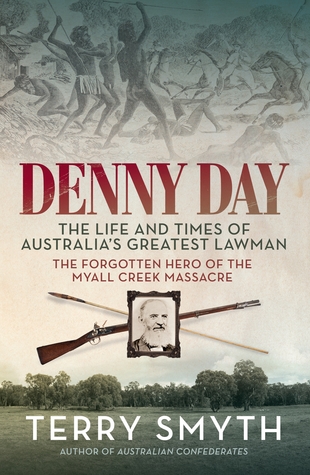
30329712Terry Smyth’s Denny Day, the Life and Times of Australia’s Greatest Lawman (Penguin Random House) adds two critical elements to the analysis of the Myall Creek Massacre that I have not encountered before.

The first is the suggestion that part of the motivation for the killings was the habit of utilising Aboriginal trackers in the recapture of escaped convicts; that the massacre was, in part, justified by the convicts among the killers as payback for Aboriginal participation in Colonial justice. But Smyth doesn’t provide much direct evidence or make an argument for any of this, leaving him wide open to accusations of victim-blaming.

The second is Smyth’s courage in including the oral history about the exact nature of the crimes, as witnessed by an Aboriginal man who was not permitted under Colonial law to give evidence at either of the trials.

Most if not all of the writing on the Myall Creek Massacre stems from a desire to ‘own’ the story, or meet another storytelling agenda, and Smyth’s book adds to a growing list of titles that view the events from one strong angle.

However, by including the description of the crimes themselves – horrid, gutless acts of evil – Smyth has done a great service that far outweighs his focus on his eponymous Denny Day.

As interesting as Day’s story is, it is not the most critical element to the story of the Myall Creek Massacre.

The crimes are the core of that story, and must never play second fiddle to the stories of others. The book that has the courage to begin with the crimes themselves, and not shy away from the scene, will be the definitive Myall Creek Massacre title.

murder-at-myall-creek-9781925456264_hrMurder at Myall Creek by Mark Tedeschi (Simon and Schuster) is not that book. It’s an absorbing read but it should probably be re-branded as more of a biography of colonial NSW Attorney General John Plunkett and his impact on the legal system of New South Wales, and less of a broad title on the Myall Creek Massacre.

What it adds to the record are insights into why Plunkett moved for an immediate second trial of some of the massacre perpetrators, and how the risk paid dividends in terms of a generally just outcome.

Tedeschi makes the case for a better understanding of Plunkett’s character and exactly what he added to Australian civil rights. He also argues for why Plunkett has been largely forgotten by a nation whose history he impacted so significantly.

Elucidating the differences between Colonial and modern Australian legal processes is one of the key aspects to Tedeschi’s work, and this focus is essential to a full understanding of the prosecutions, and several unjust outcomes of the trial.

Day’s is a policeman’s story, Plunkett’s an attorney’s. Both their accounts will become crucial resources for whoever creates an unambiguous, mainstream book on this critical episode of modern Australian history, unfiltered by post-colonial perspectives.

A deeper look at the crimes that were the pivot of both men’s contributions will be key to the meaning and scope of that work. It has the potential to make white Australians see where we have for far too long feared to really look.

© Michael Burge, all rights reserved.

Mrs Mountbatten Turns Over a New Leaf

A Writer’s Review of Alan Bennett’s The Uncommon Reader.

“Goes to the very heart of what literature does.”

ALAN Bennett has made a career out of writing about ordinary people, in fact he seems embroiled in a competition with himself to ‘out-ordinary’ his cast of characters who fade into the wallpaper, noticing the dust and fingerprints on the skirting board as they disappear.

From his gripping Talking Heads series to the divine ordinariness of memoirs about his Yorkshire family in Untold Stories, this has been a fascinating journey into the humour and pathos of the seemingly mundane.

ROYAL MALADY Nigel Hawthorne and Helen Mirren in The Madness of King George. (Photo: Keith Hamshere)

At the other end of his oeuvre sits Bennett’s ruminations on those most would class as ‘extra’-ordinary, most notably in Bennett’s stage- and screenplay The Madness of George III, famously altered to The Madness of King George at the cinema so as not to confuse US audiences about having missed I and II in the series, a ‘Bennettian’ twist if ever there was one.

Written a decade later, The Uncommon Reader is a beguiling companion piece to that previous study of royal character and frailty. Like King George, Queen Elizabeth II is quickly overtaken by something those around her consider madness after a fashion, when she exhibits a surprising appetite to read, and read voraciously.

As the novella’s protagonist, Elizabeth proves every bit as plucky, observant and youthful as a Jane Austen heroine. Reading affords her a sense of escapism and leads her to seek connections with those around her.

But a pervading sense of regret waits around every corner for Her Majesty. As literature becomes the great companion that Bennett observes is missing from this privileged life, it comes with a realisation of enormous opportunities missed.

41qiimkmhpl-_sx308_bo1204203200_In this regard, the Queen becomes less Lizzie Bennet and more like the central protagonist in one of Bennett’s monologues, which I’ll speculatively title Mrs Mountbatten Turns Over a New Leaf, in honour of how his characters always seem to find the key to reaching out.

Whether they manage to turn that key – and thereby escape their circumstances – is the rich seam of Bennett’s tragicomic style, and there are some stark differences between the journey of Queen Elizabeth and the classic Talking Heads mix of self-delusion of characters who tend to remain in their comfort zones.

The Uncommon Reader is a divine little diversion, but don’t be fooled by its apparent simplicity.

creating-waves-cover
BUY NOW

This book goes to the very heart of what literature does, and how it has the potential to change the world through opening hearts and minds.

© Michael Burge, all rights reserved.

This article also appears in Michael’s eBook Creating Waves: Critical takes on culture and politics.