Category Archives: Reviews

Massacre books a Myall off the mark

ONE of the earliest crimes I ever became aware of took place just a few kilometres from my home. It wasn’t recent and it wasn’t widely discussed between neighbouring farmers. My mother whispered what she knew of the story one afternoon, in between social tennis matches at the Myall Creek courts adjacent to the old tin hall where we gathered for community events.

The 1838 Myall Creek Massacre has haunted and inspired me ever since, in much the same way it has done for generations of grazier families in the uplands between Delungra and Bingara in the Northern Tablelands of New South Wales.

Haunted, because there is justifiable guilt attached to the murder of innocent Aboriginal people. Haunted, too, because white men were hanged for the killings, for the first time in Australia’s history. Inspired, because the massacre memorial has become one of the most enduring actions of reconciliation this country has experienced.

In 2016, two new books, pitched as seminal to an understanding of this hateful crime against innocent Aboriginal people, were published. I read with interest, not only because I am indirectly writing about the massacre, but also because I was part of the great ignorance about this pivotal moment in modern Australia.

The more we read about it, the more we come to understand the inherent racism and inhumanity that fuelled it, the closer we get to shuffling off the fundamental penal colony principles this country still practices when it comes to race relations.

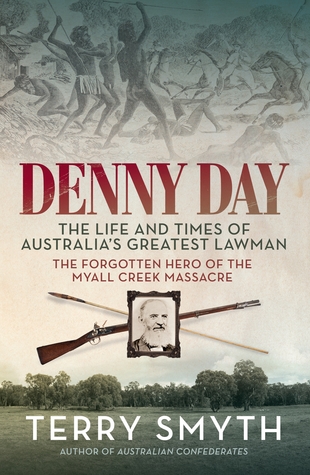
30329712Terry Smyth’s Denny Day, the Life and Times of Australia’s Greatest Lawman (Penguin Random House) adds two critical elements to the analysis of the Myall Creek Massacre that I have not encountered before.

The first is the suggestion that part of the motivation for the killings was the habit of utilising Aboriginal trackers in the recapture of escaped convicts; that the massacre was, in part, justified by the convicts among the killers as payback for Aboriginal participation in Colonial justice. But Smyth doesn’t provide much direct evidence or make an argument for any of this, leaving him wide open to accusations of victim-blaming.

The second is Smyth’s courage in including the oral history about the exact nature of the crimes, as witnessed by an Aboriginal man who was not permitted under Colonial law to give evidence at either of the trials.

Most if not all of the writing on the Myall Creek Massacre stems from a desire to ‘own’ the story, or meet another storytelling agenda, and Smyth’s book adds to a growing list of titles that view the events from one strong angle.

However, by including the description of the crimes themselves – horrid, gutless acts of evil – Smyth has done a great service that far outweighs his focus on his eponymous Denny Day.

As interesting as Day’s story is, it is not the most critical element to the story of the Myall Creek Massacre.

The crimes are the core of that story, and must never play second fiddle to the stories of others. The book that has the courage to begin with the crimes themselves, and not shy away from the scene, will be the definitive Myall Creek Massacre title.

murder-at-myall-creek-9781925456264_hrMurder at Myall Creek by Mark Tedeschi (Simon and Schuster) is not that book. It’s an absorbing read but it should probably be re-branded as more of a biography of colonial NSW Attorney General John Plunkett and his impact on the legal system of New South Wales, and less of a broad title on the Myall Creek Massacre.

What it adds to the record are insights into why Plunkett moved for an immediate second trial of some of the massacre perpetrators, and how the risk paid dividends in terms of a generally just outcome.

Tedeschi makes the case for a better understanding of Plunkett’s character and exactly what he added to Australian civil rights. He also argues for why Plunkett has been largely forgotten by a nation whose history he impacted so significantly.

Elucidating the differences between Colonial and modern Australian legal processes is one of the key aspects to Tedeschi’s work, and this focus is essential to a full understanding of the prosecutions, and several unjust outcomes of the trial.

Day’s is a policeman’s story, Plunkett’s an attorney’s. Both their accounts will become crucial resources for whoever creates an unambiguous, mainstream book on this critical episode of modern Australian history, unfiltered by post-colonial perspectives.

A deeper look at the crimes that were the pivot of both men’s contributions will be key to the meaning and scope of that work. It has the potential to make white Australians see where we have for far too long feared to really look.

© Michael Burge, all rights reserved.

Mrs Mountbatten Turns Over a New Leaf

A Writer’s Review of Alan Bennett’s The Uncommon Reader.

“Goes to the very heart of what literature does.”

ALAN Bennett has made a career out of writing about ordinary people, in fact he seems embroiled in a competition with himself to ‘out-ordinary’ his cast of characters who fade into the wallpaper, noticing the dust and fingerprints on the skirting board as they disappear.

From his gripping Talking Heads series to the divine ordinariness of memoirs about his Yorkshire family in Untold Stories, this has been a fascinating journey into the humour and pathos of the seemingly mundane.

ROYAL MALADY Nigel Hawthorne and Helen Mirren in The Madness of King George. (Photo: Keith Hamshere)

At the other end of his oeuvre sits Bennett’s ruminations on those most would class as ‘extra’-ordinary, most notably in Bennett’s stage- and screenplay The Madness of George III, famously altered to The Madness of King George at the cinema so as not to confuse US audiences about having missed I and II in the series, a ‘Bennettian’ twist if ever there was one.

Written a decade later, The Uncommon Reader is a beguiling companion piece to that previous study of royal character and frailty. Like King George, Queen Elizabeth II is quickly overtaken by something those around her consider madness after a fashion, when she exhibits a surprising appetite to read, and read voraciously.

As the novella’s protagonist, Elizabeth proves every bit as plucky, observant and youthful as a Jane Austen heroine. Reading affords her a sense of escapism and leads her to seek connections with those around her.

But a pervading sense of regret waits around every corner for Her Majesty. As literature becomes the great companion that Bennett observes is missing from this privileged life, it comes with a realisation of enormous opportunities missed.

41qiimkmhpl-_sx308_bo1204203200_In this regard, the Queen becomes less Lizzie Bennet and more like the central protagonist in one of Bennett’s monologues, which I’ll speculatively title Mrs Mountbatten Turns Over a New Leaf, in honour of how his characters always seem to find the key to reaching out.

Whether they manage to turn that key – and thereby escape their circumstances – is the rich seam of Bennett’s tragicomic style, and there are some stark differences between the journey of Queen Elizabeth and the classic Talking Heads mix of self-delusion of characters who tend to remain in their comfort zones.

The Uncommon Reader is a divine little diversion, but don’t be fooled by its apparent simplicity.

creating-waves-cover
BUY NOW

This book goes to the very heart of what literature does, and how it has the potential to change the world through opening hearts and minds.

© Michael Burge, all rights reserved.

This article also appears in Michael’s eBook Creating Waves: Critical takes on culture and politics.
Weathering relationships with Stephanie Bishop

A writer’s review of Stephanie Bishop’s The Other Side of the World.

I CALL them ‘weather stories’, books in which the protagonists are anaesthetised by the attention they pay to the elements in endless cycles of sun and rain and the sensations of water, leaves, dust and wind; and this intriguing novel qualifies.

9780733633782Locked in the inevitability of marriage and parenthood in the 1960s, Charlotte and Henry play out the drama of migration and separation between England and Australia.

One nation is predictably damp, the other is advertised as – and turns out to be – dry. One spouse is capable of seeming sure about the family journey, the other is troubled by being placed in that dilemma, so the author has them take up weather watching instead of communicating.

The dynamic raises plenty of questions: How long have they existed this way? Was it their parenthood, their different homelands and cultures, their careers or their entire generation that brought on the angst?

In exploring what she reveals in the acknowledgements as her grandparents’ story, Stephanie Bishop has either cleverly created a couple whose thought processes are so similar that even their inner voices are the same, or she’s failed readers significantly by making them so.

The result is two characters so frustratingly parallel that if they’d only talk to one another instead of watching the skies and the foliage, there’d be a sense of belonging that they seem to seek… and probably nothing more than a happy tale of life in an English cottage.

“She casts her mind and her voice back into her ancestry and reads the conditions.”

There is a scene in that place – the breakage of a precious object not long before the family departs for Australia – that I found comical and familiar enough to engage me, yet so poignant as to be painful. I felt in solid writerly hands here (there were no passages on the weather, for once, but great insights into the way families fit into houses), yet the solidity quickly vanished and we landed back in more abstract meteorological territory.

Similarly, when Bishop places Henry unexpectedly in his homeland, the descriptions of the places, the walls, the fabric, the people – not the weather – evoke a sense of chosen permanence that is engaging and insightful.

In a less page-turning way as Tim Winton’s The Riders, but every bit as inexplicably, Bishop avoids a story with easy and clear resolutions. Sometimes this is frustrating, but I was left with the sense that Bishop’s family has no explanation for their real-life, enduring mystery.

There are great stories to be told in this space, but they need more solidity and less abstraction to engage readers who want to see connections.

Bishop’s novel is set in the 1960s, but apart from the absence of mobile phones and computer games as a means to placate needy kids, there is almost nothing that places the characters in their time. Henry and Charlotte seem removed from time altogether.

Except Charlotte’s reality, as several members of the book club I read with were swift to point out: a married mother in 1960s Australia had little respite from her children’s demands.

This was perhaps another intention of the writer, but it’s this time disconnect that has led many readers to question Charlotte’s choices – she seems to exist in a more modern period where she has options, whereas Bishop has attempted to portray a woman who is challenged by motherhood at a time when that struggle was deeply misunderstood and seen as a complete aberration.

This book reminded me of my own family mysteries, also wrapped up in motherhood, loss, pain and migration. I kept reading because I felt there might be insights for me, but apart from the sense that children eventually grow up to realise our parents are human, not all-knowing and capable of protecting us from anything, Bishop doesn’t unravel the knot.

creating-waves-cover
BUY NOW

She casts her mind and her voice back into her ancestry and reads the conditions. When she finds little detail, she looks to the skies, and the prevailing weather makes for a cloudier story than it needed to be.

© Michael Burge, all rights reserved. Main photo by Dominic Lorrimer.

This article appears in Michael’s eBook Creating Waves: Critical takes on culture and politics.