Category Archives: Rural Childhood

Dry stone country

BOTH SIDES NOW Stephen Harrison, master waller, instructing on one of his dry stone walling courses.
BOTH SIDES NOW Stephen Harrison, Master Waller, instructing on one of his courses.

A Writer’s encounter with Britain’s boundaries.

ON the property where I grew up, porous volcanic rocks covered a little peak near the farm-house, the hundreds of holes in their sides the perfect dwelling place for the fairies we imagined lived there. Hours of exploration ensued on that hillock, from which the edges of the wider world could be seen, but not yet explored.

For exiled Europeans living in the pastoral dream of New South Wales, stone boundaries and homes were a link to the lands we had come from. The Northern Tablelands are scattered with flints, shales, and granite boulders. In parts, where the scrubby trees are scarce, and the skies large, you could swear you were on the Yorkshire Dales.

So when the opportunity to produce a program about dry stone walling came up, I leapt at the chance. The directive included the name of artist Andy Goldsworthy, who could be credited with taking the ancient craft and making it into a fine art.

We turned first to the Yorkshire Dales Field Centre, where Master Waller Stephen Harrison taught weekend courses in walling for anyone wanting to have a go.

This was the dawn of the reality show era, and it was suggested that we find a television presenter to send on one of these courses, to ‘throw them in the deep end’. We approached Dylan Winter, a country-based broadcaster. He was willing, we set a date in the Dales’ village of Settle, and went to build walls.

Cameraman Alan James got to ride in a hot air balloon filming the network of walls across part of the Dales. We went to an all-day walling competition. The whole thing was so much fun it hardly felt like work!

The true art of dry stone walling is in the word ‘dry’ – Stephen showed us places on the high ridges of the Pennines where walls had been built and maintained over centuries which you could kick and not make a dent in, yet they stood without a trace of binding mortar.

Very often there is little sign of human habitation, apart from the walking track, and then you’ll crest a hillock and suddenly see lines of stone – barriers – running across everything in their path for miles and miles.

The beauty of stone walls belies terrible times in the nation’s past – Hadrian’s Wall in the north might not technically be mortar-free, because it was built to keep people out of England, but dry stone walls are also evidence of a great ‘keeping out’ movement.

CLOSING-UP An English enclosure notice of the 18th Century.

It was almost four centuries of Enclosure Acts that fenced-off the shared common lands of the countryside, starting in and around villages, but extending over time across every patch of farmland. Eventually the entire landscape was owned by someone, and it was walls (or hedgerows, where stone was scarce) which marked where the boundaries were deemed by law to be.

Men and women who once worked common land found themselves fenced out of it. Many eked-out new livings on the crews who built the walls. It’s a skill which has been handed down through generations.

Sourcing archival images and footage of walling crews at work in the early 20th century proved an adventure in itself, but between the libraries of the Lake District, and private collectors, we unearthed some very unique footage for our program. The interesting thing about the photographs in particular is how they revealed walling was a family pastime – men, women and their children were taught to wall in certain communities.

Stone is an effective barrier – if used correctly it can halt flood or fire, it looks better than barbed wire, and it’s not hard to work with.

Which is the message Stephen Harrison and the Yorkshire Dales Field Centre were keen to spread to city slickers like us. Dylan made some classic errors in his section (or ‘stint’) of wall, but, as Stephen pointed out, even a flawed wall will outlast most modern wire fences.
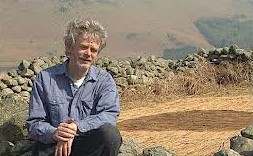
ART OF STONE Andy Goldsworthy at one of his Cumbrian Sheepfold projects.

We travelled to Cumbria to meet Andy Goldsworthy’s assistant at an agreed time in a remote pub car park. She led us up into the foothills nearby, to a sheepfold – a square or round enclosure of stone designed to pen sheep. Andy was nowhere to be seen, but his work, on that occasion an arrangement of straw on the ground inside the stone enclosure so that it would catch the light from different angles, was incredible.

We all drew breath. Someone said “wow”. I noticed a scrap of woolly grey from behind the wall at the far side, and thought perhaps it was a stray Herdwick sheep, but when the sheep stood up it revealed itself as the artist.

“Good reaction,” he said, before I told him I thought he had Herdwick-coloured hair. He laughed, and within the stunning setting of a Cumbrian valley, we interviewed Andy Goldsworthy about his work with dry stone walling, and dry stone wallers, particularly on the long-term Sheepfold Project of the 1990s.

Stephen Harrison is one of a group of British wallers who regularly work with Andy Goldsworthy on art projects both in Britain and North America, but the boundary between artist and waller is invisible. Goldsworthy started out a farm boy, after all, and Harrison is very much an artisan in his own right.

Very often they build stone structures (not always walls) in art galleries. More regularly they’ll work in farm land, or in the wilderness.

In addition to Cumbria and Yorkshire, we interviewed wallers in Wales, Scotland (where walls are known as ‘drystane dykes’), and Derbyshire. In each region the stone varies in colour and density – in parts of Wales you can chop it with your hand, in some places around Scotland you can barely break it with a hammer.

I can’t think of a more accessible way to participate in ongoing heritage than to repair or build your own dry stone walls. As soon as I had my own garden I started, and I learnt that if you follow a few simple guidelines, anyone can seem like they’ve been walling for years.

080524092650_l

Dry Stone Country is distributed on DVD by BecksDVDs.

© Michael Burge, all rights reserved.

Tilting at windmills

WINDY HILL Jack and Jill Mills in Sussex (Photo: David Blaikie).

A Writer’s quixotic adventure.

THEY all said I was mad. Every Miller in England told me there would be no wind in August. If I was expecting the sails of their mills to be turning when I arrived in the languid late summer with a camera crew, I’d be wasting my time.

But I’d already scheduled a month’s worth of filming between Lincolnshire and Sussex, crisscrossing the country in search of some of England’s most treasured surviving windmills, in places where I’d just assumed there would be plenty of wind, all year round.

So I just sat on this wisdom quietly, because I’d already promised delivery of a one-hour program in time for Christmas. If it was going to happen, the footage needed to be in the can and edited by the end of September at the outside.

Our packed itinerary started close to home in the Cambridgeshire fen lands, where, on arrival at Wicken Fen drainage mill (managed by the National Trust), the little green canvas-covered sails of the smock mill were ripping around at a very pleasing pace.

Thinking that I’d struck the one day of late summer wind, I got cameraman Alan James to film just about everything we could see that was moving in the gale.

The next day we had two interviews scheduled. Ideally, I wanted windmills turning gently in the background. Apparently, they could be cranked around by hand, so at least I had that option up my sleeve if there was no wind.

First subject was Nigel Moon, Miller at Whissendine Mill in Rutland, who scratched his head when we turned-up as agreed, saying he couldn’t credit why the wind was blowing so well for the time of year.

As we embarked, the crew noticed something very interesting about wind.

When the sun comes out from behind a cloud, it brings with it a thermal gust strong enough to get a windmill’s sails turning, making a pretty picture behind the interviewee.

But for a film crew, bright sunlight means the interviewee will be over-exposed. A sudden gust of wind is also hazardous for sound recording. The crew handled this frustrating situation with great skill and patience. We all became instant weather watchers, recording only during the passing of very large, long clouds.

At Green’s Mill, right in the city of Nottingham, Miller and writer of our documentary, David Bent, took us through the entire workings of one of England’s best-preserved windmills.

We quickly completed every bit of filming that didn’t require turning sails, so I let the crew go for lunch. Meanwhile, I climbed up into the tower mill, surrounded by its fascinating internal workings, all so beautifully wrought from timber, stone and iron. Out on the balcony, where the Miller would set the sails on his mill, there was not a trace of wind. Had my run of weather-luck finally come to an end as predicted?

Ever-hopeful, I climbed higher again, to see tiny windows looking over the courtyard where the crew lunching far below.

UNHORSED BY WINDMILLS I felt a little like Don Quixote.

The pressure of the quixotic plan to bring my first full-length documentary in on time and budget was now palpable. I’d hitched my reputation to something as fickle as the weather, an energy I already had a love-hate relationship with. The realisation struck me with a feeling of anger and desperation, so I did something I rarely do … I prayed!

After a few resigned moments looking at the view, the noise of one of the large timber-toothed cogs inside the mill caught my attention. I watched it, oblivious for a few moments to what its movement meant.

A shadow slid across the small room from the window, and I realised the sails outside were turning.

I shouted out the window to the crew and got them back on deck within a minute. Across a nicely windy afternoon we got all the shots we needed.

After a great night’s sleep we headed north into Lincolnshire. With its endless skies capturing as much wind as any Miller would ever want off the North Sea, Lincolnshire was surely designed to harness wind power.

With its sleek black tower, the six-sailed Sibsey Trader Mill (stewarded by English Heritage) rises above the flat landscape like something straight out of Tolkien. I half expected to see Saruman stalking the wrought-iron balcony.

Alford’s beautiful five-sailed Mill put on a brilliant show for the camera. This tower mill was the first operating windmill where we saw windmill-ground flour for sale, and the point of the whole windmill revolution sank in.

In the summer of 1996, food was still fighting for attention in the midst of the media’s gardening and home renovating revolution. Operating mills, which had once been the centre of every town’s economy, were lucky to have survived the industrial revolution and the invention of the supermarket. At many of Lincolnshire’s mills, the seeds of the current paddock-to-plate movement had well and truly sprouted.

Wrawby Post Mill was the next quintessential timber post mill in our Lincolnshire leg, where the Miller kindly acquiesced to my requests for him to catch a ride on one of his mill’s sails for our documentary’s historical recreations.

The majestic span of the mighty eight-sailed Heckington Mill at Sleaford was turning so fast we were able to get excellent shots of the internal workings of a windmill without the essential (but not that attractive) caging required to prevent visitor injury.

In the heat and noise within the cap of a working windmill we got a great sense of the dangers that mill workers endured. Hundreds of timber teeth wait to capture every bit of loose clothing and each stray finger.

David Bent had researched some macabre extracts from The Stamford Mercury, relating the terrible deaths of Millers in centuries past. Once harnessed, wind power can be every bit a life-threatening as electricity.

We’d been warned by more than one Miller to watch out for low-passing mill sails, which are often so quiet they’re easy to forget about, as they come rushing up behind you.

(Photo: Jason Smith)
WILD MILL Halnaker Mill in Sussex (Photo: Jason Smith)

We reached the south of England in a more confident mood, and climbed the path to film the stunning Halnaker Mill in West Sussex, high on a wild hill where every blade of grass was bent by the wind.

The Clayton Mills on the South Downs are also beautifully situated on a hillside, which is why they got their names “Jack” and “Jill” mills. Like the Union Mill in the beautifully preserved town of Cranbrook in Kent, Sussex’s upland mills show the prominence that windmills had in most townscapes during the era when wind power was the major source of energy.

By the time we got home to Suffolk, every mill that was capable of having its sails turned by the wind was captured in motion. My sense of achievement helped in tilting-at a great voice for the documentary’s narration, so I approached Janet Suzman’s agent.

I arrived at the recording studio more than a little nervous. She just stepped out of a cab, rolled up her sleeves and dived-in, instantly capturing the feel I’d anticipated for the commentary, and in her character readings of those gruesome northern newspaper reports.

Maybe it was beginner’s luck, but since the making of Seven Centuries of the English Windmill, whenever I’ve been faced with outdoor location filming and performances, I have quietly invoked whatever spirit answered my weather prayer inside Green’s Mill in Nottingham. I’ve also become an advocate for wind turbines, because wind power has a longer, cleaner and cheaper track record than any other human-created power harnessing method we’ve ever mastered. No wonder it’s considered so controversial as it makes its comeback.

seven-centuries-of-the-engl

Seven Centuries of the English Windmill is distributed on DVD.

© Michael Burge, all rights reserved.

Dearborn, death & American dreams

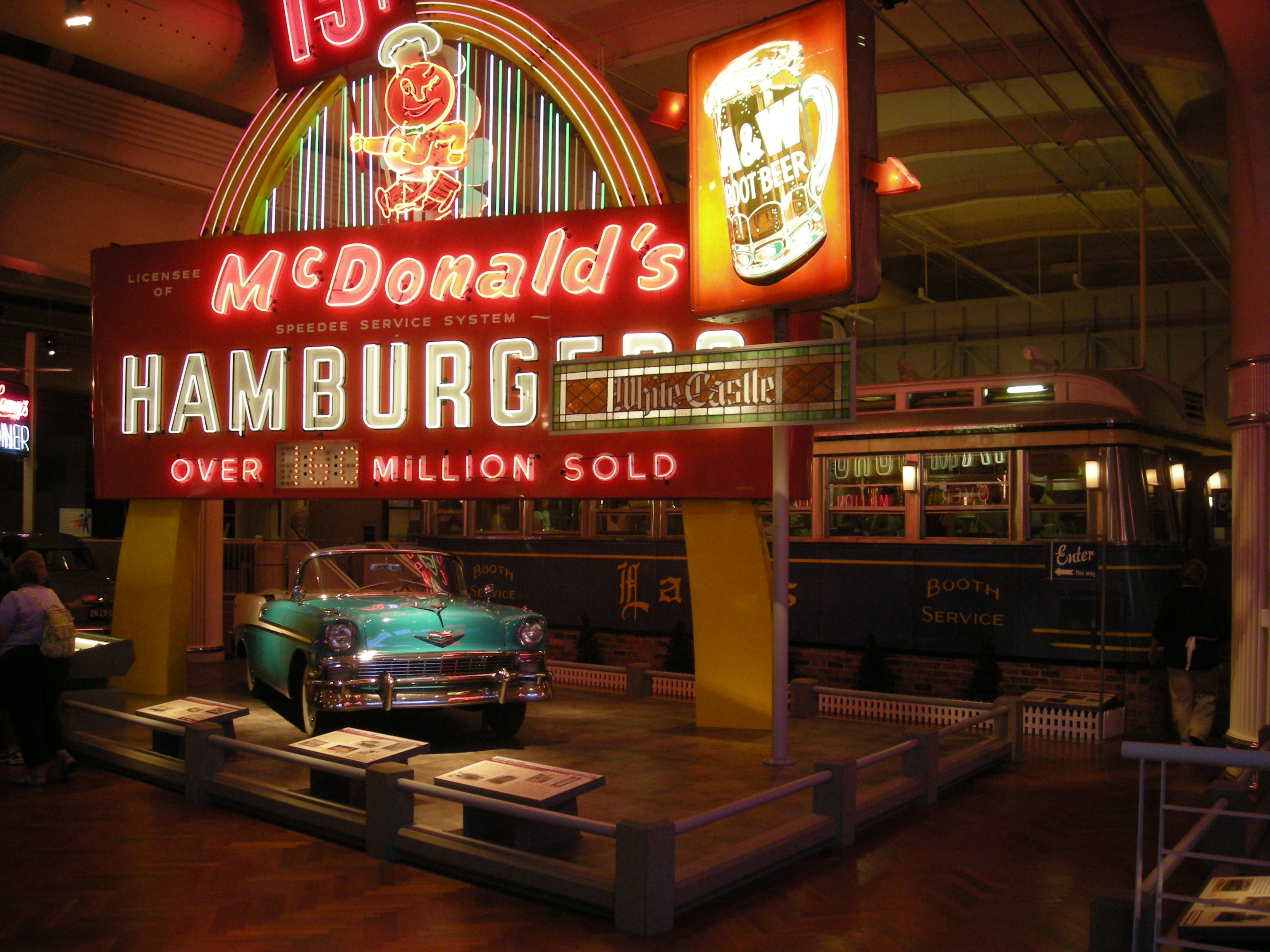
NEON DREAMS The Henry Ford Museum, Detroit.

A Writer’s Midwestern adventure.

SEEKING the childhood haunts of farming icon Henry Ford, on arrival in the great city of Detroit, we (me, a cameraman and a presenter) headed not for Motown (unfortunately) but to the city fringe and the Dearborn area.

There, the Motor City puts on a veneer of rural respectability, but on the many occasions we got lost in our hired Buick, street upon street of homely clapboard stoops in everyday neighbourhoods revealed themselves, where no-one cared much for Ford and the quiet revolutions he spearheaded.

All that is on ostentatious display at the Henry Ford Museum, our first port of call.

It would be hard to name a more complete exhibition anywhere in the world. As an entrée to life in the American heartland, this place is the veritable cherry on the pie.

Acres of halls burst with memorabilia on a huge scale – the neon sign display must be the world’s best, and there’s an entire Holiday Inn which was moved brick-by-brick as an homage to the original American road trip.

A Museum staffer showed us to another building on the far side of the exterior exhibition (filled with entire villages – Ford loved the whole brick-by-brick thing), where he pulled-up a garage door and trundled a rather strange looking machine into the daylight.

This was Henry Ford’s 1907 ‘Automotive Plow’ – the prototype for the mass-produced Fordson tractor.

This tractor changed farming practices dramatically after centuries of hard labour and heavy horses. Ford didn’t invent it, but he made it affordable for most.

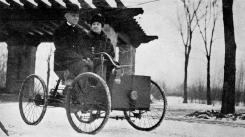
MAN OF EXTREMES Henry Ford and his wife in his first car.

A documentary shown at the Museum detailed Ford’s deep regret that his vehicle production technologies helped inspire the military tank, which tore through troops in the slaughter that was WW1.

Turns out Henry Ford (1863-1947) was not just a farmer and industrialist – he was also a pacifist and a vegetarian. Now that got me interested.

As we left the Museum, a formal line of Presidential vehicles revealed itself, from beautiful carriages to limousines. The last one was roped-off, because people respectfully leant across to touch the rear right passenger door.

I wanted to see why, but the sign explained the patently obvious – this was the car in which President John F. Kennedy was killed. Surprisingly, it had been remodelled and used by other presidents for many years after the assassination.

Quite close by, the upholstered chair in which President Abraham Lincoln was shot to death is also on display.

Such a strange, endearing collection of dreams, death and the pinnacle of farming achievements. The dichotomy says much about the man behind the collection, loved and reviled in equal measure. Say what you want about Henry Ford: he was a collector like no other.

Ford’s early tractors were manufactured the world over, and many have become collectors’ items, so we hit the road in search of them, heading south into the great farming state of Ohio, on the very edge of America’s Midwest.

As we embarked, another journey was just beginning in California. Young high flier, 7-year-old student pilot Jessica Dubroff’s ‘Sea to Shining Sea’ flight was going to rewrite history and make her the youngest person to fly across the United States, assisted by her pilot trainer and her father. The Ohio and Michigan media were anticipating seeing Jessica cross their skies any day now.

Passing through the endless city limits of mighty Cleveland, I checked our itinerary, and realised a colleague back in Suffolk, England, had booked us to do an interview in east Ohio, then travel a day and a half back to Michigan, only to turn around and drive back south into Ohio again. The English have no idea about distances! I grumbled, before calling and asking for the dates to be changed.

Meanwhile, we visited affluent farms where Ford tractors that had not tilled the soil for decades were stored like precious objects in huge, pristine sheds.

We interviewed farmers who ran thousands of head of cattle on prairie-like pastures. Here, my vegetarianism was something even I questioned, since these cows lived a life of liberty, with just their ears tagged before they were set free to graze the hills until it was time to bring them in for slaughter.

We met an Amish man who ran a sawmill entirely without electricity, just a pair of heavy horses who he treated like the precious commodity they were.

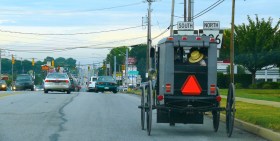
LAND OF EXTREMES A traditional Amish buggy makes its way into town (Photo: Ad Meskens).

The sight of Amish carriages crossing the landscape in the distance was an eerie link with America’s past. The culture of the Plain People contains the last vestiges of a rural romanticism that every country child can relate to.

In Ohio’s land of abundance, everything was larger than I had ever experienced. To reach the arms of the chairs in restaurants, you needed to put your arms out wide!

Then the nation awoke to terrible news that Jessica Dubroff’s plane had gone down shortly after takeoff from Cheyenne in the state of Wyoming. A brief life cut short. A dream broken in this land of big, record-breaking dreams.

Thankfully our itinerary had been adjusted, but we were asked not to delay – the subjects of our interview back in Michigan were heavily pregnant, due any day now. They couldn’t guarantee what we’d be greeted with. So we completed a long night drive across the border into Portland, Indiana, then back up to Michigan to the city of Flint, home of another great American, film maker Michael Moore.

Flint, and in fact that whole section of Michigan, was emerging from a harsh winter. Nevertheless it’s not just the climate that caused a certain down-at-heel quality.

Unlike the vasty fields of Ohio, that part of Michigan seemed rather poverty-stricken. The farmers were less welcoming and more suspicious of travellers. We got lost a few times, and the idea of knocking on doors and asking for directions was more than a little frightening.

This was long before Michael Moore’s films pricked the conscience of the western world – we were only there to interview a goat breeder.

Her flock of Boer goats was in the process of birthing its next generation, so we waited patiently while the mothers bleated. New life within a toughened landscape brought all the cheer we needed to feel better about Henry Ford’s macabre collection, about Jessica Dubroff’s life cut short, and about ourselves in the midst of a thawing state of disbelief … and more beautiful footage of brand new kids has rarely been captured, I’m sure.

© Michael Burge, all rights reserved.