Category Archives: Rural Childhood

Patricia Burge – the carer who laughed

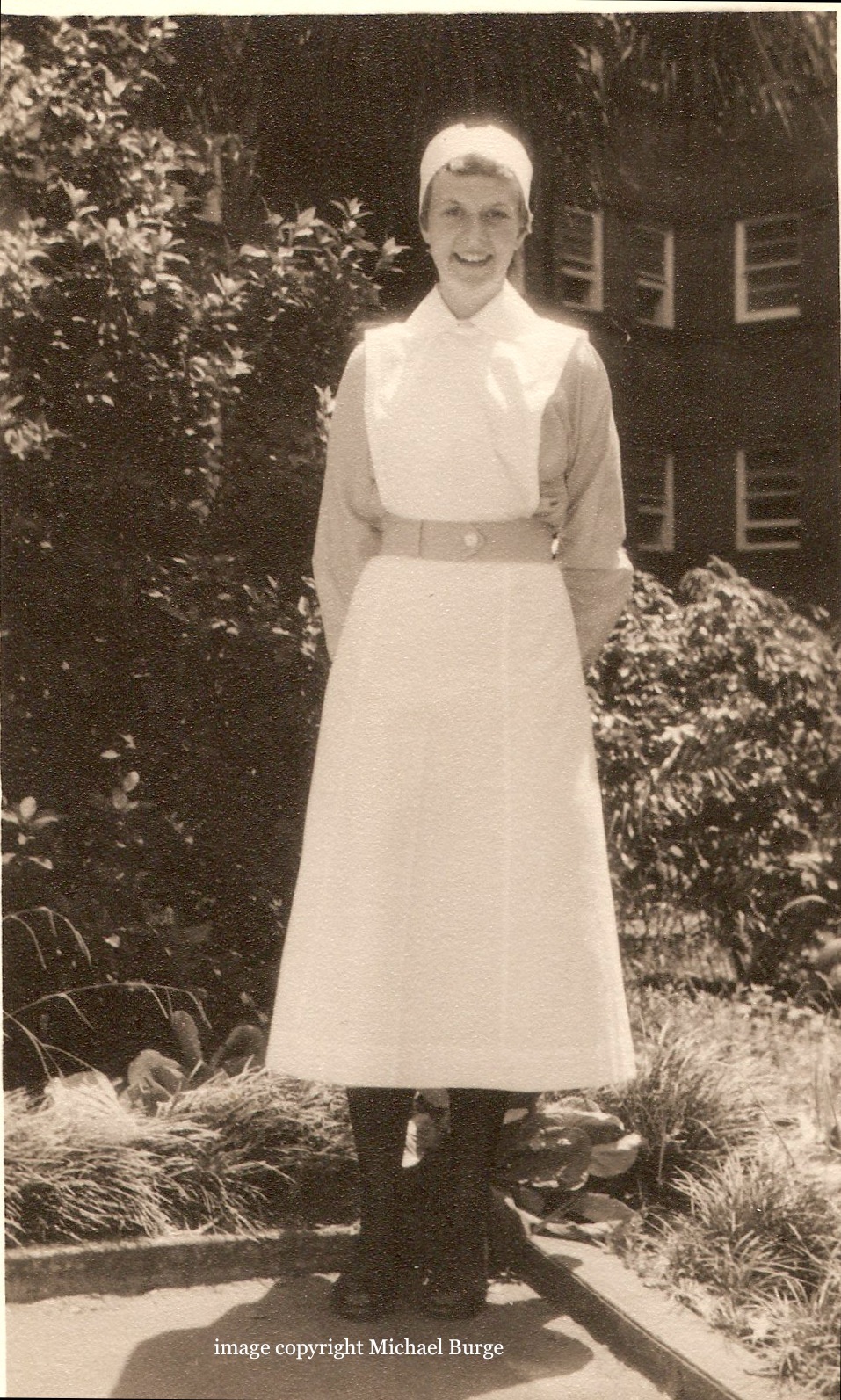
CAREER CARER Patricia Crawford as a new trainee in 1956 at RPA Hospital, Sydney.

Patricia Burge (1937-1992).

WORDS cannot really describe the shock and grief that made its way into our family when we knew that our dear Mum, Pat, was going to die.

It was one of the very few times I have been moved to prayer… night seeping into our little home, Mum noticeably absent in hospital, and my sister, just a teenager, waiting for my return. I put my arms around Jen and prayed that we would be okay. I don’t have any firm religious beliefs, but that night, we needed to be heard by something.

Pat Burge was a nurse, an excellent old school carer who knew her stuff. Born at the tail end of the generation of Australian women who were encouraged into teaching, secretarial work, or nursing (and little else), Patricia Crawford (as she was born) did the unthinkable for a North Shore girl and got herself enrolled to train at Royal Prince Alfred (RPA) Hospital in Camperdown.

She described nursing school as the making of her since it gave her female leadership in the form of matrons and older nurses who taught well and cared deeply for their profession. It transformed Mum from a directionless girl into the practical, approachable woman that she was.

When she married, she thought it was high time. Most of her friends were already having kids and she was pushing 30. Like most women of her era, she gave up work completely when she had children in quick succession.

‘The Dream’ of pastoralists to marry city girls and create dynasties to work the land was at its peak, and Mum willingly bought into the myth, relocating to a farm outside Delungra in the Northern Tablelands of NSW and making it into a family home after years of standing derelict.

But ‘The Dream’ lasted only five years, until the death of my younger brother Nicholas.

For the next six years Mum struggled to ‘get on with her life’. She gave birth to Jen, and watched her like a hawk until turning one meant the new baby was past the risk period for SIDS.

Approaching 40, she tried her hand at academia, beginning distance education in English literature. But when her first results didn’t match her promise, she gave up. Being part of the group who needed her, I was unaware of the pain that surfaced, the hopes that were dashed, and the disappointment she brought to those around her as a result of not living ‘The Dream’ to its fullest.

Nobody who hadn’t promised to stick by her ‘for better or for worse’ was affected, but when Pat Burge tested ‘The Dream’, it blew up in her face.

The moment she decided to leave Inverell was one of the turning points of Mum’s short life. No longer was she towing the line for others. She became a self-actualised person, probably for the first time. She sat her kids down and asked us if we wanted to come. I said “yes” without hesitation. What we left that Spring of 1979 was an already broken home. Dad had left, and Inverell held nothing for mum anymore. ‘The Dream’ was over.

The night we drove away, Mum turned the radio up in shock at the news that Lord Mountbatten had been killed by an IRA bomb. Mum was very ‘old school’ North Shore – the Royal Family meant something to her – and his death was like a watershed. She entered a time when there were no more heroes, only herself.

OH, PAT! Sleeves rolled-up for a school working bee, but funny bone always ready!

For the next 13 years she created a world for her children. She surrounded herself with great friends. She returned to nursing and achieved in that field in ways that she never envisaged. She taught us to believe we could do, and be, anything, and encouraged us towards a much broader set of dreams. In doing all this, Pat Burge became a heroine.

It was a bright, brief time, and we all shone.

By the time her cancer was picked-up through exploratory surgery, treatments were all too late.

Mum told me that as she woke from the anaesthetic, she felt for the post-operative tubes and knew her prognosis by virtue of her training, thinking “oh, damn!” for a moment.

Then, true to this heroine, she stayed positive for all our sakes. There was simply no other choice, and she achieved a year of denial with a funny grace – laughing about being pushed around in wheelchairs, caring for the recovering ladies who shared her hospital room, and eschewing chemotherapy until she could almost count the days left to her.

A good friend of Mum’s who was on duty at the local hospital broke the news to me that her death was imminent. He and I told her together and she just accepted it, simply because she already knew. Entering new emotional territory, we decided in a matter of minutes that we would be bringing her home to die.

During those last weeks we talked about the moments in her life that had meant something to her. These talks enabled me to write all but the last paragraph of her obituary.

What happened after that was so profound that I could only describe it as “a powerful death, after a powerful life”.

Surrounded by her nursing friends, who held her, monitored her, and comforted her, Pat Burge died in her own bed after a series of exhilarated breaths, like she could see something great coming. She had farewelled everyone, made peace with her journey, showed no more than a hint of despair and an abundance of humour.

Without her, most of us who had relied on her heroism came to absolutely nothing, and we needed to rebuild from deep within.

But hers was an inspiring death, which in its own time saw my prayer answered. We have been okay, since she had to leave us. We’ve had to grow the seeds she planted, the germ of which is the emotional intelligence that was Mum’s key attribute. When taken care of, they proved to bear wonderful fruit, and still do.

© Michael Burge, all rights reserved.

A Writer’s first obituary

BROTHERLY LOVE (L-R) Nicholas, Michael & Andrew Burge in 1973.

Nicholas Burge (June 1973 – September 1973).

ONE of the earliest original pieces of writing I completed was an obituary, written for my younger brother Nicholas who had died seven years prior from Sudden Infant Death Syndrome (SIDS).

I was in the final year of primary school, with an inspiring teacher, a sensitive Welshman, who set us a writing task to record the story of ‘something I’ll never forget’.

I don’t know why I chose Nicholas. Most probably it was because there had not been much talk about him since he died, even though I had experienced first-hand the devastating impact his loss had on my family.

The piece has long since been lost, but I know I wrote about the morning he died. Me (aged three) and my older brother (four) were the ones who discovered the baby, dead, in his cot, during our usual morning ritual of waking him and taking him into our parents’ room.

Not understanding the concept of death, of course we did not see the impact that was coming, when we went to tell mum and dad that the baby wouldn’t wake up.

At the time of writing about the day, I had no more than a mental picture of my mother, flying out of the bed with a great sweep of the pink sheets, and my father trying to wind the old party-line telephone into action. Mum, keening like a seagull, held the dead baby in her arms.

I learned much later that we’d all driven from our farmhouse into town, the dead baby in a carry-basket between my brother and I. We were left with our grandparents while Nicholas’ body was taken to the hospital.

Later again, when I retrieved his death certificate, I discovered Nicholas was buried the very next day in the family plot. Apparently my father was incapable, in his grief, of driving away from the cemetery. Mum took over.

We didn’t last much longer on the farm after that. Despite being encouraged to have another baby, the grief worked its way between my parents, and we left the land for a brief life in town, before they separated and divorced. Not long after, we moved with mum closer to the city where she’d grown up.

There were psychological reasons for everyone’s behaviour in the wake of Nicholas’ death, but this is not the place to explore them. When I wrote his obituary, I was too young to understand them anyway, I was only responding to being asked about something ‘I would never forget’.

Perhaps this was also my first lesson in how powerful words can be? I know it bonded me closer to my mother, to have her son recall with great importance something that was a life-changing moment for her family. When I packed up our house after her death, I found Nicholas’ clothes in a little bundle wrapped inside her wedding veil in a bottom drawer in the garden shed. A photograph of the baby boy confirmed they were his.

When I wrote to my father about the same events many years later, he expressed that he always believed it was better to get on with the care of the living, as opposed to thinking about the dead. At the time, I said nothing, because I didn’t know if I agreed, or not.

But writing about my memories gave Nicholas a place in my life, even though his own had been so very short. Like most of my writing, this little obituary involved looking back, and I have since learnt how controversial that can be. In this case, I believe it was more than worth it.

Obituaries are biographies, often written at acutely painful times. I recall my obituary for my brother Nicholas was very short, like his life. It was an affirmation that he existed, that we knew him, and that we loved him. Sometimes writing is really that simple.

© Michael Burge, all rights reserved.
Send her down Hughie!

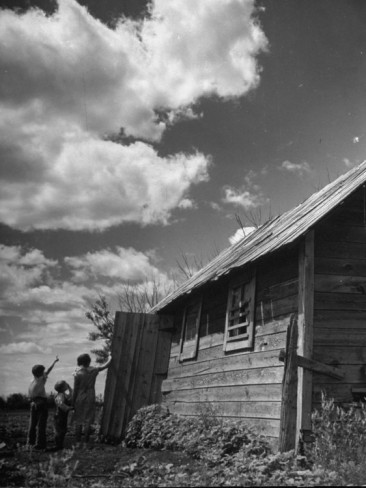
WAITING FOR RAIN Midwestern farm by Margaret Bourke-White.

A Writer’s first exposure to supernatural forces.

IN MY childhood, rain meant something. It meant action.

Buckets had to be strategically placed along the hallway of our farm-house to catch the roof leaks.

My father had to move fast, to get outdoors towards the approaching bank of clouds, cup his hands to his mouth and lean back into the wind, crying out: “Send her down Hughie!” as loud as he could. If my grandfather was around, he would yell it too.

“A farmer had to take things into his own hands, not by bending to his knees in prayer, but making a proactive, dramatic, full-throated invocation.”

I don’t recall asking what the shouting was for, like I don’t remember asking why we had to run around with buckets while mum lifted the rugs. Somehow it was just part of living on a farm.

Dad was doing what many farmers do, calling on the weather god to send down the rain and not miss our farm. Too often we’d see heavy showers passing to the south at the far end of our shallow upland valley west of Delungra, leaving our hillsides dry and cracked with the heat.

A farmer had to take things into his own hands, not by bending to his knees in prayer, but making a proactive, dramatic, full-throated invocation. Nothing less would do. You had to make a great gesture of effort, a visible show of need.

My father would also pretend to be the ghost of ‘Old Harry’ walking down the long hallway of our home, scaring me and my brother into our beds.

Seeing dad’s familiar figure pass in the half-dark, I was never sure it wasn’t ‘Old Harry’. After all, if your dad is yelling to a weather god, then anything could be true.

These days, people will try to tell you that ‘Hughie’ is Saint Hugh, the Catholic saint associated with rain. Surfers apparently invoke Hughie for the best coastal conditions. Slim Dusty even wrote a song about him.

But none of that is what Hughie means to me. Hughie is darkening skies. He’s dangerous gales. He’s the hood on your parka flapping in the wind, while you think about getting inside before the storm hits.

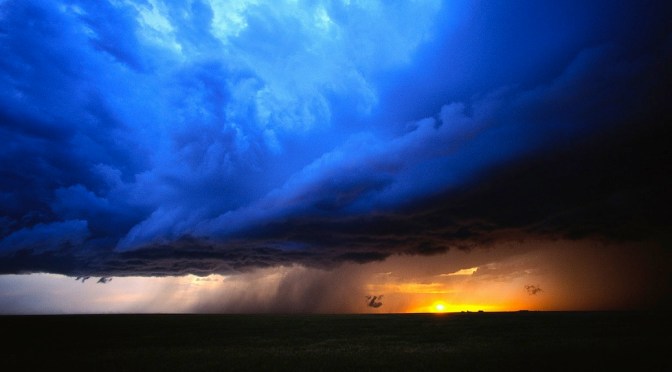
STORM FRONT Cumulus panorama.

Hughie is fickle and chaotic. He doesn’t just drop the rain anywhere. He’s up there, riding the front of the weather where it’s so loud you need to wail at the top of your voice for him to hear you. To send down the rain, Hughie needs to see someone, and not just anyone. He takes orders only from the most stoic, the most reserved member of your household, and that’s always dad.

When Hughie’s feeling generous, he’ll give you gentle, soaking rain when your crops are in and it’s time for them to grow. When you’ve pissed him off, he’ll send your sheds tumbling over themselves, and lift iron sheets off your roof.

Perhaps Hughie’s a stray weather god stranded in the southern hemisphere, lost after some climatic sortie when people stopped believing in the pantheon of Greco-Roman Gods? Perhaps Hughie’s always been here, and we’ve just given him a new name?

For me, Hughie was a precursor to chaos. Not just bad weather, but death, divorce and family divisions. He chased me and my family off the farmhouse in the late 1970s, and I even felt him blowing around the town houses we lived in after that.

I became a weather-watcher, because I could sense a change coming. My parents’ separation, divorce, and our move away from the country was all played-out against a great tension I had due to the fear of abandonment. I could hardly go to school for fear of coming home to find nobody there, with thunderstorms raging outside and no-one to protect me.

That was Hughie.

The day we arrived at our new home on the fringe of the city, shell-shocked, I began to relax. Something about that place is beyond Hughie. He rarely makes an appearance there, with the cool climate gardens and higher average rainfall.

But I still feel him at work whenever I take off in a plane. He’s that gale which creates turbulence, reminding me I am no longer earthbound.

Next time you’re waiting for rain, think of Hughie. You’ll know what to do.

© Michael Burge, all rights reserved.